IMI STI RTQD direct gas scotch yoke quarter-turn actuator
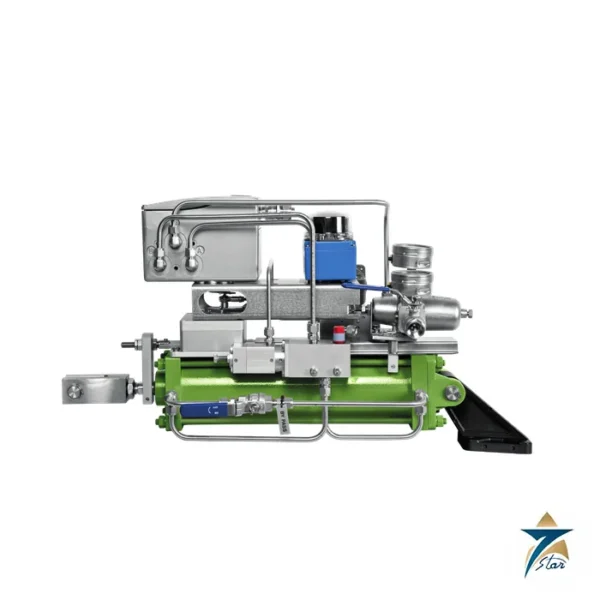
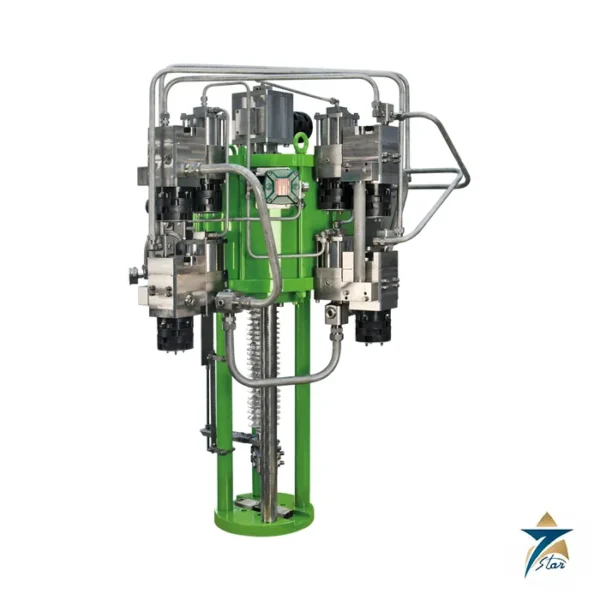
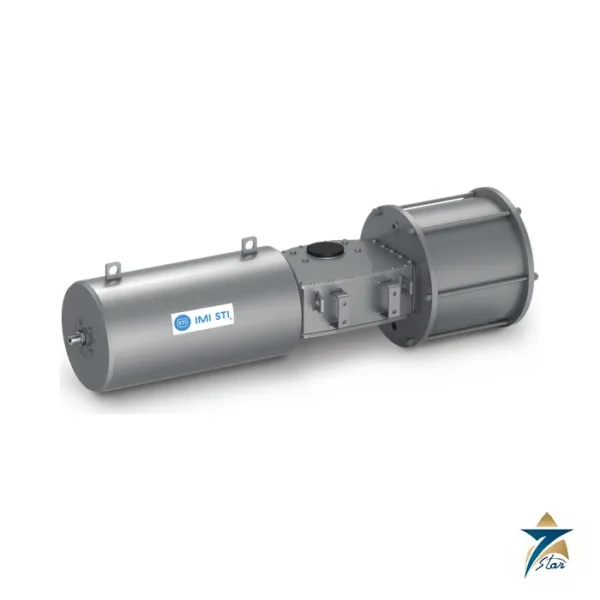
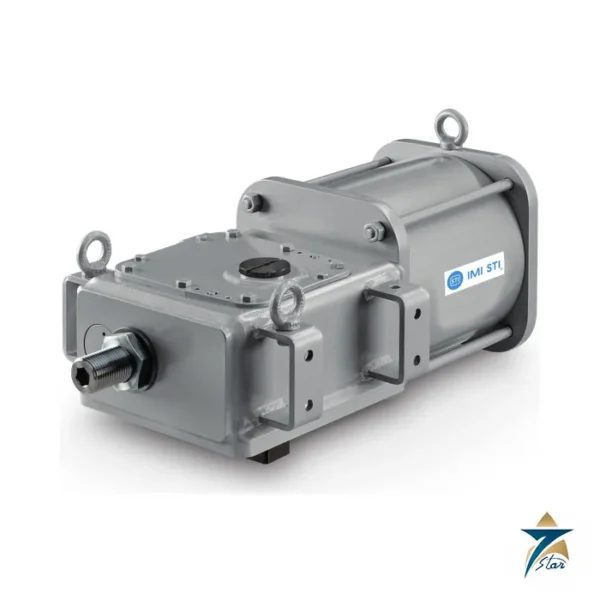
The IMI STI RTQD series is a double-acting direct gas actuator for quarter-turn valves. A scotch yoke mechanism turns the straight movement of a gas-driven cylinder into the 90-degree rotation needed to operate ball, butterfly and plug valves in heavy-duty on/off service. The actuator uses natural sweet gas or nitrogen taken from the pipeline or a nitrogen supply, so it suits gas transmission and wellhead sites where no instrument air or electricity is available for valve operation. Seven Star LLC supplies RTQD actuators in Oman and the GCC as an independent supplier in Muscat.
This page follows the manufacturer instruction manual 5900 (revision 01, July 2018), which describes the RTQD range using the example model RTQD-04S-160-HP. The model code shows how the series is organised, as decoded in the next section.
Decoding the RTQD model code
The manual gives the code structure V-M Y-C-H. Applying it to the example RTQD-04S-160-HP:
| Field |
Meaning |
Options in the manual |
Example |
| V |
Version |
RTQD = double acting |
RTQD |
| M |
Model (size) |
01 to 08 |
04 |
| Y |
Yoke type |
S = symmetric, C = canted |
S |
| C |
Cylinder diameter |
60, 75, 100, 135, 160, 200, 235, 280 or 300 mm |
160 mm |
| H |
Accessories |
HP = hydraulic hand pump |
HP |
So RTQD-04S-160-HP is a double-acting model 04 with a symmetric yoke, a 160 mm gas cylinder and a hydraulic hand pump for manual override.
Technical specifications of the RTQD series
| Parameter |
Specification |
| Manufacturer / part number |
IMI STI (STI S.r.l.) / RTQD series |
| Type |
Double-acting direct gas scotch yoke quarter-turn actuator |
| Application |
On-off service for ball, butterfly and plug valves |
| Supply medium |
Natural sweet gas or nitrogen |
| Operating temperature |
Standard -20 to +100 °C; optional -60 to +100 °C (PED applications: standard -20 to +100 °C, optional -50 to +100 °C) |
| Cylinder design pressure |
85 or 114 bar, depending on the application |
| Operating pressure |
Defined on the actuator nameplate according to customer specification |
| Stroke adjustment |
-4 / +4 degrees at both ends by external mechanical stops |
| Manual override |
Hydraulic cylinder and hand pump in the control cabinet |
| Line break device |
Factory set to trip at a pressure drop rate of 5 bar/min or more |
| Applicable standards listed |
EN ISO 12100, IEC 61508, IEC 61511, Machinery Directive 2006/42/EC, PED 2014/68/EU, ATEX 2014/34/EU |
Maximum torque by RTQD model size
| Model |
Max. operating torque (MOT) |
| RTQD 01 |
up to 12,000 Nm |
| RTQD 02 |
up to 22,000 Nm |
| RTQD 03 |
up to 40,000 Nm |
| RTQD 04 |
up to 70,000 Nm |
| RTQD 05 |
up to 125,000 Nm |
| RTQD 06 |
up to 220,000 Nm |
| RTQD 07 |
up to 350,000 Nm |
| RTQD 08 |
up to 500,000 Nm |
The actual torque of a given actuator depends on the cylinder diameter, the gas pressure and the yoke type, and is stated on its nameplate. Sizing should always be made against the valve breakaway and running torque with a suitable margin.
How the RTQD scotch yoke works
Pressurising one side of the gas cylinder drives the piston rod and guide block, and the yoke turns the output shaft. Admitting gas to the other chamber reverses the motion. A symmetric yoke produces its highest torque at the start (0 degrees) and end (90 degrees) of the stroke, which matches the torque curve of a ball valve. A canted yoke produces very high torque in the closed position, which suits the torque characteristic of a butterfly valve. The mechanism sits in a weatherproof housing, and the centre cover is machined to take accessories such as a positioner, limit switches or a position transmitter, all driven from the actuator drive sleeve.
Control cabinet, line break and manual override
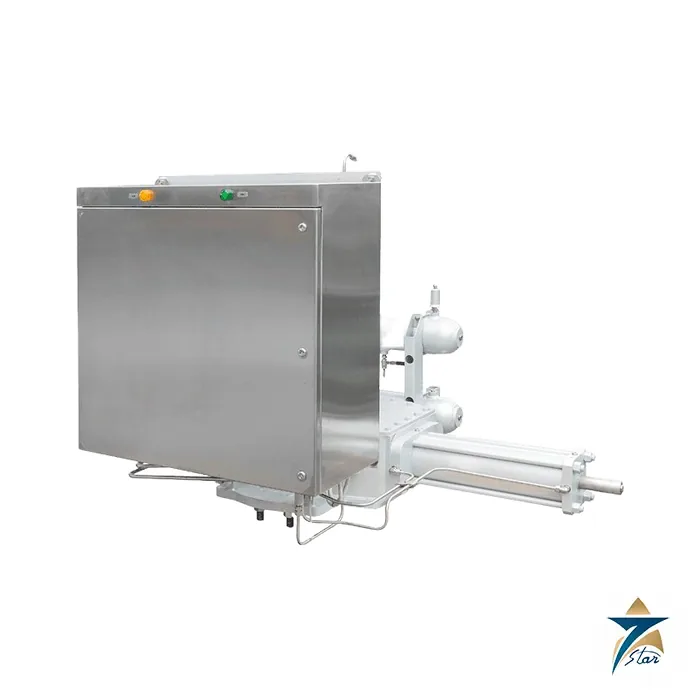
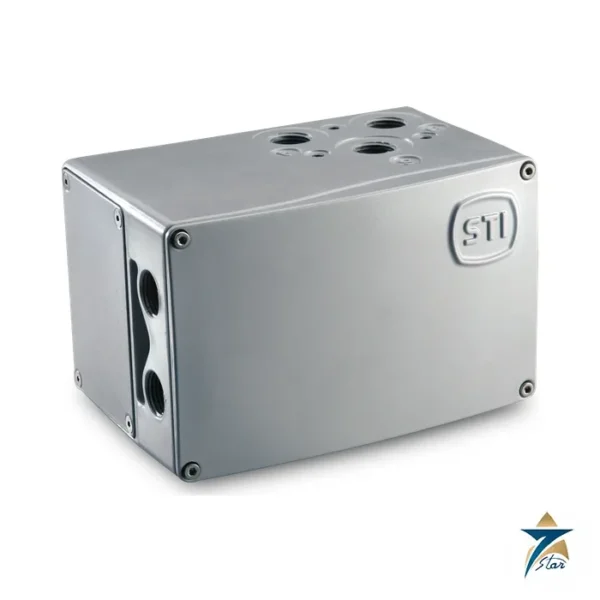
The RTQD is supplied with a control cabinet containing the line break device, junction box, solenoid valves, gas filter and the manual hand pump. The line break device trips on a rapid drop in line pressure, which is a protection measure for pipelines, and it is set at the factory to react at 5 bar per minute or more. A local reset procedure is described in the manual. Gas tanks are part of the main assembly, and a hydraulic cylinder on the opposite side of the mechanism lets the operator move the valve without gas pressure through the hand pump. If a remote or solenoid command is given while the hand pump is in use, the automatic command takes priority.
Selection and ordering checklist for the RTQD
- Valve type and its breakaway, running and end-of-stroke torque, including the safety margin.
- Gas supply: natural sweet gas or nitrogen, supply pressure range and gas quality (filtering).
- Yoke type: symmetric for ball and plug valve torque curves, canted for butterfly valves.
- Model size and cylinder diameter from the 01 to 08 and 60 to 300 mm ranges.
- Ambient temperature, to choose standard or low-temperature construction.
- Valve mounting data: flange pattern, stem coupling and bracket.
- Control cabinet scope: solenoids, voltage, limit switches, line break setting and hazardous area needs.
- Fail or safe position, and the manual override required.
Installation, commissioning and maintenance of the RTQD
Lift the actuator only at its marked lifting points with the angle between the chains below 90 degrees; these points are for the actuator alone, not for the valve and actuator together. Move valve and actuator to the safe position before coupling, remove oil and grease from mating surfaces and tighten the bolting to the manual torque table, for example 150 Nm on M16, 300 Nm on M20 and 550 Nm on M24. Connect and flush gas pipes, check for leaks, and set the mechanical stops on the actuator, not the valve, so that the actuator stops fully open and closed.
The manual recommends a general inspection about every two years, depending on conditions, plus checks of valve operation, remote signals, filters, paint and gas connections. No lubrication is needed during life, and seal kits for the scotch yoke and cylinder are replaced by following the sectional drawings; original spare parts and the nameplate serial number should be quoted when ordering. Dust build-up should be cleaned because it can raise surface temperature.
Typical applications in Oman and the GCC
Gas-driven actuators are a natural fit for pipeline block valves, compressor station isolation, wellhead and gathering system valves and gas processing plant ESD duties, particularly at remote locations without reliable power. In hot, sandy environments the sealed housing and the maintenance interval of the RTQD help, and the optional low-temperature construction covers colder pipeline services.
Information to send with your RFQ for the RTQD
Send the valve type, size and pressure class, torque data from the valve maker, gas supply details, ambient temperature range, fail position, cabinet and electrical requirements, hazardous area class and quantity.
Documents and quotation
The IMI STI instruction manual 5900 for the RTQD series is attached on this page for download.
Send the part number RTQD or the full model code with your valve data and we will prepare a quotation for Oman and the GCC.




























Reviews
There are no reviews yet.