A single-channel limit alarm for any 4…20 mA level or pressure sensor
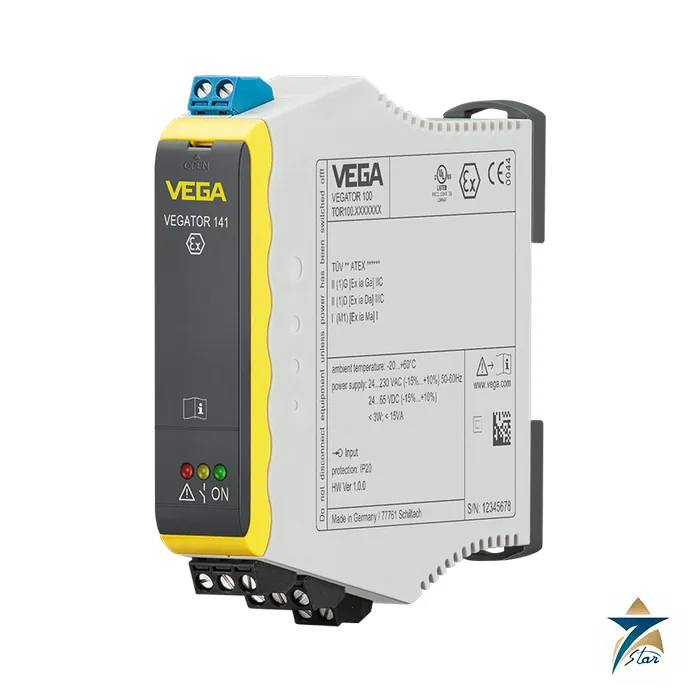
The VEGATOR 141 is a single-channel controller for level detection with sensors that deliver an analogue 4…20 mA signal, such as capacitive electrodes, hydrostatic pressure transmitters or process pressure transmitters. VEGA names pump control (on/off) and monitoring functions such as overfill and dry-run protection as typical applications. The module is mounted on a 35 mm carrier rail, powers an active sensor itself or accepts a passive one with its own supply, and drives an operating relay as limit alarm with an optional active fail-safe relay. The signal circuit is monitored permanently for line break and short-circuit, and the signal can come from a hazardous area.
Technical specifications
| Parameter |
Specification |
| Type |
VEGATOR 141, single-channel controller for 4…20 mA sensors |
| Series |
Module unit for carrier-rail mounting, 35 x 7.5 mm rail acc. to EN 50022/60715, detachable coded terminals |
| Operating voltage |
24…230 V AC (-15 %, +10 %), 50/60 Hz; 24…65 V DC |
| Max. power consumption |
2 W (8 VA) |
| Input |
1 x 4…20 mA, active (sensor powered by VEGATOR 141) or passive (selectable) |
| Terminal voltage, idle |
18.2 V DC ± 5 % |
| Internal resistance |
200 Ω (active input), 100 Ω (passive input) ± 1 % |
| Current limitation |
23 mA, permanently short-circuit proof |
| Fault detection |
Line break ≤ 3.6 mA; short-circuit ≥ 21 mA |
| Switching threshold |
Adjustable in the range 4…20 mA |
| Relay output |
1 operating relay + 1 optional fail-safe relay; floating SPDT contacts |
| Contact rating |
10 mV DC min.; max. 253 V AC / 50 V DC; 3 A AC / 1 A DC; max. 500 VA, 54 W DC |
| Switch-on/off delay |
150 ms basic (± 10 %); adjustable 2 / 6 / 8 s (± 20 %) |
| Ambient temperature, protection |
-20…+60 °C; IP20; overvoltage category per IEC 61010-1; pollution degree 2 |
Pump control and dry-run protection
Because the switching threshold is adjustable anywhere between 4 and 20 mA, one VEGATOR 141 can turn a continuous transmitter into a switch: set the threshold to the level at which a pump should start, and use the adjustable delay of 2, 6 or 8 s to avoid chatter on waves or turbulent surfaces. The optional second relay gives an active fault signal, so a controller can distinguish between a genuine low level and a failed sensor or cable.
Selecting and ordering
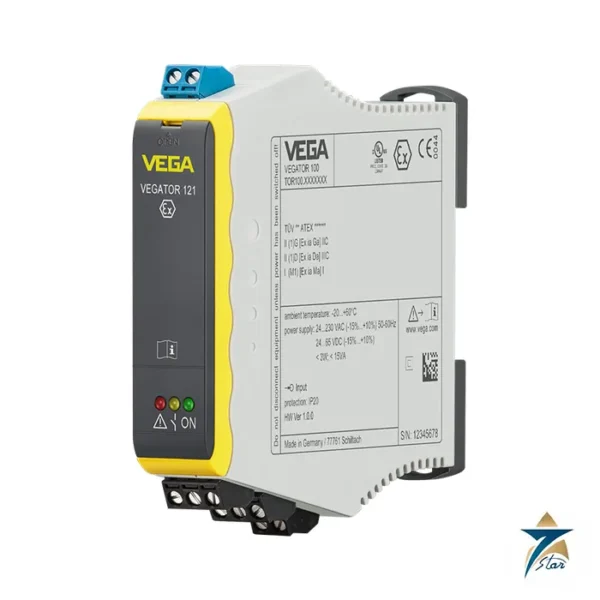
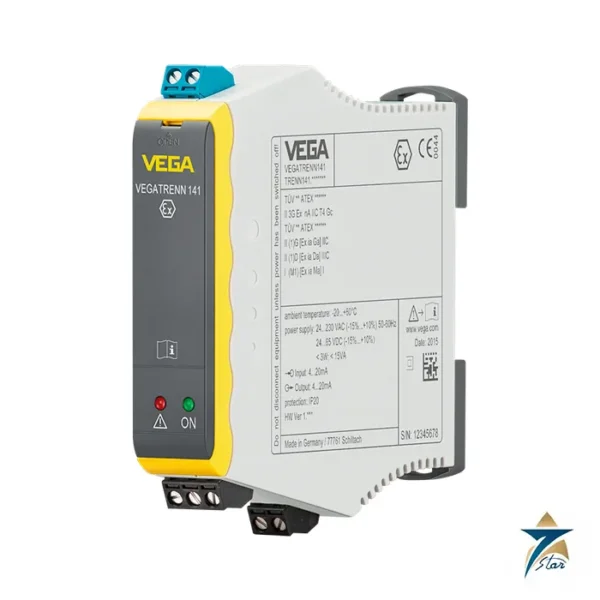
Choose the VEGATOR 141 when the sensor outputs 4…20 mA; the VEGATOR 121 serves vibrating switches with 8/16 mA signals, and the VEGATRENN 141 is an Ex separator for HART sensors. The two supply ranges (AC 24 to 230 V, DC 24 to 65 V) allow one module for most control cabinets. Per VEGA, the technical data in the safety instructions apply for approved instruments and may differ from the sheet, so specify any Ex requirement, the relay quantity and the sensor type in your RFQ and confirm the approval marking with VEGA.
When specifying, list the sensor type, its supply requirement and the number of loops, because a single-channel controller serves one measuring point and a second point needs a second module on the rail. Cabinet builders usually add a separate fuse and terminal block per loop. Confirm the relay load and the supply voltage printed on the sheet against your control circuit before ordering.
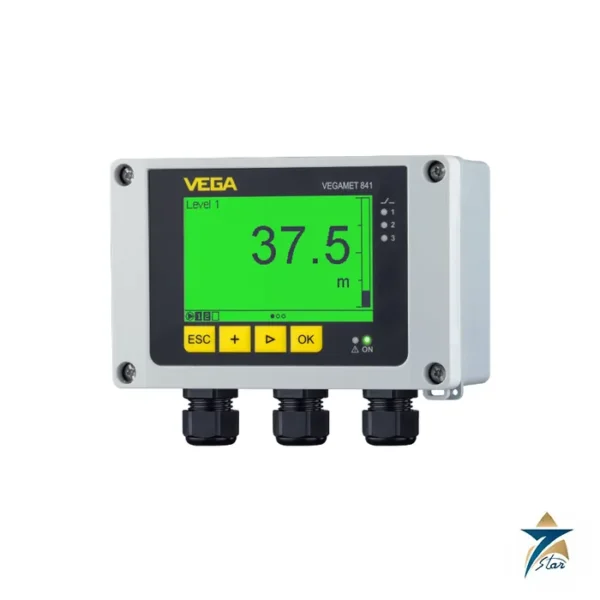
Related VEGA products: VEGA VEGAMET 841 Field Level Controller, VEGA VEGATRENN 141 Ex Separator for 4-20 mA HART Sensors and VEGA VEGATOR 121 Controller for 8/16 mA Vibrating Switches.
Active or passive sensor input
VEGA’s specification sheet shows that the VEGATOR 141 input can be set up in two ways. With the active input, the controller supplies the two-wire 4…20 mA sensor itself; the internal resistance is 200 Ω and the terminal voltage in the idle state is 18.2 V DC. With the passive input, the sensor has its own supply and the internal resistance is 100 Ω. The input current is limited to 23 mA and is permanently short-circuit proof. Typical sensors are capacitive electrodes, hydrostatic pressure transmitters and process pressure transmitters, and VEGA notes that the signal can also come from a hazardous area.
Line monitoring and fault signalling
The signal circuit is permanently monitored. A current of 3.6 mA or less is detected as a line break, and 21 mA or more as a short circuit, so a cut cable or failed sensor cannot be mistaken for a normal level. Besides the fault indication on the unit, an optional fail-safe relay can provide an active fault signal to the control system.
Relay contacts and switching delay
The operating relay is a floating changeover contact (SPDT). It can switch from 10 mV DC / 10 µA up to 253 V AC or 50 V DC, with a maximum current of 3 A AC or 1 A DC and a breaking capacity of up to 500 VA or 54 W DC. This is enough to drive a pump contactor coil directly. The switch-on and switch-off delay has a basic value of 150 ms and can be set to 2, 6 or 8 s, which helps prevent rapid pump cycling on turbulent surfaces. The switching threshold is adjustable anywhere in the 4…20 mA range.
Mounting and supply
The unit mounts on a 35 × 7.5 mm carrier rail to EN 50022/60715, with detachable coded terminals for wires from 0.25 to 2.5 mm². It accepts 24…230 V AC (50/60 Hz) or 24…65 V DC with a maximum consumption of 2 W (8 VA), operates at −20 to +60 °C and has IP20 protection, so it is installed inside a control cabinet.
Documents and quotation
The official VEGA VEGATOR 141 specification sheet (46842-EN, version 250605) is attached to this page for download and covers the technical data, dimensions and wiring summarised above.
Send Seven Star LLC your tag list, process medium, vessel geometry, required approvals and quantity and we will prepare a quotation from our Muscat office. We are an independent supplier; more level instrumentation is listed on our site. Confirm the final order code and approval marking with the manufacturer before ordering.

























Reviews
There are no reviews yet.