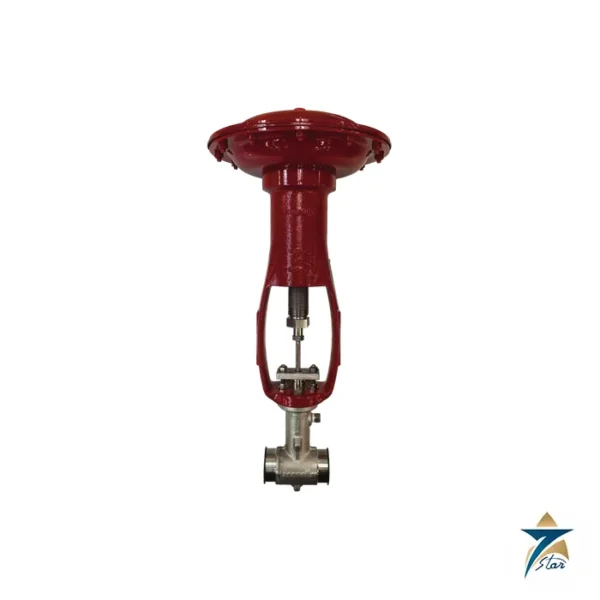
Samson Type 33-7 excess pressure valve for large water lines
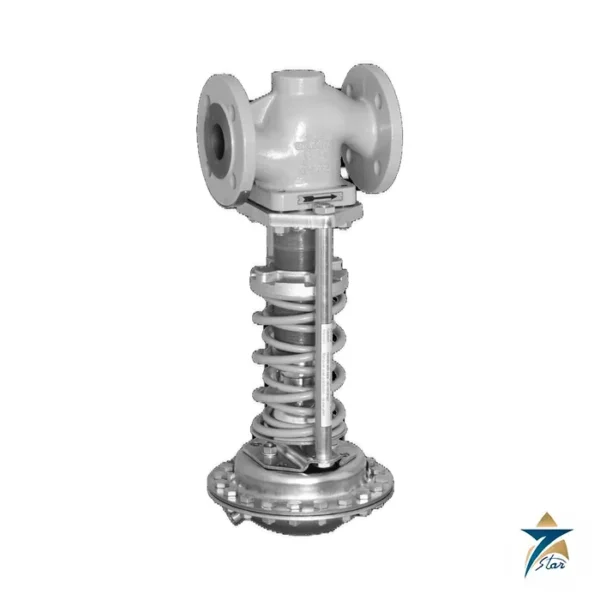
The Samson Type 33-7 is a self-operated excess pressure valve for larger pipe sizes. It holds the upstream pressure at an adjusted set point between 1 and 11 bar by opening when the pressure ahead of the valve exceeds that value. The datasheet lists nominal sizes DN 65 to 250, pressure ratings PN 16 to 40 and use with water up to 150 °C. Seven Star LLC supplies the Type 33-7 in Oman and the GCC as an independent supplier in Muscat; typical uses are pressure-holding and overflow duties on pump discharge headers, hot-water circuits and utility networks.
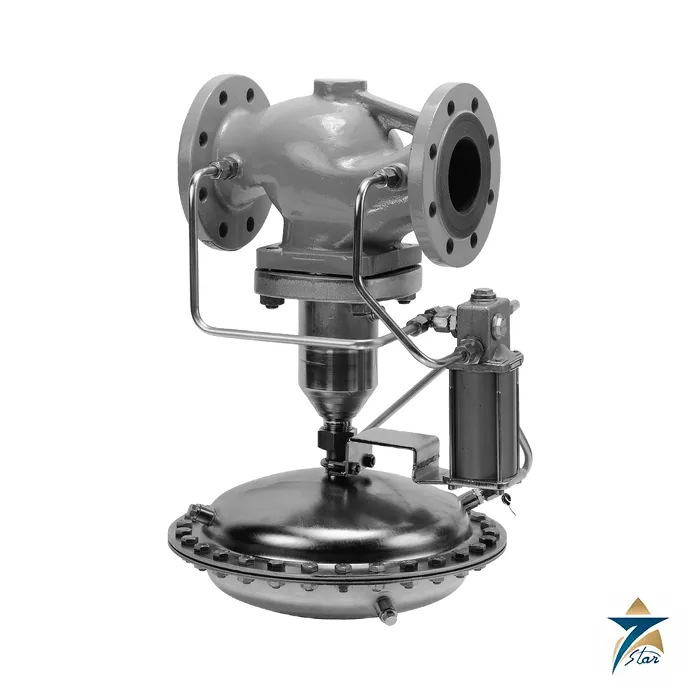
The regulator is made of three parts: a valve with a soft-seated plug, an actuator with an EPDM rolling diaphragm of 640 cm² area, and an attached pilot valve. The pilot valve gives the regulator its fast response and small offset, because the controlled pressure is amplified through the pilot rather than acting directly on the diaphragm.
What the 33-7 designation means in the Series 33 family
Series 33 covers pressure regulators of the pilot-operated kind. The type number after the dash identifies the function and size range: the 33-7 is the excess pressure (back-pressure) version, which controls the pressure upstream of the valve. Samson also offers the Type 33-1 safety shut-off valve, which is already on this site and is a different function. The datasheet ordering text asks for the type, DN, body material and PN.
Type 33-7 technical specifications
| Parameter |
Specification |
| Manufacturer / part number |
Samson / Type 33-7 excess pressure valve (Series 33 pilot-operated regulator) |
| Nominal size |
DN 65, 80, 100, 125, 150, 200, 250 |
| Pressure rating |
PN 16 to 40 |
| KVS coefficient |
50, 80, 125, 190, 280, 420, 500 for DN 65 to 250 |
| Set point range |
1 to 11 bar, continuously adjustable at the pilot valve |
| Max. permissible upstream pressure p1 |
16 bar |
| Max. permissible differential pressure |
16 bar, 12 bar or 10 bar depending on size |
| Min. differential pressure (to open) |
0.4 bar, 0.5 bar or 0.6 bar depending on size |
| Max. temperature |
150 °C; cast iron EN-GJL-250 DN 125 to 250: 130 °C |
| Body material |
Cast iron EN-GJL-250 (PN 16), spheroidal graphite iron EN-GJS-400-18-LT (DN 150 and smaller), cast steel 1.0619 |
| Seat / plug |
Seat stainless steel 1.4006; plug stainless steel 1.4004 with EPDM seal; balancing bellows 1.4571 |
| Face-to-face length |
DN 65: 290 mm; DN 80: 310; DN 100: 350; DN 125: 400; DN 150: 480; DN 200: 600; DN 250: 730 |
| Actuator |
EPDM rolling diaphragm, area 640 cm² |
How the Type 33-7 works
Medium flows through the valve in the direction of the arrow. The valve is fully balanced: upstream pressure acts on the outside of a metal bellows through a hole in the plug stem, and the pressure downstream acts on the inside, so the forces on the plug cancel. The upstream pressure p1 is sent to the pilot valve through a control line, where it creates a control pressure ps that depends on the set point. As p1 rises, ps falls and the valve opens against the set point springs; when ps equals p1 the springs close the valve.
The differential pressure across the regulator is used as auxiliary energy, so the regulator can only open when the differential pressure is at least the minimum value in the datasheet. Selection must therefore consider the lowest pressure that will be available downstream, not just the set point.
Where the Type 33-7 fits in a system
An excess pressure valve is used to hold a minimum pressure in a header, to relieve pump discharge flow back to a tank, or to maintain a back pressure on a heat exchanger. It sits next to the Samson Type 2405 and 2406 excess and reducing valves for smaller lines and the Type 2404-2 for tank service, all covered on this site. For hot water it is described as an element of the district heating networks according to DIN 4747-1.
Selection checklist for a Type 33-7
- Set point (1 to 11 bar) and the maximum upstream pressure, which must not exceed 16 bar.
- Minimum pressure available downstream, to confirm the minimum differential pressure.
- Maximum flow, converted to the required KVS and DN 65 to 250.
- Medium and temperature, with water limited to 150 °C and 130 °C for larger cast iron bodies.
- Body material and PN: cast iron, spheroidal graphite iron or cast steel.
- Flange standard and face-to-face length against the piping layout.
Installation, commissioning and maintenance of the 33-7
Install the regulator in a horizontal pipe with the actuator suspended downward and the arrow in the flow direction. Connect the control lines according to the instructions, and provide shut-offs to allow the valve to be removed. Set the pressure at the set point adjuster on the pilot valve while a stable flow is running. Maintenance consists of inspecting the diaphragm, the soft seal on the plug, the bellows and the pilot valve; the seat is exchangeable. Strainers upstream protect the pilot valve from particles that can block it.
Typical applications of the Type 33-7 in Oman and the GCC
Utility water, chilled and heating water loops, cooling-water return headers, and fire or service water pump bypass lines are typical places. In desalination and power plants such regulators hold back pressure on auxiliary cooling systems, while in district energy networks they stabilise pressure on branch connections. Because no external power is needed, they remain functional during a power loss.
Information to send with your Type 33-7 RFQ
- Set point pressure and the pressure range at the valve.
- Maximum flow and the media with temperature.
- Line size, PN and flange standard.
- Body material requirement.
- Quantity, tag numbers and delivery site.
Documents and quotation
The Samson data sheet T 2551-2 for the Type 33-7 is attached on this page. Send your duty data and we will confirm availability and lead time. Seven Star LLC is an independent supplier and does not claim any official status with the manufacturer.
Other Models in the Samson Self Operated Regulators Range
Seven Star LLC supplies models from the Samson Self Operated Regulators range in Oman and the GCC. Compare the related models below and request a quote for the one that matches your application.






















Reviews
There are no reviews yet.