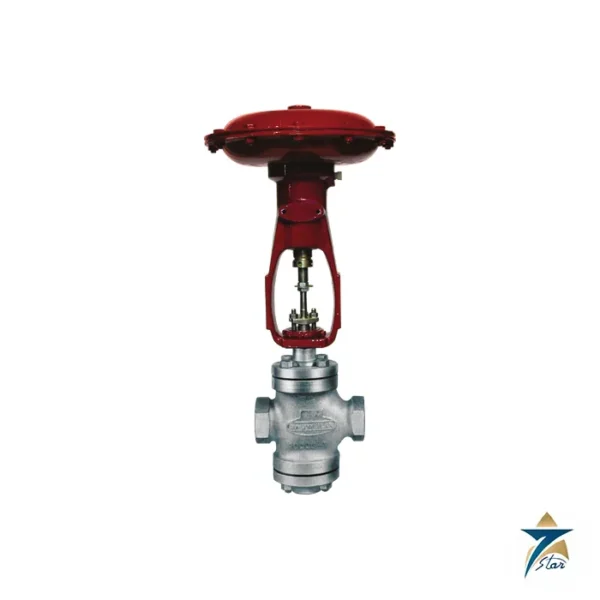
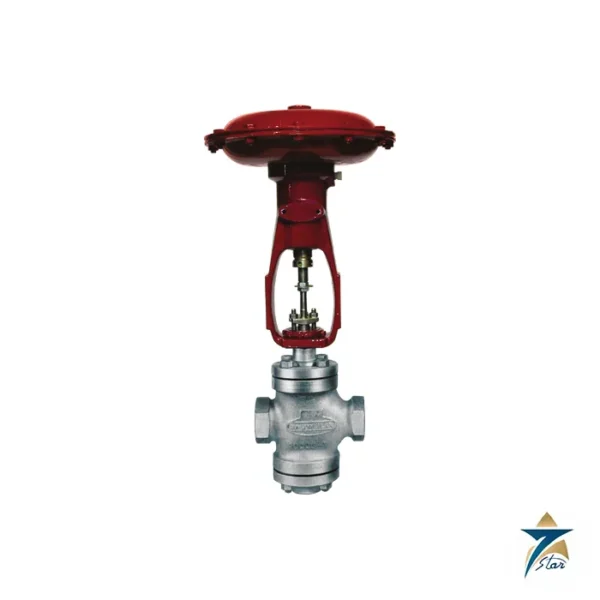
Samson 33-1 safety shut-off valve with pressure reducing function
The Samson 33-1 is a self-operated safety shut-off valve (SSV) that includes an integrated pressure reducing valve. It controls the downstream pressure p2 to a set point adjusted at an attached pilot valve, and it closes if the valve is damaged. The 33-1 is type-tested for water by the German technical surveillance association TÜV and tested according to the AGFW document FW 504 for district heating, and the regulator up to DN 150 is stated to comply with that requirement. Seven Star LLC supplies the Samson 33-1 in Oman and the GCC as an independent supplier in Muscat.
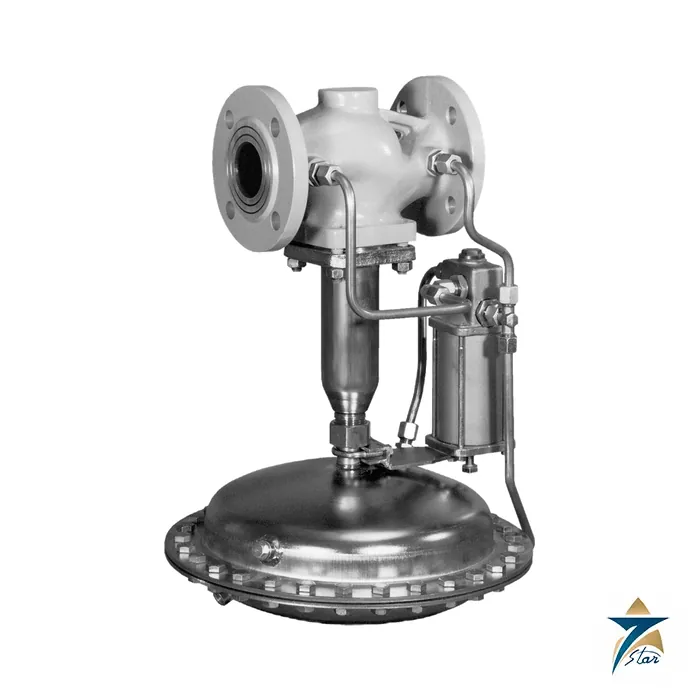
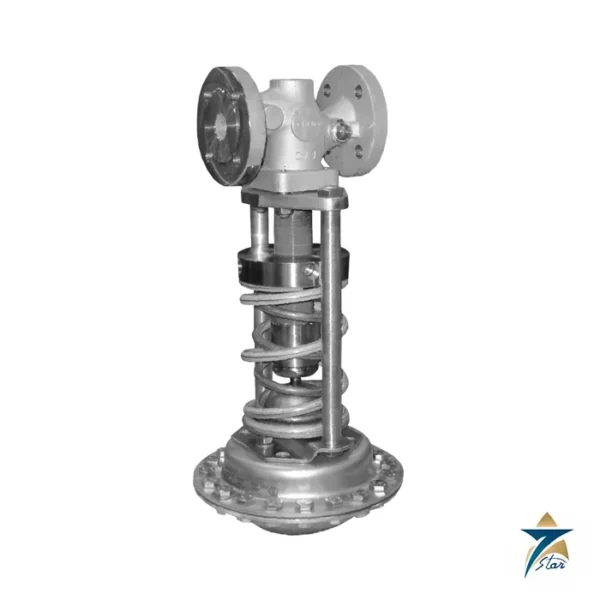
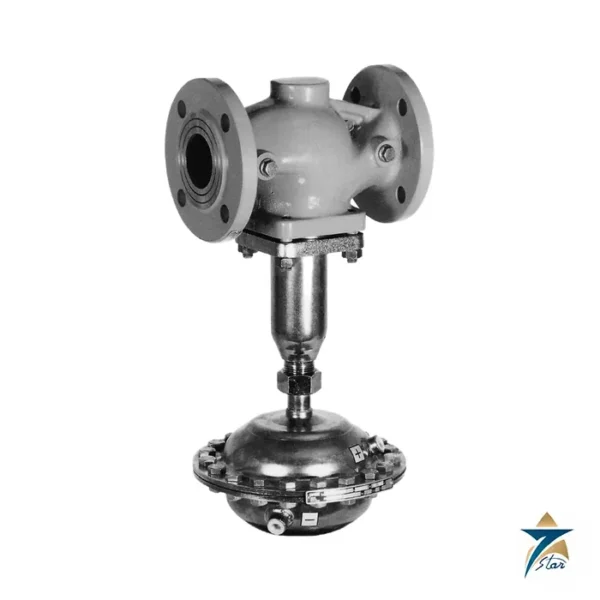
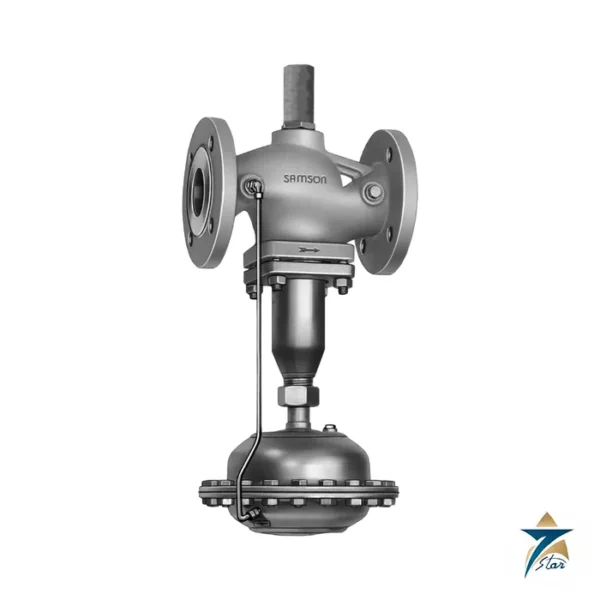
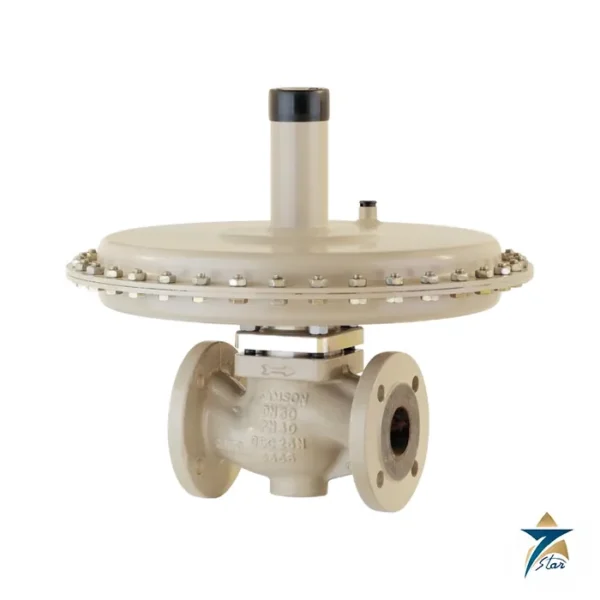
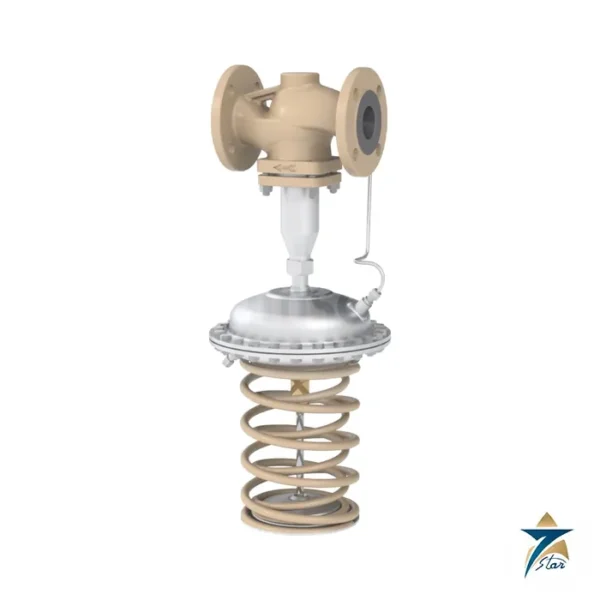
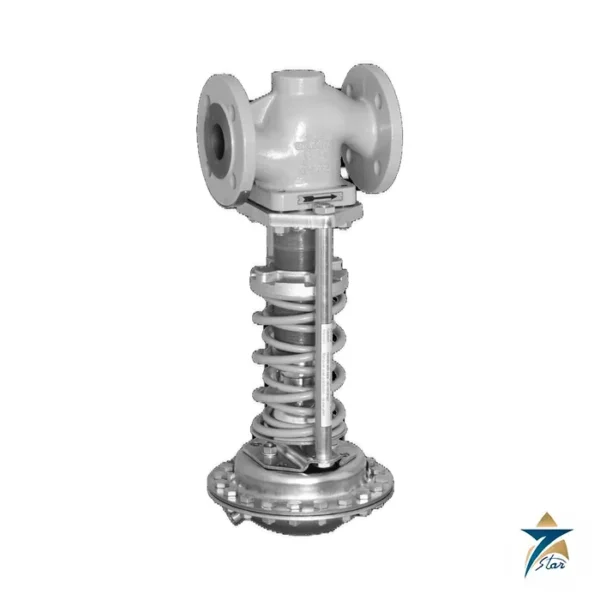
Structurally the 33-1 consists of three elements: a single-seated, balanced valve with a soft-seated plug, an actuator with an EPDM rolling diaphragm of 640 cm² area, and the pilot valve that determines the function and holds the set point adjuster. The differential pressure across the regulator itself is the auxiliary energy, so no electrical or pneumatic supply is needed, but a minimum differential pressure must be present for the valve to open.
33-1 technical specifications
| Parameter |
Specification |
| Manufacturer / part number |
Samson / 33-1 (valve, 640 cm² actuator and attached pilot valve) |
| Function |
Self-operated pressure reducing valve with safety shut-off function |
| Set point range |
1 to 10.5 bar, continuously adjustable at the pilot valve (2 to 16 bar not type-tested, on request) |
| Nominal size |
DN 65 to DN 250 (DN 200 and 250 not type-tested, on request) |
| Pressure rating |
PN 16 to 40 |
| Max. upstream pressure p1 |
25 bar |
| Media |
Water and other liquids up to 150 °C; air and non-flammable gases up to 80 °C |
| Min. differential pressure Δpmin |
0.4 bar (DN 65 to 100), 0.5 bar (DN 125 to 150), 0.6 bar (DN 200 to 250) |
| Max. differential pressure Δp |
16 bar (DN 65 to 100), 12 bar (DN 125 to 150), 10 bar (DN 200 to 250) |
| Actuator pressure limit |
1 bar above the closing point adjusted at the regulator; a downstream excess pressure valve is required |
| Type test |
TÜV type-tested (for water) according to AGFW FW 504 |
How the 33-1 pilot-operated pressure reducing valve works
The medium flows through the valve in the direction of the arrow. The plug is balanced by a metal bellows: upstream pressure acts on the outside of the bellows through a hole in the plug stem, downstream pressure on the inside, so the plug is free from pressure forces. The upstream pressure p1 is also taken through a control line to the pilot valve, where it is used as auxiliary energy to create the control pressure pS.
The downstream pressure p2, which should stay constant, is fed to the pilot valve and to the underside of the actuator diaphragm, while pS acts on the top of the diaphragm. If p2 falls, pS rises and the valve opens. When pS equals p2, the set point springs close the valve. Because the pilot valve amplifies the control action, the 33-1 has fast dynamic response and a small offset, in other words good control accuracy for a self-operated regulator.
Where the 33-1 fits and related Samson regulators
The 33-1 is used where a downstream pressure must be held and where a failure of the regulator must not pass excessive pressure into a weaker network section, as in hot water district heating substations. It sits between the primary network and a secondary system of lower pressure rating. Comparable Samson types are the 36-4 (safety shut-off valve with pressure reducing valve for DN 40 to 80, with a dual-diaphragm actuator), the 2357-1 for cryogenic pressure control and the Series 42 differential pressure regulators. For the 33-1 itself the datasheet requires the system to be protected by a downstream safety excess pressure valve and recommends a strainer such as Type 2 NI upstream.
33-1 valve sizes, KVS and weights
| DN |
KVS |
Δpmin (bar) |
Max. Δp (bar) |
Length L (mm) |
Weight, PN 16 |
| 65 |
50 |
0.4 |
16 |
290 |
53 kg |
| 80 |
80 |
0.4 |
16 |
310 |
58 kg |
| 100 |
125 |
0.4 |
16 |
350 |
66 kg |
| 125 |
190 |
0.5 |
12 |
400 |
96 kg |
| 150 |
280 |
0.5 |
12 |
480 |
140 kg |
| 200 |
420 |
0.6 |
10 |
600 |
280 kg |
| 250 |
500 |
0.6 |
10 |
730 |
330 kg |
Height H is 495 mm for DN 65 to 80, 550 mm for DN 100, 635 mm for DN 125, 755 mm for DN 150 and 925 mm for DN 200 to 250 (add 15 mm for PN 40). The diaphragm housing diameter is 380 mm. Add about 10 % to the weights for cast steel 1.0619 or spheroidal graphite iron.
Materials and construction of the 33-1
The valve body is cast iron EN-GJL-250 for PN 16, spheroidal graphite iron EN-GJS-400-18-LT for PN 16 and 25 (DN 150 and smaller) or cast steel 1.0619 up to PN 40. The seat is stainless steel 1.4006, the plug is stainless steel with an EPDM seal, the balancing bellows is stainless steel 1.4571 and the body seal is graphite on a metal core. The actuator housing is sheet steel with an EPDM diaphragm with fabric reinforcement. The pilot valve has a brass body and plug, a brass bellows, CrNiMo steel control lines and steel screw fittings. For cast iron bodies in DN 125 to 250 the datasheet limits the temperature to 130 °C for hot-water district heating use.
Selecting and ordering the 33-1
The ordering text calls for DN, body material, PN and set point range. Please also provide:
- Upstream pressure range and the downstream pressure to be held, with minimum and maximum flow.
- Medium and temperature, and confirmation that the differential pressure meets the minimum for the chosen size.
- Whether a TUV test mark is required; the datasheet states that it is available on request.
- Details of the safety excess pressure valve downstream, as the 33-1 does not protect the diaphragm actuator by itself.
- Need for DN 200 or 250 or the 2 to 16 bar range, both outside the type-tested scope.
Check the size against both the flow demand and the minimum differential pressure, because the pilot-operated design will not open fully without it.
Installing and maintaining a 33-1
Install the regulator in a horizontal pipe with the arrow in the flow direction and the actuator suspended downward. Fit a strainer upstream, connect the control lines for p1 and p2 as shown in the datasheet, and set the pressure at the pilot valve while the system is in service. Leakage behaviour can be affected by dirt trapped at the seat, so the datasheet suggests considering the specified leakage value when sizing the downstream safety valve. Maintenance work includes checking the strainer, inspecting the pilot valve and control lines for blockage, and replacing the actuator diaphragm and the plug seal at scheduled intervals. Keep complete nameplate data on file for spare parts.
Applications of the 33-1 in Oman and the GCC
The 33-1 is relevant in district heating and cooling schemes, large building hot water systems, industrial utility water headers and boiler feed systems, where a lower-rated secondary network is protected from supply pressure excursions. Typical use is in plant rooms of hospitals, airports and industrial parks, and in utility areas of power and desalination sites. High ambient temperature and dust require attention to the pilot valve connections, while water quality should be assessed for the brass pilot components.
Information to send with a 33-1 RFQ
Send the part number 33-1, DN, PN, body material, set point, upstream and downstream pressures, flow and temperature, plus whether a type-test mark is needed. For a replacement, add a nameplate photo and the existing pipe layout.
Documents and quotation
A Samson datasheet for the 33-1 is attached on this page, with the principle of operation, technical data, materials and dimensions.
Seven Star LLC is an independent supplier in Muscat. Send the part number 33-1 and your process data and we will confirm availability and lead time with your RFQ.
























Reviews
There are no reviews yet.