Samson 42-36 self-operated flow regulator for heating networks
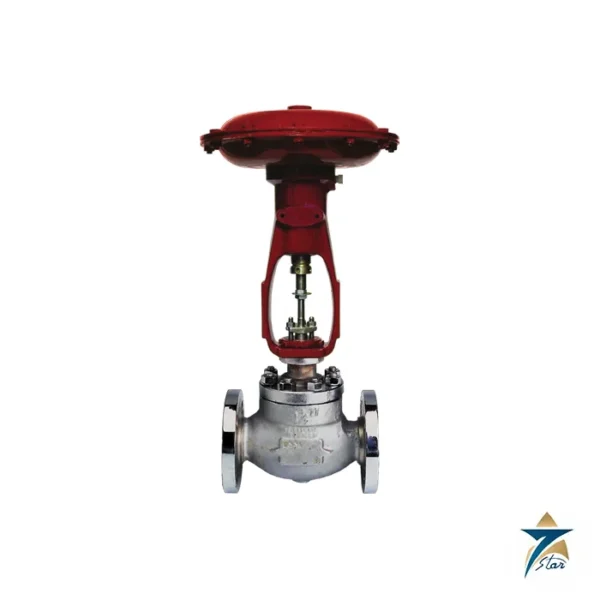
The Samson 42-36 is a self-operated flow regulator that limits the flow rate in a pipeline to an adjusted maximum. It is made of the Type 2423 valve, which has an integrated adjustable restriction, and the Type 2426 actuator connected by a control line. When the flow rises above the set value the valve closes progressively, so the flow is held at the set point without any external energy. Seven Star LLC supplies the Samson 42-36 in Oman and the GCC as an independent supplier based in Muscat.
The 42-36 belongs to Samson Series 42. Where the 42-24 and 42-25 regulate a pressure difference, the 42-36 turns the pressure drop across its own restriction into a measure of flow rate and regulates that. This makes it useful for district heating and large heating networks, where each branch should receive no more than its design flow so that remote consumers are not starved.
42-36 technical specifications
| Parameter |
Specification |
| Manufacturer / part number |
Samson / 42-36 (Type 2423 valve with Type 2426 actuator) |
| Function |
Flow regulator, valve closes when flow rate rises; set point adjusted at the restriction |
| Nominal size |
DN 15 to DN 250 (larger sizes for steam and gases on request) |
| Pressure rating |
PN 16, 25 or 40 |
| Media and temperature |
Liquids, gases and vapors from 5 to 150 °C; special versions up to 220 °C |
| Valve body temperature (bellows version) |
180 °C for DN 15 to 100 (special steam version 220 °C); 220 °C for DN 125 to 250 |
| Differential pressure at the restriction |
0.2 bar or 0.5 bar (0.3 bar and, up to DN 50, 0.1 bar as special versions) |
| Pressure balancing |
Stainless steel bellows, or EPDM balancing diaphragm for DN 65 to 250 |
| Leakage class (IEC 60534-4) |
≤0.05 % of KVS coefficient |
| Body materials |
Cast iron EN-GJL-250, spheroidal graphite iron EN-GJS-400-18-LT, cast steel 1.0619, cast stainless steel 1.4408, forged stainless steel 1.4404 |
| Version 42-36 E |
Pressure-independent control valve version |
Working principle of the 42-36 flow regulator
Medium passes through the restriction that is integrated in the Type 2423 valve; its opening is adjusted at the set point adjuster and secured with a lock nut. The pressure upstream of the restriction is led by the control line to the lower diaphragm chamber of the Type 2426 actuator, and the pressure downstream of the restriction is routed through the hollow plug stem to the upper chamber. The pressure difference across the restriction therefore acts on the operating diaphragm.
If the flow increases, the pressure difference across the restriction increases too, and the extra force compresses the set point springs until the forces balance again. The plug moves toward the seat, the free area shrinks and the flow falls back to the setting. Because the plug is balanced by a bellows or diaphragm, no flow forces act on it and the control is stable. The adjustment is made once on site, which suits fixed-capacity branches.
42-36 flow set point ranges and KVS values
The table gives representative values for the bellows-balanced Type 2423 valve at 0.2 bar differential pressure across the restriction. Flow ranges are for water in m³/h.
| DN |
KVS |
Flow range at 0.2 bar (m³/h) |
| 15 |
4 |
0.05 to 2 |
| 25 |
8 |
0.25 to 3.5 |
| 40 |
20 |
0.6 to 11 |
| 50 |
32 |
0.9 to 16 |
| 65 |
50 |
2 to 28 |
| 80 |
80 |
3.5 to 35 |
| 100 |
125 |
6.5 to 63 |
| 150 |
280 |
18 to 120 |
| 250 |
500 |
26 to 220 |
At 0.5 bar across the restriction, ranges shift upward (for example DN 100: 11 to 90 m³/h on the bellows-balanced valve). Diaphragm-balanced valves from DN 65 to 250 have KVS 50 to 800 and flow ranges up to 520 m³/h. Maximum permissible differential pressure across the valve is 25 bar up to DN 50, 20 bar for DN 65 to 80, 16 bar for DN 100, 12 bar for DN 125 to 150 and 10 bar for DN 200 to 250 on bellows valves.
Minimum differential pressure required across the 42-36
The regulator needs a minimum pressure drop to work. The datasheet gives the relation Δpmin = Δprestriction + (V̇ / KVS)², where V̇ is the adjusted flow in m³/h and KVS is the valve coefficient in m³/h. For example, a DN 50 valve with KVS 32 set to 16 m³/h at a restriction value of 0.2 bar needs at least 0.2 + (16/32)² = 0.45 bar across the valve. This simple check is the first thing to do when verifying a branch, because an undersized pressure supply means the regulator simply stays fully open and the set point cannot be reached.
Related Samson regulators and accessories
The 42-36 shares the valve family of Series 42 with the differential pressure regulators 42-20, 42-24, 42-25 and 42-28. In some branches a flow regulator and a differential pressure regulator are used in sequence: the 42-24 holds a stable pressure difference and the 42-36 caps the flow. The version 42-36 E is described as a pressure-independent control valve. Compression fittings, needle valves, equalizing tanks and control lines come from the accessory datasheet, and a strainer such as Type 2 NI is advised upstream because dirt on the restriction would shift the set point.
Selecting and ordering the 42-36
The ordering text of the datasheet asks for DN, balancing type, body material, PN, and the differential pressure at the restriction (0.2 or 0.5 bar). Add the following when you request a quotation:
- Required flow set point in m³/h and medium density if not water.
- Minimum and maximum available pressure across the valve.
- Temperature of the medium and whether steam is involved (bellows version required).
- Mounting position: suspended is standard; lying positions for riser pipes need the fixed plug guide in DN 125 to 250.
- Special versions: FKM internals for mineral oils, up to 220 °C, ANSI or JIS flanges, two-diaphragm actuator.
Select the restriction so that the set point falls in the middle of a range rather than at its edge, to leave room for later adjustment.
Installation, commissioning and care of the 42-36
Valve, actuator and control line are supplied unattached and must be assembled before start-up. Install the valve preferably in a horizontal pipe with the arrow matching the flow direction and fit a strainer upstream. After pressurising the system, set the flow by turning the adjuster, using a flow meter or heat meter in the branch as reference, then lock the nut. Keep the control line free of air pockets and kinks. If a two-diaphragm actuator is used, the rupture indicator shows a failure at about 1.5 bar. Periodic checks should confirm that the strainer is clean, that the lock nut has not moved and that the flow still matches the design value.
42-36 applications in Oman and the GCC
Flow regulators are typical in district cooling and heating plants, hotel and hospital hot water distribution, and industrial heat supply loops, where each building or process branch should be limited to its contracted flow. They are also used to protect heat exchangers from over-flow in utility circuits at refineries, power stations and desalination plants. Regional water quality and high ambient temperatures call for correct material selection, and outdoor installations benefit from shading and protection of control line fittings against dust and salt.
Information to send with a 42-36 RFQ
Please send the part number 42-36, the required DN and PN, the flow set point and medium, available differential pressure, temperature and body material. A photo of an existing nameplate speeds up replacement requests. Include the project name and delivery location.
Documents and quotation
A Samson datasheet for the 42-36 is attached on this page and contains the principle, technical data, KVS and flow range tables, materials and dimensions.
Seven Star LLC is an independent supplier in Muscat. Send the part number 42-36 with your flow and pressure data and we will confirm availability and lead time with your RFQ.
Other Models in the Samson Series 42 Range
Seven Star LLC supplies models from the Samson Series 42 range in Oman and the GCC. Compare the related models below and request a quote for the one that matches your application.
























Reviews
There are no reviews yet.