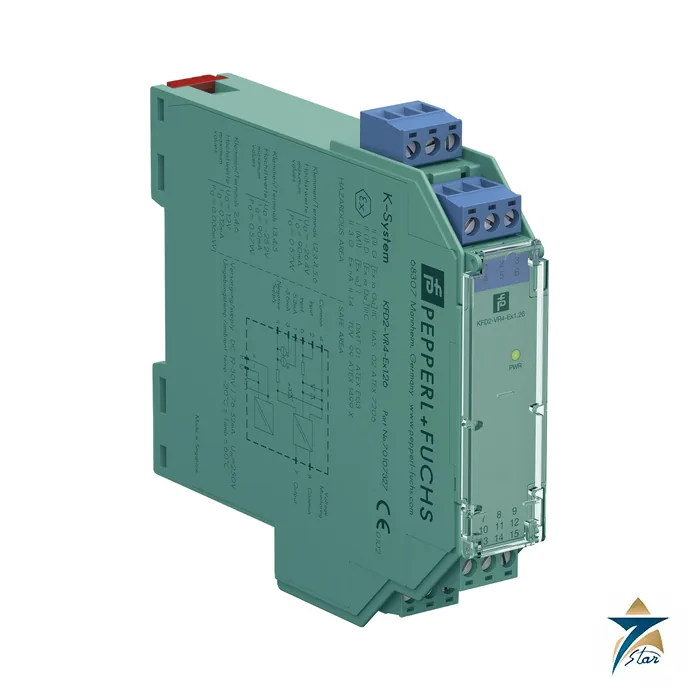
KFD2-VR4-Ex1.26 voltage repeater for vibration sensors
The KFD2-VR4-Ex1.26 is a one-channel isolated barrier from Pepperl+Fuchs built for dynamic vibration signals. It powers an accelerometer or vibration transmitter in a hazardous area with a floating supply and repeats the sensor voltage (0 to -20 V) to the safe area with low distortion. The datasheet names Bently Nevada sensors as a typical load, so it is relevant for machinery monitoring racks.
Reading the part number: KFD2 is the 24 V DC barrier range, VR4 a voltage repeater generation 4 and Ex1 a single channel; the .26 suffix identifies this -20 V version with its supply options.
Seven Star LLC supplies the barrier in Oman and the GCC as an independent supplier in Muscat.
Technical specifications of the KFD2-VR4-Ex1.26
| Parameter |
Specification |
| Manufacturer / part number |
Pepperl+Fuchs KFD2-VR4-Ex1.26 |
| Input |
Voltage 0 to -20 V; input resistance 10 kΩ; terminals 4 (common), 2 and 6 (signal), 1, 3, 5 (supply) |
| Sensor supply options |
5.3 mA ± 0.4 mA (terminal 1), 3.6 mA ± 0.7 mA (terminal 3), or > 10 mA at -21 V / > 20 mA at -18 V (terminal 5) |
| Output |
-20 to 0 V; terminals 7-, 8+; load ≥ 9 kΩ (3-wire), ≥ 2 kΩ (2-wire) |
| Output resistance |
24 Ω typical, 27 Ω maximum |
| Cut-off frequency |
10 kHz (-0.1 dB), 20 kHz (-1 dB) |
| DC transfer error |
< 10 mV with 10 kΩ load |
| Time delay / ripple |
7.1 ± 0.3 µs; < 3 mVrms in 20 kHz bandwidth |
| Supply |
19 to 30 V DC, Power Rail or terminals 11+/12-; ≤ 1.6 W |
| Functional safety |
SIL 2 acc. to IEC/EN 61508 |
| Hazardous area data |
BAS 02 ATEX 7206, [Ex ia Ga] IIC; Uo -26.4 V, Io 90 mA, Po 570 mW |
| Ambient temperature |
-20 to 60 °C |
| Housing |
Type B2, 20 x 119 x 115 mm, IP20, approx. 125 g |
Why vibration signals need a dedicated repeater
Vibration sensors deliver a fast AC signal riding on a DC bias, typically in the -10 V area for a 2-wire accelerometer. An ordinary slow isolator would distort or filter it. The KFD2-VR4-Ex1.26 keeps the bandwidth to 10 kHz at -0.1 dB and a transfer error under 10 mV, with a sine span of up to 20 Vpp acceptable, which the datasheet equates to 100 g peak at 100 mV/g.
The barrier output resistance of 24 Ω is far lower than a zener barrier loop. The datasheet warns that a monitor designed for use with a zener barrier may need a different input setting, so follow the monitor manufacturer’s advice when moving from zener barriers to this isolated type.
System fit and related parts
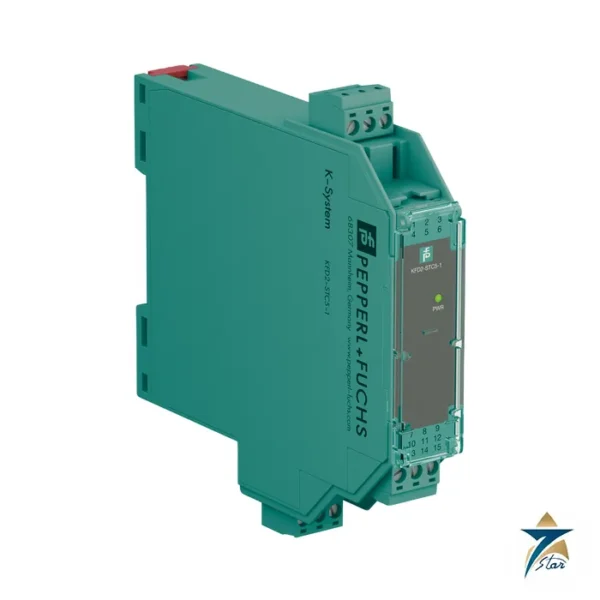
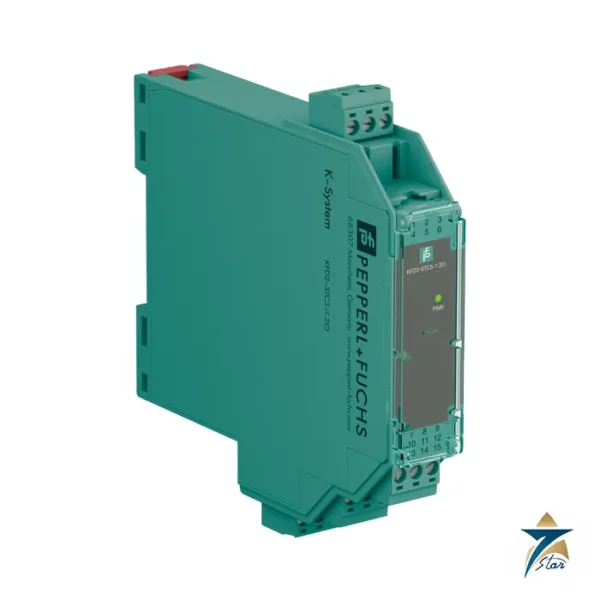
Connect the sensor to terminals 1, 3 or 5 depending on required supply current (3.6 mA, 5.3 mA or 18 V at 20 mA for 3-wire sensors), and the monitoring system to terminals 7 and 8. For general analog signals, a plain isolator such as KFD2-STC5-1 is better; the KFD2-VR4-Ex1.26 is the choice specifically for dynamic vibration channels.
Selection and ordering checklist
- Identify the sensor type (2-wire accelerometer or 3-wire) and its bias voltage.
- Choose supply terminal 1, 3 or 5 accordingly.
- Check the monitor input resistance and whether it tolerates 24 Ω source impedance.
- Check the span (0 to -20 V) against the sensor sensitivity and range.
- Verify Ex ia entity parameters of sensor and cable.
- Check 19 to 30 V DC supply.
Installation, commissioning and maintenance of the KFD2-VR4-Ex1.26
Wire the hazardous-area cable to the blue terminals and screen it according to the monitor manufacturer instructions. Measure the sensor bias at the output (about -10 V for typical sensors) and compare it with the monitor “OK” window; then tap or shake the machine to verify a dynamic signal. Replacing a barrier requires re-checking the bias, since a different supply terminal can shift it.
Practical notes on grounding, bias and cable choice
Because the output of the KFD2-VR4-Ex1.26 is a floating negative voltage, the monitoring system must accept an input referenced the way the sensor bias requires. The floating supply gives only functional insulation of 50 V AC between output and power supply, so the safe-side wiring should be kept as in the manufacturer drawing and the screen grounded at one point only to avoid hum loops.
Use low-capacitance screened twisted-pair cable for the field side; cable capacitance reduces bandwidth at 10 kHz and counts toward the permitted Ex ia capacitance. Keep the field cable away from variable-speed drive cables, because induced noise appears directly in the vibration spectrum.
Typical applications in Oman and the GCC
The KFD2-VR4-Ex1.26 is typical for compressor, turbine and pump casings in Zone 1 or 2 areas of oil and gas and power facilities in Oman, where accelerometers and velocity transmitters must feed a machinery protection system placed in a control room.
Family comparison
| Part |
Key difference |
| KFD2-VR4-Ex1.26 (this part) |
Voltage repeater for vibration sensors, 0 to -20 V |
| KFD2-STC5-1 |
SMART transmitter power supply, 4 to 20 mA |
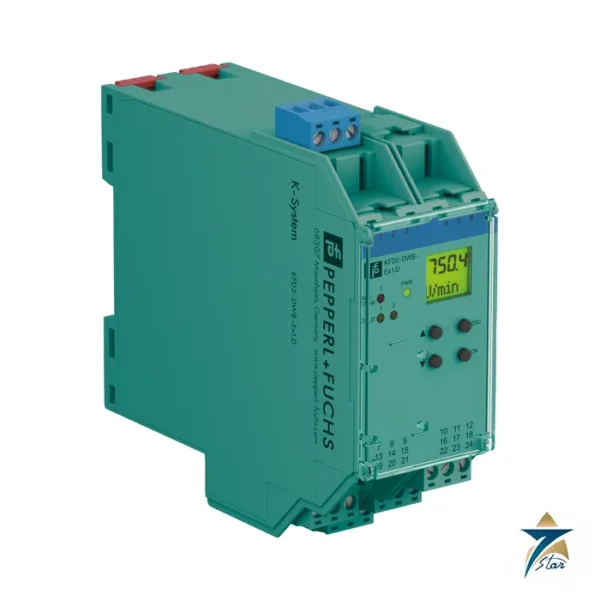
| KFD2-DWB-Ex1.D |
Rotation speed monitor |
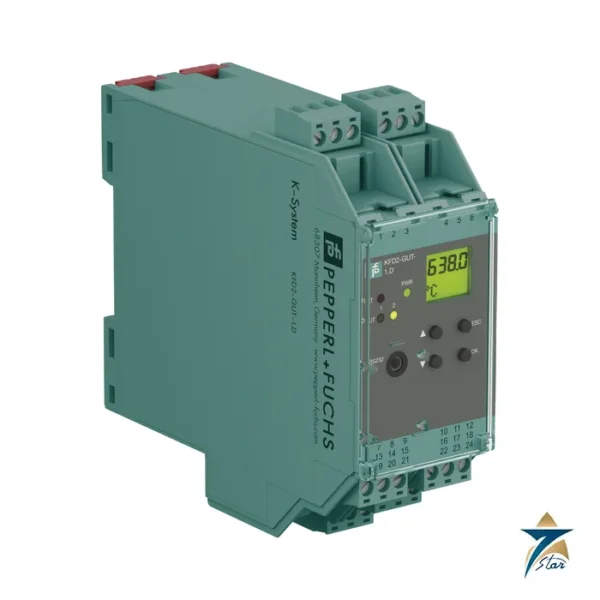
| KFD2-GUT-Ex1.D |
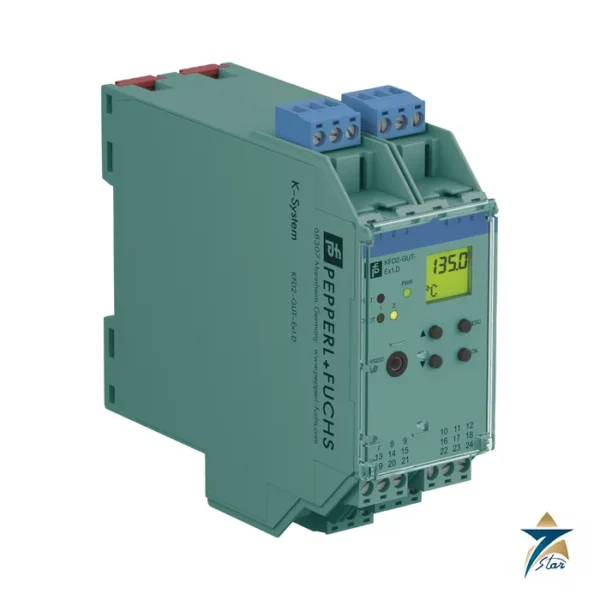
Temperature converter with trip values |
Information to send with an RFQ
- Part number KFD2-VR4-Ex1.26 and quantity
- Sensor make, model and supply type
- Monitor type and input resistance
- Zone and gas group
- Supply method
- Delivery location
Site conditions in Oman for the KFD2-VR4-Ex1.26
Control cabinets in Gulf plants often run hot, because many sit in outdoor kiosks or in rooms where air conditioning is not always reliable. Before you finalise the KFD2-VR4-Ex1.26, check the permitted ambient range and any derating stated by the manufacturer against the real temperature inside your panel, and leave the recommended spacing around the device so that heat can escape. Long cable runs between the field and the marshalling cabinet are common on large sites, so confirm the signal types, wiring limits and earthing arrangement early in the design.
It also helps to standardise on a small number of part numbers across a project. Keeping a few spare KFD2-VR4-Ex1.26 units on site in Oman shortens recovery time after a fault, and documenting configuration settings makes replacement faster for the maintenance team.
Documents and quotation
The manufacturer datasheet for KFD2-VR4-Ex1.26 is attached on this page, so you can check wiring, approvals and dimensions before ordering. Send the exact part number, quantity and delivery location in Oman or the GCC and Seven Star LLC will reply with a quotation.
Seven Star LLC is an independent supplier in Muscat and is not the manufacturer; confirm availability, lead time and any project approval requirements in your RFQ.



















Reviews
There are no reviews yet.