KFD0-CC-1 loop-powered current and voltage converter
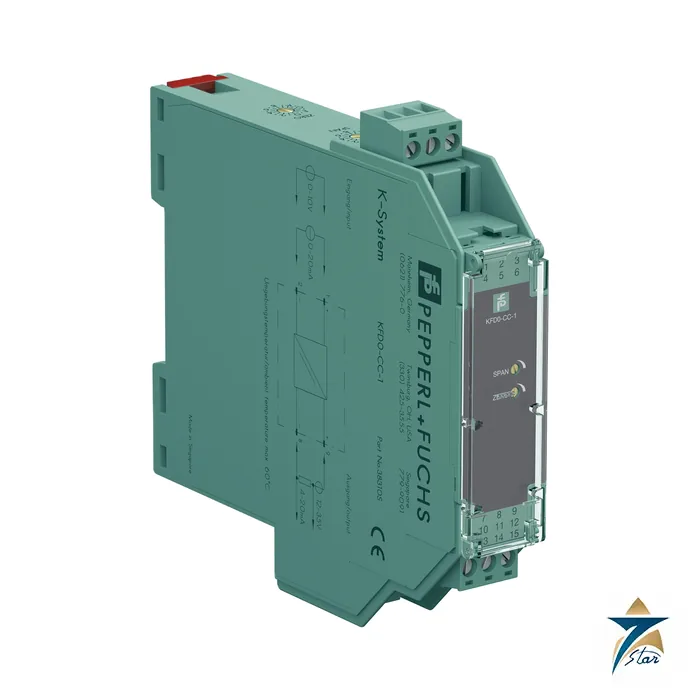
The KFD0-CC-1 is a one-channel loop-powered isolator that converts a 0 to 20 mA or 0 to 10 V signal into an isolated 4 to 20 mA output. It is meant for non-intrinsically safe applications in the safe area and takes its power from the output loop.
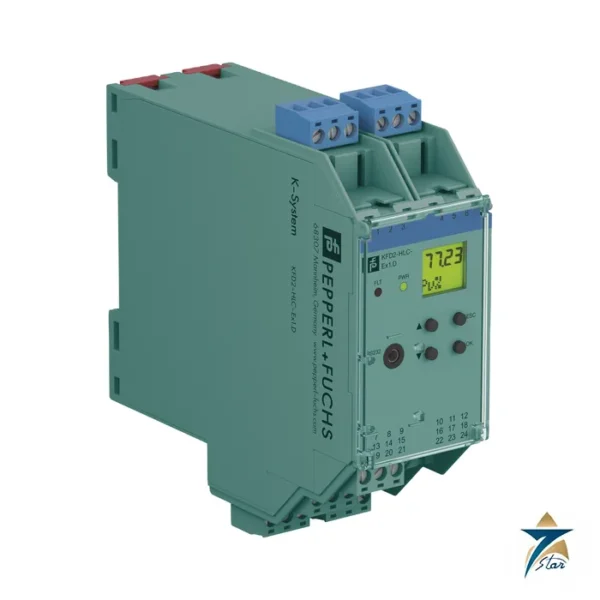
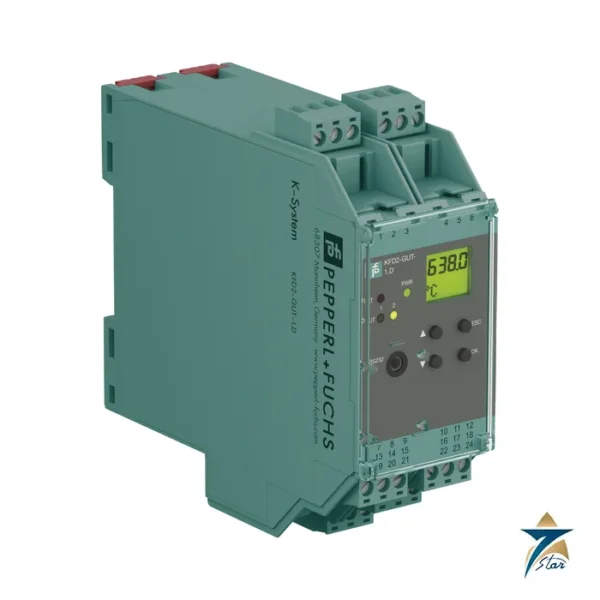
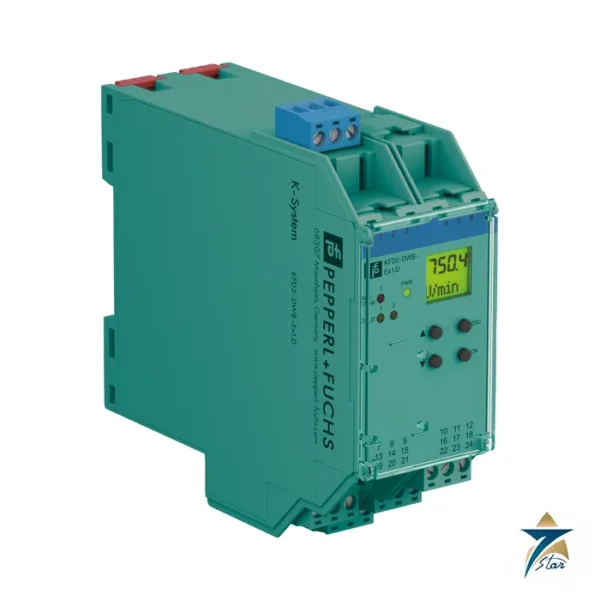
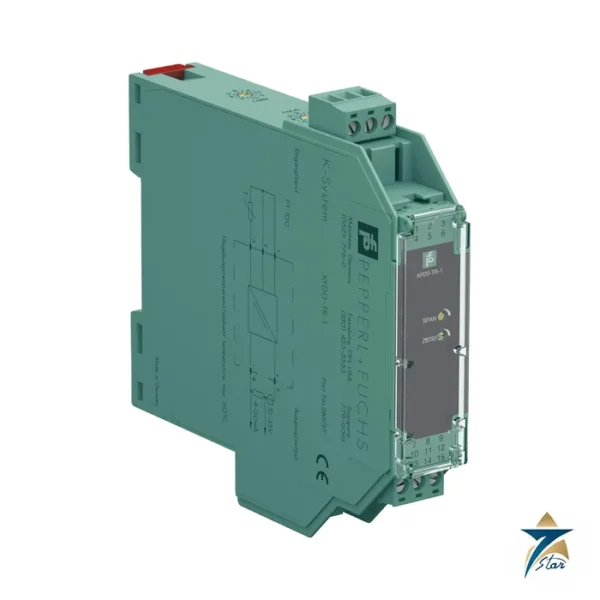
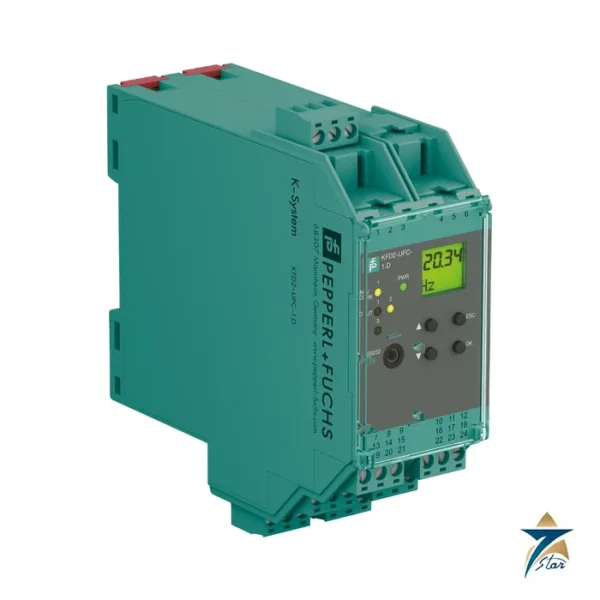
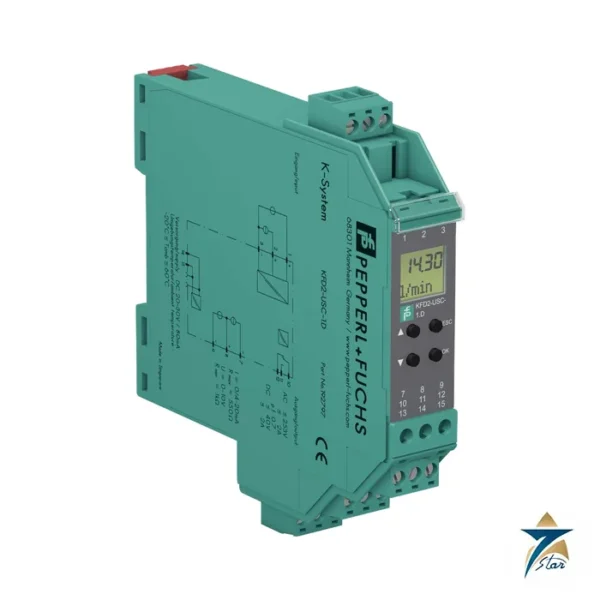
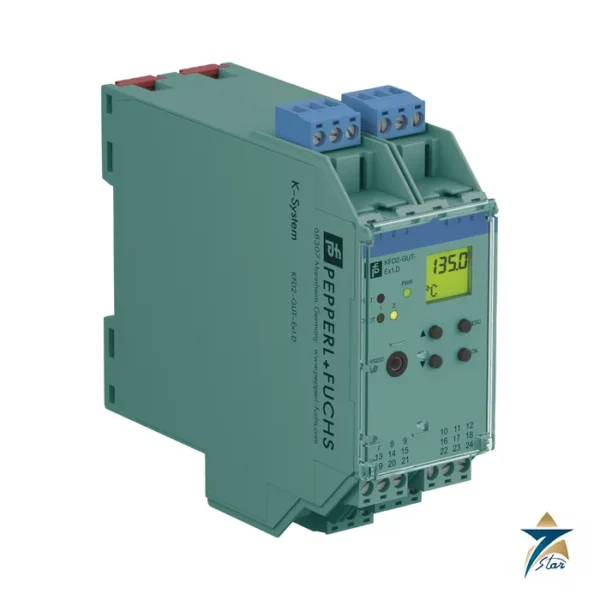
In the part number, KFD0 marks the loop-powered 20 mm isolator family, CC stands for current converter and 1 for one channel. A KFD0-TR-1 does the same job for a Pt100 sensor, and the KFD2-USC-1.D is the 24 V powered universal current and voltage converter with display.
Seven Star LLC supplies this module in Oman and the GCC as an independent supplier in Muscat.
Technical specifications of the KFD0-CC-1
| Parameter |
Specification |
| Manufacturer / part number |
Pepperl+Fuchs KFD0-CC-1 |
| Input |
0 to 20 mA with load ≤ 50 Ω, or 0 to 10 V with load ≥ 100 kΩ; terminals 1+/2- |
| Supply |
12 to 35 V DC, loop powered; power dissipation 0.4 W |
| Output |
4 to 20 mA at terminals 9+/8-, limited to ≤ 35 mA; load (U – 12 V) / 0.02 A |
| Fault signal |
Downscale ≤ 3 mA; line fault detection (LFD) |
| Accuracy |
0.1 % of full-scale after calibration; linearity ≤ 0.04 %; temperature effect span 0.05 %/K, zero 0.06 %/K of span; rise time 250 ms |
| Isolation |
Safe isolation acc. to EN 50178, rated insulation voltage 253 V rms |
| Settings |
DIP switches for coarse range, potentiometers for span and zero |
| Ambient temperature |
-20 to 70 °C |
| Housing |
Type B1, 20 x 107 x 115 mm, IP20, approx. 100 g, screw terminals, 35 mm DIN rail |
How the KFD0-CC-1 duplicates and isolates a signal
The low input resistance of 50 Ω makes it possible to insert the KFD0-CC-1 into an existing 20 mA measurement circuit and obtain a second, galvanically separated copy of the signal for a recorder, a second PLC or a local indicator. Because the input is so low-ohmic, the extra voltage drop in the original loop stays small.
The module converts the input to a proportional 4 to 20 mA output and watches for line faults, setting the output to 3 mA or lower when a fault is detected. DIP switches choose the input and output ranges coarsely, and the potentiometers trim the result.
System fit and related parts
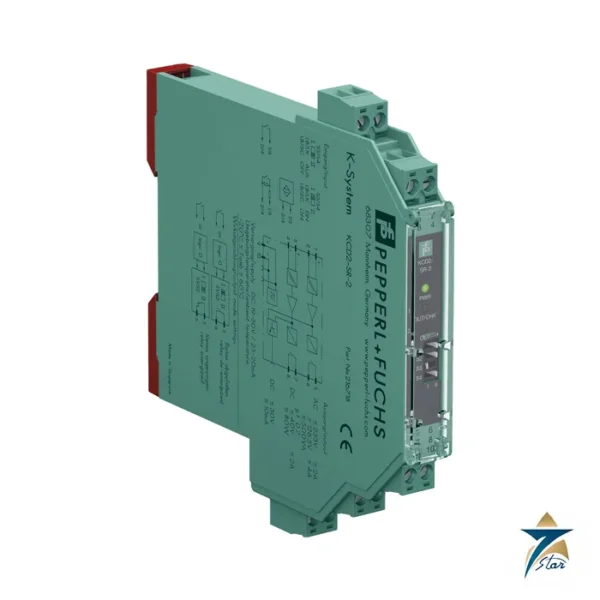
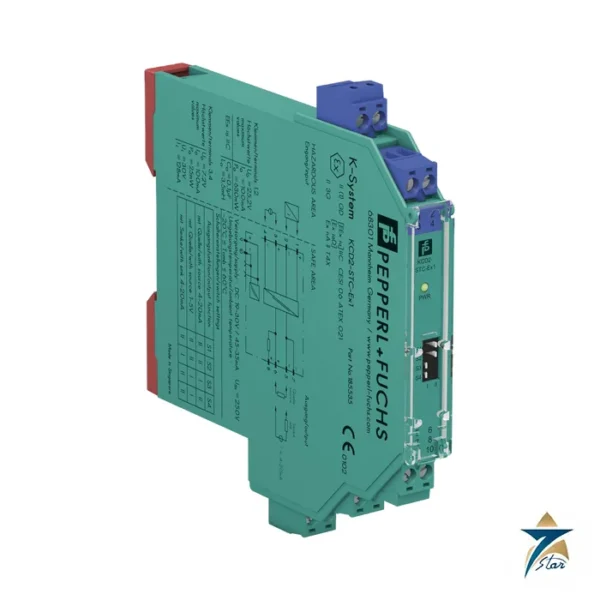
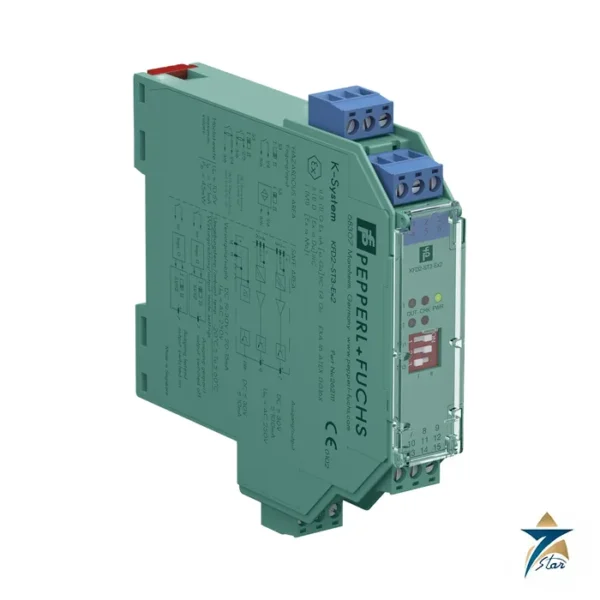
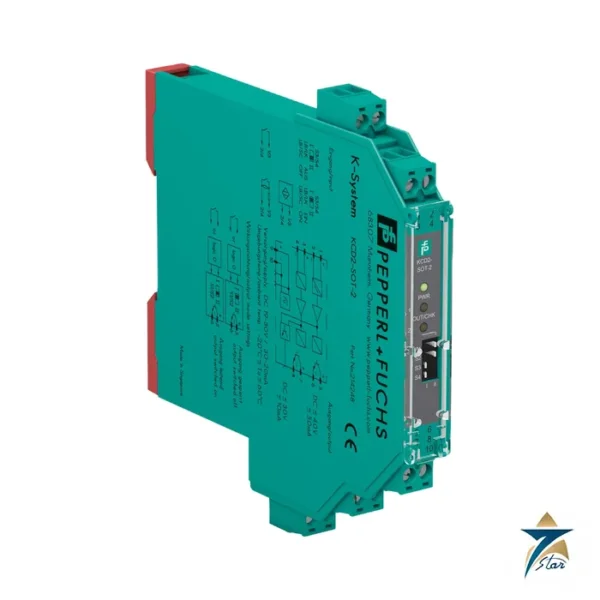
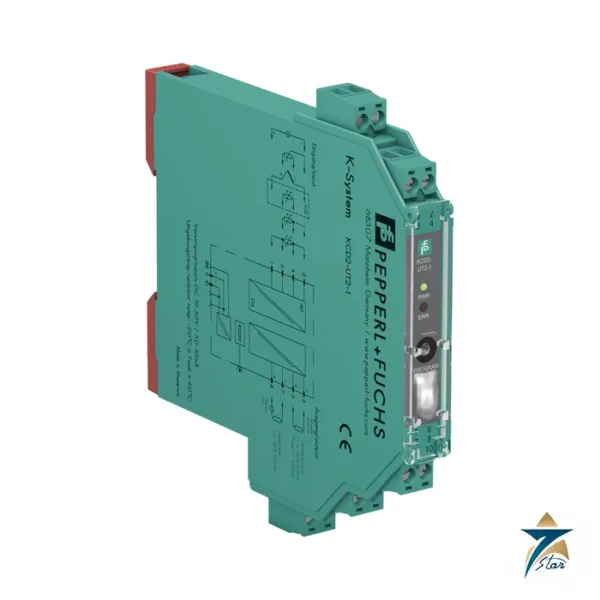
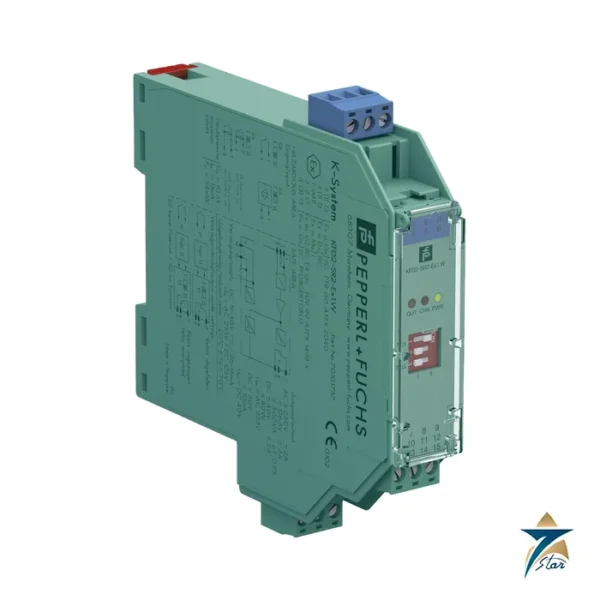
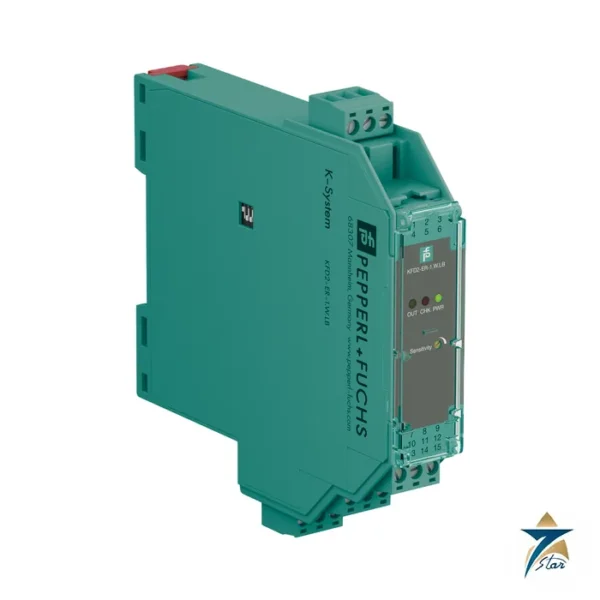
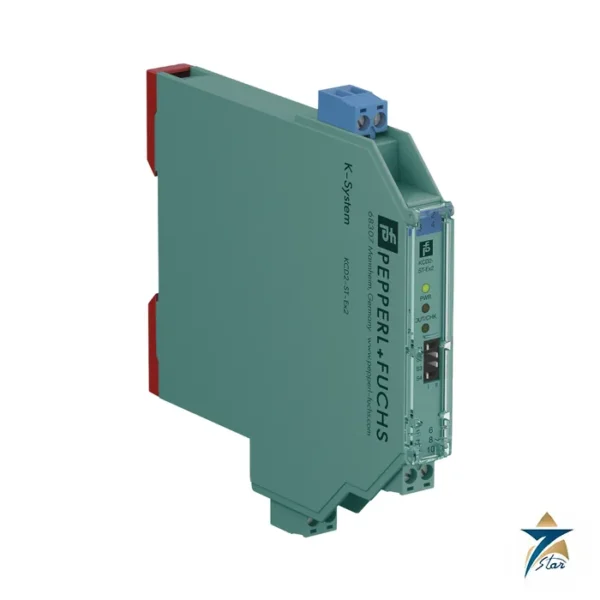
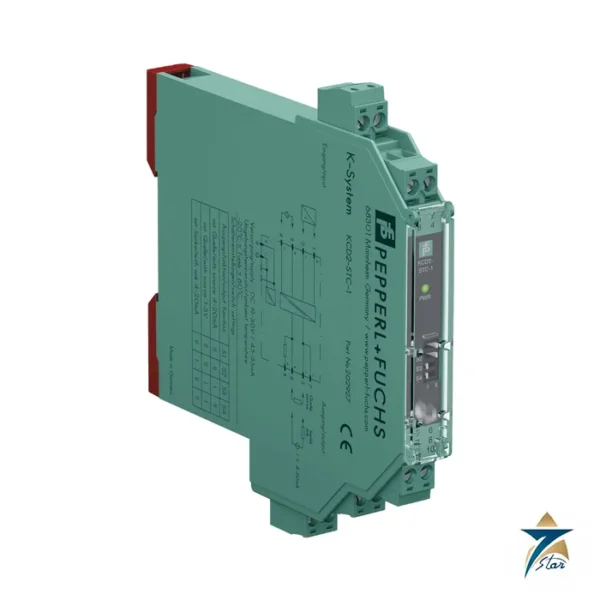
The KFD0-CC-1 is a safe-area part. For a transmitter in a hazardous area use a barrier such as KFD2-STC5-1 or KCD2-STC-Ex1. For a powered, display-equipped conditioner with wider scaling, see the KFD2-USC-1.D. Where only a Pt100 signal needs isolation, the KFD0-TR-1 is the matching loop-powered module.
Selection and ordering checklist for the KFD0-CC-1
- Input type and range: 0 to 20 mA or 0 to 10 V.
- Loop voltage: 12 V minimum at the module plus load.
- Whether a 3 mA downscale fault signal fits the control system alarm limits.
- Number of copies needed (one channel per module).
- Rail space of 20 mm per module and ambient up to 70 °C.
Installation, commissioning and maintenance of the KFD0-CC-1
Wire input to terminals 1+ and 2-, output to 9+ and 8-. Use a calibrated current source or voltage source at the input and a milliammeter in the output loop. Set the DIP switches, then trim zero and span at 4 and 20 mA.
Verify that line breakage produces the downscale value and that the control system treats it as a fault. Record the calibration in the loop folder.
Because the module is not intrinsically safe and has screw terminals only, keep field wiring tidy and labeled, separate from mains cables, and re-torque terminals during the first scheduled shutdown after commissioning.
Voltage budget of a loop-powered module
A loop-powered module consumes part of the available loop voltage. The datasheet gives the permitted load as (U – 12 V) / 0.02 A, so at a 24 V loop the load may be up to 600 Ω, and at 30 V up to 900 Ω. Add cable resistance and any other series device to the receiver input resistance before ordering the KFD0-CC-1.
The output is limited to 35 mA, which protects the loop in fault situations but also means the module cannot be used as a current booster.
Typical applications in Oman and the GCC
Typical uses of the KFD0-CC-1 in Oman and the GCC are signal duplication for existing analog loops in power plant control rooms, isolating legacy 0 to 10 V controllers from new PLC inputs, and breaking ground loops in water and desalination plants. The wide ambient range up to 70 °C helps in cabinets that heat up in summer, but spacing between modules and ventilation should still be planned, because several loop-powered modules side by side add their own heat to the enclosure.
Family comparison
| Part |
Key difference |
| KFD0-CC-1 (this part) |
Current/voltage to 4-20 mA, loop powered |
| KFD0-TR-1 |
Pt100 to 4-20 mA, loop powered |
| KFD2-USC-1.D |
24 V powered universal converter with display |
| KFD2-STC5-1 |
Ex ia transmitter power supply, 1 channel |
Information to send with an RFQ
- Part number KFD0-CC-1 and quantity
- Input signal and range
- Loop supply voltage and receiver load
- Alarm behavior required
- Delivery location
Site conditions in Oman for the KFD0-CC-1
Control cabinets in Gulf plants often run hot, because many sit in outdoor kiosks or in rooms where air conditioning is not always reliable. Before you finalise the KFD0-CC-1, check the permitted ambient range and any derating stated by the manufacturer against the real temperature inside your panel, and leave the recommended spacing around the device so that heat can escape. Long cable runs between the field and the marshalling cabinet are common on large sites, so confirm the signal types, wiring limits and earthing arrangement early in the design.
It also helps to standardise on a small number of part numbers across a project. Keeping a few spare KFD0-CC-1 units on site in Oman shortens recovery time after a fault, and documenting configuration settings makes replacement faster for the maintenance team.
Documents and quotation
The manufacturer datasheet for KFD0-CC-1 is attached on this page, so you can check wiring, approvals and dimensions before ordering. Send the exact part number, quantity and delivery location in Oman or the GCC and Seven Star LLC will reply with a quotation.
Seven Star LLC is an independent supplier in Muscat and is not the manufacturer; confirm availability, lead time and any project approval requirements in your RFQ.



















Reviews
There are no reviews yet.