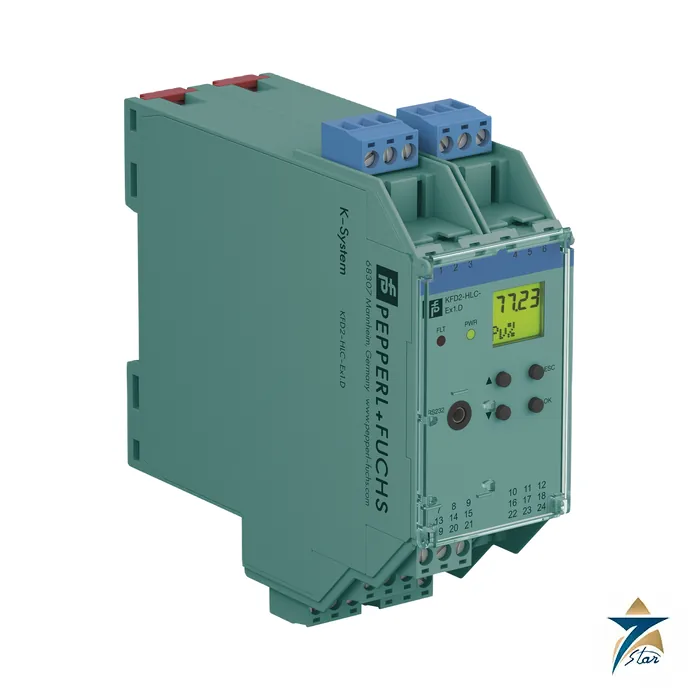
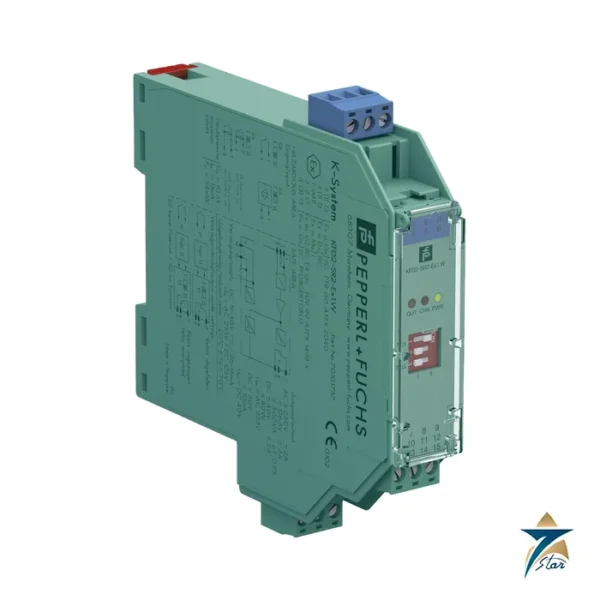
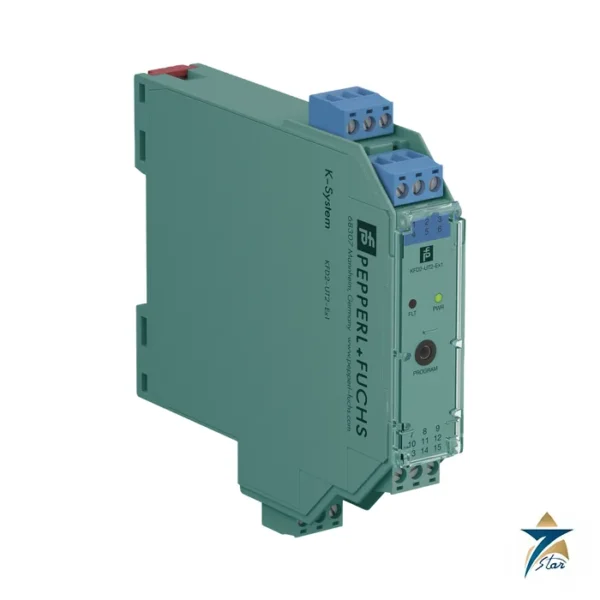
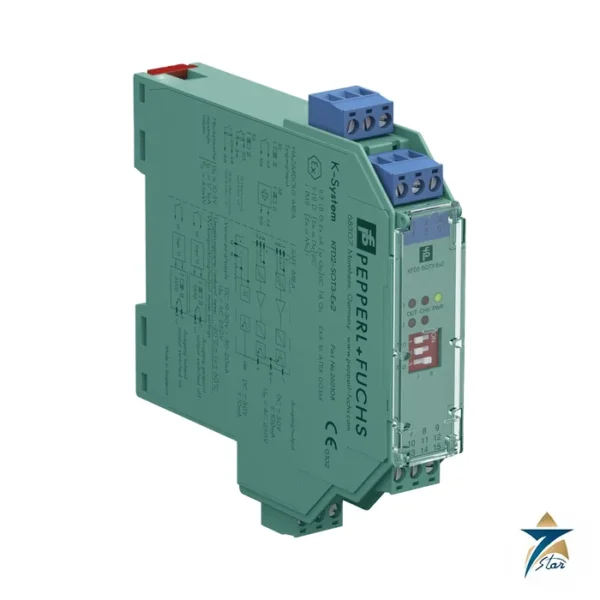
KFD2-HLC-Ex1.D HART loop converter with three 4-20 mA outputs
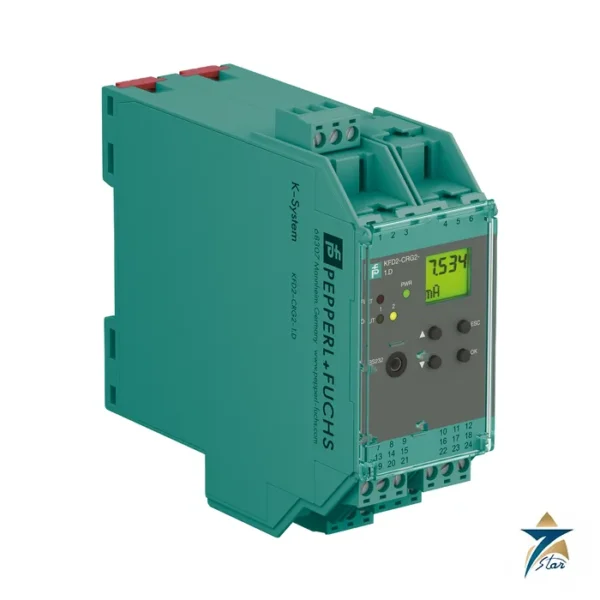
The KFD2-HLC-Ex1.D is a 40 mm wide isolated barrier that powers a HART transmitter in a hazardous area, or connects in parallel to an existing HART loop, and reads the digital HART data. It can evaluate the four HART variables PV, SV, TV and QV and turn any three of them into separate 4 to 20 mA signals for a control system or display.
Part number reading: KFD2 is the 24 V DC isolated barrier range, HLC stands for HART loop converter, Ex1 means one input channel and .D means display and keypad version. The related .D.2W version is a variant for 2-wire use; check its own datasheet.
Seven Star LLC supplies this module in Oman and the GCC as an independent supplier in Muscat.
Technical specifications of the KFD2-HLC-Ex1.D
| Parameter |
Specification |
| Manufacturer / part number |
Pepperl+Fuchs KFD2-HLC-Ex1.D |
| Input |
HART field device, revision 5 to 7; terminals 1 to 6; 250 Ω (5 %) input resistance |
| Transmitter supply |
Open circuit typ. 24 V / short-circuit 28 mA; ≥ 15.5 V at 20 mA, short-circuit protected |
| Outputs |
3 x 4 to 20 mA, source (load max. 650 Ω) or sink (5 to 30 V external supply) |
| Fault signal |
Downscale ≤ 2 mA, upscale ≥ 21.5 mA (NAMUR NE 43) or hold value |
| Resolution / accuracy |
max. 2 µA / < 20 µA (typically 10 µA) |
| Response |
HART message acquisition time plus 100 ms |
| HART features |
Primary or secondary module; automatic burst; handheld on terminals 22/24; signal splitting |
| Supply |
19 to 30 V DC, Power Rail or terminals 23+/24-; approx. 120 mA; power consumption 2.9 W |
| Hazardous area data |
BASEEFA 07 ATEX 0174, [Ex ia Ga] IIC; Uo 25.2 V, Io 104.9 mA, Po 0.661 W, Ci 1.1 nF |
| Ambient temperature |
-20 to 60 °C |
| Housing |
Type C2, 40 x 119 x 115 mm, IP20, 300 g |
How the KFD2-HLC-Ex1.D converts HART data to analog
The module supplies the transmitter and listens to the HART digital messages riding on the 4 to 20 mA loop. After reading, it assigns up to three of the variables to its three outputs, each of which can be set to source or sink mode. This lets one smart transmitter feed three analog inputs, for example the process value, a secondary temperature and a diagnostic variable, without extra field cabling.
It can be a primary or a secondary HART master, and a handheld communicator can still be connected on the safe-area side. Configuration is done on the front keypad or in PACTware. In a fault, outputs can go downscale, upscale or hold the last value.
System fit and related parts
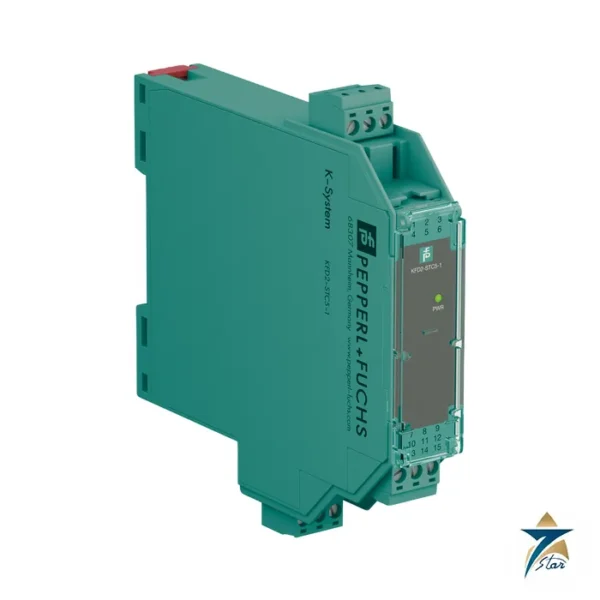
Use the KFD2-HLC-Ex1.D when an older control system has no HART input but the plant wants to read secondary variables of a smart transmitter. For plain 4 to 20 mA transmitter supply without variable extraction, the KFD2-STC5-1 or KCD2-STC-Ex1 are smaller and simpler.
Selection and ordering checklist
- HART revision of the transmitter (5 to 7 supported).
- Which three variables are needed and their scaling.
- Source or sink mode for each output and the receiving device.
- Whether the module is primary or secondary master.
- Ex ia entity values of transmitter and cable.
- Supply 19 to 30 V DC and 2.3 W dissipation.
Installation, commissioning and maintenance of the KFD2-HLC-Ex1.D
Mount on DIN rail, observe the wiring diagram jumper between terminals 5 and 6 for the 250 Ω HART resistance, and configure the outputs. Verify each output with the transmitter in simulation mode or with a HART communicator, and check that downscale and upscale values do not conflict with alarms in the control system.
HART practice when using the KFD2-HLC-Ex1.D
HART communication needs a minimum loop resistance of about 230 to 250 Ω for the digital signal to be read reliably, and the KFD2-HLC-Ex1.D includes a 250 Ω input resistance that can be used when the loop has none. Cable capacitance in long field runs weakens the HART signal, so check the cable data when the transmitter is far away.
When several modules are used on a Power Rail the first can act as primary master and the others as secondary; plan the polling so that two masters never talk at the same time. Burst mode is supported automatically, which helps with devices that send data without polling. Always record the HART device address and tag of each transmitter in the loop dossier before switching a new converter on.
Typical applications in Oman and the GCC
The KFD2-HLC-Ex1.D is common in brownfield upgrades at oil, gas and power plants in Oman where HART transmitters are installed but older I/O only reads 4 to 20 mA; the additional variables can be exposed for monitoring without replacing the DCS cards.
Family comparison
| Part |
Key difference |
| KFD2-HLC-Ex1.D (this part) |
HART loop converter, 3 analog outputs, display |
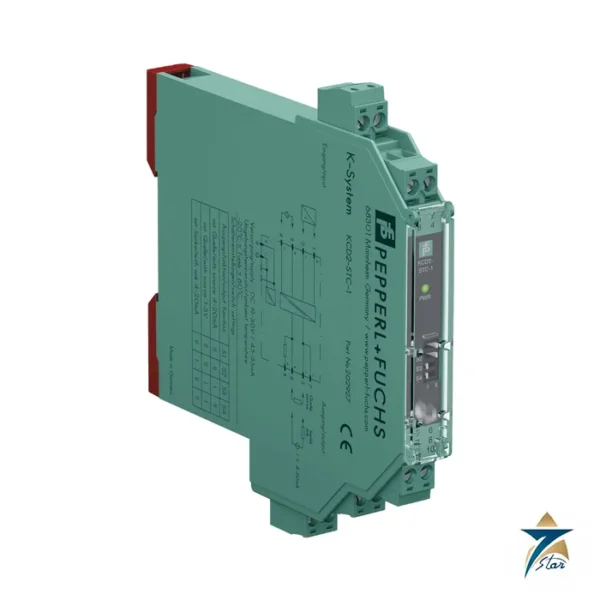
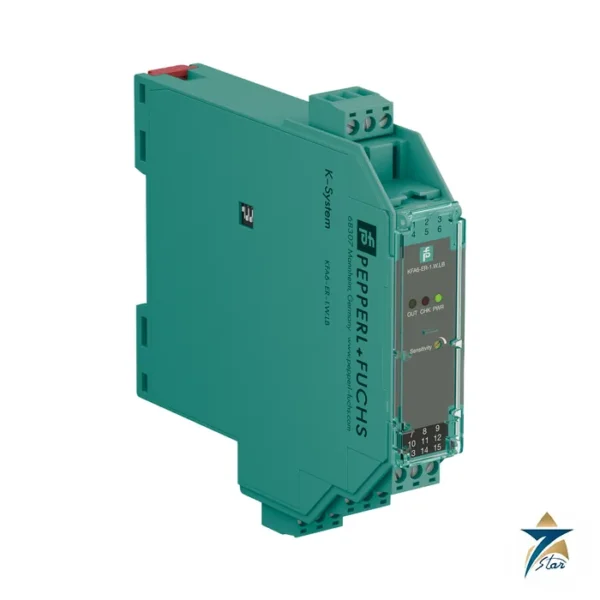
| KCD2-STC-Ex1 |
12.5 mm SMART transmitter supply |
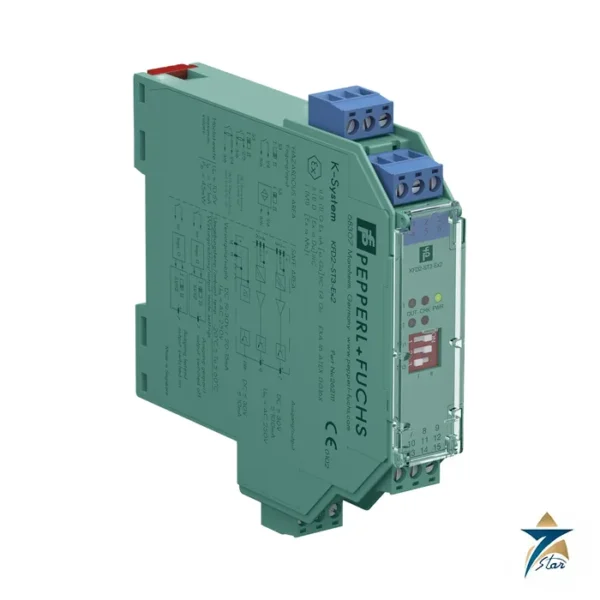
| KFD2-STC5-1 |
20 mm SMART transmitter supply |
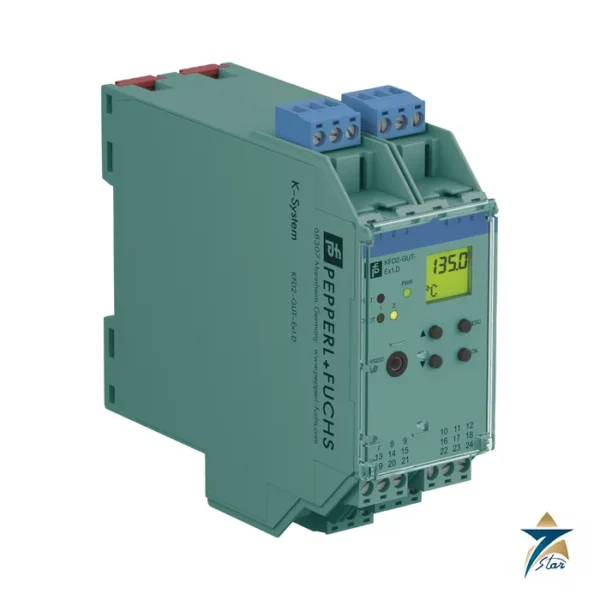
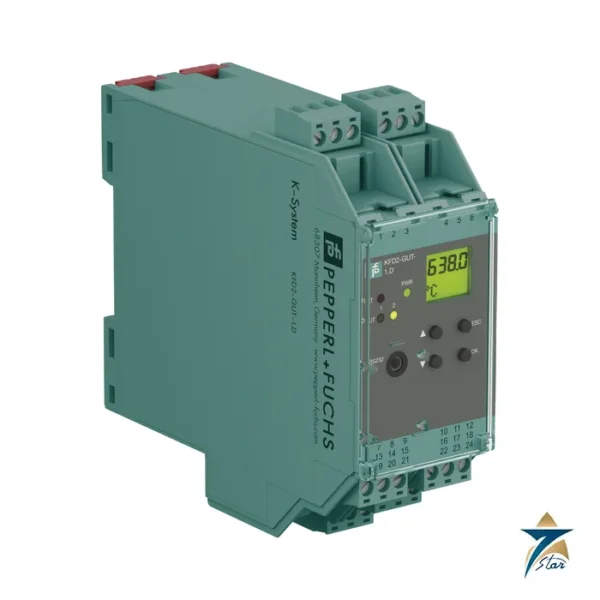
| KFD2-GUT-Ex1.D |
Temperature converter with trip values |
Information to send with an RFQ
- Part number KFD2-HLC-Ex1.D and quantity
- Transmitter model and HART revision
- Variables needed
- Output mode
- Supply method
- Delivery location
Site conditions in Oman for the KFD2-HLC-Ex1.D
Control cabinets in Gulf plants often run hot, because many sit in outdoor kiosks or in rooms where air conditioning is not always reliable. Before you finalise the KFD2-HLC-Ex1.D, check the permitted ambient range and any derating stated by the manufacturer against the real temperature inside your panel, and leave the recommended spacing around the device so that heat can escape. Long cable runs between the field and the marshalling cabinet are common on large sites, so confirm the signal types, wiring limits and earthing arrangement early in the design.
It also helps to standardise on a small number of part numbers across a project. Keeping a few spare KFD2-HLC-Ex1.D units on site in Oman shortens recovery time after a fault, and documenting configuration settings makes replacement faster for the maintenance team.
Documents and quotation
The manufacturer datasheet for KFD2-HLC-Ex1.D is attached on this page, so you can check wiring, approvals and dimensions before ordering. Send the exact part number, quantity and delivery location in Oman or the GCC and Seven Star LLC will reply with a quotation.
Seven Star LLC is an independent supplier in Muscat and is not the manufacturer; confirm availability, lead time and any project approval requirements in your RFQ.



















Reviews
There are no reviews yet.