- Automation & ControlView all 3,044 products
- Automation Accessories
- AC Drives
- PLC & I/O Cards
- Industrial Communications
- Vibration Monitoring
- Isolator & Barrier
- Controllers & Data Acquisition
- Safety Switches & Guard Locking
- Motor Soft Starters
- Encoders
- CCTV & Security
- Pneumatic Cylinders
- HMI Displays
- Servo Drives
- Industrial Computers
- Machine Vision
- Automation Software
- Robotics
Brand: Pepperl+Fuchs
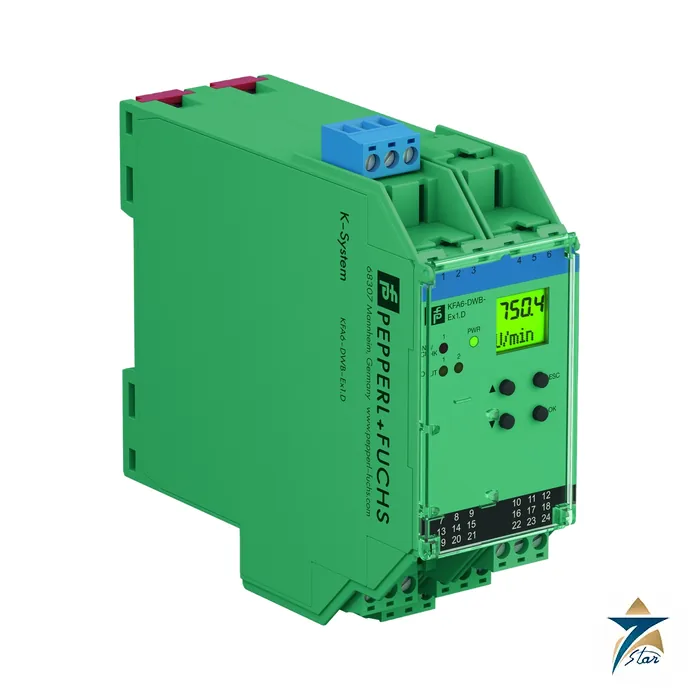
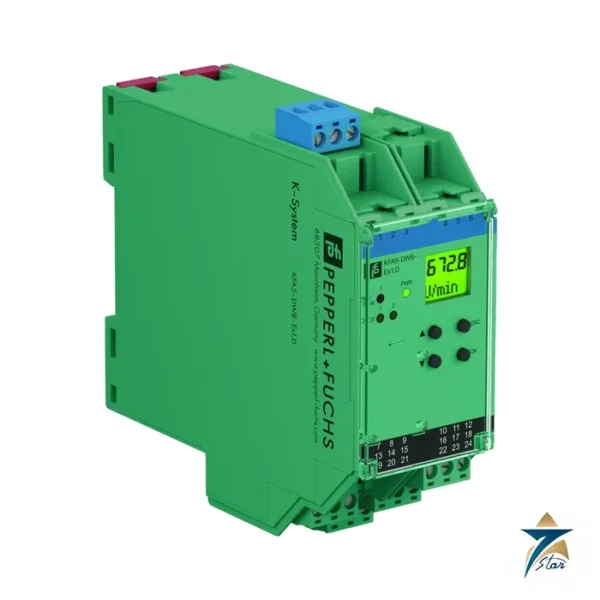
Pepperl+Fuchs KFA6-DWB-Ex1.D Speed Monitor 230 V AC
Description
What the Pepperl+Fuchs KFA6-DWB-Ex1.D does
Installations without a 24 V DC bus sometimes still need hazardous-area speed supervision, and the Pepperl+Fuchs KFA6-DWB-Ex1.D answers that case. It is an isolated barrier powered directly from 230 V AC (plus or minus 10 percent, 18 mA, no more than 2 VA) that reads a NAMUR sensor or dry contact from a hazardous area and reports overspeed or underspeed through two relays.
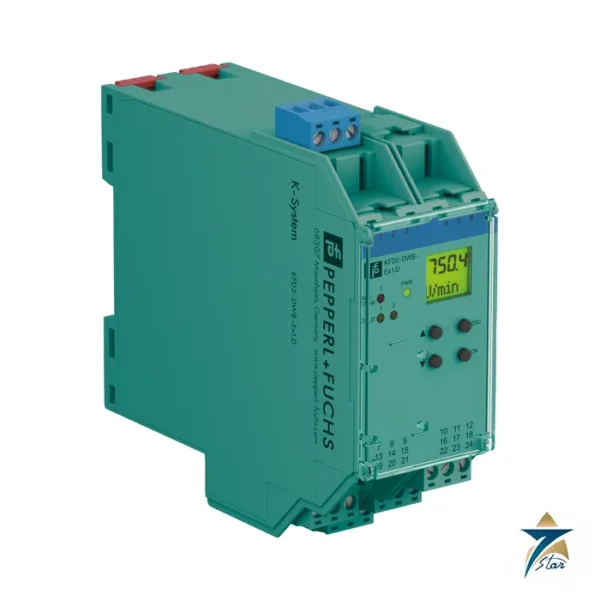
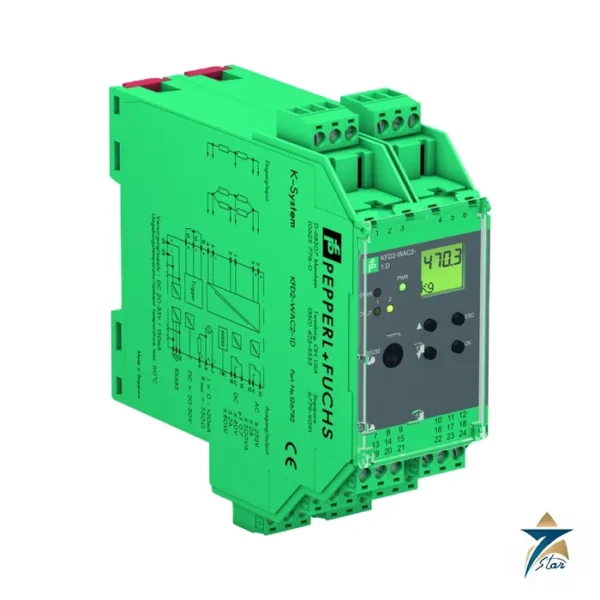
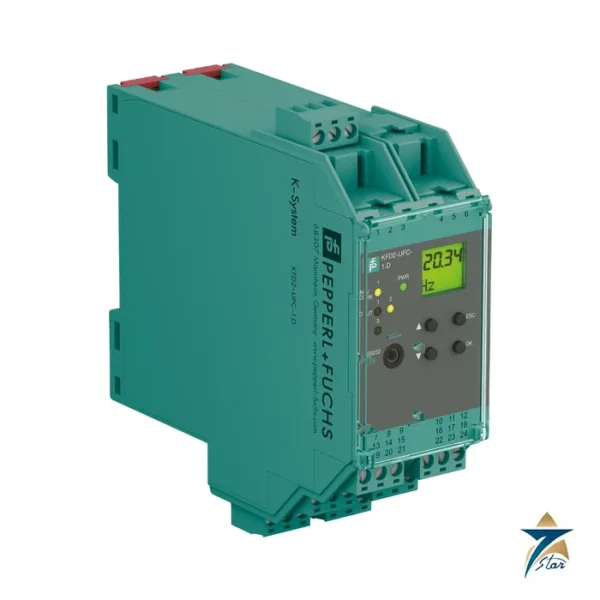
Settings are made with the on-board keypad, and the result of every comparison is visible on the display. The monitor is one of the models that tolerate rotation measurements from 1 mHz up to 5 kHz.
Quick facts
- Supply 230 V AC, terminals 23 and 24, rated current 18 mA
- Input I intrinsically safe on terminals 1+ and 3-; Uo 10.1 V, Io 13.5 mA, Po 34 mW
- Input II on terminals 13+ and 14- for the 1 to 1000 s start-up override
- Outputs: two relays, 10-11-12 and 16-17-18
- SIL 2 according to IEC/EN 61508 and IEC/EN 61511
KFA6-DWB-Ex1.D specification sheet
| Parameter | Value |
|---|---|
| Supply | 230 V AC plus or minus 10 percent, 18 mA, up to 2 VA |
| Maximum safe voltage Um | 253 V AC |
| Input frequency | 0.001 to 5000 Hz, pulses longer than 50 microseconds |
| Measuring accuracy | 0.1 percent of the measured value |
| Active / passive level of input II | above 4 mA for at least 100 ms / below 1 mA |
| Open-circuit voltage / short-circuit current of input II | 18 V / 5 mA |
| Line-fault thresholds | breakage 0.15 mA or less; short circuit above 6.5 mA |
| Relay rating | 253 V AC / 2 A / cos phi 0.7 or better; 40 V DC / 2 A |
| Response delay | 200 ms or less |
| Insulation of start-up override to supply | reinforced, 300 Veff |
| Ex ia certificate | TUV 99 ATEX 1408; IECEx TUN 03.0000 |
| Zone 2 certificate | TUV 02 ATEX 1885 X, Ex nA nC IIC T4 Gc |
| Dimensions | 40 x 119 x 115 mm, housing type C2, 300 g |
| Ambient temperature | -20 to 60 degrees C |
Why choose the 230 V AC build of the DWB family
Brownfield plants in the Gulf often keep a 230 V AC instrument supply for panel-mounted equipment, with no DC rails running through the field cabinets. Specifying KFA6-DWB-Ex1.D means the monitor plugs straight into that supply and still enjoys full Ex ia protection on the sensor side. There is no collective-error output to a Power Rail, so line faults are indicated by the red LED and the relay only.
How KFA6-DWB-Ex1.D differs from the 24 V and 115 V relatives
- Against KFD2-DWB-Ex1.D: same 5 kHz Ex ia input, but 230 V AC instead of 20 to 30 V DC and no Power Rail or collective error line.
- Against KFA5-DWB-Ex1.D: same function with a 115 V AC supply.
- Against KFD2-DWB-1.D: that unit is a non-Ex conditioner reaching 12 kHz.
Mounting and wiring practice
Fit the module on a DIN rail, keep intrinsically safe wiring segregated from mains and relay conductors, and use the blue terminal colour as the visible cue for the intrinsically safe side. Connect mains to terminals 23 and 24 through a protective device suited to the cabinet, and leave at least the clearance required by the installation instructions between neighbouring modules that carry different voltage levels.
Setting up and proving the loop
Enter the limit frequencies, decide on relay logic, then simulate the lowest permitted pulse rate. A start-up override of several minutes may be programmed so that a slowly accelerating pump does not trip the underspeed relay during run-up. Break the sensor loop to make sure the fault indication appears.
Upkeep
Inspect terminals at each shutdown, test both relays yearly, and log the ambient temperature of the cabinet. Relay mechanical life is given as 5 x 10 to the power 7 cycles.
Documentation to keep with the installation
Store the loop diagram, the entity parameters of the sensor and cable, the programmed frequency limits and the start-up override time together with the instrument index. Auditors in hazardous areas ask for evidence that the sum of cable capacitance and inductance stays within the permitted values, and a single sheet that lists Uo, Io and Po for terminals 1+ and 3- makes that check quick. Note also the supply fuse rating chosen for the mains feed, since that detail is easy to lose after a plant turnaround.
When the module is later replaced, the stored sheet lets the maintenance team re-enter the same limits within minutes and verify them against a signal generator.
Operating environment and limits
The datasheet allows -20 to 60 degrees C ambient, IP20 protection and mounting on a 35 mm rail. In Gulf summers a closed cabinet in direct sun can exceed that range unless it is shaded or ventilated, so confirm cabinet temperature rather than ambient air temperature. Dust ingress is prevented by the enclosure, not by the module, which means door gaskets deserve a periodic look. Keep the unit away from heat sources such as power supplies placed directly underneath.
Safety function notes for KFA6-DWB-Ex1.D
The data sheet places the module in the group of devices capable of SIL 2 under IEC/EN 61508 and IEC/EN 61511. A designer who wants to claim that rating in a safety instrumented function must still use the figures from the safety manual for failure rates and proof-test intervals, and must combine them with the sensor and final element in the loop. For purely protective alarms below that level, the standard relay outputs are sufficient. Keep in mind that the datasheet date and revision should match the unit delivered, so check the label against the file you hold.
Questions buyers ask about KFA6-DWB-Ex1.D
What supply voltage does KFA6-DWB-Ex1.D use? It operates from 230 V AC plus or minus 10 percent on terminals 23 and 24, drawing about 18 mA.
What are the intrinsically safe values of KFA6-DWB-Ex1.D? Input I on terminals 1+ and 3- has Uo 10.1 V, Io 13.5 mA and Po 34 mW with a linear characteristic.
Does KFA6-DWB-Ex1.D support a Power Rail? No. The listed supply connection is terminals 23 and 24 at 230 V AC, and there is no Power Rail collective error message.
How fast can KFA6-DWB-Ex1.D count pulses? Its measuring range is 0.001 to 5000 Hz with a resolution and accuracy of 0.1 percent of the measured value.
Is the safe-area side of KFA6-DWB-Ex1.D approved for Zone 2? The datasheet lists certificate TUV 02 ATEX 1885 X with marking Ex nA nC IIC T4 Gc for the non-intrinsically safe circuits.
Documents and quotation
The manufacturer datasheet for KFA6-DWB-Ex1.D accompanies this listing as a PDF so your engineers can verify terminals, ratings and approvals before purchase. Mention the supply voltage of your cabinet when asking for stock. To request a quotation, send the RFQ with the exact part number KFA6-DWB-Ex1.D, the quantity, the delivery location in Oman or the GCC and any project reference. Seven Star LLC is an independent supplier serving Oman and the GCC and is not affiliated with the manufacturer.
Other Models in the Dwb Speed Range
Seven Star LLC supplies models from the Dwb Speed range in Oman and the GCC. Compare the related models below and request a quote for the one that matches your application.
| Model | Category | |
|---|---|---|
| Pepperl+Fuchs KFD2-DWB-1.D Speed Monitor 12 kHz | Isolator & Barrier | View details |
| Pepperl+Fuchs KFA6-DWB-Ex1.D Speed Monitor 230 V AC | Isolator & Barrier | You are viewing this model |
| Pepperl+Fuchs KFA5-DWB-Ex1.D Speed Monitor 115 V AC | Isolator & Barrier | View details |
Datasheets & Documents
- Datasheet Pepperl+Fuchs KFA6-DWB-Ex1.D Speed Monitor 230 V AC Datasheet Download
Reviews (0)
How would you rate this product? Cancel reply
About brand
Pepperl+Fuchs is a German manufacturer of industrial sensors and explosion protection equipment, founded in 1945 in Mannheim by Walter Pepperl and Ludwig Fuchs as a radio repair shop. Defective transformers led them into manufacturing, and the company developed its first proximity switch in the late 1950s. Pepperl+Fuchs is headquartered in Mannheim and is a pioneer of intrinsically safe electrical equipment for hazardous areas.
Seven Star LLC lists Pepperl+Fuchs sensors, isolated barriers, power supplies and hazardous-area mobile devices, and supplies them to instrument and automation teams in Oman by exact model designation.
Pepperl+Fuchs company profile
| Founded | 1945, Mannheim-Sandhofen, Germany, by Walter Pepperl and Ludwig Fuchs |
|---|---|
| Headquarters | Mannheim, Germany |
| Ownership | Privately owned (Pepperl+Fuchs SE) |
| Origins | Radio repair workshop that began making replacement transformers |
| Product families | Inductive, capacitive, ultrasonic and photoelectric sensors, rotary encoders, R2000 LiDAR scanners, KFD and HiC isolated barriers, Zener barriers, remote I/O, purge and pressurization systems, Ex-rated enclosures |
Milestones
- 1945: Walter Pepperl and Ludwig Fuchs open their radio repair shop in Mannheim.
- 1958: The first proximity switch is developed (some company sources say 1959).
Pepperl+Fuchs product families on this page
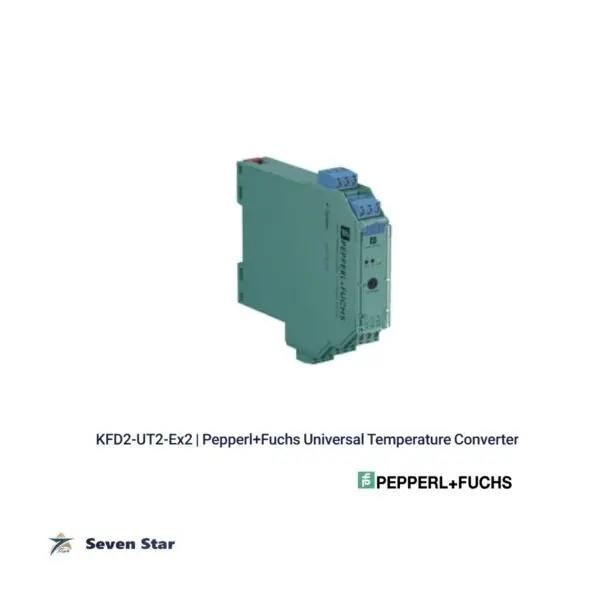
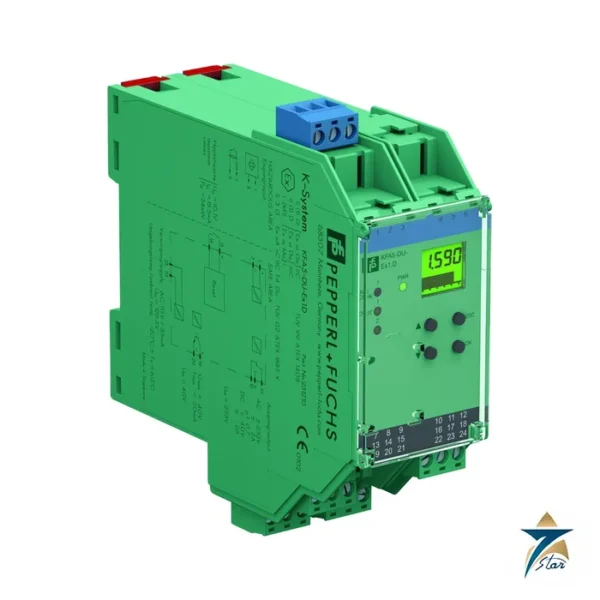
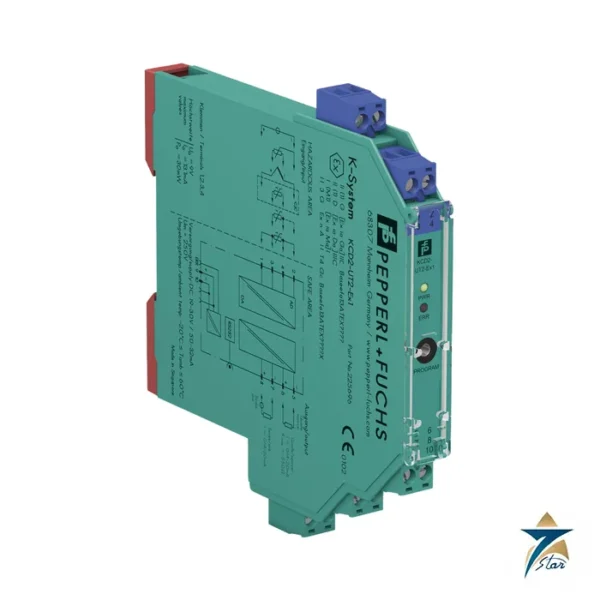
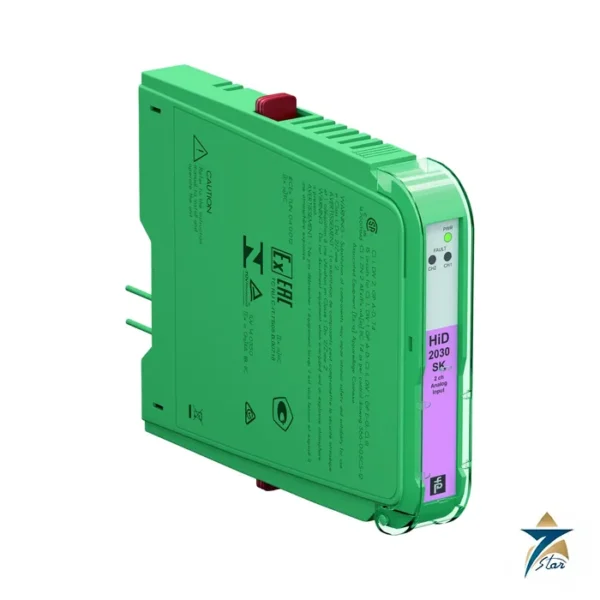
On the interface side there are two systems. The K-System mounts on DIN rail and is represented here by the KFD2-UT2-Ex2 universal temperature converter. The H-System plugs into termination boards and is represented by the HiD2030 SMART transmitter power supply with HART. The PS1000-A6-24.20 is a 24 VDC, 20 A power supply for cabinets. Sensors listed include the NJ2-12GK-SN NAMUR inductive sensor, the R101 retro-reflective photoelectric sensor and the R2000 2-D LiDAR scanner. For field staff there are the Tab-Ex 05 DZ1 tablet for Zone 1/21 areas and the Smart-Ex 03 DZ2 smartphone for Zone 2/22 and Division 2 areas.
Where Pepperl+Fuchs equipment is used
Isolated barriers sit between field instruments in Zone 0 or Zone 1 and the DCS or safety system in refineries, gas plants and chemical works. NAMUR sensors report valve position and machine states in classified areas. Photoelectric sensors and LiDAR scanners work in conveying, packaging, warehousing and vehicle guidance. Ex-rated tablets and phones are carried on operator rounds and maintenance jobs.
Pepperl+Fuchs products we list
Ordering Pepperl+Fuchs parts: what we need
Send the complete model designation as printed on the device, including every suffix; a single letter can change the supply voltage or the output type. Add the part number if the label shows one. For barriers, tell us the field device and signal type, the number of channels and whether the safety loop needs a SIL-assessed module. For mobile devices, state the zone or division and the regional radio version.
Facts checked against Pepperl+Fuchs's own chronicle pages, October 2026.
Browse Pepperl+Fuchs products by category: Sensors & Transmitters, Industrial Computer, Isolator & Barrier, Power Modules.
FAQ
Questions about the Pepperl+Fuchs KFA6-DWB-Ex1.D Speed Monitor 230 V AC
Answers from our engineering team on installation, compatibility and integration.
01What supply voltage does KFA6-DWB-Ex1.D use?
It operates from 230 V AC plus or minus 10 percent on terminals 23 and 24, drawing about 18 mA.
02What are the intrinsically safe values of KFA6-DWB-Ex1.D?
Input I on terminals 1+ and 3- has Uo 10.1 V, Io 13.5 mA and Po 34 mW with a linear characteristic.
03Does KFA6-DWB-Ex1.D support a Power Rail?
No. The listed supply connection is terminals 23 and 24 at 230 V AC, and there is no Power Rail collective error message.
04How fast can KFA6-DWB-Ex1.D count pulses?
Its measuring range is 0.001 to 5000 Hz with a resolution and accuracy of 0.1 percent of the measured value.
05Is the safe-area side of KFA6-DWB-Ex1.D approved for Zone 2?
The datasheet lists certificate TUV 02 ATEX 1885 X with marking Ex nA nC IIC T4 Gc for the non-intrinsically safe circuits.


Reviews
There are no reviews yet.