- Automation & ControlView all 3,044 products
- Automation Accessories
- AC Drives
- PLC & I/O Cards
- Industrial Communications
- Vibration Monitoring
- Isolator & Barrier
- Controllers & Data Acquisition
- Safety Switches & Guard Locking
- Motor Soft Starters
- Encoders
- CCTV & Security
- Pneumatic Cylinders
- HMI Displays
- Servo Drives
- Industrial Computers
- Machine Vision
- Automation Software
- Robotics
Brand: Pepperl+Fuchs
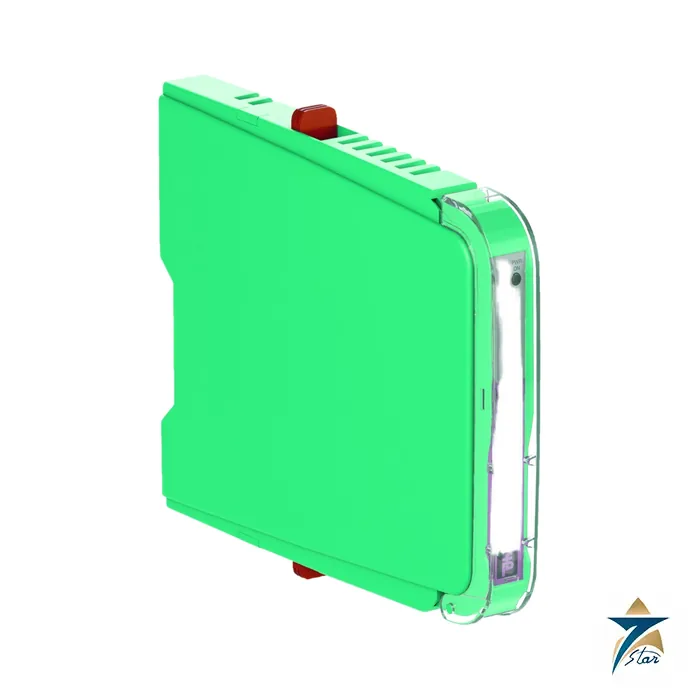
Pepperl+Fuchs HiD2026 SMART Transmitter Power Supply
Description
HiD2026: low-dissipation transmitter power supply
Compactness and heat are the two enemies of dense marshalling. The Pepperl+Fuchs HiD2026 addresses both: two channels in an 18 mm module (106 mm high, 128 mm deep), each dissipating 0.8 W, which is about a quarter less than the HiD2030 at 1.05 W. It powers 2-wire SMART transmitters in the hazardous area and repeats the current for a safe-area load.
Bi-directional communication is supported for transmitters that use current modulation to send data and voltage modulation to receive it, which covers HART and similar protocols.
What it offers
- Output 4 to 20 mA into 0 to 650 ohm, or 1 to 5 V across the 250 ohm internal 0.1 percent shunt
- Response time 40 ms for a 10 to 90 percent step, the fastest in this group
- Rated supply current 95 mA at 24 V with 20 mA output
- Configuration through DIP switches; see the system description
- SIL 2 according to IEC/EN 61508
HiD2026 data sheet figures
| Parameter | Value |
|---|---|
| Supply | 20.4 to 30 V DC, bus powered through a HiD Termination Board |
| Current at 24 V | 95 mA with 20 mA output |
| Power dissipation | 0.8 W per channel at 24 V |
| Input | 4 to 20 mA, limit about 26 mA, at least 15.5 V at 20 mA |
| Output | 4 to 20 mA or 1 to 5 V; load 0 to 650 ohm |
| Accuracy | better than 0.1 percent of full scale |
| Linearity | better than 0.1 percent of full scale |
| Load influence | better than 0.1 percent of full scale from 0 to 650 ohm |
| Temperature influence | under 2 microamps per K (0 to 60 degrees C); under 4 microamps per K (-20 to 0 degrees C) |
| Communication channel | 0.5 to 40 kHz within 3 dB |
| Isolation | input to output and supply 375 V peak; channel to channel 60 V peak |
| Safe-side values | Uo 26 V, Io 93 mA, Po 605 mW |
| Certificates | CESI 10 ATEX 025; PF 10 CERT 1609 X; IECEx CES 10.0011 |
| Dimensions | 18 x 106 x 128 mm, about 140 g |
A note on output referencing
The datasheet states that the outputs are isolated from the inputs and referenced to the power supply common, with no isolation between output and power supply. In design terms this means the safe-side loop shares the 24 V common of the Termination Board, so the receiving cards must have compatible common-return arrangements.
HiD2026 compared with HiD2030
No signal-splitter mode, no current-source input resistance figure and no fault bus output are listed for this module; in exchange you get the lowest dissipation, the quicker 40 ms response and a smaller depth of 128 mm instead of 130 mm. It also uses a different ATEX certificate, CESI 10 ATEX 025, with IECEx coverage under CES 10.0011.
Mounting and thermal planning
A rack of 16 modules dissipates roughly 0.8 W times 32 channels, or about 26 W. Compare that with the same rack of HiD2030 at about 34 W: the saving is a practical benefit when cabinet temperatures in the Gulf approach the 60 degrees C limit.
Commissioning
Set the DIP switches per the system description, apply the 24 V bus and verify each loop with a simulator. Confirm HART communication through the module using a handheld communicator.
Maintenance and spare policy
Because the module is plug-in, a single spare covers many channels. Test with a calibrator at turnarounds and keep a record of channel assignments.
Order-related remarks
Specify the Termination Board and system cables separately. Check the output type needed by your DCS cards before ordering, since sink-type versions use a different part number.
Heat budget and layout
Dissipation of 0.8 W per channel leads to lower rack temperature rise, which extends the life of electrolytic components inside every module nearby. Leave the ventilation spacing recommended by the Termination Board drawing and keep dust filters on cabinet fans clean and avoid stacking heat sources such as power supplies beneath the rack. Where outdoor kiosks are used, a sun shield and a small fan with a thermostat help keep the interior comfortably below the 60 degrees C ambient limit stated in the datasheet. Record the actual cabinet temperature during a summer inspection, preferably at the hottest hour of the afternoon with the plant at full load, to confirm margin, since the ratio between dissipation and ambient is the main driver of long-term reliability.
Questions buyers ask about HiD2026
What is the power dissipation of HiD2026? It is 0.8 W per channel at 24 V, lower than the 1.05 W per channel of HiD2030.
How fast does HiD2026 respond? The response time is 40 ms for a 10 to 90 percent step change.
Does HiD2026 support HART communication? Yes. Bi-directional communication is supported for SMART transmitters using current modulation to send and voltage modulation to receive, in the 0.5 to 40 kHz band.
What is the output of HiD2026? The output is 4 to 20 mA into 0 to 650 ohm, or 1 to 5 V across an internal 250 ohm shunt with 0.1 percent tolerance.
Which approvals are listed for HiD2026? The datasheet lists CESI 10 ATEX 025, PF 10 CERT 1609 X for Ex nA IIC T4 Gc, and IECEx CES 10.0011.
Documents and quotation
The manufacturer datasheet for HiD2026 accompanies this listing as a PDF so your engineers can verify terminals, ratings and approvals before purchase. Include the number of channels you need. To request a quotation, send the RFQ with the exact part number HiD2026, the quantity, the delivery location in Oman or the GCC and any project reference. Seven Star LLC is an independent supplier serving Oman and the GCC and is not affiliated with the manufacturer.
Ordering Checklist for the Pepperl+Fuchs HiD2026
Before you ask for a quotation for the Pepperl+Fuchs HiD2026, check the full order code on the nameplate of the unit you are replacing, the supply voltage, and the process or signal ranges your system expects. If this is an upgrade rather than a like-for-like swap, tell us the existing make and model so that mounting, wiring and connection details can be checked against the isolator & barrier already installed. For multi-unit orders, list the quantity per site and the delivery location in Oman or the wider GCC, so packing, paperwork and lead time can be confirmed in a single quotation.
Installation and Commissioning Planning
Planning ahead shortens downtime when a Pepperl+Fuchs HiD2026 goes into service. Confirm the available mounting space, cable entry or process connection, and the tools and spare seals needed on the day. Keep the existing configuration or calibration data so the new unit can be set up to match, and check that loop drawings and the asset register are updated after the swap. If the installation has to fit a short shutdown window, tell us the date when you request a quotation so that delivery of the Pepperl+Fuchs equipment can be planned around it.
Other Models in the Hid Transmitter Range
Seven Star LLC supplies models from the Hid Transmitter range in Oman and the GCC. Compare the related models below and request a quote for the one that matches your application.
| Model | Category | |
|---|---|---|
| Pepperl+Fuchs HiD2030SK Transmitter Supply, Current Sink | Isolator & Barrier | View details |
| Pepperl+Fuchs HiD2026 SMART Transmitter Power Supply | Isolator & Barrier | You are viewing this model |
Datasheets & Documents
- Datasheet Pepperl+Fuchs HiD2026 SMART Transmitter Power Supply Datasheet Download
Reviews (0)
How would you rate this product? Cancel reply
About brand
Pepperl+Fuchs is a German manufacturer of industrial sensors and explosion protection equipment, founded in 1945 in Mannheim by Walter Pepperl and Ludwig Fuchs as a radio repair shop. Defective transformers led them into manufacturing, and the company developed its first proximity switch in the late 1950s. Pepperl+Fuchs is headquartered in Mannheim and is a pioneer of intrinsically safe electrical equipment for hazardous areas.
Seven Star LLC lists Pepperl+Fuchs sensors, isolated barriers, power supplies and hazardous-area mobile devices, and supplies them to instrument and automation teams in Oman by exact model designation.
Pepperl+Fuchs company profile
| Founded | 1945, Mannheim-Sandhofen, Germany, by Walter Pepperl and Ludwig Fuchs |
|---|---|
| Headquarters | Mannheim, Germany |
| Ownership | Privately owned (Pepperl+Fuchs SE) |
| Origins | Radio repair workshop that began making replacement transformers |
| Product families | Inductive, capacitive, ultrasonic and photoelectric sensors, rotary encoders, R2000 LiDAR scanners, KFD and HiC isolated barriers, Zener barriers, remote I/O, purge and pressurization systems, Ex-rated enclosures |
Milestones
- 1945: Walter Pepperl and Ludwig Fuchs open their radio repair shop in Mannheim.
- 1958: The first proximity switch is developed (some company sources say 1959).
Pepperl+Fuchs product families on this page
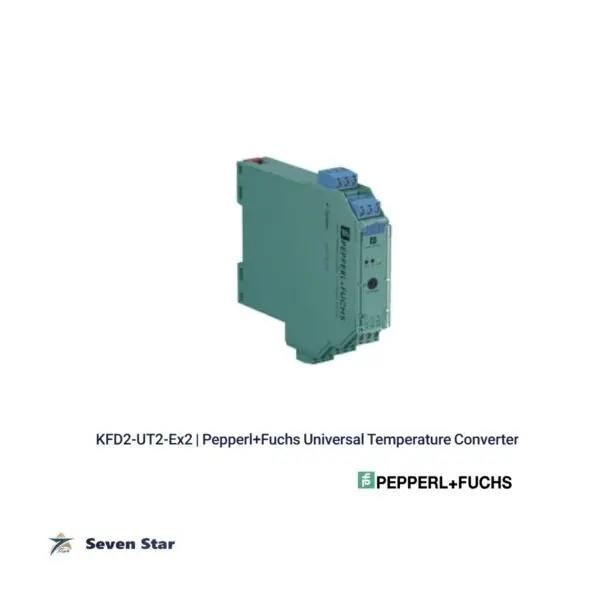
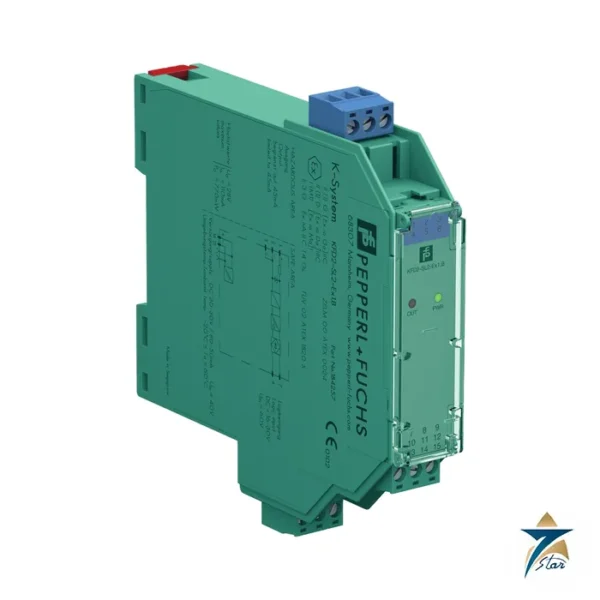
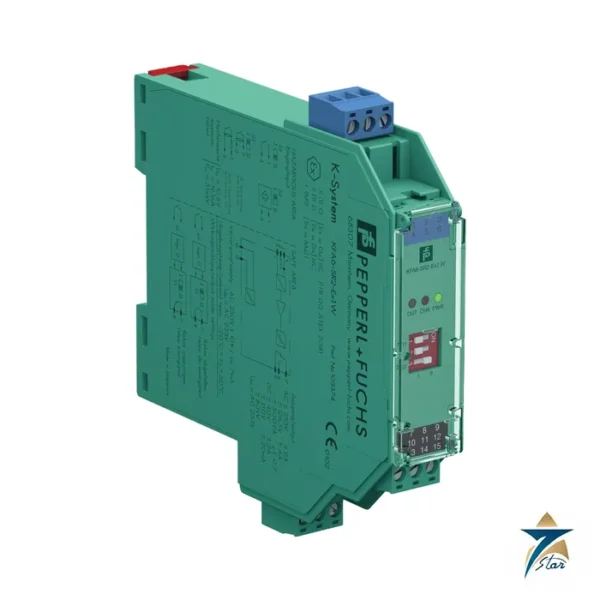
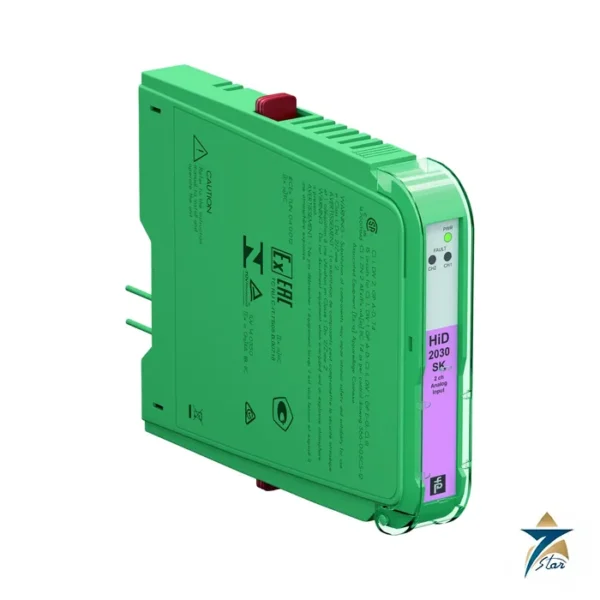
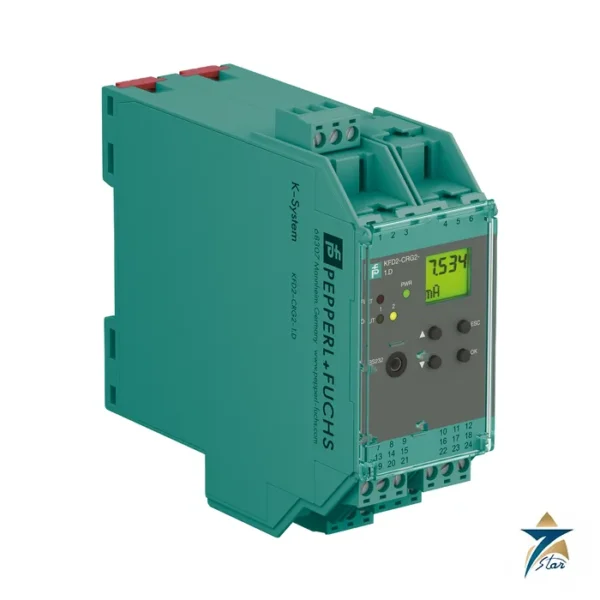
On the interface side there are two systems. The K-System mounts on DIN rail and is represented here by the KFD2-UT2-Ex2 universal temperature converter. The H-System plugs into termination boards and is represented by the HiD2030 SMART transmitter power supply with HART. The PS1000-A6-24.20 is a 24 VDC, 20 A power supply for cabinets. Sensors listed include the NJ2-12GK-SN NAMUR inductive sensor, the R101 retro-reflective photoelectric sensor and the R2000 2-D LiDAR scanner. For field staff there are the Tab-Ex 05 DZ1 tablet for Zone 1/21 areas and the Smart-Ex 03 DZ2 smartphone for Zone 2/22 and Division 2 areas.
Where Pepperl+Fuchs equipment is used
Isolated barriers sit between field instruments in Zone 0 or Zone 1 and the DCS or safety system in refineries, gas plants and chemical works. NAMUR sensors report valve position and machine states in classified areas. Photoelectric sensors and LiDAR scanners work in conveying, packaging, warehousing and vehicle guidance. Ex-rated tablets and phones are carried on operator rounds and maintenance jobs.
Pepperl+Fuchs products we list
Ordering Pepperl+Fuchs parts: what we need
Send the complete model designation as printed on the device, including every suffix; a single letter can change the supply voltage or the output type. Add the part number if the label shows one. For barriers, tell us the field device and signal type, the number of channels and whether the safety loop needs a SIL-assessed module. For mobile devices, state the zone or division and the regional radio version.
Facts checked against Pepperl+Fuchs's own chronicle pages, October 2026.
Browse Pepperl+Fuchs products by category: Sensors & Transmitters, Industrial Computer, Isolator & Barrier, Power Modules.
FAQ
Questions about the Pepperl+Fuchs HiD2026 SMART Transmitter Power Supply
Answers from our engineering team on installation, compatibility and integration.
01What is the power dissipation of HiD2026?
It is 0.8 W per channel at 24 V, lower than the 1.05 W per channel of HiD2030.
02How fast does HiD2026 respond?
The response time is 40 ms for a 10 to 90 percent step change.
03Does HiD2026 support HART communication?
Yes. Bi-directional communication is supported for SMART transmitters using current modulation to send and voltage modulation to receive, in the 0.5 to 40 kHz band.
04What is the output of HiD2026?
The output is 4 to 20 mA into 0 to 650 ohm, or 1 to 5 V across an internal 250 ohm shunt with 0.1 percent tolerance.
05Which approvals are listed for HiD2026?
The datasheet lists CESI 10 ATEX 025, PF 10 CERT 1609 X for Ex nA IIC T4 Gc, and IECEx CES 10.0011.


Reviews
There are no reviews yet.