- Automation & ControlView all 3,044 products
- Automation Accessories
- AC Drives
- PLC & I/O Cards
- Industrial Communications
- Vibration Monitoring
- Isolator & Barrier
- Controllers & Data Acquisition
- Safety Switches & Guard Locking
- Motor Soft Starters
- Encoders
- CCTV & Security
- Pneumatic Cylinders
- HMI Displays
- Servo Drives
- Industrial Computers
- Machine Vision
- Automation Software
- Robotics
Brand: Pepperl+Fuchs
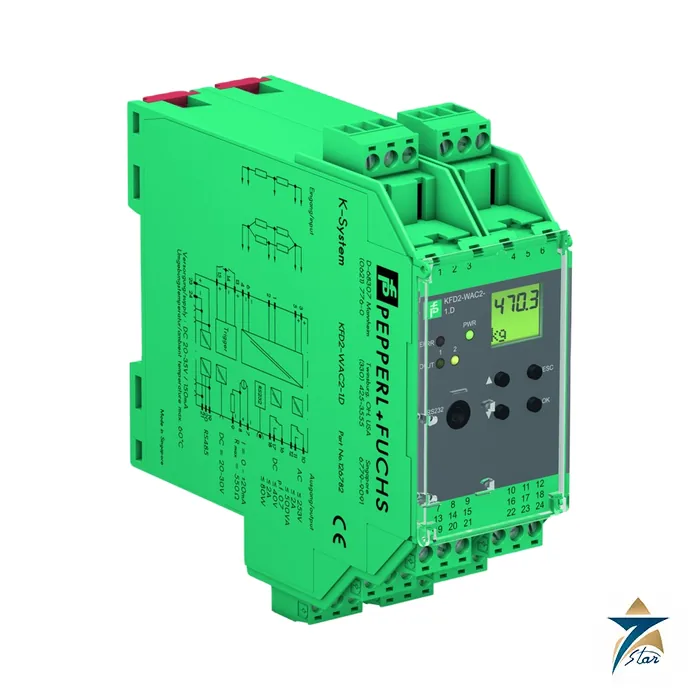
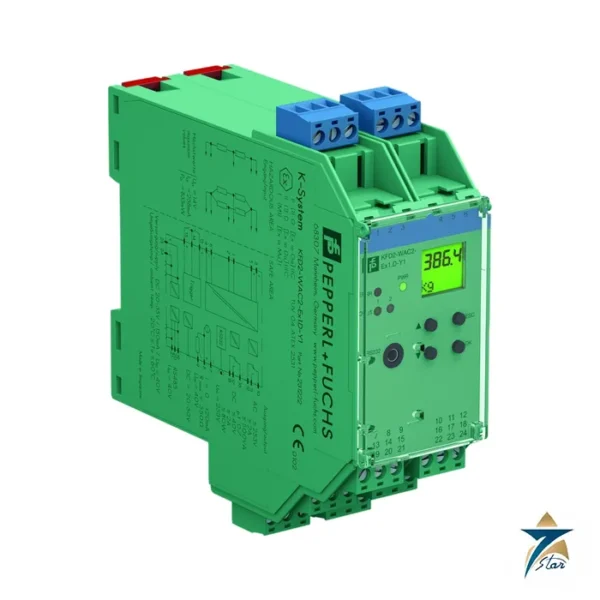
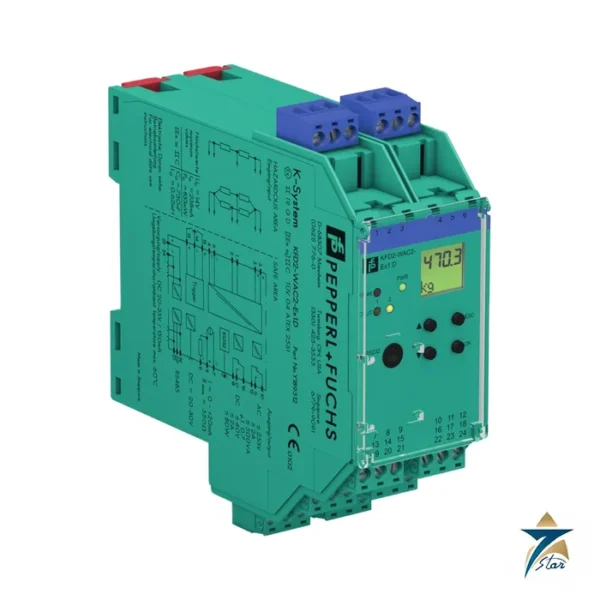
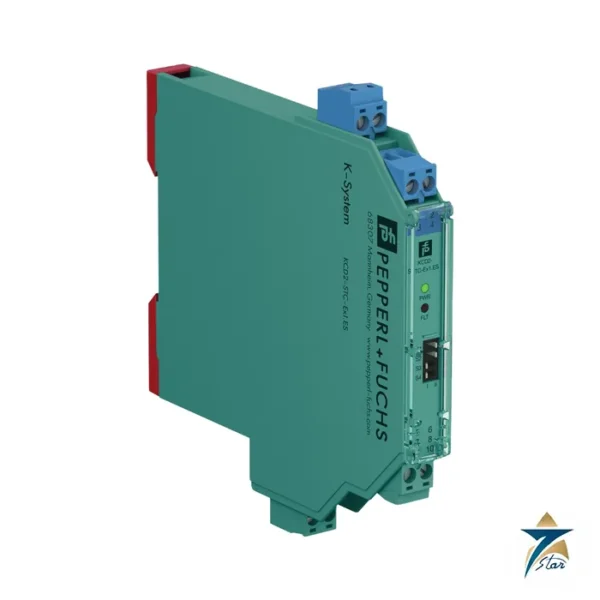
Pepperl+Fuchs KFD2-WAC2-1.D Strain Gauge Converter
Description
KFD2-WAC2-1.D: strain gauge converter in the K-System
Weighing, force and torque measurements start with a bridge that produces only a few millivolts, and the Pepperl+Fuchs KFD2-WAC2-1.D turns that feeble signal into something a control system can use. It excites a full or half bridge with 5 V, reads the differential voltage between minus 100 mV and plus 100 mV, isolates it galvanically and delivers a scaled current or voltage together with two alarm relays.
The module is the non-hazardous-area member of the WAC2 group. Its input circuit carries no intrinsic safety rating, so the load cell must be in a safe location, and what the user gains is the fast configuration, RS-485 data link and the 0.05 percent accuracy figure.
Highlights
- 5 V bridge excitation, usable with devices that need 10 V thanks to the A/D converter
- Up to four 350 ohm strain gauges in parallel; combined resistance 116 ohm to 10 kilohm
- Output III: 0 to plus or minus 20 mA, 4 to 20 mA or 0 to plus or minus 10 V
- Two relay outputs with programmable high and low alarm
- RS-485 interface for transmitting measurements with 20 bit resolution, up to 31 converters on a Power Rail UPR-05 or terminals 19, 20 and 21
- Tare adjustable from 0 to 500 percent of span; calibration through keypad or PACTware
Technical specification of KFD2-WAC2-1.D
| Parameter | Value |
|---|---|
| Supply | 20 to 35 V DC, Power Rail or terminals 23+ and 24-, up to 3 W |
| Input I (bridge) | terminals 1+ and 2-, signal -100 to 100 mV, input resistance above 1 megohm |
| Input II and III | terminals 13+/14- and 15+/14-: tare, calibration and zero via contact |
| Accuracy | 0.05 percent including non-linearity and hysteresis |
| Temperature effect | 0.01 percent per K |
| Reaction time | 300 to 850 ms |
| Current output | -20 to 20 mA; load up to 550 ohm; terminals 7 and 8 |
| Voltage output | 0 to plus or minus 10 V, 500 ohm output resistance with bridge between terminals 7 and 9 |
| Line fault signal | downscale -21.5 mA (-10.75 V) or 2 mA (1 V); upscale 21.5 mA (10.75 V) |
| Relays I and II | 253 V AC / 2 A / 500 VA / cos phi 0.7 or better; 40 V DC / 2 A; 2 x 10 to the power 7 cycles |
| Interface | RS-485 and programming socket |
| Dimensions and mass | 40 x 119 x 115 mm, housing C2, about 250 g |
| Environment | -20 to 60 degrees C, IP20 |
| Approval | UL E223772 |
Typical measuring tasks
Silo and hopper weighing, belt scales, crane overload protection, pressure transducers built on strain gauges and torque shafts on test benches all fit. A utility may use the relays to signal a bunker low level, while the current output feeds the DCS and the digital interface archives raw values at higher resolution. Because the RS-485 route carries 20 bit information, small weight changes appear in the data that the 4 to 20 mA loop would hide.
How KFD2-WAC2-1.D differs from other WAC2 versions
The sibling KFD2-WAC2-Ex1.D family adds an intrinsically safe bridge input with Uo 14 V, Io 238 mA and Po 833 mW so that the load cell may sit in a hazardous area. The KFD2-WAC2-1.D has no such input and instead quotes a worst-case accuracy of 0.05 percent and a reaction time of 300 to 850 ms, whereas the -Y1 Ex version in the same group quotes 0.2 percent accuracy with a quick 150 ms response. The selection therefore rests on where the cell is located and whether speed or accuracy matters more.
Wiring and calibration
Connect the bridge to terminals 1+ and 2-, observing the sense and shield arrangement of the transducer. Enter tare, zero and final value either by keypad or through PACTware and the K-ADP-USB adapter. Calibrate with certified test weights near the lower and upper ends of the range, and keep the calibration certificate of those weights with the loop file. If several converters share a Power Rail UPR-05, give each its own RS-485 address.
Looking after the module
Annual re-verification with a known load is good practice, particularly for custody-style or batching duties where a small drift translates into product loss, and the verification should be repeated after any mechanical work on the weighing structure, any lightning event nearby or replacement of the load cell. Keep the cable between load cell and converter short and screened, because millivolt signals are susceptible to disturbance. Replace terminal blocks when screws loosen.
System components
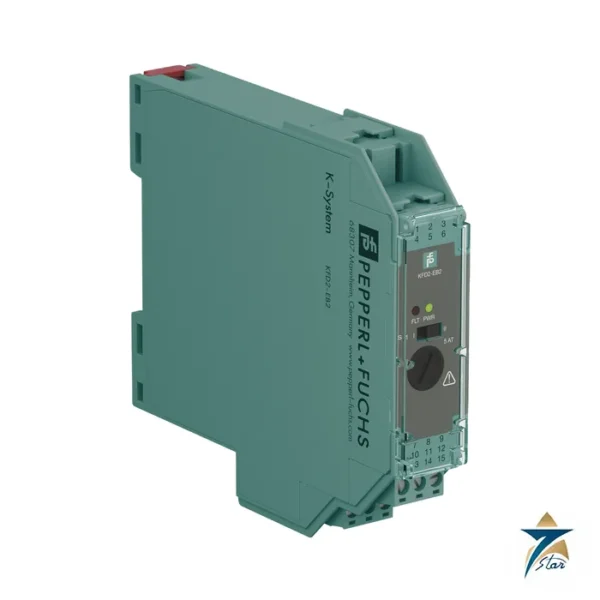
Compatible accessories shown on the datasheet include KF-ST-5GN green terminal blocks and KF-CP red coding pins in packs of 20 x 6. The KFD2-EB2.R4A.B power feed module provides bus access to the Power Rail for RS-485 traffic.
Commissioning checklist for a weighing loop
Before powering the converter, check the load cell data sheet for bridge resistance and rated output in mV/V, and compare the product of excitation and output with the plus or minus 100 mV input window. With the vessel empty, set the zero; apply a known mass near the full range and set the final value. Verify that both alarm relays change state at the programmed limits and that the analogue output reads the expected current. Finally disconnect one sense wire to confirm the line-fault action selected for the output. These steps take under an hour and make the first fill of the vessel safe to supervise.
Questions buyers ask about KFD2-WAC2-1.D
What excitation does KFD2-WAC2-1.D supply to a bridge? It provides 5 V excitation, and its A/D converter allows use with devices that normally require 10 V.
How many strain gauges can KFD2-WAC2-1.D drive? Up to four 350 ohm gauges in parallel may be powered and evaluated, with a resulting resistance between 116 ohm and 10 kilohm.
Is KFD2-WAC2-1.D approved for hazardous areas? The datasheet lists only a UL approval and no intrinsically safe input rating, so the strain gauge must be in a safe area.
What outputs does KFD2-WAC2-1.D offer? It has two relay outputs, an analogue output of 0 to plus or minus 20 mA, 4 to 20 mA or 0 to plus or minus 10 V, and an RS-485 interface.
What accuracy does KFD2-WAC2-1.D reach? The deviation is 0.05 percent including non-linearity and hysteresis, with a temperature effect of 0.01 percent per K.
Documents and quotation
The manufacturer datasheet for KFD2-WAC2-1.D accompanies this listing as a PDF so your engineers can verify terminals, ratings and approvals before purchase. Add the load-cell rating and the wanted output signal to your request. To request a quotation, send the RFQ with the exact part number KFD2-WAC2-1.D, the quantity, the delivery location in Oman or the GCC and any project reference. Seven Star LLC is an independent supplier serving Oman and the GCC and is not affiliated with the manufacturer.
Other Models in the Wac2 Strain Range
Seven Star LLC supplies models from the Wac2 Strain range in Oman and the GCC. Compare the related models below and request a quote for the one that matches your application.
| Model | Category | |
|---|---|---|
| Pepperl+Fuchs KFD2-WAC2-1.D Strain Gauge Converter | Isolator & Barrier | You are viewing this model |
| Pepperl+Fuchs KFD2-WAC2-Ex1.D-Y1 Strain Gauge Barrier | Isolator & Barrier | View details |
Datasheets & Documents
- Datasheet Pepperl+Fuchs KFD2-WAC2-1.D Strain Gauge Converter Datasheet Download
Reviews (0)
How would you rate this product? Cancel reply
About brand
Pepperl+Fuchs is a German manufacturer of industrial sensors and explosion protection equipment, founded in 1945 in Mannheim by Walter Pepperl and Ludwig Fuchs as a radio repair shop. Defective transformers led them into manufacturing, and the company developed its first proximity switch in the late 1950s. Pepperl+Fuchs is headquartered in Mannheim and is a pioneer of intrinsically safe electrical equipment for hazardous areas.
Seven Star LLC lists Pepperl+Fuchs sensors, isolated barriers, power supplies and hazardous-area mobile devices, and supplies them to instrument and automation teams in Oman by exact model designation.
Pepperl+Fuchs company profile
| Founded | 1945, Mannheim-Sandhofen, Germany, by Walter Pepperl and Ludwig Fuchs |
|---|---|
| Headquarters | Mannheim, Germany |
| Ownership | Privately owned (Pepperl+Fuchs SE) |
| Origins | Radio repair workshop that began making replacement transformers |
| Product families | Inductive, capacitive, ultrasonic and photoelectric sensors, rotary encoders, R2000 LiDAR scanners, KFD and HiC isolated barriers, Zener barriers, remote I/O, purge and pressurization systems, Ex-rated enclosures |
Milestones
- 1945: Walter Pepperl and Ludwig Fuchs open their radio repair shop in Mannheim.
- 1958: The first proximity switch is developed (some company sources say 1959).
Pepperl+Fuchs product families on this page
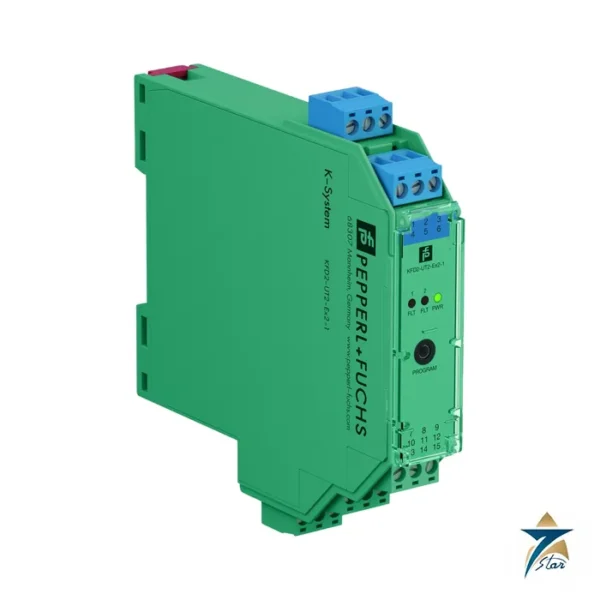
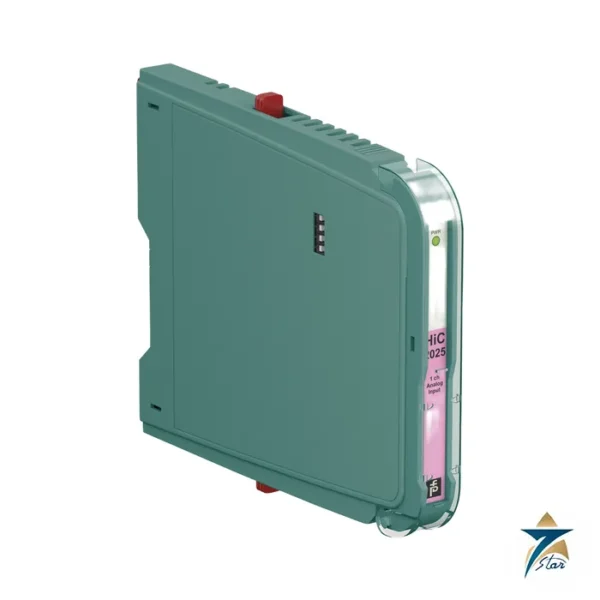
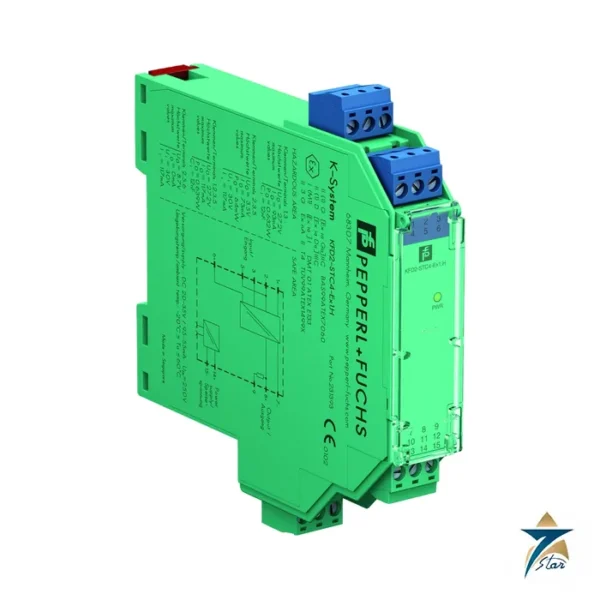
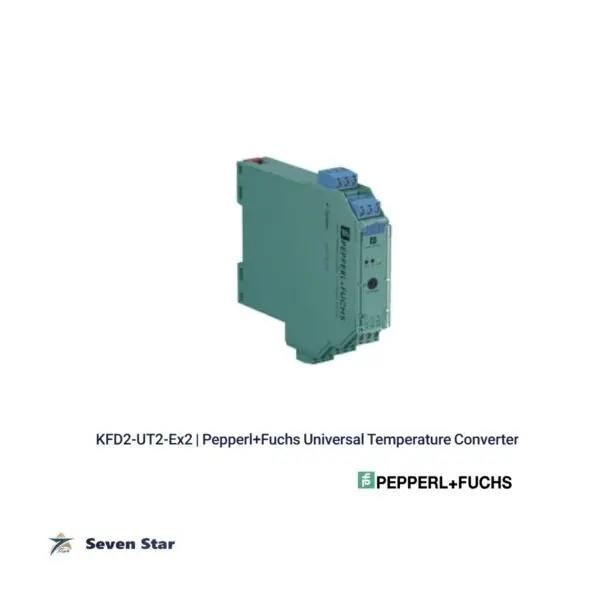
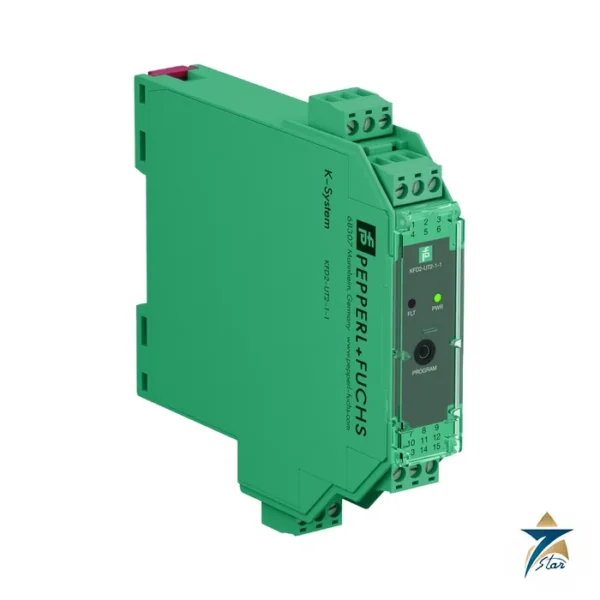
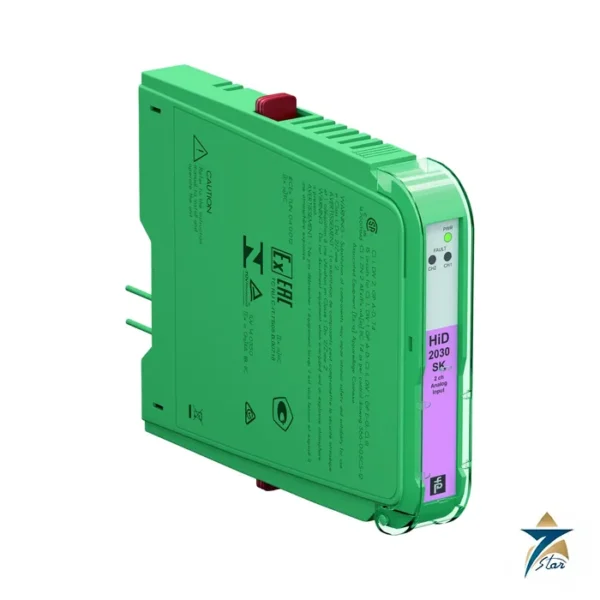
On the interface side there are two systems. The K-System mounts on DIN rail and is represented here by the KFD2-UT2-Ex2 universal temperature converter. The H-System plugs into termination boards and is represented by the HiD2030 SMART transmitter power supply with HART. The PS1000-A6-24.20 is a 24 VDC, 20 A power supply for cabinets. Sensors listed include the NJ2-12GK-SN NAMUR inductive sensor, the R101 retro-reflective photoelectric sensor and the R2000 2-D LiDAR scanner. For field staff there are the Tab-Ex 05 DZ1 tablet for Zone 1/21 areas and the Smart-Ex 03 DZ2 smartphone for Zone 2/22 and Division 2 areas.
Where Pepperl+Fuchs equipment is used
Isolated barriers sit between field instruments in Zone 0 or Zone 1 and the DCS or safety system in refineries, gas plants and chemical works. NAMUR sensors report valve position and machine states in classified areas. Photoelectric sensors and LiDAR scanners work in conveying, packaging, warehousing and vehicle guidance. Ex-rated tablets and phones are carried on operator rounds and maintenance jobs.
Pepperl+Fuchs products we list
Ordering Pepperl+Fuchs parts: what we need
Send the complete model designation as printed on the device, including every suffix; a single letter can change the supply voltage or the output type. Add the part number if the label shows one. For barriers, tell us the field device and signal type, the number of channels and whether the safety loop needs a SIL-assessed module. For mobile devices, state the zone or division and the regional radio version.
Facts checked against Pepperl+Fuchs's own chronicle pages, October 2026.
Browse Pepperl+Fuchs products by category: Sensors & Transmitters, Industrial Computer, Isolator & Barrier, Power Modules.
FAQ
Questions about the Pepperl+Fuchs KFD2-WAC2-1.D Strain Gauge Converter
Answers from our engineering team on installation, compatibility and integration.
01What excitation does KFD2-WAC2-1.D supply to a bridge?
It provides 5 V excitation, and its A/D converter allows use with devices that normally require 10 V.
02How many strain gauges can KFD2-WAC2-1.D drive?
Up to four 350 ohm gauges in parallel may be powered and evaluated, with a resulting resistance between 116 ohm and 10 kilohm.
03Is KFD2-WAC2-1.D approved for hazardous areas?
The datasheet lists only a UL approval and no intrinsically safe input rating, so the strain gauge must be in a safe area.
04What outputs does KFD2-WAC2-1.D offer?
It has two relay outputs, an analogue output of 0 to plus or minus 20 mA, 4 to 20 mA or 0 to plus or minus 10 V, and an RS-485 interface.
05What accuracy does KFD2-WAC2-1.D reach?
The deviation is 0.05 percent including non-linearity and hysteresis, with a temperature effect of 0.01 percent per K.


Reviews
There are no reviews yet.