Brand:

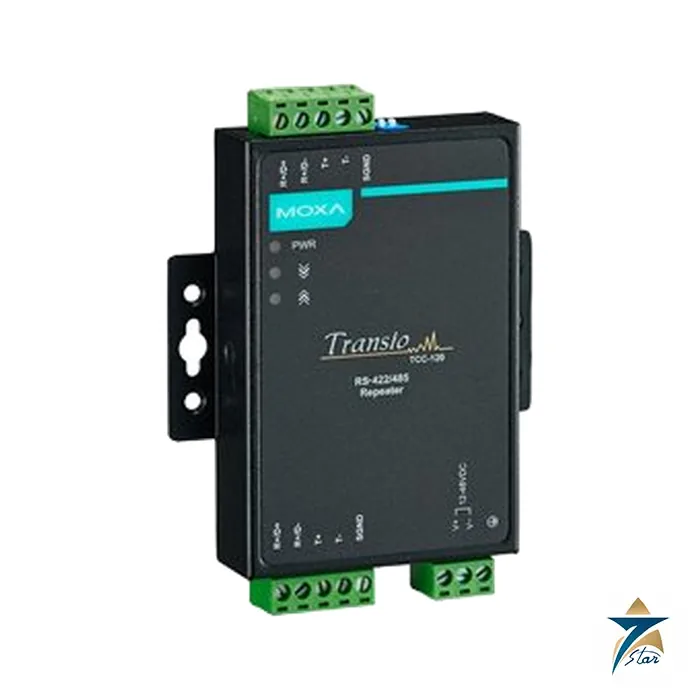
Moxa TCC-120I Isolated RS-422/485 Converter and Repeater

Description

TCC-120I isolated RS-422/485 converter and repeater for serial networks

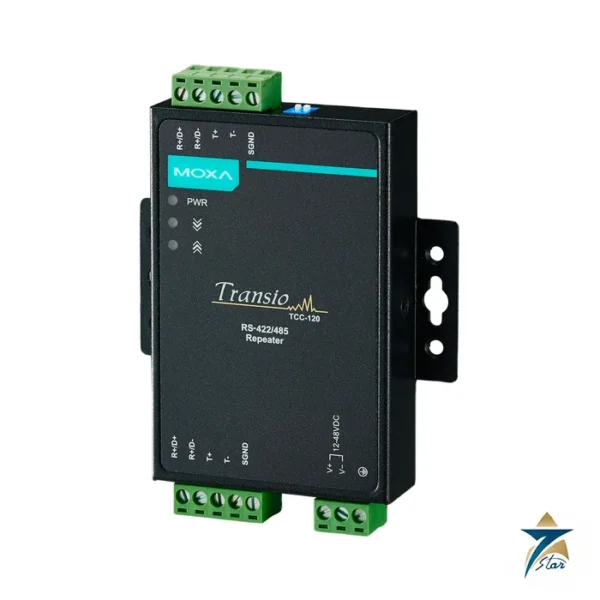
The Moxa TCC-120I is a compact industrial converter and repeater that translates between RS-422 and RS-485 and also boosts the signal to extend serial cable reach. The “I” in TCC-120I marks the isolated version of the TCC-120 family: it adds 2 kV isolation between the serial ports and the supply side, which protects equipment from ground loops and surges on long runs.

Both serial ports sit on removable-style terminal blocks, the metal housing is rated IP30, and the unit runs from 12 to 48 V DC. Seven Star LLC supplies the TCC-120I in Oman and the GCC as an independent supplier in Muscat.

TCC-120I technical specifications

Parameter Specification
Manufacturer / part number Moxa / TCC-120I
Function RS-422/485 converter and repeater, isolated
Serial standards RS-422, RS-485 (2-wire and 4-wire)
Connector Terminal block, 2 ports
Isolation 2 kV (TCC-120I)
Baud rate 50 bps to 921.6 kbps, non-standard rates supported
Direction control ADDC (automatic data direction control)
Pull high/low resistors 1 kΩ or 150 kΩ (switch selectable)
Terminator 120 Ω by DIP switch
Input voltage 12 to 48 V DC, one power input
Current 180 mA at 12 V DC
Overload protection Supported
Housing / IP rating Metal / IP30
Dimensions 67 x 100.4 x 22 mm
Weight 148 g
Operating temperature -20 to 60 °C
Storage temperature -40 to 85 °C
Humidity 5 to 95 % non-condensing
MTBF 1,949,025 hours
Warranty 5 years
Mounting Wall, or DIN rail with the optional DK35A kit

How the TCC-120I works

The unit regenerates the serial signal at its output stage, so a weak or distorted RS-485 waveform from a long cable is restored to full amplitude. Because ADDC senses traffic, no RTS signal or special software is needed to switch the transmitter between sending and receiving; this makes the device transparent to Modbus RTU and other master/slave protocols.

The isolation barrier of 2 kV separates the two sides, so an earth potential difference between two cabinets or buildings does not flow through the data cable. In addition, DIP switches select the 120 Ω terminator and the pull-up/pull-down resistor values, which define the idle state of the line.

Where the TCC-120I fits in the system

Use the TCC-120I between a PLC, DCS or gateway serial port and a field network of meters, drives or analyzers, or in the middle of a long bus as a repeater. It converts a four-wire RS-422 master to a two-wire RS-485 multidrop bus, a frequent need when connecting older devices to newer controllers.

Within the family, the non-isolated TCC-120 serves short indoor links, while the TCC-120I is the choice for plant environments with ground differences. Accessories listed by the manufacturer include the DK35A DIN-rail kit and the CBL-PJTB-10 power cable.

Selection and ordering checklist

  • Confirm the interface of both ends (RS-422 four-wire, RS-485 two-wire or four-wire).
  • Decide whether isolation is needed; for different earth potentials choose the TCC-120I.
  • Check the highest baud rate needed against the 921.6 kbps limit.
  • Verify the DC supply, 12 to 48 V, and polarity at the terminals.
  • Order the DK35A kit if DIN-rail mounting is planned.

Installation, commissioning and maintenance

Wire Tx+/Tx-/Rx+/Rx- and GND for RS-422 or four-wire RS-485, or Data+/Data- and GND for two-wire RS-485. Enable the 120 Ω terminator only at the two physical ends of a bus, never at every node. Set the pull resistors on one point of the bus only, normally at the master.

After powering up, verify communication with a protocol test tool and watch for frame errors. Keep data cables apart from power cables, and ground the shield at one end. The unit has no consumable parts; check terminals during routine shutdowns.

Typical applications in Oman and the GCC

Serial links remain common in oil and gas metering skids, power plant auxiliaries, water and desalination SCADA and building management. The TCC-120I extends Modbus RTU runs between control rooms and remote panels, and the -20 to 60 °C range suits enclosed cabinets, though sun-heated outdoor panels in Oman need shading or ventilation to stay inside the rating. Isolation helps where cable runs cross between substations with different earthing.

TCC-120 family comparison

Model Isolation Typical use
TCC-120 None Short non-isolated links
TCC-120I 2 kV Isolated links, long runs, ground-loop protection

Wiring and troubleshooting tips for the TCC-120I

Most field problems with serial converters come from termination and biasing rather than from the converter itself. A bus that works on the bench but fails on site usually has too many or too few terminators, a floating idle line or a swapped data pair. Label A/B or Data+/Data- on both ends of every cable, since vendors use different naming conventions for the two conductors.

If the master receives garbled frames, first confirm the baud rate, parity and stop bits at every node, then check that only one set of pull resistors is active. If a long run is unreliable, use shielded twisted pair with the correct characteristic impedance, keep stub lengths short, and consider placing a second repeater in the middle of the segment. When isolation is installed, remember each side then needs its own signal ground reference connected to GND on the terminal block so that the receiver stays within its common-mode range.

  • No response: check power polarity and that the supply is within 12 to 48 V DC.
  • Intermittent errors: inspect terminators, shield grounding and routing near drives or contactors.
  • One slave missing: verify its address and that it is on the correct side of the converter.
  • Slow bus: reduce the number of devices per segment or lower the baud rate.

Information to send with an RFQ

  • Part number TCC-120I and quantity.
  • Serial type and protocol at each end.
  • Cable distance and baud rate.
  • Supply voltage available on site.
  • Mounting kit and cable accessories needed.

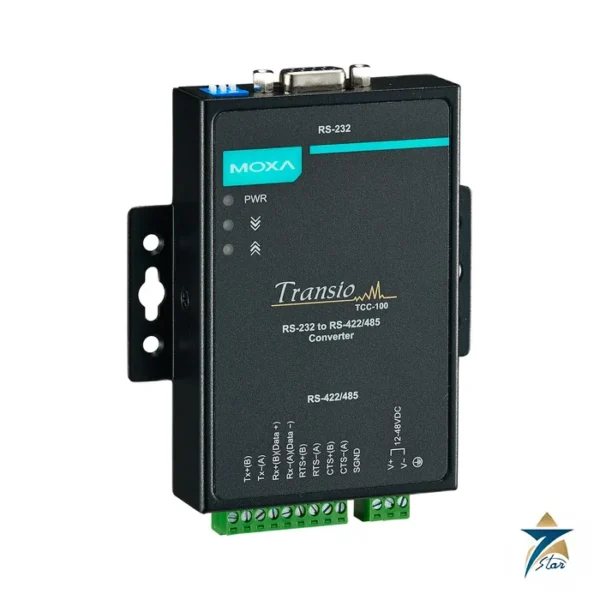
Related MOXA products: Moxa TCC-120 RS-422/485 Converter and Repeater, Moxa TCC-100 RS-232 to RS-422/485 Converter, Moxa TCC-80 RS-232 to RS-422/485 Port-Powered Converter, Moxa UPort 1250-G2 2-Port RS-232/422/485 USB-to-Serial Converter, MOXA TCF-142-S-SC-T RS-232/422/485 to Single-Mode Fiber Converter and Moxa IMC-101-M-SC Media Converter, Multi-Mode SC.

Documents and quotation

A datasheet is attached on this page for the TCC-120I. Send us the quantity and your application and we will quote as an independent supplier serving Oman and the GCC.

Datasheets & Documents
Reviews (0)

Reviews

There are no reviews yet.

How would you rate this product?

It takes about 10 seconds — just tap a star. Your email is never published.

About brand

Moxa is the Taiwanese maker of industrial networking equipment: Ethernet switches, serial device servers, protocol gateways, media converters, secure routers and remote I/O. It was founded in Taiwan in 1987 and started with serial communication products before moving into industrial Ethernet. It is headquartered in Taipei.

Seven Star LLC is an independent supplier in Muscat. We list Moxa switches, serial servers, gateways and converters, and supply them to control system integrators, utilities, oil and gas and building automation projects in Oman and the GCC by exact model.

Moxa at a glance

Established 1987, Taiwan
Headquarters Taipei, Taiwan
First products Serial communication boards and serial connectivity
Product families Unmanaged, managed and rackmount industrial Ethernet switches, serial device servers, Modbus and fieldbus gateways, media converters, serial converters, secure routers, remote I/O and industrial computers

Moxa products we list

Family Models Typical use
Unmanaged switches EDS-205A, EDS-208A, EDS-2008-EL, EDS-2010-ML, EDS-308, EDS-316, EDS-G2005-EL, EDS-G205, EDS-G308, EDS-P206A PoE Simple plug-and-play networks inside control panels
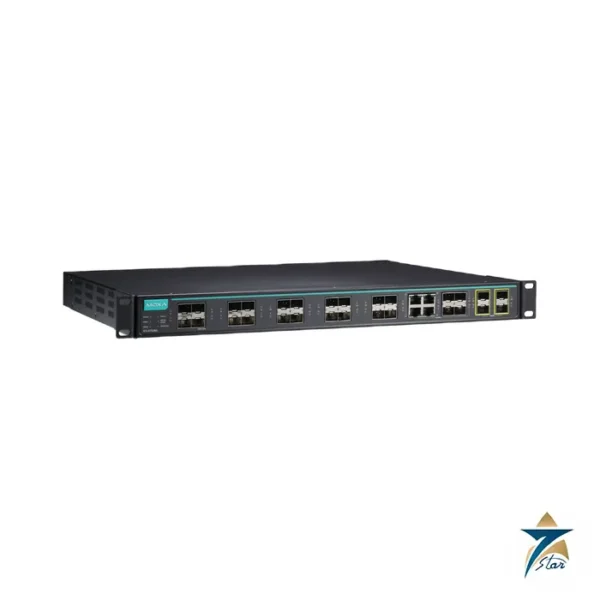
Managed switches EDS-405A, EDS-408A, EDS-508A, EDS-510A, EDS-510E, EDS-518A, EDS-528E, EDS-G508E, EDS-G509, EDS-G512E, ICS-G7528A rackmount Redundant ring networks, VLANs and diagnostics for SCADA and DCS
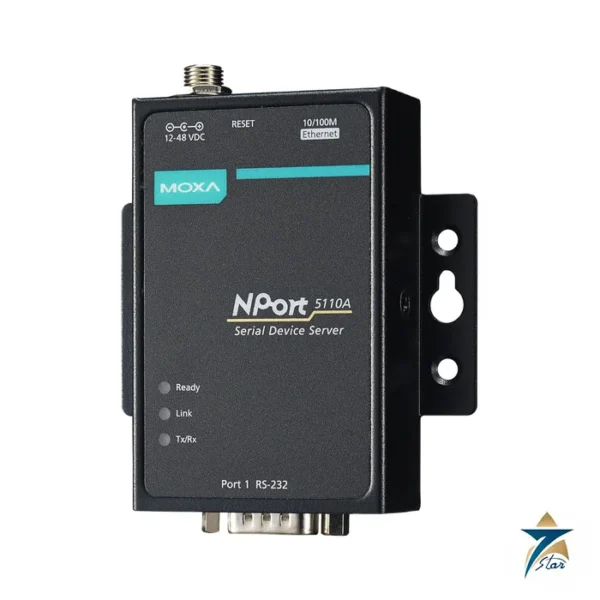
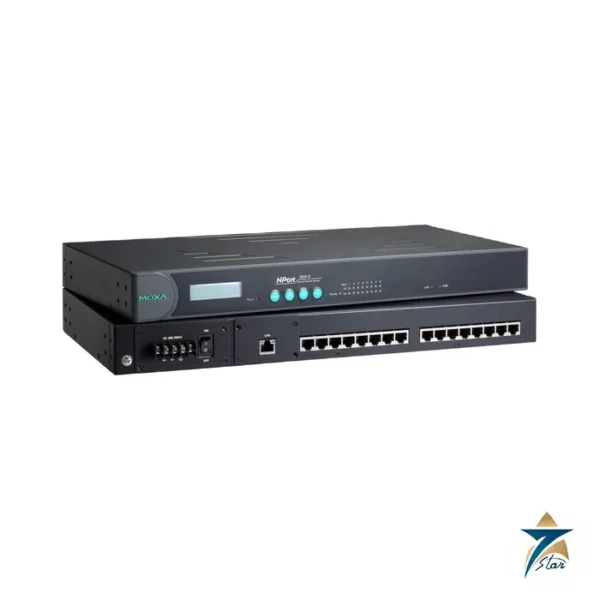
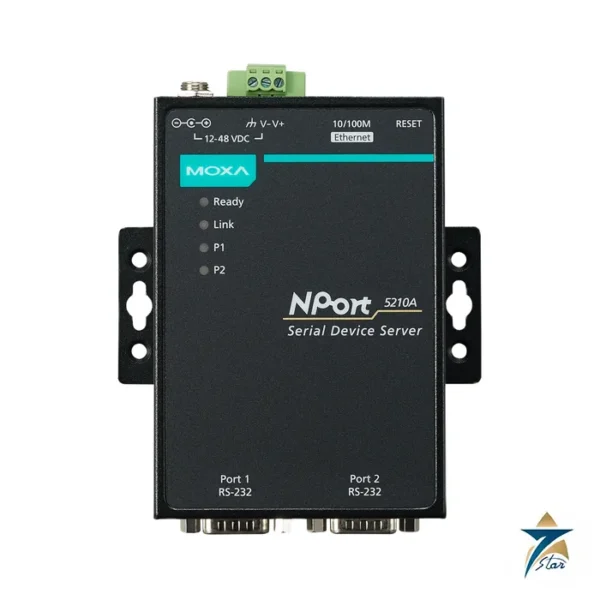
Serial device servers NPort 5110A, 5150A, 5210A, 5250A, 5410, 5450, 5610-8, 5650-8, 6150, IA5150A Putting RS-232/422/485 devices on an Ethernet network
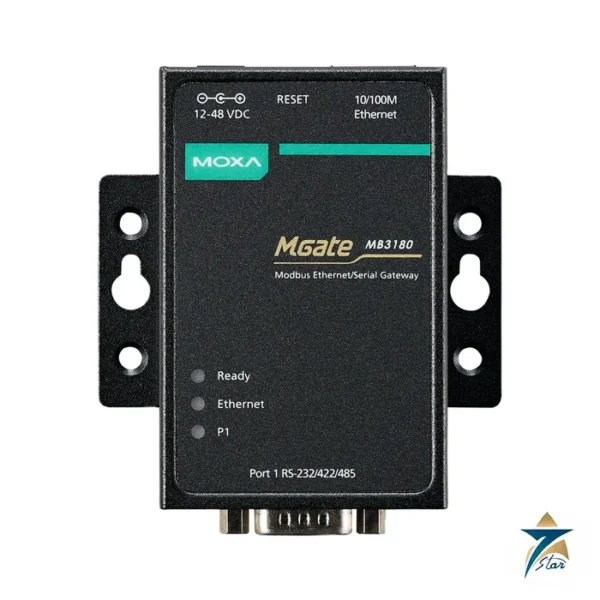
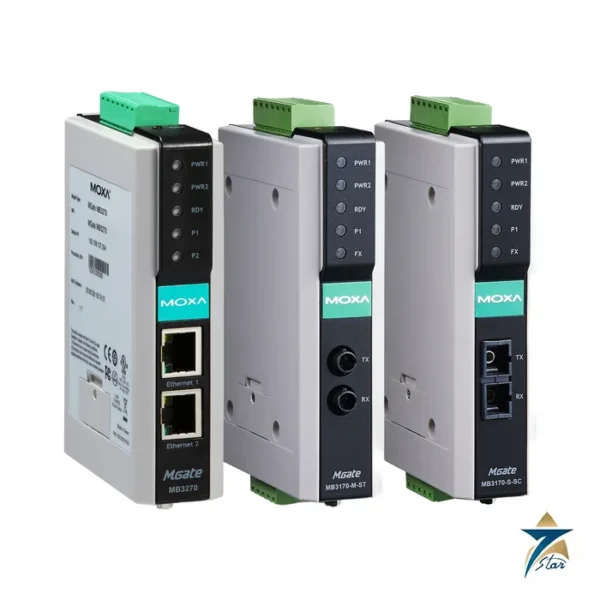
Protocol gateways MGate MB3180, MB3170, MB3280, MB3270, 5101-PBM-MN, 5105-MB-EIP, 5109 DNP3, 5114 IEC 104 Linking Modbus RTU/TCP, PROFIBUS, EtherNet/IP, DNP3 and IEC 60870-5-104 systems
Converters, routers and I/O IMC-21A, IMC-101, IMC-21GA, TCF-142, TCC-100, TCC-80, TCC-120, EDR-G9010 router, ioLogik E2210 Fibre links over long distances, serial conversion, network security and remote I/O

The choice between switch types follows the network. An unmanaged switch simply forwards traffic and suits a small, isolated panel. A managed switch adds redundancy protocols (Moxa's Turbo Ring recovers a broken ring in milliseconds), VLANs to separate traffic, port mirroring and alarms, which a SCADA or DCS network needs. The suffix on a Moxa model also matters: "-T" means a wide operating temperature range (typically -40 to 75 °C), which is the safe choice for outdoor cabinets in the Gulf summer. "-MM-SC" or "-S-SC" means multi-mode or single-mode fibre with SC connectors.

Where Moxa products are used

In Oman and the GCC, Moxa equipment connects RTUs, PLCs, meters and protection relays in oil and gas fields, electrical substations, water and wastewater SCADA, transport, and building and energy management systems.

Ordering Moxa products: what we need

Send the complete model including all suffixes (for example EDS-508A-MM-SC-T), the quantity, and for fibre models the fibre type and distance. For gateways, tell us which two protocols need to be linked.

Facts checked against Moxa company information, October 2026.

FAQ

Questions about the Moxa TCC-120I Isolated RS-422/485 Converter and

Answers from our engineering team on installation, compatibility and integration.

01Does the TCC-120I convert RS-422 to RS-485?
Yes. It converts RS-422 to RS-485 and also acts as a repeater to extend the serial distance.
02What isolation does it provide?
The TCC-120I provides 2 kV isolation, while the non-isolated TCC-120 does not.
03Is RTS needed to control direction?
No. Automatic data direction control (ADDC) switches the direction without software support.
04What power input is required?
12 to 48 V DC on a terminal block, drawing 180 mA at 12 V DC, with overload current protection.
05How is it mounted?
On a wall, or on a 35 mm DIN rail using the optional DK35A kit.