9190A ultra-cool field metrology well from -95 °C to 140 °C
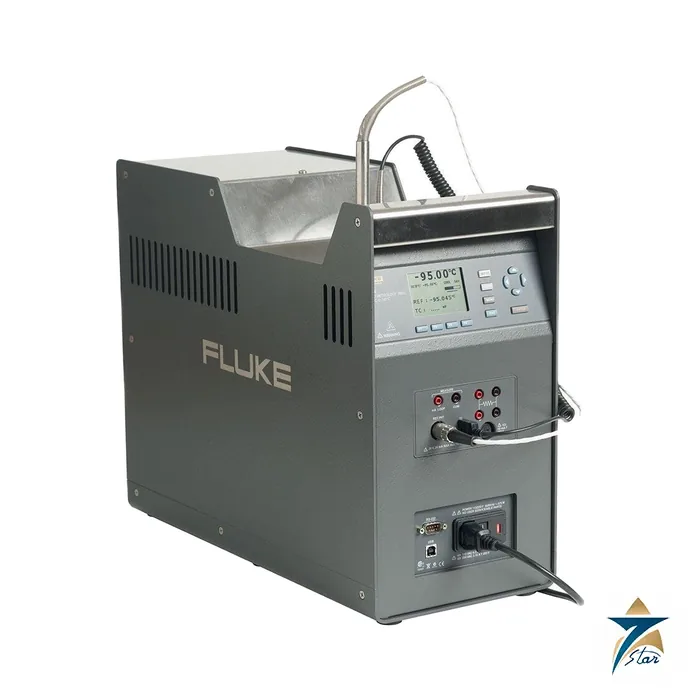
The Fluke Calibration 9190A Ultra-Cool Field Metrology Well is a dry-block calibrator for very low temperatures. Its range runs from -95 °C to 140 °C, which brackets the cold end needed for ultra-low freezers, blood banks, cold rooms and freeze dryers, as well as normal ambient and warm ranges. It weighs 16 kg, uses a free-piston Stirling cooler instead of a fluid bath, and carries a stability of 0.015 °C over the whole range. Seven Star LLC supplies the 9190A in Oman and the GCC as an independent supplier in Muscat, not affiliated with the manufacturer.
The ordering names are 9190A-X and 9190A-X-P, where X is the insert letter and -P adds process electronics. Insert codes are decoded here.
| Element |
Meaning |
Detail |
| 9190A |
Model |
Ultra-cool dry-block, -95 °C to 140 °C |
| X = A to F |
Well insert |
A imperial misc. holes; B imperial comparison; C 0.25 inch holes; D metric comparison; E metric misc. with 0.25 inch hole; F metric comparison misc. with 0.25 inch hole; Y custom; Z blank |
| -P |
Process electronics |
Built-in reference, RTD, thermocouple and mA readouts with 24 V loop power |
9190A technical specifications
| Parameter |
Specification |
| Manufacturer / part number |
Fluke Calibration / 9190A (9190A-X, 9190A-X-P) |
| Temperature range at 23 °C |
-95 °C to 140 °C (-139 °F to 284 °F) |
| Display accuracy |
±0.2 °C full range |
| Accuracy with external reference |
±0.05 °C full range |
| Stability |
±0.015 °C full range |
| Axial uniformity at 40 mm |
±0.05 °C full range |
| Radial gradient |
±0.01 °C full range |
| Well depth / diameter |
160 mm / 30 mm |
| Cooling time |
23 °C to -90 °C in 80 min; to -95 °C in 90 min; 140 °C to 23 °C in 60 min |
| Heating time |
-95 °C to 140 °C in 40 min |
| Stabilisation time |
15 minutes |
| Size / weight |
480 x 205 x 380 mm / 16 kg |
| Power |
100 to 115 V or 200 to 230 V, 50/60 Hz, 575 W |
| Interfaces |
RS-232, USB; 9930 Interface-it software included |
| Operating conditions |
0 °C to 35 °C; specifications at 13 °C to 33 °C |
| Refrigerants |
R32 (under 20 g) and R704 helium (under 20 g) |
Process option and reference measurement on the 9190A
The -P version reads a four-wire reference PRT with accuracy from ±0.010 °C at -95 °C to ±0.025 °C at 140 °C, a four-terminal RTD input for Pt-100 (385, 3926, JIS) and Ni-120, thermocouple input for J, K, T, E, R, S, M, L, U, N and C, and a mA readout at 0.02 % of reading + 0.002 mA with 24 V loop power. These accuracies refer to the readout only and do not include the sensor probe. Control can be passed from the internal sensor to the external reference PRT, which reduces the effect of axial gradients when short sensors are tested.
Why dry-block cooling suits cleanrooms and cold-chain work
Liquid baths give excellent uniformity but can spill, give off vapour and are heavy, which is a problem in a laboratory or pharmaceutical area. The 9190A uses no heat-transfer fluid, so nothing can spill, and it conforms to the EURAMET cg-13 guidelines for temperature block calibrators. Dual heater zones minimise the axial gradient, and ramp-and-soak lets the user define up to eight setpoints for an automated sequence.
Other features listed in the datasheet include a stability indicator that shows when the block is within limits, a loading effect of ±0.006 °C with several 6.35 mm probes in the block, and a remote operation capability over USB and RS-232. The display shows degrees Celsius or Fahrenheit at 0.01 resolution. Taken together, these make the unit suitable for repeated calibration of several sensors in one visit, where loading and stability, not only the setpoint accuracy, decide the uncertainty.
Selecting the 9190A
- Confirm that your lowest calibration point is above -95 °C.
- Choose an insert with the hole sizes that match your probes; a custom insert with up to eight holes can be requested.
- Add the -P option if you need a built-in reference readout and loop power.
- Check mains supply: 100 to 115 V or 200 to 230 V.
- Plan for two-person lifting; it weighs 16 kg with front and back handles.
Commissioning and maintenance of the 9190A
Install the unit on a level surface with free airflow and operate it in 0 °C to 35 °C ambient. Allow the stated cooling time and the 15-minute stabilisation time after reaching the setpoint. Insert only dry probes, and let probes warm before removing them from cold wells to avoid frost. The unit contains small amounts of refrigerants R32 and helium in a sealed system, and should be serviced by qualified personnel only. Recalibration should follow your quality system.
Typical applications of the 9190A in Oman and the GCC
Hospitals, blood banks, pharmaceutical stores, food processing plants and research laboratories in Oman and the GCC need regular calibration of ultra-low freezers and cold rooms. The 9190A reaches their working temperatures and is portable, so the work can be done on site. Because hot ambient conditions lengthen cooling times, allow extra time in warm areas and keep within the 35 °C operating limit.
Information to send with an RFQ for the 9190A
- Part number 9190A, insert letter and whether the -P process option is needed
- Quantity and mains voltage
- Probe types and diameters
- Delivery location and time frame
- Calibration certificate requirement
Storage, handling and spares for the Fluke 9190A
Keep the Fluke 9190A in its carrying case when it is not in use, and store it in a clean, dry place. Remove or charge the batteries as recommended in the user manual before long storage. Field teams in Oman and the GCC should avoid leaving the instrument in a vehicle in the sun, as high cabin temperatures can exceed the storage range and shorten battery life.
- Check the instrument, cables, hoses or lenses for damage before each job.
- Clean the unit with a soft, slightly damp cloth only; do not use solvents unless the manual allows them.
- Plan a calibration interval that matches your quality system, and keep the calibration certificate with the asset record.
- Order wear parts and accessories, such as batteries, test leads, hoses or adapters, together with the instrument.
For calibration and test work, it helps to state in your RFQ whether you need an accredited calibration certificate with the Fluke 9190A, so the right documents can be confirmed with the quotation.
Documents and quotation
A datasheet for the 9190A is attached on this page.
Send us the part number 9190A with the insert letter and process option, and we will confirm availability and a quotation.



























Reviews
There are no reviews yet.