- Automation & ControlView all 3,044 products
- Automation Accessories
- AC Drives
- PLC & I/O Cards
- Industrial Communications
- Vibration Monitoring
- Isolator & Barrier
- Controllers & Data Acquisition
- Safety Switches & Guard Locking
- Motor Soft Starters
- Encoders
- CCTV & Security
- Pneumatic Cylinders
- HMI Displays
- Servo Drives
- Industrial Computers
- Machine Vision
- Automation Software
- Robotics
Brand: Endress+Hauser (E & H)
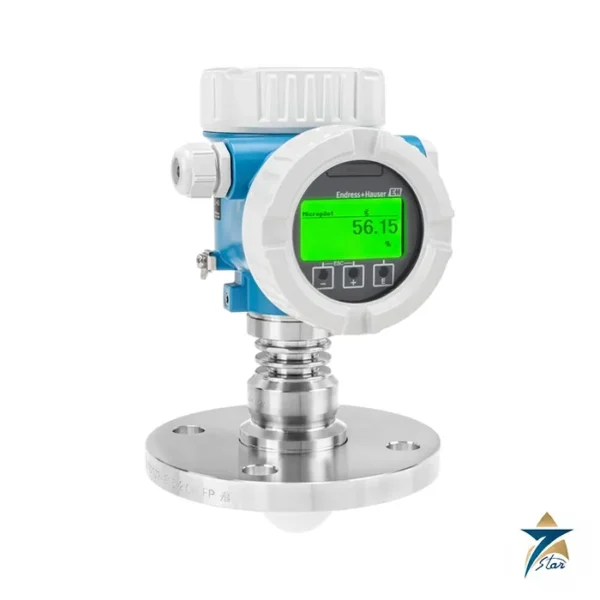
Endress+Hauser FMR54 Micropilot Horn and Planar Radar
Description
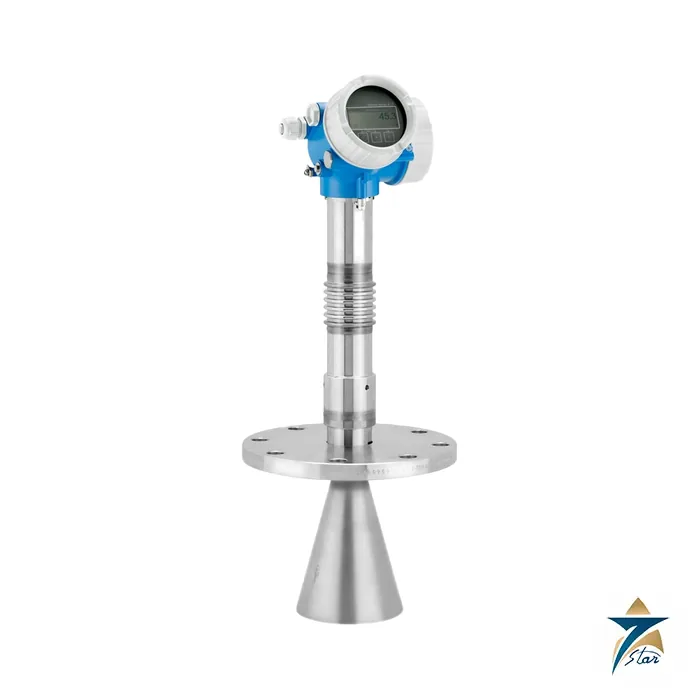
Endress+Hauser FMR54: horn and planar radar for large liquid tanks
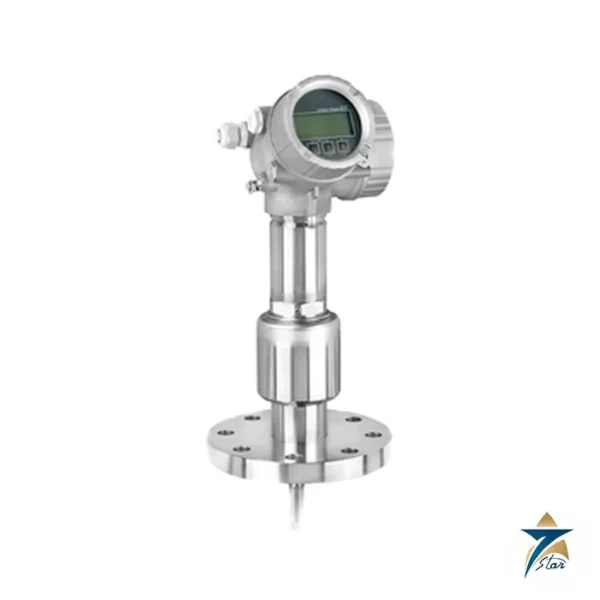
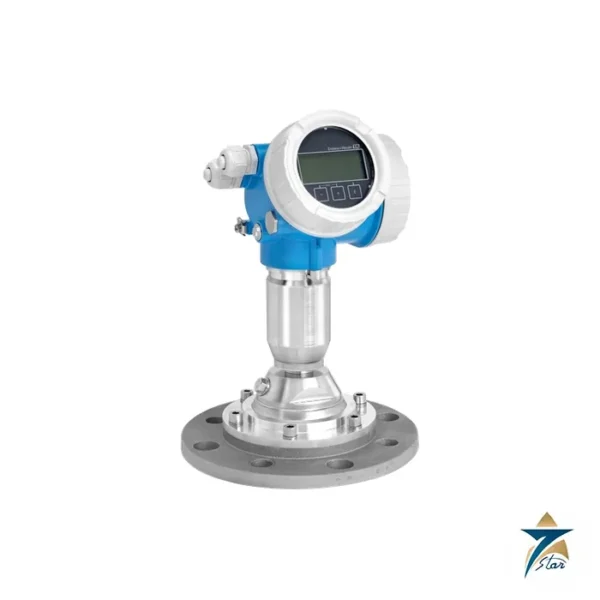
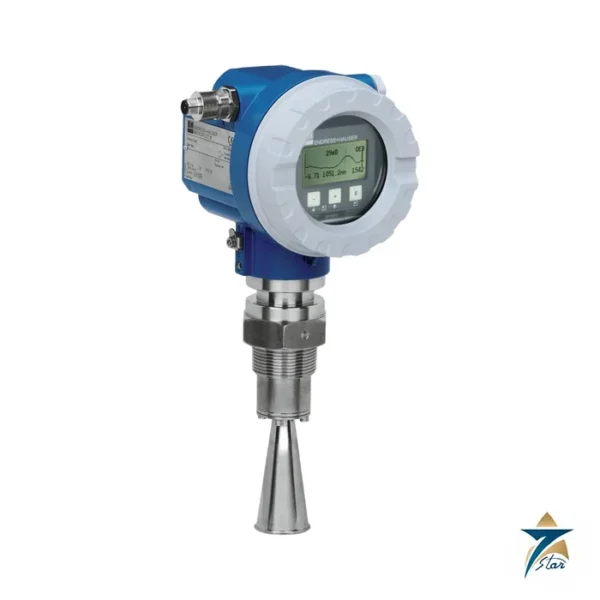
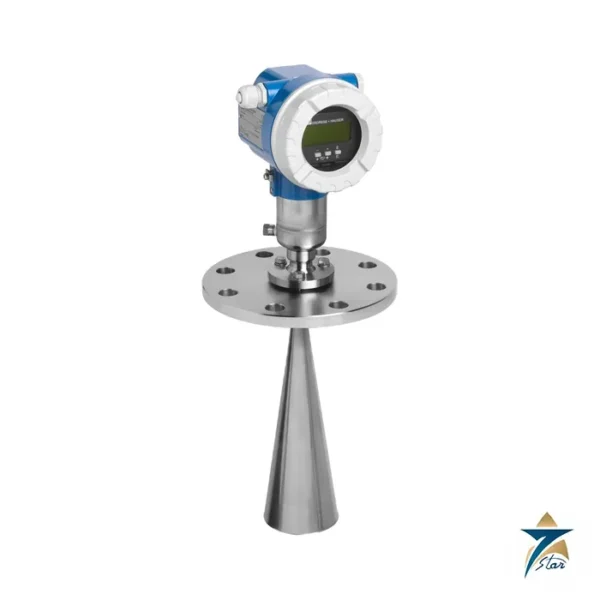
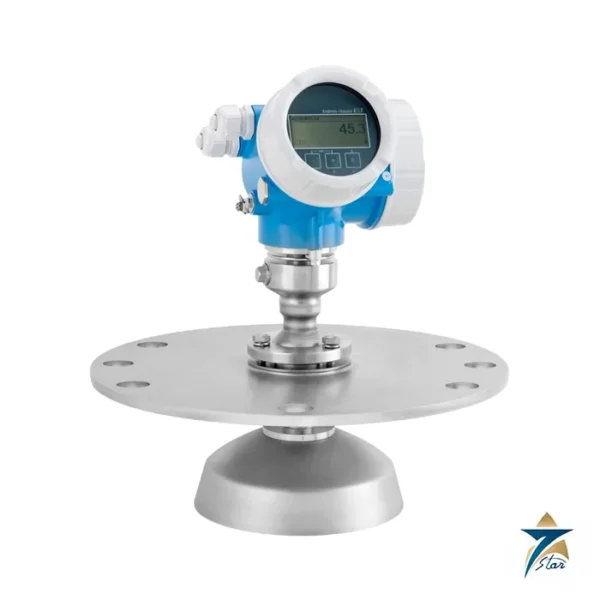
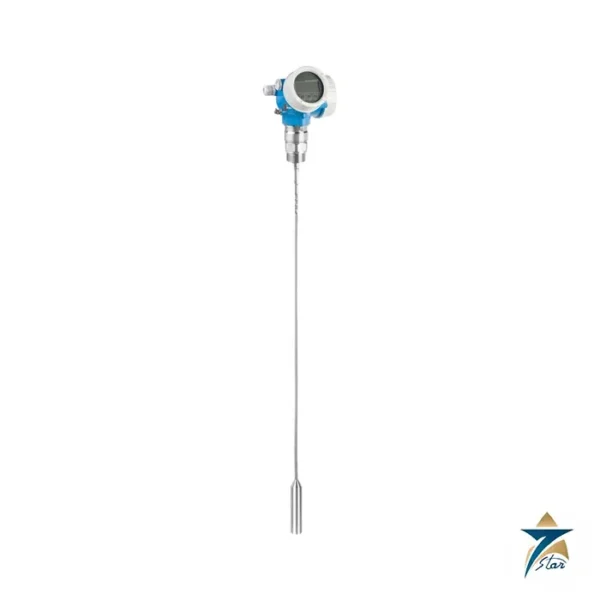
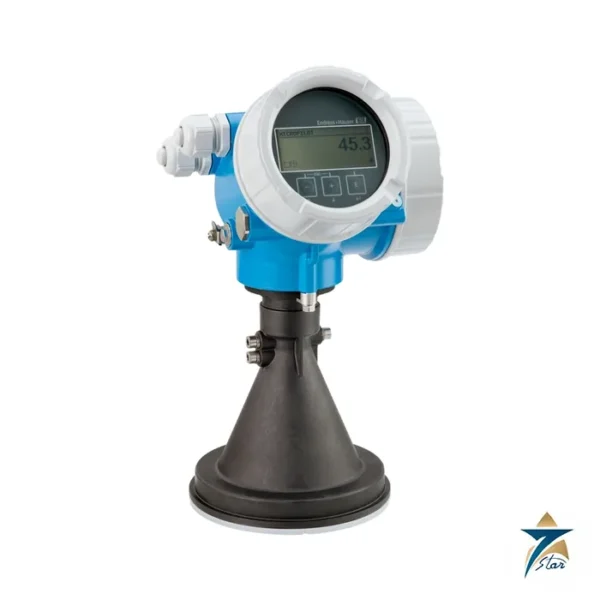
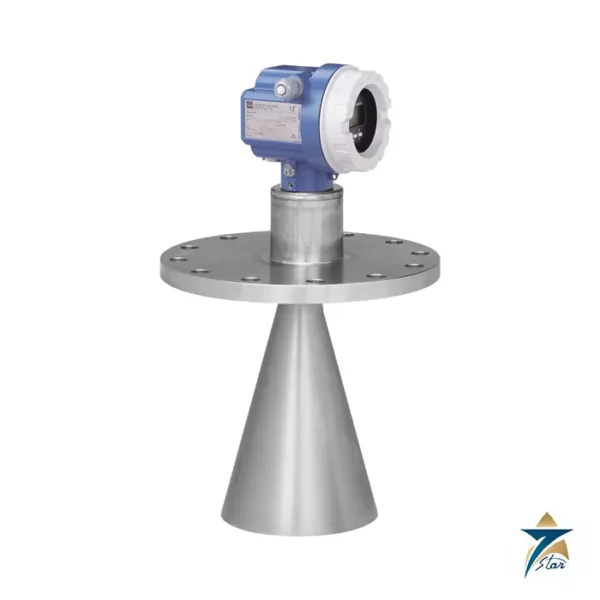
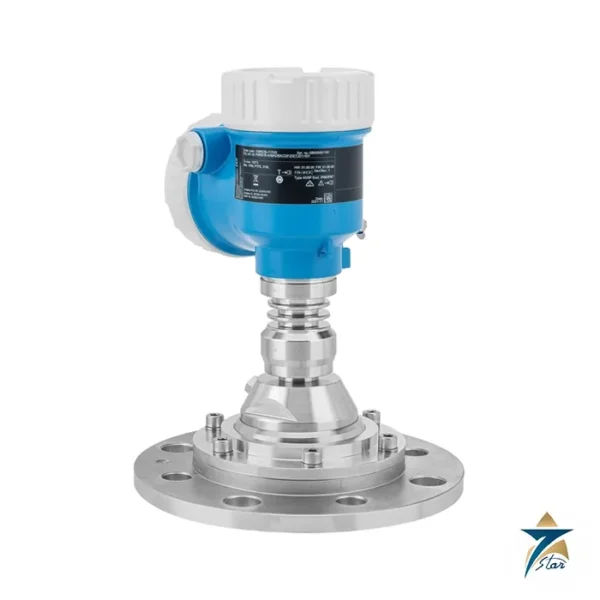
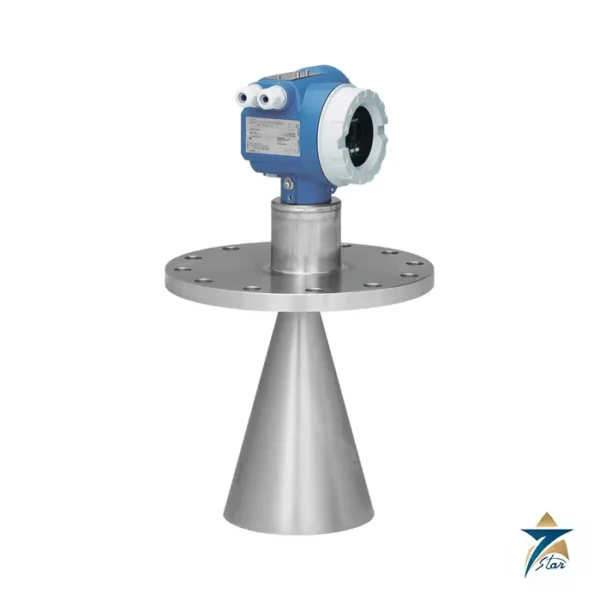
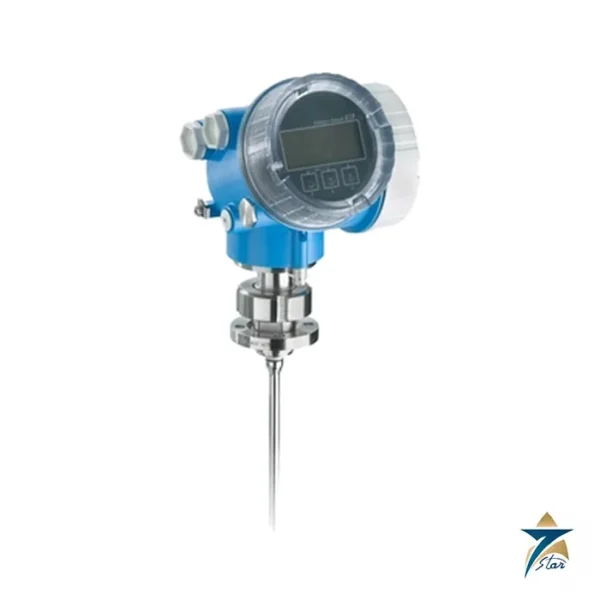
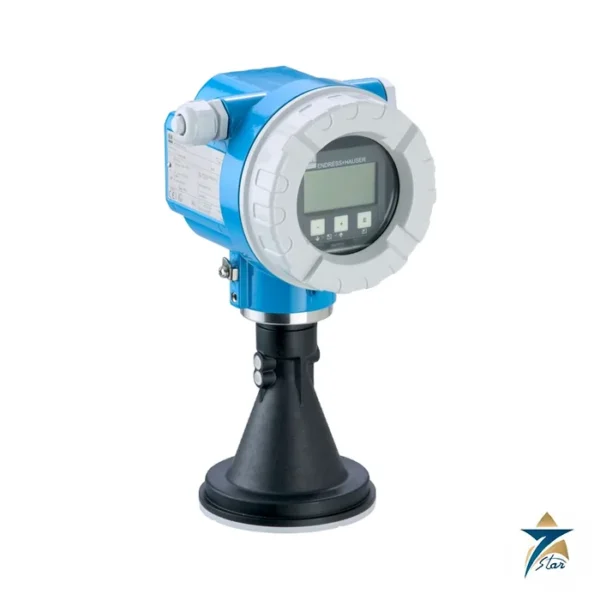
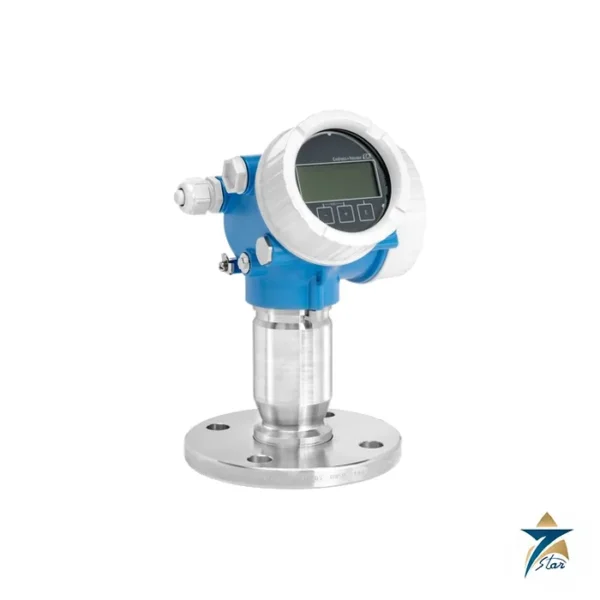
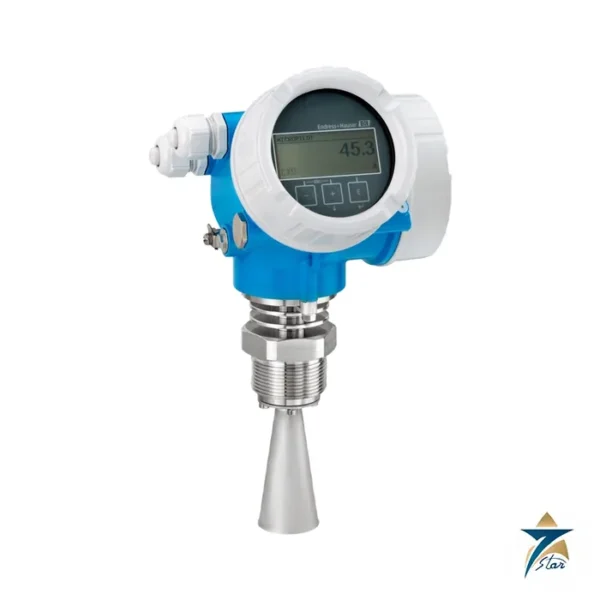
Endress+Hauser FMR54 is the large-antenna version of the pair FMR53/FMR54. Where the rod version squeezes through small openings, FMR54 uses horn antennas of 150, 200 or 250 mm, or a planar antenna, to gather a stronger echo from bigger vessels. The datasheet gives 20 m as the maximum for horn versions and 38 m for the planar antenna working inside a stilling well.
The unit is a 26 GHz, two-wire HART radar for liquids, pastes and sludges. It has Bluetooth, HistoROM and Heartbeat functions, SIL2 capability, WHG and marine approvals and the usual choice of GT18, GT19 or GT20 housing.
Measured facts for FMR54
| Parameter | Value |
|---|---|
| Antenna options | Horn 150, 200, 250 mm (6, 8, 10 in) or planar antenna |
| Beam angles | Horn 150 mm: 23 degrees; 200 mm: 19 degrees; 250 mm: 15 degrees |
| Maximum range | 20 m with horn; 38 m with planar antenna in a stilling well |
| Accuracy | Plus or minus 6 mm; offset plus or minus 4 mm |
| Weight | Antenna and connection up to 9 kg plus flange; housing 1.2 to 4.5 kg |
| Response time | Below 0.8 s (tank under 10 m), below 1 s (under 20 m) |
| Process limits (series) | Minus 196 to plus 400 degrees Celsius, minus 1 to 160 bar per connection |
| Output | HART, 1,200 bit/s, galvanic isolation |
| Housing protection | IP68 / NEMA 6P, IP66 / NEMA 4X |
| Approvals | Ex certificates, WHG, marine, 3 or 5 point linearity protocol |
Why the antenna choice matters on FMR54
A wider antenna means a narrower beam, and a narrower beam means fewer echoes from heating coils, baffles and agitators. The 250 mm horn at 15 degrees is therefore the right choice on busy vessels, while the 150 mm horn at 23 degrees suits clean tanks with a smaller nozzle. The planar antenna is intended for stilling wells and bypass pipes, where it tolerates tapered or non-circular pipe sections better than a horn.
The datasheet adds one caution: horn versions BC (80 mm) and BD (100 mm) are not for free-space installation in a tank but for specific restricted installations.
Using FMR54 on storage and process tanks
In refineries and terminals the planar variant in a stilling well gives a dependable level on floating-roof tanks or on pressurised spheres with a bypass chamber, covering the 38 m span. In water and utilities the horn variants watch large clarifier feed tanks, chemical bulk storage and slop vessels. Moving surfaces or foam need extra care in selection, and media with a permittivity between 1.4 and 1.9, such as liquefied gases, need a stilling well.
One practical illustration is a crude or product tank equipped with a stilling well: the planar antenna lets the radar look straight down the pipe, so surface turbulence, vapor layers and foam outside the pipe have little effect, while the 38 m range covers tall tanks. The horn antennas, in contrast, are chosen for open vessels where the main concern is a clean echo past mixers and coils.
How FMR54 differs from FMR53
Compared with the rod-type FMR53, FMR54 carries a heavier assembly of up to 9 kg plus flange against 3.0 kg for the rod, and the beam narrows from 23 degrees down to 15 degrees on the 250 mm horn. Range is the same 20 m in free space, but FMR54 alone reaches 38 m with its planar antenna in a stilling well. Accuracy and electronics are identical.
Against the flush PTFE horn of the FMR52, FMR54 trades hygiene and a 2 mm accuracy for larger antennas and a broader choice of high-pressure process connections; the family limit of 160 bar and 400 degrees Celsius makes it the stronger option for hot or pressurised duties.
Installation of FMR54
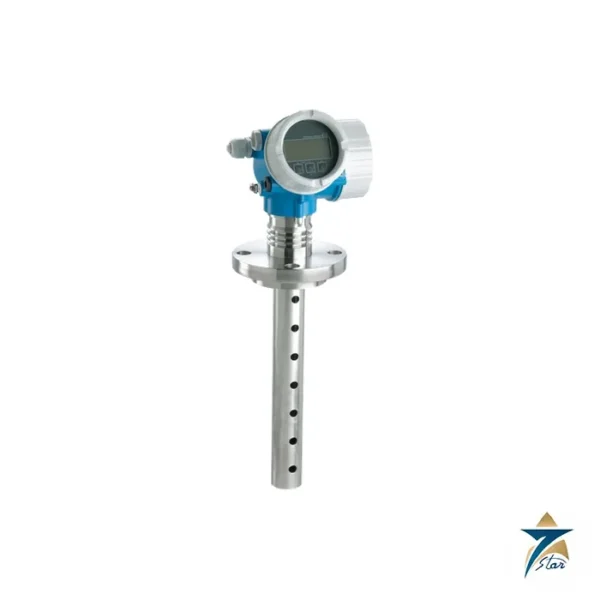
Align the horn axis with the vessel axis, keep the horn 200 mm or more clear (antenna length plus 50 mm, minimum 200 mm) from the wall, and ensure the planar antenna sees about 1 m of free pipe. Support the weight of a large flange sensibly on top of nozzles, and check that the tank roof is strong enough for the assembly. Stilling pipes must be smooth inside, free of welds and cracks, and have the same diameter over the entire length so the planar antenna can launch a clean wave. Hole spacing in perforated pipes should follow the datasheet drawing, otherwise echoes from the slots appear in the signal.
Maintenance and checks for FMR54
Inspect the antenna for build-up, especially horn versions in sticky service, and rinse it when the echo amplitude drops. Compare the envelope curve with the stored baseline at every shutdown and test the loop current at both ends of the span. Heartbeat verification can document the device status for audits. When the sensor is replaced, copy the stored parameter set from the old module if it is still readable, because it carries the empty distance, linearization and false-echo map that took time to set up.
In dusty or salty coastal air, wipe the housing seals and re-grease the cover threads at each service so the covers remain easy to remove and the housing keeps its protection rating.
Ordering notes for FMR54
List antenna type, process connection, seal, housing, approval and the optional second output on the enquiry. Hazardous-area and marine requirements must be given at the start, because they restrict which options can be combined. Add the tank height, the product and the working pressure to the enquiry so the right antenna and flange can be proposed together.
Documents and quotation
Use datasheet TI01041F for FMR54. Send the part number, quantity and antenna choice through the RFQ form. Seven Star LLC is an independent supplier serving Oman and the GCC and is not affiliated with the manufacturer.
Documentation and Compliance
Industrial buyers often need more than the hardware. When you order the Endress+Hauser FMR54, tell us which documents your project or quality team requires, such as certificates of origin, conformity declarations, calibration or test records, or hazardous-area certificates where the variant carries them. Mentioning these at the enquiry stage avoids delays at customs and at goods receipt on site. For tenders and project packages, we can also align the quotation with your line-item format so that Endress+Hauser (E & H) radar & guided wave radar level items can be checked against the bill of materials quickly.
Other Models in the Micropilot Fmr5x Range
Seven Star LLC supplies models from the Micropilot Fmr5x range in Oman and the GCC. Compare the related models below and request a quote for the one that matches your application.
| Model | Category | |
|---|---|---|
| Endress+Hauser FMR53 Micropilot Rod Antenna Radar | Radar & Guided Wave Radar Level | View details |
| Endress+Hauser FMR54 Micropilot Horn and Planar Radar | Radar & Guided Wave Radar Level | You are viewing this model |
| Endress+Hauser FMR56 Micropilot Radar for Bulk Solids | Radar & Guided Wave Radar Level | View details |
| Endress+Hauser FMR57 Micropilot Parabolic Radar for Silos | Radar & Guided Wave Radar Level | View details |
Datasheets & Documents
- Datasheet Endress+Hauser FMR54 Micropilot Horn and Planar Radar Datasheet Download
Reviews (0)
How would you rate this product? Cancel reply
About brand
Endress+Hauser makes process measurement instruments for flow, level, pressure, temperature and liquid analysis. Georg H. Endress and Ludwig Hauser started the business in Lörrach, Germany, on 1 February 1953, first selling level meters, and the Endress+Hauser name has been used since 1957. The group is headquartered in Reinach, Switzerland, and has been wholly owned by the Endress family since 1975.
Seven Star LLC is an independent supplier listing Endress+Hauser flowmeters, level and pressure transmitters, temperature assemblies and liquid analysis products for buyers in Oman and the GCC. Instruments are matched from the full order code on the nameplate.
Endress+Hauser company profile
| Origin | Founded in Lörrach, Germany, on 1 February 1953 by the Swiss engineer Georg H. Endress and Ludwig Hauser |
|---|---|
| Headquarters | Endress+Hauser AG, Reinach (Basel-Landschaft), Switzerland |
| Ownership | Family owned; the Endress family has been the sole shareholder since 1975, and a family charter commits the company to stay family owned |
| Size | About 16,500 employees and sales of about EUR 3.7 billion (2023, as reported by the company) |
| Product families | Proline flowmeters, Micropilot and Levelflex radar, Liquiphant switches, Cerabar and Deltabar pressure, iTEMP and iTHERM temperature, Liquiline and Memosens liquid analysis |
Milestones
- 1953: Georg H. Endress and Ludwig Hauser start the business in Lörrach on 1 February, first selling level meters.
- 1957: The Endress+Hauser name comes into use.
- 1975: The Endress family becomes sole shareholder.
- 2023: About 16,500 employees and sales of about EUR 3.7 billion, as reported by the company.
Endress+Hauser product lines
| Line | Measuring principle | Typical use |
|---|---|---|
| Promass F 300, Promass 80F, 83F/84F | Coriolis mass flow | Direct mass flow and density of liquids and gases, hydrocarbon transfer and chemical dosing |
| Promag P 300, P 500, H 300, W 400, W 10, 50P | Electromagnetic flow | Water, wastewater, slurries and other conductive liquids |
| Prowirl F 200, 72F | Vortex flow | Steam, gas and low-viscosity liquids |
| Prosonic Flow 92F, t-mass 65F | Ultrasonic and thermal mass flow | Water lines; compressed air and industrial gases |
| Micropilot FMR62, FMR67, FMR60, FMR10B, FMR20, FMR50, FMR52 | Free-space radar level, 80 GHz and 26 GHz | Tanks, process vessels, silos and open water channels |
| Levelflex FMP51, FMP50, FMP54, FMP55 | Guided wave radar level | Level and interface in vessels, separators and bypass chambers |
| Liquiphant FTL51, Prosonic S FMU90 | Vibronic point level; ultrasonic level | High and low level alarms, pump protection, open channel flow |
| Cerabar PMC71B, PMP51B, PMP71, Deltabar PMD78B, PMD75 | Pressure and differential pressure | Process pressure, hydrostatic level and DP flow |
| iTEMP TMT82, TMT162, iTHERM TM101, TR66, TR10 | Temperature transmitters and thermometers | RTD and thermocouple points with thermowells |
| Liquiline CM444, CM442, Memosens CPS11E, Stamolys reagents | Liquid analysis | pH, ORP, conductivity, dissolved oxygen and nutrient analysis in water treatment and process |
Where Endress+Hauser instruments are used
In Oman and the GCC, Endress+Hauser instruments are common in oil and gas production and processing, refineries and petrochemicals, desalination and water networks, wastewater treatment, power plants and food and beverage plants. Coriolis meters measure hydrocarbon and chemical flows, electromagnetic meters cover water and wastewater, radar transmitters handle tank and silo level, and Liquiline analysers monitor water quality. Proline 300 and 500 flowmeters include Heartbeat Technology for in-situ verification, which reduces the need to remove a meter for checks.
Ordering Endress+Hauser instruments: what we need
The order code on the nameplate (for example PMP71-1QA1S11RDADU) defines every option: measuring range, process connection, materials, output, approvals and display. Send it with the serial number; Endress+Hauser can retrieve the original configuration from the serial number. For a new instrument add the medium, operating and design pressure and temperature, range, line size or tank geometry, process connection, wetted materials, output or protocol (4-20 mA HART, PROFIBUS, FOUNDATION Fieldbus, Modbus) and the hazardous-area approval required. Older models such as Promass 80/83 or Micropilot M are replaced by current Proline or 80 GHz Micropilot devices.
Facts checked against Endress+Hauser company history and product information, October 2026.
Browse Endress+Hauser products by category: Flowmeters, Level Transmitter, Pressure Instrumentation, Temperature, Liquid Analysis Sensors, Liquid Analytical Systems.
FAQ
Questions about the Endress+Hauser FMR54 Micropilot Horn and Planar
Answers from our engineering team on installation, compatibility and integration.
01What antennas can Endress+Hauser FMR54 have?
Horn antennas in 150, 200 and 250 mm sizes or a planar antenna for stilling wells, with beam angles of 23, 19 and 15 degrees for the horn sizes.
02How far does FMR54 measure?
20 m with horn antennas and 38 m with the planar antenna installed in a stilling well.
03What accuracy does FMR54 have?
Plus or minus 6 mm for non-linearity, non-repeatability and hysteresis, plus a 4 mm offset, per the FMR53/FMR54 sheet.
04How heavy is the FMR54 antenna assembly?
Up to 9 kg plus flange weight, compared with 3.0 kg plus flange for the rod-antenna FMR53.
05Does FMR54 carry marine or WHG approval?
The application block of the datasheet lists WHG, marine approvals and international explosion-protection certificates.


Reviews
There are no reviews yet.