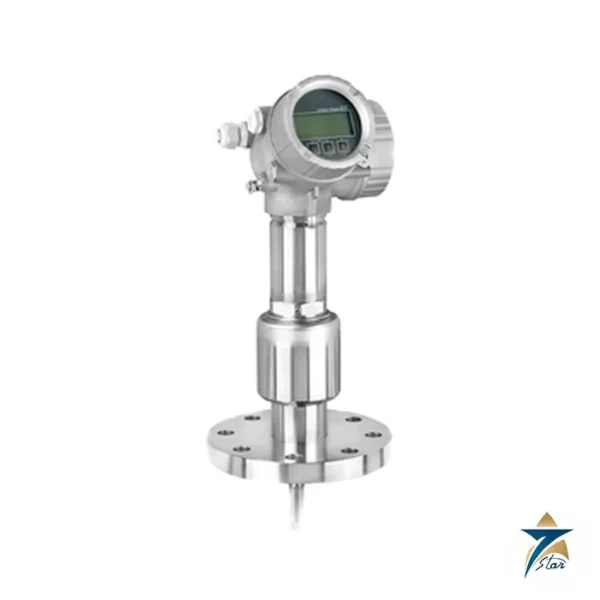
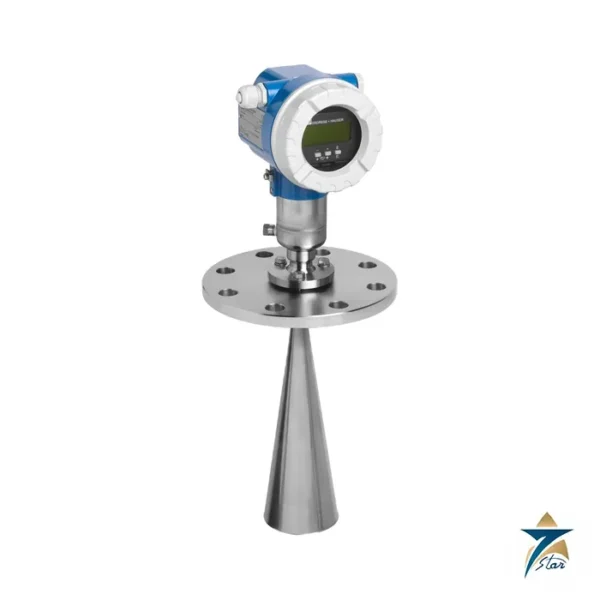
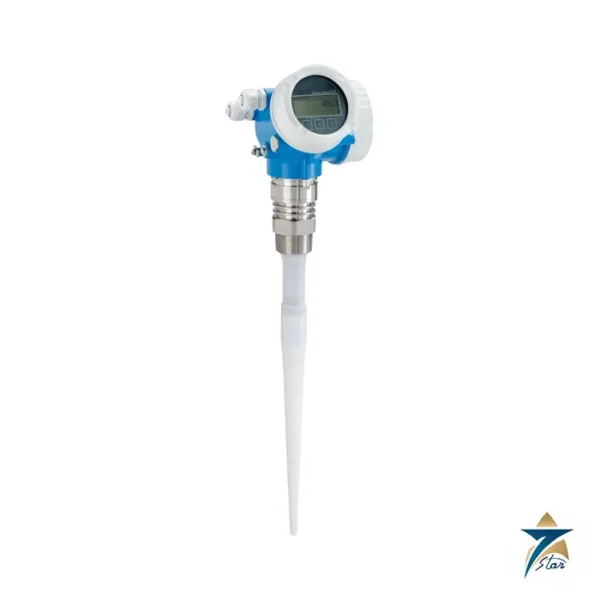
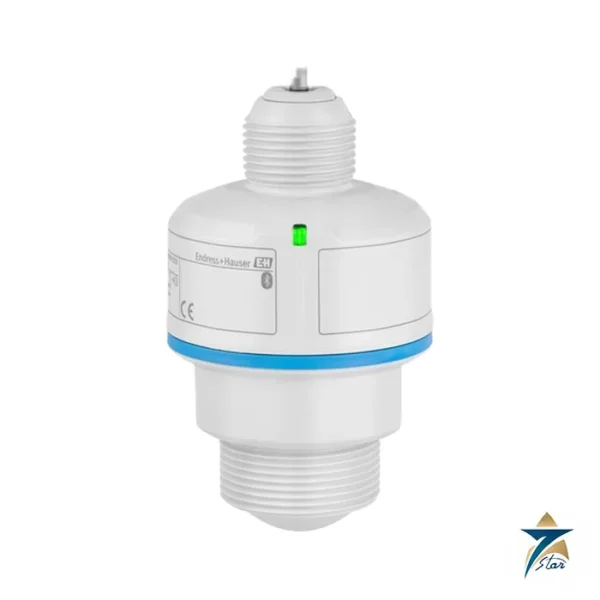
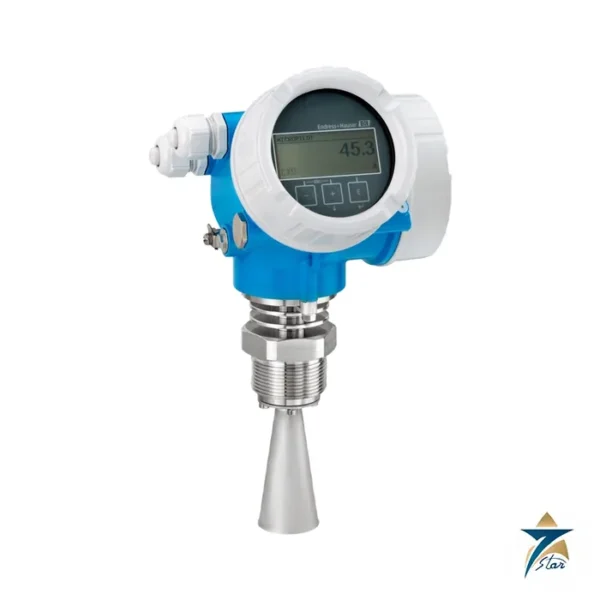
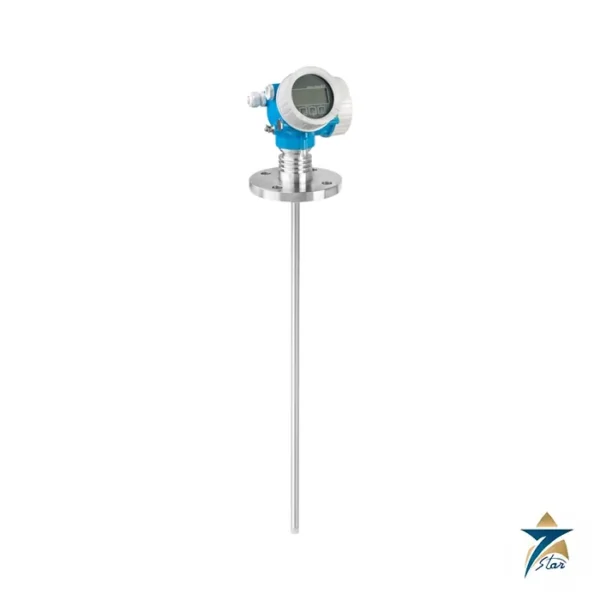
Endress+Hauser FMR533 Micropilot S Parabolic Tank Gauging Radar

Description

Endress+Hauser FMR533: parabolic Micropilot S for the biggest free-space tanks

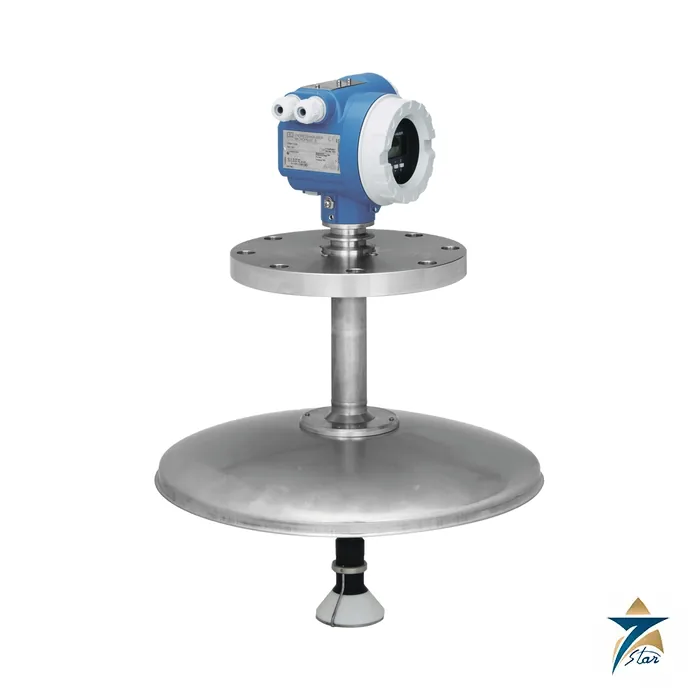
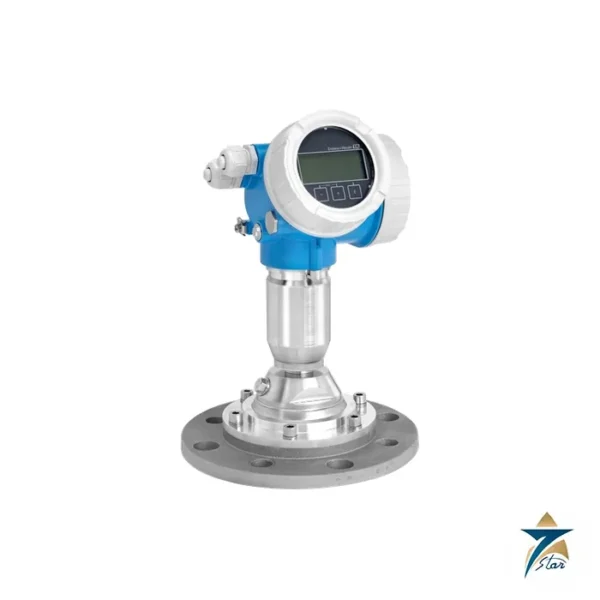
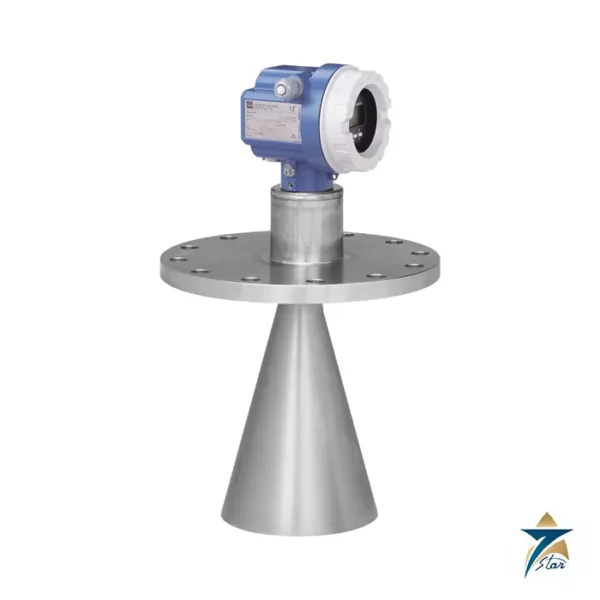
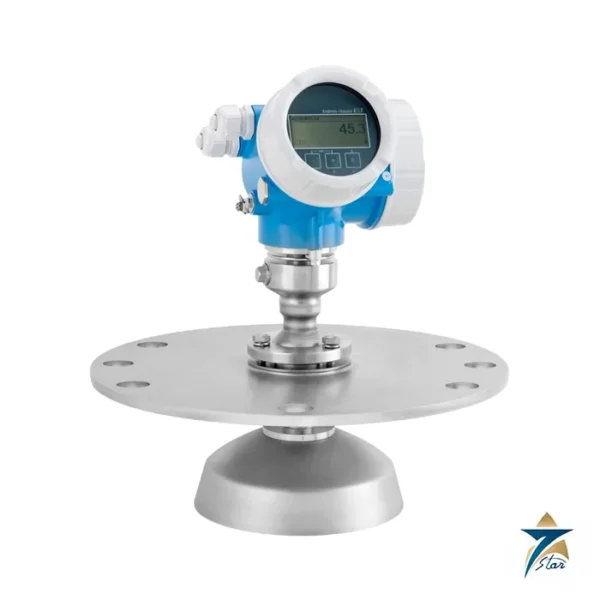
Endress+Hauser FMR533 has the largest antenna of the Micropilot S line, a parabolic reflector with the smallest beam angle. The datasheet TI01123F calls it excellently suited for free-space applications up to 40 m (131 ft) and gives a typical accuracy of plus or minus 0.5 mm. Like its siblings it carries NMi and PTB approvals and meets OIML R85 and API 3.1B.

The Micropilot S family is wired in a different way from ordinary two-wire transmitters. A four-wire cable carries 24 VDC power and the HART signal, intrinsically safe, to a Tank Side Monitor or a stand-alone supply, and power consumption stays low at 330 mW at 16 V and 500 mW at 24 V. This arrangement preserves a clean digital signal and allows several gauges on one tank to share the monitor.

Data for FMR533

  • Free-space range up to 40 m; with NMi custody transfer approval 25 m.
  • Absolute accuracy better than plus or minus 1 mm; typical plus or minus 0.5 mm in free space.
  • Intended for installation near tank walls through a manway cover.
  • An excellent choice for low-reflectivity products such as asphalts and bitumens.
  • Four-wire HART with 24 VDC, intrinsically safe; power up to 500 mW at 24 V.
  • Inventory Control version with 3 mm accuracy for non-custody applications.
  • Gas-tight process connection (second line of defense) standard.

Parabolic antenna in practice with FMR533

Every Micropilot S leaves the factory with an individual calibration certificate: the deviation of each unit is recorded against a laser interferometer with 0.1 mm absolute accuracy, and a second reference with 0.25 mm absolute accuracy is used as a cross-check. That record is what allows the instrument to be sealed for custody transfer. The sheet explains that a bigger antenna gives a smaller beam angle and fewer interference echoes. The parabolic reflector is therefore selected when the tank has fittings, heating coils or a roof structure close to the beam, or when the product, such as bitumen, reflects weakly. Mapping suppresses fixed echoes electronically, and a stilling well can still be used to avoid interference, in which case the datasheet recommends the FMR532 with planar antenna for wells from DN 150, and antenna alignment in free space follows the tank-mounting instructions in the sheet.

Typical applications of FMR533 in Oman and the GCC

Large crude, fuel-oil and bitumen tanks at refineries and terminals, with a manway on the roof for installation. Because the parabolic dish is large, it needs a clear manway, and the tank must have enough diameter that the beam does not meet the wall on both sides.

Low-reflectivity products are the special case where the parabolic antenna earns its extra size. Bitumen and asphalt have low dielectric constants and often a rough, warm surface; the narrow beam and high antenna gain give a clean echo where a horn might deliver a weak one. The datasheet also warns that for media with a low dielectric constant the tank bottom may be visible through the product at low level, reducing accuracy near empty, and suggests setting the zero point a distance above the bottom if that range matters.

An inventory-control version is available with 3 mm accuracy, so a plant can equip custody-transfer tanks with the full-accuracy version and process or buffer tanks with the cheaper version while keeping the same type of instrument and the same wiring practice.

How FMR533 differs from FMR530 and FMR532

Item FMR533 FMR530 FMR532
Antenna Parabolic Horn Planar
Free-space range Up to 40 m Up to 25 m Not applicable
Typical accuracy 0.5 mm 0.5 mm 0.8 mm
Best for Low reflectivity, large tanks Small nozzles Stilling wells

Fitting FMR533 to the tank

Mount the reflector through the manway and align it per the free-space drawing. Keep the beam clear of the tank wall on both sides so no double reflection arises, and keep fixed internals out of the beam, since the parabolic dish concentrates energy but cannot ignore a pipe standing in its cone. Enter the gauge reference height carefully, because it is the largest single contributor to the final result. Wire to the NRF590 with screened four-wire cable, shield on one side.

Verification of FMR533

Use manual gauging at set intervals agreed with the tank owner and, for custody transfer, the metrology authority, file each verification under the instrument tag, keep the factory calibration certificate, which records deviations against a laser interferometer with 0.1 mm absolute accuracy, and store the sealed configuration. After tank maintenance, repeat the empty calibration. The device continuously monitors compliance with OIML R85 accuracy requirements and raises an alarm if the accuracy cannot be maintained, which provides a layer of assurance between formal verifications.

Remember that the sheet treats the gauge reference height as decisive for accuracy: strap the tank, record the datum in the calibration file and do not rely on drawing dimensions alone. Record at the same time the ambient and product temperatures, because the tank shell height varies with temperature and the tank gauging system can compensate for that.

Ordering FMR533 correctly

Provide tank diameter, manway size and approval needs, and mention if a replacement needs to match an installed gauge. State the product, working temperature range and whether the tank roof is fixed or floating, because a floating roof changes the installation approach.

Also mention the process connection class, the intrinsic safety requirements and the type of tank gauging system, so that the signal and power arrangement can be checked at the quotation stage.

Documents and quotation

Datasheet: Technical Information TI01123F. Send the part number and quantity through the RFQ form. Seven Star LLC is an independent supplier serving Oman and the GCC and is not affiliated with the manufacturer.

Other Models in the Micropilot S Range

Seven Star LLC supplies models from the Micropilot S range in Oman and the GCC. Compare the related models below and request a quote for the one that matches your application.

ModelCategory
Endress+Hauser FMR530 Micropilot S Custody Transfer RadarRadar & Guided Wave Radar LevelView details
Endress+Hauser FMR532 Micropilot S Planar Stilling Well RadarRadar & Guided Wave Radar LevelView details
Endress+Hauser FMR533 Micropilot S Parabolic Tank Gauging RadarRadar & Guided Wave Radar LevelYou are viewing this model
Datasheets & Documents
  • PDF Datasheet Endress+Hauser FMR533 Micropilot S Parabolic Tank Gauging Radar Datasheet Download
Reviews (0)

Reviews

There are no reviews yet.

How would you rate this product?

It takes about 10 seconds — just tap a star. Your email is never published.

About brand

Endress+Hauser makes process measurement instruments for flow, level, pressure, temperature and liquid analysis. Georg H. Endress and Ludwig Hauser started the business in Lörrach, Germany, on 1 February 1953, first selling level meters, and the Endress+Hauser name has been used since 1957. The group is headquartered in Reinach, Switzerland, and has been wholly owned by the Endress family since 1975.

Seven Star LLC is an independent supplier listing Endress+Hauser flowmeters, level and pressure transmitters, temperature assemblies and liquid analysis products for buyers in Oman and the GCC. Instruments are matched from the full order code on the nameplate.

Endress+Hauser company profile

Origin Founded in Lörrach, Germany, on 1 February 1953 by the Swiss engineer Georg H. Endress and Ludwig Hauser
Headquarters Endress+Hauser AG, Reinach (Basel-Landschaft), Switzerland
Ownership Family owned; the Endress family has been the sole shareholder since 1975, and a family charter commits the company to stay family owned
Size About 16,500 employees and sales of about EUR 3.7 billion (2023, as reported by the company)
Product families Proline flowmeters, Micropilot and Levelflex radar, Liquiphant switches, Cerabar and Deltabar pressure, iTEMP and iTHERM temperature, Liquiline and Memosens liquid analysis

Milestones

  • 1953: Georg H. Endress and Ludwig Hauser start the business in Lörrach on 1 February, first selling level meters.
  • 1957: The Endress+Hauser name comes into use.
  • 1975: The Endress family becomes sole shareholder.
  • 2023: About 16,500 employees and sales of about EUR 3.7 billion, as reported by the company.

Endress+Hauser product lines

Line Measuring principle Typical use
Promass F 300, Promass 80F, 83F/84F Coriolis mass flow Direct mass flow and density of liquids and gases, hydrocarbon transfer and chemical dosing
Promag P 300, P 500, H 300, W 400, W 10, 50P Electromagnetic flow Water, wastewater, slurries and other conductive liquids
Prowirl F 200, 72F Vortex flow Steam, gas and low-viscosity liquids
Prosonic Flow 92F, t-mass 65F Ultrasonic and thermal mass flow Water lines; compressed air and industrial gases
Micropilot FMR62, FMR67, FMR60, FMR10B, FMR20, FMR50, FMR52 Free-space radar level, 80 GHz and 26 GHz Tanks, process vessels, silos and open water channels
Levelflex FMP51, FMP50, FMP54, FMP55 Guided wave radar level Level and interface in vessels, separators and bypass chambers
Liquiphant FTL51, Prosonic S FMU90 Vibronic point level; ultrasonic level High and low level alarms, pump protection, open channel flow
Cerabar PMC71B, PMP51B, PMP71, Deltabar PMD78B, PMD75 Pressure and differential pressure Process pressure, hydrostatic level and DP flow
iTEMP TMT82, TMT162, iTHERM TM101, TR66, TR10 Temperature transmitters and thermometers RTD and thermocouple points with thermowells
Liquiline CM444, CM442, Memosens CPS11E, Stamolys reagents Liquid analysis pH, ORP, conductivity, dissolved oxygen and nutrient analysis in water treatment and process

Where Endress+Hauser instruments are used

In Oman and the GCC, Endress+Hauser instruments are common in oil and gas production and processing, refineries and petrochemicals, desalination and water networks, wastewater treatment, power plants and food and beverage plants. Coriolis meters measure hydrocarbon and chemical flows, electromagnetic meters cover water and wastewater, radar transmitters handle tank and silo level, and Liquiline analysers monitor water quality. Proline 300 and 500 flowmeters include Heartbeat Technology for in-situ verification, which reduces the need to remove a meter for checks.

Ordering Endress+Hauser instruments: what we need

The order code on the nameplate (for example PMP71-1QA1S11RDADU) defines every option: measuring range, process connection, materials, output, approvals and display. Send it with the serial number; Endress+Hauser can retrieve the original configuration from the serial number. For a new instrument add the medium, operating and design pressure and temperature, range, line size or tank geometry, process connection, wetted materials, output or protocol (4-20 mA HART, PROFIBUS, FOUNDATION Fieldbus, Modbus) and the hazardous-area approval required. Older models such as Promass 80/83 or Micropilot M are replaced by current Proline or 80 GHz Micropilot devices.

Facts checked against Endress+Hauser company history and product information, October 2026.

FAQ

Questions about the Endress+Hauser FMR533 Micropilot S Parabolic Tank

Answers from our engineering team on installation, compatibility and integration.

01What is special about Endress+Hauser FMR533?
It carries a parabolic antenna, the largest and narrowest-beam option of the Micropilot S range, for free-space tank gauging.
02How far does FMR533 measure?
Up to 40 m (131 ft) in free space, and 25 m (82 ft) with custody-transfer NMi approval.
03Which products suit FMR533?
The sheet mentions low-reflectivity products such as asphalts and bitumens as an excellent application.
04What accuracy does FMR533 reach?
Better than plus or minus 1 mm absolute, typically plus or minus 0.5 mm in free space.
05What approvals does FMR533 hold?
NMi and PTB approvals for custody transfer, meeting OIML R85 and API 3.1B.