Brand:

Autonics TX4M-14R 72×72 LCD PID Temperature Controller

Description

Overview

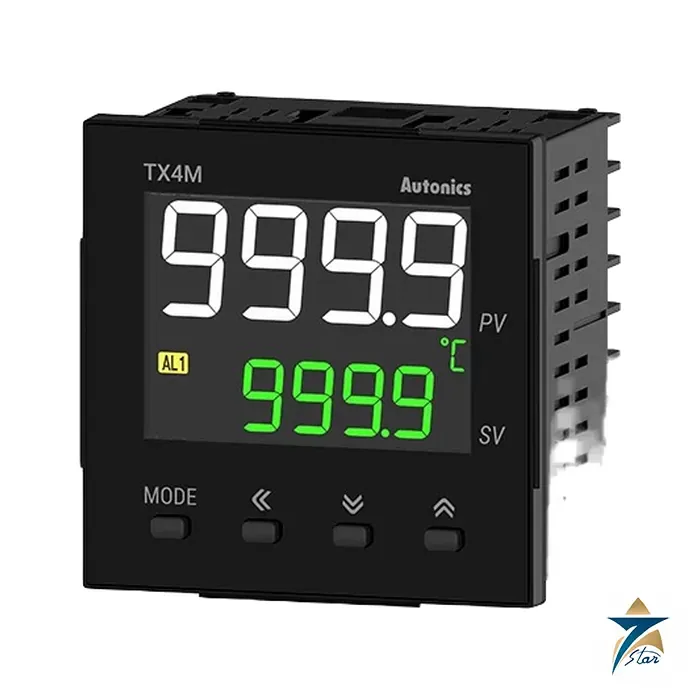
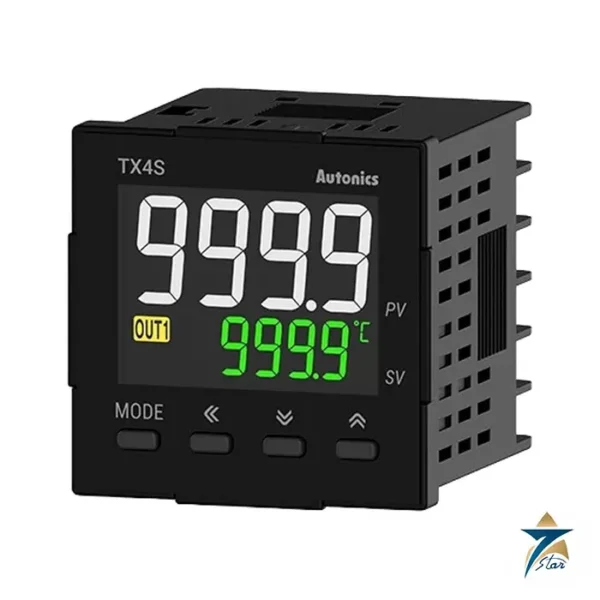
Operators read this display from across a room. The Autonics TX4M-14R is the 72 x 72 mm version of the TX series LCD PID controller, with the large white process value and a green setpoint line that stay legible at a distance and at an angle. Inside is the same four-digit controller as the smaller models: relay output, alarm 1, 100 to 240 V AC supply, 50 ms sampling and ON/OFF, P, PI, PD or PID control. Seven Star LLC is an independent supplier serving Oman and the GCC.

How to decode Autonics TX4M-14R

TX4 is the series name for four-digit LCD controllers. M indicates the 72 x 72 mm case. The 1 that follows the dash is the option input and output, alarm 1, and the 4 is the 100 to 240 V AC power. The final R means output 1 is a relay. As nothing follows, the terminals are the screw type, and the code is a normal single-output controller.

Specification list for Autonics TX4M-14R

Item Data
Front size 72 x 72 mm, cut-out 68 mm square, body depth 45 mm
Display 11-segment LCD, PV white, SV green
Supply 100 to 240 V AC 50/60 Hz, 8 VA or less, 90 to 110 percent
Output Relay 250 V AC 3 A, 30 V DC 3 A, 1a; alarm 1 relay
Control cycle 0.5 to 120.0 seconds
Manual reset 0.0 to 100.0 percent
Thermocouples K, J, L, T, R, S
RTD DPt100, Cu50
Insulation resistance 100 megohm or more at 500 V DC
Dielectric strength 3,000 V AC for 1 minute
Noise immunity 2 kV square wave, 1 microsecond
Vibration 0.75 mm amplitude, 5 to 55 Hz, 2 hours per axis
Ambient minus 10 to plus 50 degrees C
Protection IP50 front
Weight about 138 g, about 213 g packaged

How the Autonics TX4M-14R differs from other TX4 variants

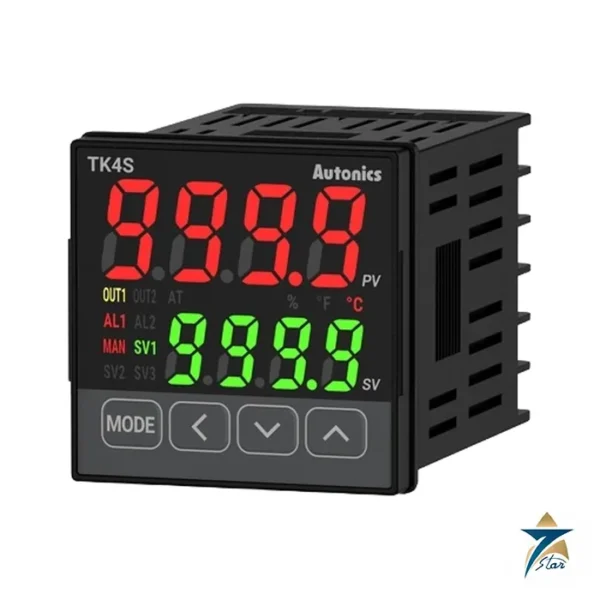
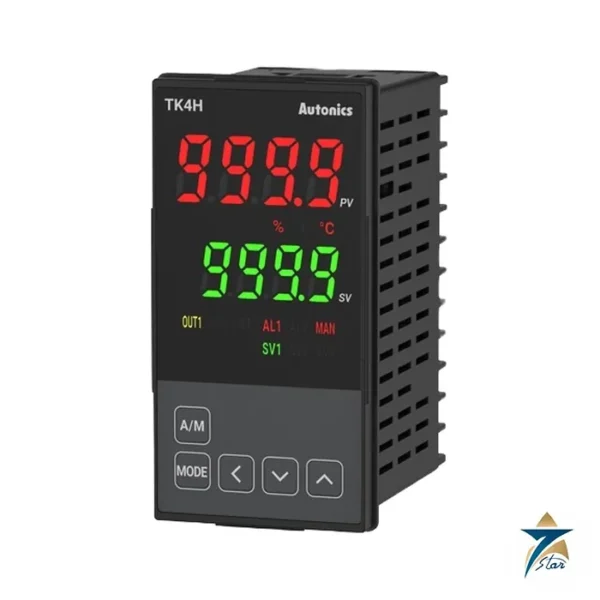
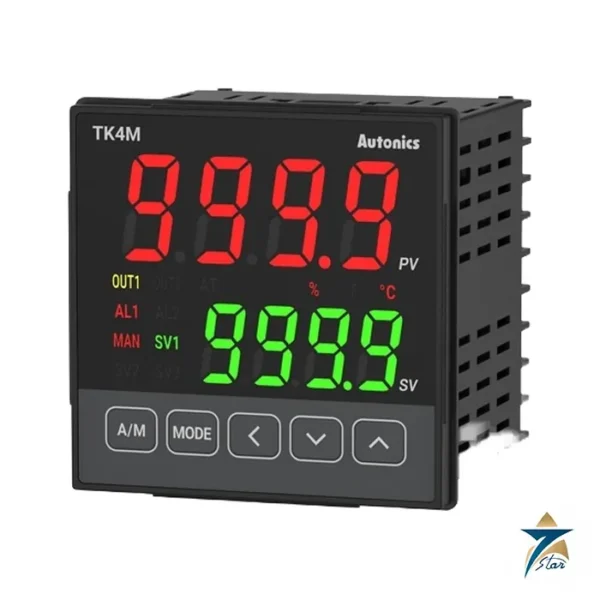
Sizes in the TX4 range run from the 48 x 24 mm TX4N through TX4S, TX4SP, TX4M, the 96 x 48 mm TX4W and 48 x 96 mm TX4H, up to the 96 x 96 mm TX4L. The Autonics TX4M-14R is in the middle with a 68 mm cut-out. It weighs about 138 g, roughly 40 g more than the TX4S at 97 g, and about 66 g less than the TX4L at 204 g. All of them share the same relay life and input list. Within this size, the options 2, R, T, A and B add alarm 2, PV transmission and RS485 in various combinations, while the output letters S and C swap the relay for an SSR drive or selectable current.

Control behaviour

The proportional band runs from 0.1 to 999.9 degrees, integral time from 0 to 9,999 seconds, derivative time from 0 to 9,999 seconds, with hysteresis from 1 to 100 degrees in ON/OFF mode. With a relay, the control cycle is typically set longer than the 0.5 second minimum to protect the contacts, which are rated for 200,000 electrical operations under 250 V AC 3 A resistive load. The relay handles direct switching of small heaters, but larger loads should be run through a contactor or SSR.

Applications in Oman and the GCC

With a larger display, this controller suits plant ovens, drying cabinets, plastic processing machines, water heating and boiler panels where the operator stands a few metres from the front. Because the case depth is only 45 mm, it can be fitted to thin doors and shallow boxes. In dry coastal and desert environments, dust and fine sand are a concern: the front is IP50, so mount it inside a closed cabinet door, or behind a transparent cover, and keep ambient below 50 degrees C.

Reading the large display of the Autonics TX4M-14R

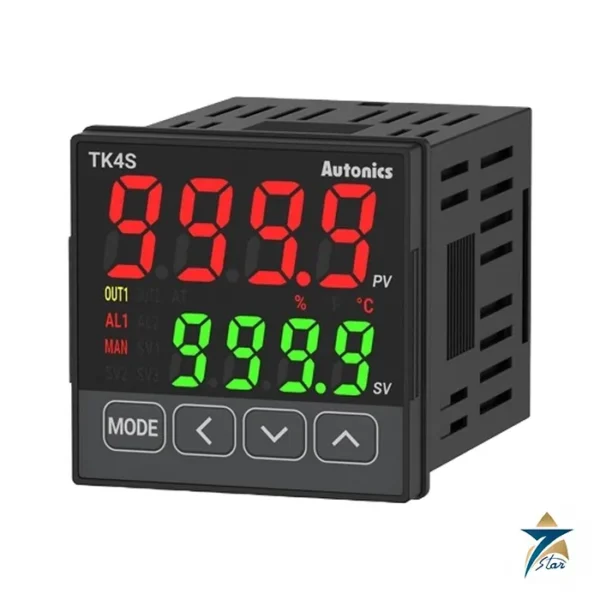
The upper line shows the process value in white and the lower line the setting value in green, while yellow indicators report the state of the control output, the alarm, auto tuning and manual mode. In setting mode the upper line shows the parameter name and the lower line its value. Four keys, mode and three arrows, handle all programming, so a technician can change a setpoint without a manual after a short introduction. The manual notes that when the controller is used below 0 degrees C the display cycle slows down, which is no concern for heated cabinets in the Gulf but matters for cold stores.

An LCD controller consumes little power and, compared with LED units, shows no visible flicker in photographs or video of the panel, which some quality departments use for records. The controller can transmit the process value as a 4 to 20 mA signal or communicate with a PLC over RS485 Modbus RTU when the matching option digit is chosen; the present code carries neither option, so choose one of the extended codes when a data link to a supervisory system is planned.

Modbus RTU on the RS485 option runs at 2,400 to 38,400 bps, supports up to 31 units on one line and reaches 800 m, and these figures are useful when a number of controllers are to be networked later, though they apply to other order codes in the family and not to this one.

Panel installation

Cut the panel to 68 mm square, with at least 90 mm between adjacent controllers, and push the bracket in with a flathead screwdriver. Wire the supply and output with correct crimp terminals, three equal-length leads for RTDs, and route the sensor away from power. When the controller shares a panel with inverters, use shielded sensor cable and earth the shield at one end.

Accuracy and ranges

Room-temperature accuracy is plus or minus 0.3 percent or 1 degree C, whichever is greater, plus one digit. The ranges are limited compared with other Autonics controller series: thermocouple K covers minus 50 to 1,200 degrees C, J minus 30 to 800, L minus 40 to 800, T minus 50 to 400, and R and S 0 to 1,700 degrees C. RTD DPt100 reads minus 100 to 400 degrees C and Cu50 reads minus 50 to 200 degrees C. Choose a different series if you need B thermocouples or analog inputs.

Service

Inspect terminals after commissioning and again after the first thermal cycles. Use the key lock after set-up. Memory retention of about ten years means that no battery is required, and the parameters survive power loss. If readings jump, check the sensor, its connection and the earthing of the cable, before blaming the controller.

Related items you may also need: Autonics E40S6-2500-6-L-5 Rotary Encoder Incremental | SICK WL150-P430 Miniature Retro-Reflective Sensor, 2 m | SICK KT5W-2N1116 KT5 Contrast Sensor, NPN, RGB LED | All Autonics products.

Documents and quotation

The TX series product manual covering the Autonics TX4M-14R is attached to this page with the ordering table, input ranges, wiring and cut-out data. Send an RFQ with the part number Autonics TX4M-14R, quantity and delivery location in Oman or the GCC.

Other Models in the TX Range

Seven Star LLC supplies models from the TX range in Oman and the GCC. Compare the related models below and request a quote for the one that matches your application.

ModelCategory
Autonics TX4S-14R 48×48 LCD PID Temperature ControllerPhotoelectric SensorsView details
Autonics TX4M-14R 72×72 LCD PID Temperature ControllerPhotoelectric SensorsYou are viewing this model
Datasheets & Documents
  • PDF Datasheet Autonics TX4M-14R 72x72 LCD PID Temperature Controller Datasheet Download
Reviews (0)

Reviews

There are no reviews yet.

How would you rate this product?

It takes about 10 seconds — just tap a star. Your email is never published.

About brand

Autonics is a South Korean maker of sensors and controllers, founded in 1977 as a small engineering business making controllers for looms. It took the Autonics name in 1988 and opened a new corporate headquarters in Busan in 2014. Autonics makes proximity and photoelectric sensors, rotary encoders, temperature controllers, counters, timers and stepper motor systems, with factories in Busan and Yangsan.

Seven Star LLC lists the Autonics E40S6-2500-6-L-5 incremental rotary encoder and supplies Autonics sensors and control devices in Oman and the GCC.

Autonics company profile

Founded 1977, South Korea
Current name Autonics, since 1988
Headquarters Busan, South Korea
Factories Busan and Yangsan
Product families E40 and E50 rotary encoders, PR proximity sensors, BJ photoelectric sensors, TK temperature controllers

Milestones

  • 1977: The company is founded.
  • 1988: Renamed Autonics Corporation.
  • 2014: Opens its Busan headquarters.

Reading the Autonics E40S encoder code

E40S is the 40 mm diameter shaft-type incremental encoder, and the 6 that follows is the 6 mm shaft. 2500 is the resolution in pulses per revolution. The next 6 means six output signals: A, B and Z with their inverted signals. L is a line driver output and the final 5 is a 5 V DC supply. The same 40 mm body is made in hollow shaft form as the E40H and E40HB series.

Where Autonics encoders are used

Servo and spindle feedback, conveyor length measurement, packaging and printing machines.

Ordering Autonics encoders: what we need

Send the complete model string from the label. If it is worn off, give the body and shaft diameter, pulses per revolution, output type, supply voltage and cable or connector style.

Facts checked against Autonics corporate profiles, October 2026.

FAQ

Questions about the Autonics TX4M-14R 72×72 LCD PID Temperature

Answers from our engineering team on installation, compatibility and integration.

01What size is the Autonics TX4M-14R?
It is a 72 x 72 mm DIN controller with a 68 mm square panel cut-out, a 45 mm body depth and a weight of about 138 g.
02What does the R in Autonics TX4M-14R stand for?
R means control output 1 is a relay, rated 250 V AC 3 A or 30 V DC 3 A, 1a, while S would be an SSR drive and C a selectable current or SSR output.
03What input sensors does the Autonics TX4M-14R support?
Thermocouples K, J, L, T, R and S, and RTD types DPt100 and Cu50, within the ranges of the TX series input table.
04How long does the relay of the Autonics TX4M-14R last?
The manual lists 5 million mechanical operations and 200,000 electrical operations at 250 V AC 3 A resistive load.
05Is the Autonics TX4M-14R suited to dusty areas?
Its front panel is IP50, so it should be installed in a closed cabinet or behind a cover instead of being left exposed to dust or washdown.