- Automation & ControlView all 3,046 products
- Automation Accessories
- AC Drives
- PLC & I/O Cards
- Industrial Communications
- Vibration Monitoring
- Isolator & Barrier
- Controllers & Data Acquisition
- Safety Switches & Guard Locking
- Motor Soft Starters
- Encoders
- CCTV & Security
- Pneumatic Cylinders
- HMI Displays
- Servo Drives
- Industrial Computers
- Machine Vision
- Automation Software
- Robotics
Brand: Autonics
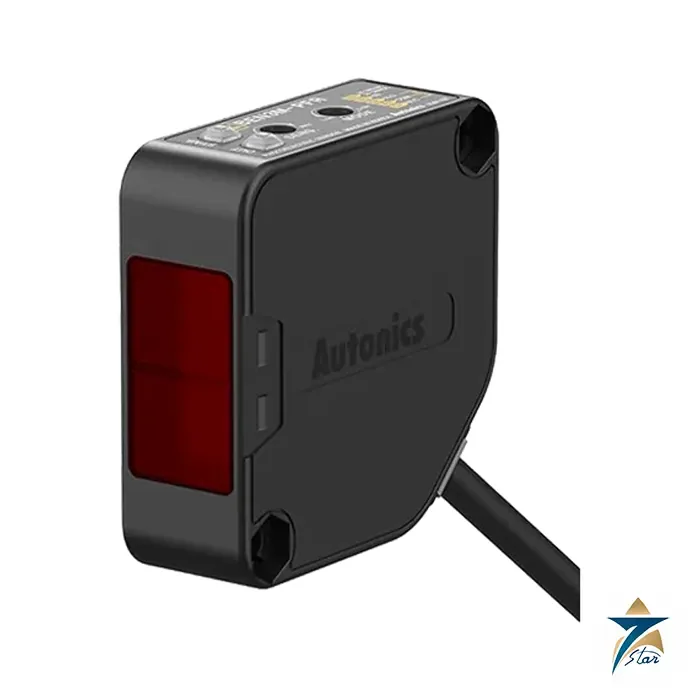
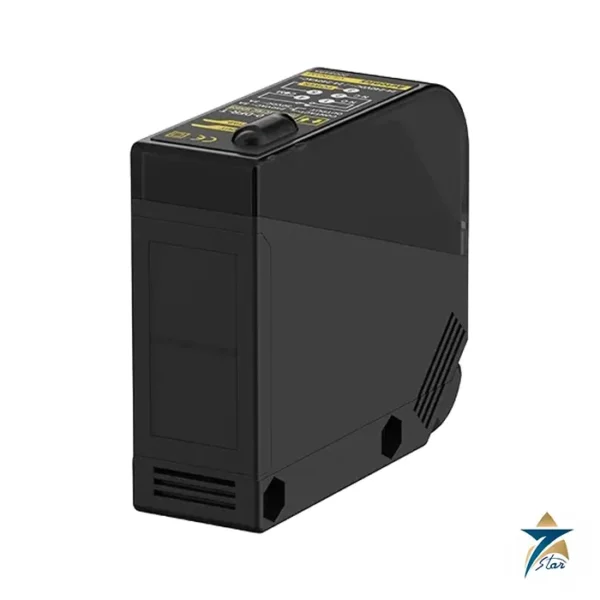
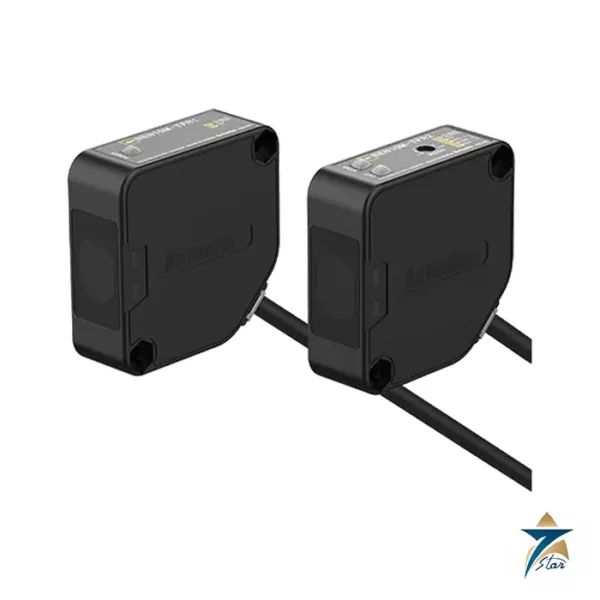
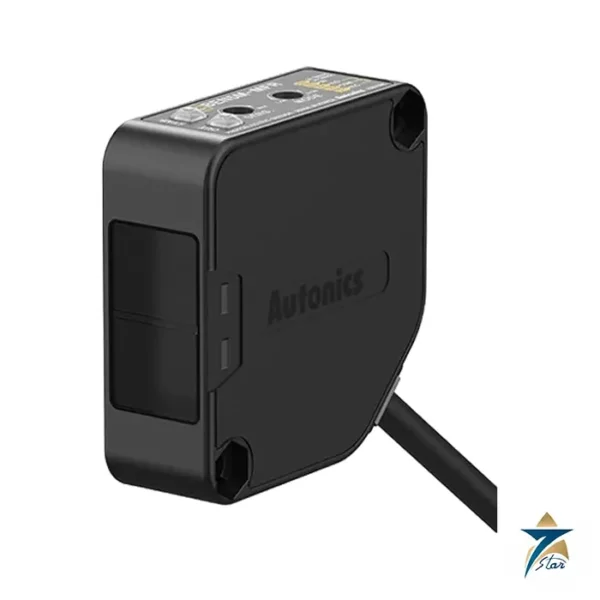
Autonics BEN3M-PFR 3 m Polarized Retroreflective Sensor
Description
Overview
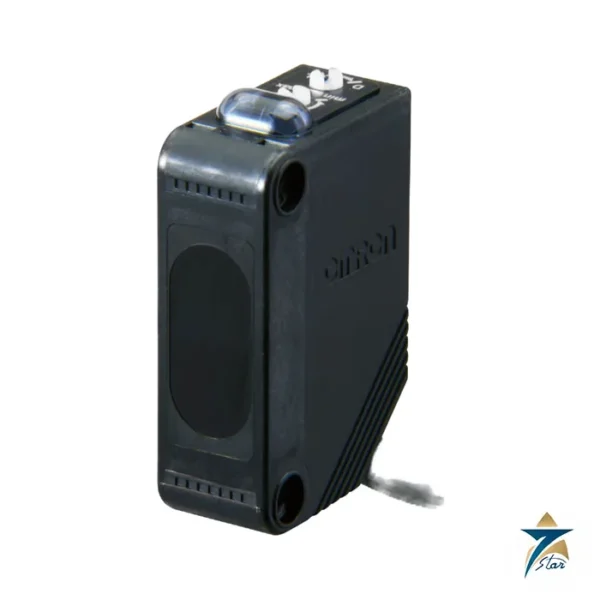
Shiny packaging, steel sheet and plastic film often confuse a retroreflective sensor, because the target throws the light back just as the reflector does. The Autonics BEN3M-PFR was designed for this problem. It is a polarized retroreflective photoelectric sensor from the BEN series, with a red 660 nm light source, a working range of 0.1 to 3 m measured with the MS-2 reflector, and a universal 24 to 240 V AC or DC supply with a relay output. Seven Star LLC is an independent supplier serving Oman and the GCC.
Understanding the code Autonics BEN3M-PFR
BEN is the series, 3M gives a sensing distance of 3 metres, and P identifies the polarized retroreflective principle. FR means that the sensor takes AC/DC power and switches a relay contact. A DT ending would instead denote a 12 to 24 V DC unit with a transistor output. Since this is a reflective type, the code carries no emitter or receiver digit.
Key data of the Autonics BEN3M-PFR
| Parameter | Value |
|---|---|
| Sensing type | Polarized retroreflective |
| Sensing distance | 0.1 to 3 m with reflector MS-2 |
| Detectable object | Opaque, minimum diameter 60 mm |
| Light source | Red, peak wavelength 660 nm |
| Response time | 20 ms or less |
| Sensitivity | Adjustable by screw adjuster |
| Mode | Light ON or Dark ON, selectable |
| Supply | 24 to 240 V AC 50/60 Hz or 24 to 240 V DC, plus or minus 10 percent |
| Consumption | 4 VA or less |
| Output | 1c relay, 250 V AC 3 A, 30 V DC 3 A resistive |
| Relay life | 50 million mechanical, 100,000 electrical |
| Indicators | Operation red, stability green |
| Ambient light | Sunlight 11,000 lx, incandescent 3,000 lx |
| Ambient limits | minus 20 to plus 65 degrees C, 35 to 85 percent RH |
| Protection | IP50 |
| Cable | 5 mm, 5-wire, 2 m |
| Weight | about 208 g |
How the Autonics BEN3M-PFR differs from other BEN variants
The BEN5M-M sibling is a plain retroreflective sensor with infrared light at 940 nm and a reach of 0.1 to 5 m, while the Autonics BEN3M-PFR gives 0.1 to 3 m. The shorter reach pays for polarization: a filter in front of the receiver accepts only light that the corner-cube reflector has rotated, so a bright metal surface that reflects light unrotated is not mistaken for the reflector. The red light source of the Autonics BEN3M-PFR also helps visual alignment, since the spot can be seen on the reflector, which is not possible with the invisible infrared beam of the other types. The weight is the same at about 208 g.
Typical uses
Because the polarized optics reject shiny objects, the sensor suits foil-wrapped products, glossy cartons, steel drums and metal sheet on conveyors. In the Gulf region it is applied in bottling and canning lines, in recycling plants that handle aluminium cans, and in automatic gates where a mirror-like car body could confuse a conventional unit. The relay output and wide AC/DC supply let it replace sensors in older control panels without adding a power supply.
Reflector choice and alignment
The MS-2 reflector is supplied with the sensor, and the manual lists reflector tapes and larger reflectors, such as MS-3, which give a longer distance. Mount the sensor and reflector at least 0.1 m apart and parallel to each other. If a glossy object is present, tilt the sensor 30 to 45 degrees relative to its surface. Use the adjuster to set sensitivity as the manual describes: turn from minimum to the position where the indicator lights, then to the position where it lights while the beam is interrupted, and finally set the adjuster midway.
Connections
Connect the brown and blue wires to the supply. The relay contact leads are black for normally open, white for the common, and grey for normally closed. The relay is rated for 3 A resistive load only; for lamps, motors and solenoid valves use an interposing contactor or a suppressor. Do not wire the sensor while it is live, and keep the sensor and load on separate power lines when the load causes noise.
Care and troubleshooting
Wipe the lens and the reflector with a dry cloth, as the manual excludes water and organic solvents. If the green stability light goes out, clean the reflector first, then re-check alignment. When the output chatters, look for background light such as sunlight above 11,000 lx falling on the receiver. The relay life of 100,000 electrical operations is shortened by heavy loads, so consider the DT version for high-speed counting.
Check the cable for bending and keep the sensor out of washdown areas, since the housing carries an IP50 rating. In dusty plants, add a small hood and schedule lens cleaning together with other routine rounds, and verify the reflector has not yellowed or been scratched, as this lowers the received light margin.
Why polarization matters for the Autonics BEN3M-PFR
In a standard retroreflective sensor, the emitter and receiver sit behind one lens, and the receiver reads the light that returns from a distant reflector. An object between sensor and reflector interrupts the light, and the output changes. A highly reflective object, however, may send back a strong beam of its own, and the receiver cannot tell it from the reflector. Polarization breaks this ambiguity. The emitted light is polarized in one plane; the corner-cube reflector rotates the plane of the light by ninety degrees on its way back, and a crossed filter on the receiver passes only the rotated light. A shiny can or sheet of steel returns the light unrotated, so the receiver does not see it as a reflector and the beam is correctly judged to be interrupted.
This is the reason why the manual lists separate reflectors for polarized sensors, such as MS-2A and the high reflectivity MS-2S, and why the reflector tape table gives a lower effective reflectance for polarized types than for plain retroreflective ones. When you choose the reflector, remember that the standard reflector reaches the full 3 m, whereas tapes of 50 x 50 mm reach less. The actual distance depends on contamination, ambient light, reflector angle and the size of the object, and the manual includes characteristic curves for this.
The red spot also gives a convenient test: with the power on, a sheet of white paper in front of the lens shows the beam position, and a small mirror can confirm that the reflector is centred in the spot. After the final position is set, lock the bracket screws and perform a trial with the smallest and the glossiest product that the line will handle.
Related items you may also need: Autonics E40S6-2500-6-L-5 Rotary Encoder Incremental | SICK WTB9-3P3461 W9 Background Suppression Sensor | Keyence LR-W500C Full-Spectrum Reflective Photoelectric Sensor | All Autonics products.
Documents and quotation
The Autonics BEN series manual covering the Autonics BEN3M-PFR is attached with timing charts, reflector options and wiring details. Send an RFQ with the part number Autonics BEN3M-PFR, quantity and delivery location in Oman or the GCC.
Other Models in the BEN Range
Seven Star LLC supplies models from the BEN range in Oman and the GCC. Compare the related models below and request a quote for the one that matches your application.
| Model | Category | |
|---|---|---|
| Autonics BEN5M-MFR Retroreflective Photoelectric Sensor 5 m | Photoelectric Sensors | View details |
| Autonics BEN10M-TFR 10 m Through-Beam Photoelectric Sensor | Photoelectric Sensors | View details |
| Autonics BEN3M-PFR 3 m Polarized Retroreflective Sensor | Photoelectric Sensors | You are viewing this model |
Datasheets & Documents
- Datasheet Autonics BEN3M-PFR 3 m Polarized Retroreflective Sensor Datasheet Download
Reviews (0)
How would you rate this product? Cancel reply
About brand
Autonics is a South Korean maker of sensors and controllers, founded in 1977 as a small engineering business making controllers for looms. It took the Autonics name in 1988 and opened a new corporate headquarters in Busan in 2014. Autonics makes proximity and photoelectric sensors, rotary encoders, temperature controllers, counters, timers and stepper motor systems, with factories in Busan and Yangsan.
Seven Star LLC lists the Autonics E40S6-2500-6-L-5 incremental rotary encoder and supplies Autonics sensors and control devices in Oman and the GCC.
Autonics company profile
| Founded | 1977, South Korea |
|---|---|
| Current name | Autonics, since 1988 |
| Headquarters | Busan, South Korea |
| Factories | Busan and Yangsan |
| Product families | E40 and E50 rotary encoders, PR proximity sensors, BJ photoelectric sensors, TK temperature controllers |
Milestones
- 1977: The company is founded.
- 1988: Renamed Autonics Corporation.
- 2014: Opens its Busan headquarters.
Reading the Autonics E40S encoder code
E40S is the 40 mm diameter shaft-type incremental encoder, and the 6 that follows is the 6 mm shaft. 2500 is the resolution in pulses per revolution. The next 6 means six output signals: A, B and Z with their inverted signals. L is a line driver output and the final 5 is a 5 V DC supply. The same 40 mm body is made in hollow shaft form as the E40H and E40HB series.
Where Autonics encoders are used
Servo and spindle feedback, conveyor length measurement, packaging and printing machines.
Ordering Autonics encoders: what we need
Send the complete model string from the label. If it is worn off, give the body and shaft diameter, pulses per revolution, output type, supply voltage and cable or connector style.
Facts checked against Autonics corporate profiles, October 2026.
Browse Autonics products by category: Encoders.
FAQ
Questions about the Autonics BEN3M-PFR 3 m Polarized Retroreflective
Answers from our engineering team on installation, compatibility and integration.
01What does the P in Autonics BEN3M-PFR stand for?
P marks the polarized retroreflective sensing principle, which ignores glossy objects that would otherwise reflect light back like a reflector.
02What is the range of the Autonics BEN3M-PFR?
The sensing distance is 0.1 to 3 m when used with the MS-2 reflector, and the minimum detectable opaque object is 60 mm in diameter.
03Does the Autonics BEN3M-PFR use visible light?
Yes, it has a red light source with a peak wavelength of 660 nm, which makes aligning the spot on the reflector much easier than with infrared.
04What output does the Autonics BEN3M-PFR have?
It has a 1c relay output rated 250 V AC 3 A or 30 V DC 3 A resistive, switched from a 24 to 240 V AC or DC supply.
05Is the reflector included with the Autonics BEN3M-PFR?
The manual lists the MS-2 reflector among the product components for the polarized retroreflective type, together with a bracket and an adjustment screwdriver.


Reviews
There are no reviews yet.