Brand:

Autonics BX700-DFR Diffuse Photoelectric Sensor 700 mm

Description

Overview

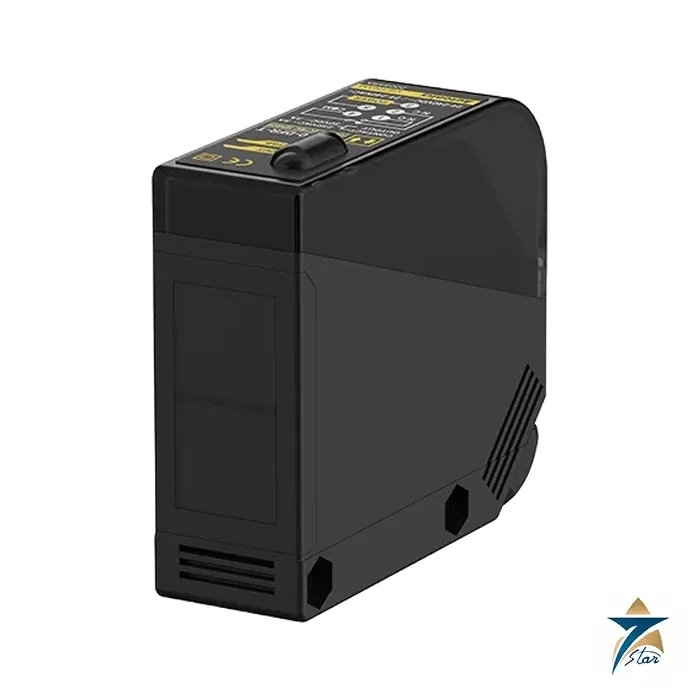
When a conveyor, door or machine guard has to be sensed with no reflector and no second device, a diffuse reflective sensor is the simplest answer, and Autonics BX700-DFR is the AC/DC relay-output version of that idea from the Autonics BX Series. Its code is explicit: 700 is the sensing distance of 700 mm, D marks the diffuse reflective type, and FR means AC/DC power with a relay contact output. The housing is a rugged PC case with an acrylic sensing part and a wire terminal connection, and it runs on 24 to 240 V DC or 24 to 240 V AC. Seven Star LLC is an independent supplier serving Oman and the GCC.

Strengths of Autonics BX700-DFR

  • 700 mm detection of objects against a non-glossy white paper reference of 200 x 200 mm.
  • Infrared light source at 940 nm, sensitivity adjuster, and selectable Light ON or Dark ON through a switch.
  • Universal supply from 24 to 240 V DC or AC, 3 VA or less.
  • Relay contact output rated for 30 V DC 3 A on resistive load, with an electrical life of at least 100,000 operations.
  • IP65 protection and an ambient range of minus 20 to plus 55 degrees C.
  • Wire terminal block for the supply and output, fastened with a 0.8 N m torque.

Specification summary for Autonics BX700-DFR

Parameter Value
Model BX700-DFR
Sensing type Diffuse reflective
Sensing distance 700 mm
Reference target non-glossy white paper 200 x 200 mm
Light source Infrared, 940 nm
Response time 20 ms or less
Power supply 24 to 240 V DC or 24 to 240 V AC 50/60 Hz
Power consumption 3 VA or less
Output Relay contact
Insulation resistance 20 megohm or more at 500 V DC
Dielectric strength 1,500 V AC for 1 minute
Vibration 1.5 mm double amplitude, 10 to 55 Hz
Ambient temperature minus 20 to plus 55 degrees C
Protection IP65
Weight approx. 115 g

How BX700-DFR differs from other BX variants

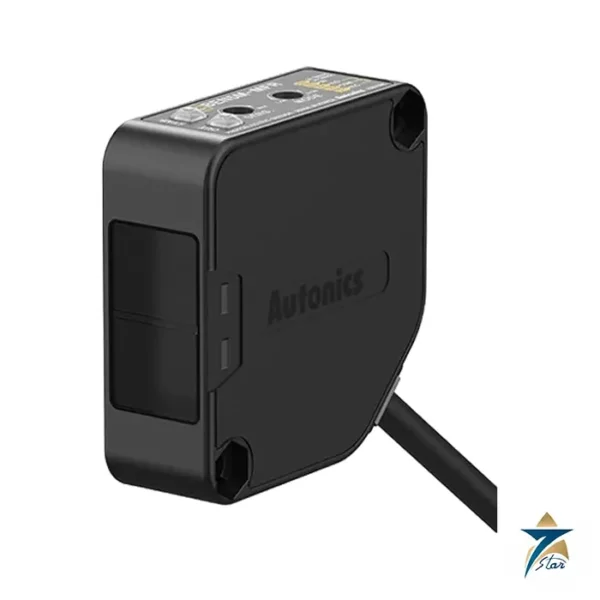
The BX Series is built around four sensing types, and the distance numbers differ greatly. The through-beam BX15M-T reaches 15 m, the retroreflective BX5M-M reaches 5 m with an MS-2 reflector, the polarised retroreflective BX3M-P reaches 3 m with a red 660 nm source, and Autonics BX700-DFR reaches 700 mm without any reflector. Unit weights follow the same pattern: about 225 g for the AC/DC through-beam set against about 115 g for the diffuse model.

The DC solid-state counterpart is BX700-DDT, working at 12 to 24 V DC with a transistor output and a response of 1 ms or less. A version with a built-in timer is also described in the same manual, offering OFF delay, ON delay, OFF delay and one-shot modes with an adjustable 0.1 to 5 second delay.

Where it is used

Examples across Oman and the GCC include detecting cartons and pallets on conveyors, confirming the presence of a vehicle or trolley in a bay, monitoring bin and hopper contents at a fixed height, and controlling doors and barriers. The relay output lets the sensor start a contactor coil or a signal lamp directly on mains-powered equipment.

Selection and compatibility notes

A diffuse sensor’s range depends on the target’s colour and finish, so the 700 mm figure applies to white paper; dark or matt black objects are detected at shorter range. Reduce sensitivity when detecting through a bright background. Do not choose this model for transparent targets such as glass. Keep the relay load within 3 A and add a surge suppressor on inductive loads. Provide 0.5 seconds after power-up before relying on the output, since the control output stays off for that time.

Housing, indicators and commissioning aids

The BX body is larger than a compact sensor because it houses the wide-range power supply and the relay, and that space is also used for a clear set of aids. A yellow operation indicator shows the output state, a green self-diagnosis indicator confirms that the received light level is stable, and a switch on the side selects Light ON or Dark ON without rewiring. The manual describes a sensitivity adjuster that is set with the screwdriver supplied, and it warns against turning it with excessive force. For the diffuse type the rule of thumb is to turn the adjuster up from minimum until the operation indicator comes on with the target in position, mark that point, then remove the target and note where it goes off, and finally set the adjuster between the two positions. That procedure gives Autonics BX700-DFR a margin against dust build-up on the lens and against changes in background reflection.

Installation and commissioning

Mount on a bracket using the bolts supplied and wire the terminals with UL approved stripped crimp terminals, tightening the terminal screws to 0.8 N m and the protective cover to 0.3 to 0.5 N m. For waterproofing, use round cable of 6 to 10 mm outer diameter in the gland. Power up, aim the beam at the target, then set the sensitivity and mode. Verify the operation indicator and the self-diagnosis indicator on Autonics BX700-DFR before leaving the machine in production.

Maintenance

Clean the acrylic lens periodically, check terminal tightness after vibration, and replace the sensor once relay contacts approach their electrical life limit.

Ordering notes for Autonics BX700-DFR

Quote BX700-DFR with the quantity. If you need DC transistor output, a timer function or a longer range, tell us and we will propose the corresponding BX code.

Related items you may also need: Autonics E40S6-2500-6-L-5 Rotary Encoder Incremental | SICK GTB10-P4211 Background Suppression Sensor | Banner QS30ARXH2OQ5 Water Sensor Receiver, High Gain | All Autonics products.

Documents and quotation

The BX Series product manual is attached to this listing. To request pricing, send part number BX700-DFR, the quantity and your delivery location in Oman or the GCC through the RFQ form and we will confirm availability and lead time.

Datasheets & Documents
  • PDF Datasheet Autonics BX700-DFR Diffuse Photoelectric Sensor 700 mm Datasheet Download
Reviews (0)

Reviews

There are no reviews yet.

How would you rate this product?

It takes about 10 seconds — just tap a star. Your email is never published.

About brand

Autonics is a South Korean maker of sensors and controllers, founded in 1977 as a small engineering business making controllers for looms. It took the Autonics name in 1988 and opened a new corporate headquarters in Busan in 2014. Autonics makes proximity and photoelectric sensors, rotary encoders, temperature controllers, counters, timers and stepper motor systems, with factories in Busan and Yangsan.

Seven Star LLC lists the Autonics E40S6-2500-6-L-5 incremental rotary encoder and supplies Autonics sensors and control devices in Oman and the GCC.

Autonics company profile

Founded 1977, South Korea
Current name Autonics, since 1988
Headquarters Busan, South Korea
Factories Busan and Yangsan
Product families E40 and E50 rotary encoders, PR proximity sensors, BJ photoelectric sensors, TK temperature controllers

Milestones

  • 1977: The company is founded.
  • 1988: Renamed Autonics Corporation.
  • 2014: Opens its Busan headquarters.

Reading the Autonics E40S encoder code

E40S is the 40 mm diameter shaft-type incremental encoder, and the 6 that follows is the 6 mm shaft. 2500 is the resolution in pulses per revolution. The next 6 means six output signals: A, B and Z with their inverted signals. L is a line driver output and the final 5 is a 5 V DC supply. The same 40 mm body is made in hollow shaft form as the E40H and E40HB series.

Where Autonics encoders are used

Servo and spindle feedback, conveyor length measurement, packaging and printing machines.

Ordering Autonics encoders: what we need

Send the complete model string from the label. If it is worn off, give the body and shaft diameter, pulses per revolution, output type, supply voltage and cable or connector style.

Facts checked against Autonics corporate profiles, October 2026.

FAQ

Questions about the Autonics BX700-DFR Diffuse Photoelectric Sensor 700

Answers from our engineering team on installation, compatibility and integration.

01What does BX700-DFR mean?
BX is the series, 700 is a 700 mm sensing distance, D is diffuse reflective and FR is AC/DC power with relay contact output.
02What supply voltage does BX700-DFR accept?
The relay model accepts 24 to 240 V DC or 24 to 240 V AC at 50/60 Hz with 10 percent tolerance.
03What is the protection rating of this sensor?
The product manual gives IP65 under IEC standards and an ambient range of minus 20 to plus 55 degrees C.
04How is the sensor wired?
It has a wire terminal block; the manual calls for UL approved crimp terminals and a terminal screw torque of 0.8 N m.
05Does the output turn on right after power-up?
No. The control output stays off for 0.5 seconds after power-on to prevent malfunction.