- Automation & ControlView all 3,060 products
- Automation Accessories
- AC Drives
- PLC & I/O Cards
- Industrial Communications
- Vibration Monitoring
- Isolator & Barrier
- Controllers & Data Acquisition
- Safety Switches & Guard Locking
- Motor Soft Starters
- Encoders
- CCTV & Security
- Pneumatic Cylinders
- HMI Displays
- Servo Drives
- Industrial Computers
- Machine Vision
- Automation Software
- Robotics
Brand: Autonics
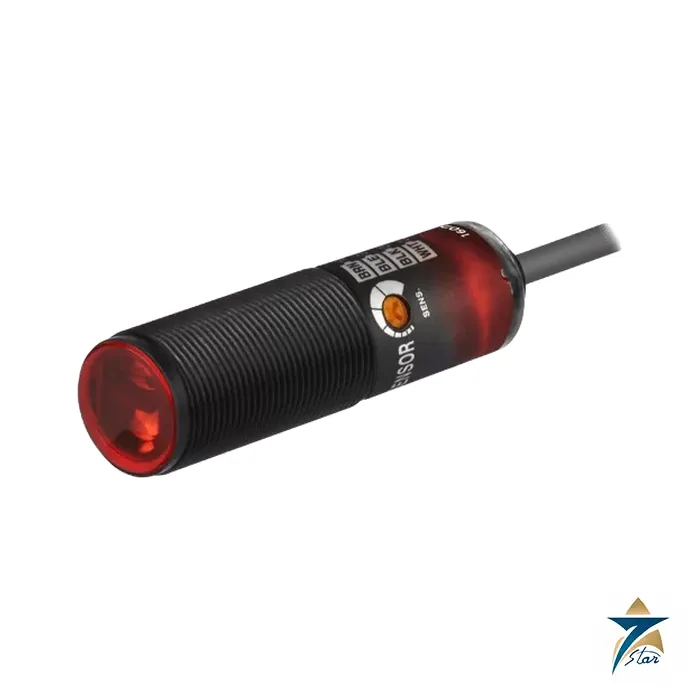
Autonics BRQP400-DDTA M18 Diffuse Photoelectric Sensor 400 mm
Description
Overview
A threaded M18 plastic barrel, a red spot of light and a reach of 400 mm: this is the Autonics BRQP400-DDTA, a diffuse reflective photoelectric sensor from the BRQ cylindrical family. It is meant for detecting objects directly, without a reflector or second housing, and it combines a sensitivity adjuster, mutual interference prevention and an IP67 rating in a body that weighs only about 70 g. It operates from 10 to 30 V DC and has an NPN output. Seven Star LLC is an independent supplier serving Oman and the GCC.
Breaking down the code Autonics BRQP400-DDTA
BRQ is the cylindrical series with front sensing. The letter P stands for the plastic case material, whereas T would denote SUS316L stainless steel and M nickel plated brass. The number 400 is the sensing distance in millimetres. The first D in the group DDTA is the diffuse reflective sensing type, the second D indicates 10 to 30 V DC supply, T the solid state transistor output, and A the standard appearance, as opposed to B, the short body plastic model. With no C and no P at the end, the connection is a fixed cable and the output is NPN.
Technical data of Autonics BRQP400-DDTA
| Parameter | Value |
|---|---|
| Sensing type | Diffuse reflective |
| Sensing distance | 400 mm on non-glossy white paper 100 x 100 mm |
| Objects | Opaque and translucent |
| Hysteresis | 20 percent of sensing distance or less |
| Response time | 1 ms or less |
| Light source | Red, 660 nm |
| Sensitivity | Adjustable by screw adjuster |
| Mutual interference prevention | Yes |
| Operation mode | Light ON or Dark ON selectable by control wire |
| Supply | 10 to 30 V DC, plus or minus 10 percent, ripple 10 percent or less |
| Consumption | 30 mA or less |
| Output | NPN open collector, 30 V DC, 100 mA, residual 2 V or less |
| Indicators | Operation yellow, stability green |
| Ambient | minus 25 to plus 60 degrees C, 35 to 85 percent RH |
| Protection | IP67 |
| Cable | 4 mm, 4-wire, 2 m, AWG 26 |
| Material | Plastic case, PMMA lens |
| Weight | about 70 g, about 150 g packaged |
How the Autonics BRQP400-DDTA differs from other BRQ variants
The BRQ family offers three principles. The through-beam types reach 5, 20 or 30 m and detect objects of 7 mm, the polarized retroreflective types reach 3 m with the MS-2A reflector and need objects of 75 mm, and the diffuse types reach 100 mm, 400 mm or 1 m. Within the diffuse group, the Autonics BRQP400-DDTA sits at the middle distance: farther than the 100 mm unit and nearer than the 1 m unit, which is tested on a larger 300 x 300 mm white paper. Its hysteresis of 20 percent is the same across the diffuse types. Compared with stainless and brass variants, which weigh about 70 g too but need 14.7 N m of nut torque, the plastic body requires only 0.39 N m.
Where it works well
The 400 mm reach is practical for detecting boxes on a conveyor from the side, pallets in a stack, vehicles approaching a barrier, or products inside a filling station. Since translucent objects are detected too, thin plastic containers and film can be sensed. Plants in Oman and the GCC use similar cylindrical sensors in food processing, packaging, logistics and water treatment, where a plastic housing resists cleaning chemicals better than painted steel. The IP67 rating protects against dust and temporary immersion.
Mounting the Autonics BRQP400-DDTA
The M18 x 1 barrel fits a hole of about 18.5 mm, and the two supplied M18 nuts hold it in place. The plastic body must only be tightened to 0.39 N m, so do not use a wrench with force. Fit the sensor perpendicular to the direction of travel, or tilt it slightly when targets are glossy. When several sensors are mounted next to one another, the manual warns about mutual interference; this sensor includes prevention, but it is still wise to keep the beams from overlapping or crossing. Protect the cable from sharp bending and impacts, since damage reduces water resistance.
Sensitivity setting and modes
Use the supplied screwdriver to turn the adjuster gently from minimum to the point where the yellow operation indicator turns on with the target present, then from there to maximum or to the point where the indicator turns on with only background, and finish with the adjuster midway between the two points. The green stability light confirms a safe margin. The default is Light ON; to select Dark ON, connect the control wire as the connection diagram shows. Wait 0.5 seconds after power-up before relying on the output, and when the sensor and the load use separate supplies, switch the sensor on first. Connect inductive loads through a surge suppressor, and keep the sensor wiring as short as practical and away from power cables.
Maintenance and troubleshooting
Clean the lens with a dry cloth, not with water or solvents. If the sensor will not detect a dark object at the expected distance, the colour of the object reduces the effective reach, so reduce the distance or increase sensitivity. If it triggers on the background, bring the sensitivity down or add a matt black screen behind the target. Use a diode or varistor across inductive loads, and ground the F.G. terminal when the panel contains inverters or servo drives. A damaged unit is replaced as a whole. Remember that the sensing distance on coloured or dark objects is shorter than the 400 mm stated for white paper, because the manual rates the distance on a non-glossy white target; a trial with the real product, at the real speed and at the temperature extremes of the site, is the only reliable way to set the margin.
Keep a record of the sensitivity position and mode used on each machine, so that after a replacement the same behaviour can be recreated in minutes, and label the cable with the part number Autonics BRQP400-DDTA.
Related items you may also need: Autonics E40S6-2500-6-L-5 Rotary Encoder Incremental | Keyence LV-NH37 Laser Sensor Head, Spot Reflective | SICK GL6L-P3211 G6 Retro-Reflective Sensor | All Autonics products.
Documents and quotation
The Autonics BRQ series manual that covers the Autonics BRQP400-DDTA is attached with ordering information, diagrams and characteristic curves. Send an RFQ with the part number Autonics BRQP400-DDTA, quantity and delivery location in Oman or the GCC.
Datasheets & Documents
- Datasheet Autonics BRQP400-DDTA M18 Diffuse Photoelectric Sensor 400 mm Datasheet Download
Reviews (0)
How would you rate this product? Cancel reply
About brand
Autonics is a South Korean maker of sensors and controllers, founded in 1977 as a small engineering business making controllers for looms. It took the Autonics name in 1988 and opened a new corporate headquarters in Busan in 2014. Autonics makes proximity and photoelectric sensors, rotary encoders, temperature controllers, counters, timers and stepper motor systems, with factories in Busan and Yangsan.
Seven Star LLC lists the Autonics E40S6-2500-6-L-5 incremental rotary encoder and supplies Autonics sensors and control devices in Oman and the GCC.
Autonics company profile
| Founded | 1977, South Korea |
|---|---|
| Current name | Autonics, since 1988 |
| Headquarters | Busan, South Korea |
| Factories | Busan and Yangsan |
| Product families | E40 and E50 rotary encoders, PR proximity sensors, BJ photoelectric sensors, TK temperature controllers |
Milestones
- 1977: The company is founded.
- 1988: Renamed Autonics Corporation.
- 2014: Opens its Busan headquarters.
Reading the Autonics E40S encoder code
E40S is the 40 mm diameter shaft-type incremental encoder, and the 6 that follows is the 6 mm shaft. 2500 is the resolution in pulses per revolution. The next 6 means six output signals: A, B and Z with their inverted signals. L is a line driver output and the final 5 is a 5 V DC supply. The same 40 mm body is made in hollow shaft form as the E40H and E40HB series.
Where Autonics encoders are used
Servo and spindle feedback, conveyor length measurement, packaging and printing machines.
Ordering Autonics encoders: what we need
Send the complete model string from the label. If it is worn off, give the body and shaft diameter, pulses per revolution, output type, supply voltage and cable or connector style.
Facts checked against Autonics corporate profiles, October 2026.
Browse Autonics products by category: Encoders.
FAQ
Questions about the Autonics BRQP400-DDTA M18 Diffuse Photoelectric
Answers from our engineering team on installation, compatibility and integration.
01What is the sensing distance of the Autonics BRQP400-DDTA?
It is a diffuse reflective sensor with a 400 mm sensing distance on 100 x 100 mm non-glossy white paper, adjustable by a sensitivity screw.
02What does the P in Autonics BRQP400-DDTA mean?
P stands for the plastic case material; the same series also uses T for SUS316L stainless steel and M for nickel plated brass.
03What supply does the Autonics BRQP400-DDTA require?
A 10 to 30 V DC supply with ripple up to 10 percent, drawing 30 mA or less, with an NPN open collector output up to 100 mA.
04Can the Autonics BRQP400-DDTA work in Dark ON mode?
Yes, Light ON or Dark ON can be selected through the control wire, according to the connection diagram of the manual.
05What is the protection rating of the Autonics BRQP400-DDTA?
The plastic model is rated IP67 and operates from minus 25 to plus 60 degrees C at 35 to 85 percent relative humidity.


Reviews
There are no reviews yet.