Brand:

Autonics BM1M-MDT 1 m Retroreflective Photoelectric Sensor

Description

Overview

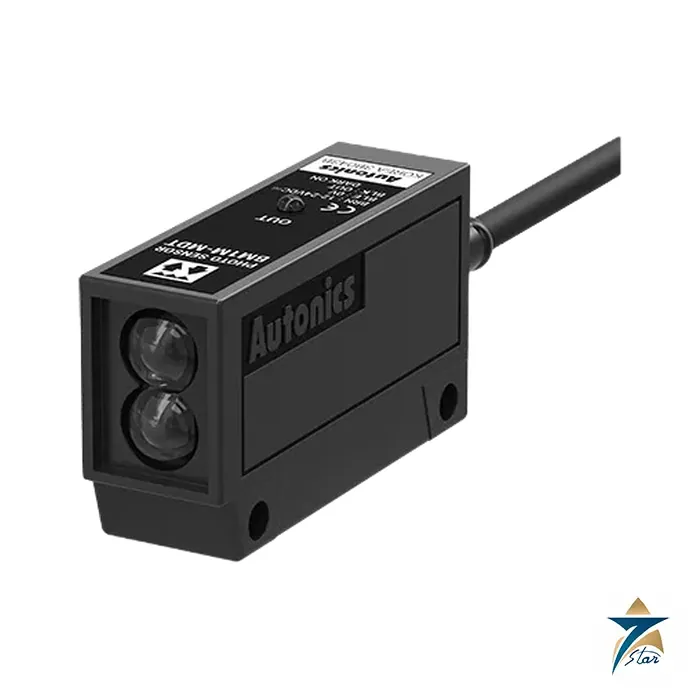
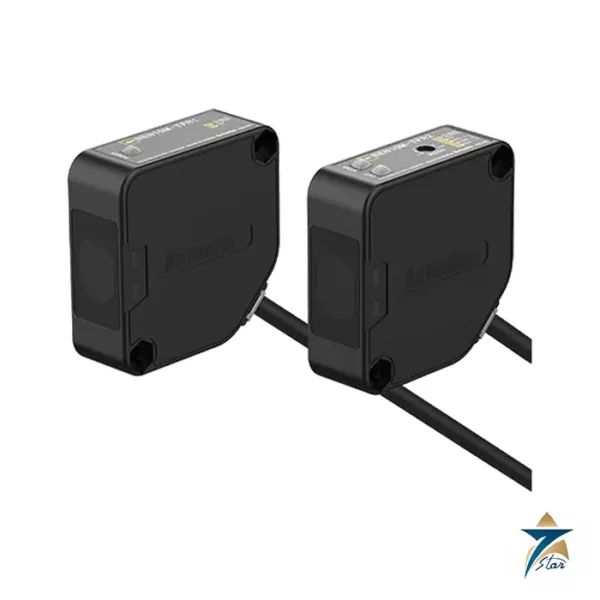
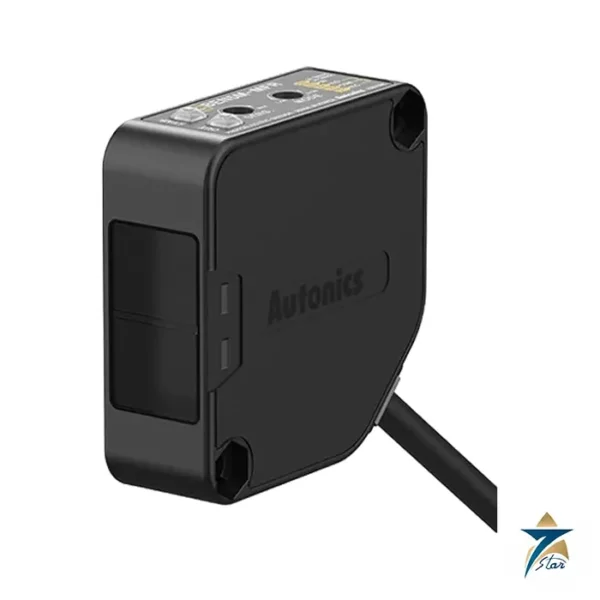
Not every detection task justifies a premium sensor, and the BM series exists for exactly those jobs. The Autonics BM1M-MDT is a retroreflective photoelectric sensor in a small plastic housing, working over 1 m with the MS-2 reflector and switching an NPN open collector output from a 12 to 24 V DC supply. It is economical, quick to wire with its fixed 2 m cable, and sized to fit into narrow machine frames. Seven Star LLC is an independent supplier serving Oman and the GCC.

Interpreting Autonics BM1M-MDT

The prefix BM identifies the economical general-purpose family. The figure 1M gives the range as 1 metre, and the next letter M names the retroreflective principle, in contrast with T for through-beam and D for diffuse. The letter D that follows is the 12 to 24 V DC supply and T is the solid state transistor output. Because the code finishes there, it is a reflective type and has no emitter or receiver digit; the cable is the standard fixed type.

Specifications of the Autonics BM1M-MDT

Item Value in the manual
Sensing type Retroreflective
Sensing distance 1 m with reflector MS-2
Object Opaque materials, minimum diameter 60 mm
Response time 3 ms or less
Light source Infrared, 940 nm
Operation mode Dark ON
Supply 12 to 24 V DC, plus or minus 10 percent, ripple 10 percent or less
Current consumption 40 mA or less
Output NPN open collector, 30 V DC and 100 mA maximum, residual 1.5 V or less
Protection Reverse power and output short overcurrent
Ambient illuminance Sunlight 11,000 lx, incandescent 3,000 lx
Ambient temperature minus 10 to plus 60 degrees C, no condensation
Dielectric strength 1,000 V AC for 1 minute
Cable 4 mm, 3-wire, 2 m
Housing ABS case, acrylic sensing part, steel bracket
Weight about 105 g, about 188 g packaged

How the Autonics BM1M-MDT differs from other BM variants

The BM series has three basic sensing types. The BM3M-TDT through-beam sensor reaches 3 m and detects objects as small as 8 mm, but it takes two housings and weighs about 170 g. The diffuse BM200-DDT reaches only 200 mm on white paper and weighs about 88 g, and it is the only type with a sensitivity adjuster and Light ON mode as standard. The Autonics BM1M-MDT sits between these: the 1 m reach with a reflector needs only one cable run, and it weighs about 105 g, but it has no sensitivity adjustment and it requires an object of at least 60 mm diameter.

Applications

Retroreflective sensors of this size are applied to conveyor object detection, door and shutter monitoring, parts feeders, vending and packaging machines. In Oman and the GCC, light conveyors in logistics, labelling lines and small water bottling plants use them as a low-cost way to confirm product presence. The Dark ON action means that the output is on when the beam is interrupted, which is a convenient default for object detection since a broken cable or a lost reflector can also be recognised by a standing condition.

Mounting and wiring

Fix the sensor with the supplied bracket and bolts, and place the MS-2 reflector facing it, parallel to the sensing side. Use the brown wire for the positive supply, blue for 0 V, and black for the NPN output. The load is connected between the black wire and the positive supply, and the current is limited to 100 mA. Connect an inductive load such as a relay or solenoid through a diode. Keep the cable away from power lines and extend it only with an equal or heavier conductor.

Alignment advice

With the power on, move the sensor or the reflector until the red operation indicator behaves as expected: it should change state when a hand is placed in the beam and recover when removed. Because the target must have a diameter of at least 60 mm, a small bottle neck or a thin strap will not reliably interrupt the beam. For glossy objects consider a polarized type of another series, because the infrared retroreflective principle can confuse shiny items with the reflector.

Choosing a reflector for the Autonics BM1M-MDT

The MS-2 reflector is the standard choice, and the manual also lists larger and smaller reflectors, such as MS-3 at 81.5 by 60.5 mm, and the compact MS-4, MS-5 and MS-6 for tight spaces. A larger reflector generally gives a longer detection distance, and a high reflectance reflector increases it. Reflector tapes of the MST series can also be cut to size, with effective reflectance for the BM series of 70 percent for the 50 mm tape, 110 percent for the 100 mm tape and 170 percent for the 200 mm tape when compared with the standard mirror. Since the reach of 1 m is stated for the MS-2, shortening the distance will give a wider margin where dust is expected, for example around cement, flour or fabric handling.

The infrared beam is invisible, so to check alignment look at the red operation indicator while moving the sensor across the reflector, noting the two edges at which the state changes and then fixing the sensor midway between them. A reflector mounted on a swinging door or vibrating guard should be fixed with both bolts and checked for loosening, as a small angular change moves the return beam off the lens.

Maintenance

Wipe the lens and reflector with a soft dry cloth. Check the bracket screws after the first week of running. If the output stays unchanged when the beam is blocked, check supply polarity, reflector cleanliness and background light intensity, particularly strong sunlight through a roller door above 11,000 lx. The housing has no stated IP rating in the manual, so protect it from spray, and install it in a dry location.

Replace the unit when the cable or housing is damaged, since there are no user serviceable parts. For production lines that cannot stop, keep one spare in the maintenance cabinet and note its code Autonics BM1M-MDT on the shelf label.

Related items you may also need: Autonics E40S6-2500-6-L-5 Rotary Encoder Incremental | SICK GRSE18-N2442 GR18 Through-Beam Sensor | SICK GTB6-P4231 Miniature Background Suppression Sensor | All Autonics products.

Documents and quotation

The Autonics BM series manual covering the Autonics BM1M-MDT is attached to this page with its order code, circuit diagrams, reflector options and dimensions. Send an RFQ with the part number Autonics BM1M-MDT, quantity and delivery location in Oman or the GCC.

Datasheets & Documents
  • PDF Datasheet Autonics BM1M-MDT 1 m Retroreflective Photoelectric Sensor Datasheet Download
Reviews (0)

Reviews

There are no reviews yet.

How would you rate this product?

It takes about 10 seconds — just tap a star. Your email is never published.

About brand

Autonics is a South Korean maker of sensors and controllers, founded in 1977 as a small engineering business making controllers for looms. It took the Autonics name in 1988 and opened a new corporate headquarters in Busan in 2014. Autonics makes proximity and photoelectric sensors, rotary encoders, temperature controllers, counters, timers and stepper motor systems, with factories in Busan and Yangsan.

Seven Star LLC lists the Autonics E40S6-2500-6-L-5 incremental rotary encoder and supplies Autonics sensors and control devices in Oman and the GCC.

Autonics company profile

Founded 1977, South Korea
Current name Autonics, since 1988
Headquarters Busan, South Korea
Factories Busan and Yangsan
Product families E40 and E50 rotary encoders, PR proximity sensors, BJ photoelectric sensors, TK temperature controllers

Milestones

  • 1977: The company is founded.
  • 1988: Renamed Autonics Corporation.
  • 2014: Opens its Busan headquarters.

Reading the Autonics E40S encoder code

E40S is the 40 mm diameter shaft-type incremental encoder, and the 6 that follows is the 6 mm shaft. 2500 is the resolution in pulses per revolution. The next 6 means six output signals: A, B and Z with their inverted signals. L is a line driver output and the final 5 is a 5 V DC supply. The same 40 mm body is made in hollow shaft form as the E40H and E40HB series.

Where Autonics encoders are used

Servo and spindle feedback, conveyor length measurement, packaging and printing machines.

Ordering Autonics encoders: what we need

Send the complete model string from the label. If it is worn off, give the body and shaft diameter, pulses per revolution, output type, supply voltage and cable or connector style.

Facts checked against Autonics corporate profiles, October 2026.

FAQ

Questions about the Autonics BM1M-MDT 1 m Retroreflective Photoelectric

Answers from our engineering team on installation, compatibility and integration.

01What is the sensing distance of the Autonics BM1M-MDT?
It is a retroreflective sensor with a 1 m range measured with the MS-2 reflector, for opaque objects of at least 60 mm diameter.
02What is the output of the Autonics BM1M-MDT?
It has an NPN open collector output up to 100 mA and 30 V DC, with a residual voltage of 1.5 V or less and short circuit protection.
03What supply does the Autonics BM1M-MDT need?
A 12 to 24 V DC supply with plus or minus 10 percent tolerance and ripple of 10 percent or less, drawing 40 mA or less.
04What operation mode does the Autonics BM1M-MDT use?
The manual lists Dark ON mode for the retroreflective type, so the output is on when the beam to the reflector is interrupted.
05How fast is the Autonics BM1M-MDT?
The response time is 3 ms or less, using an infrared light source with a peak wavelength of 940 nm.