Brand:

Autonics TX4S-14R 48×48 LCD PID Temperature Controller

Description

Overview

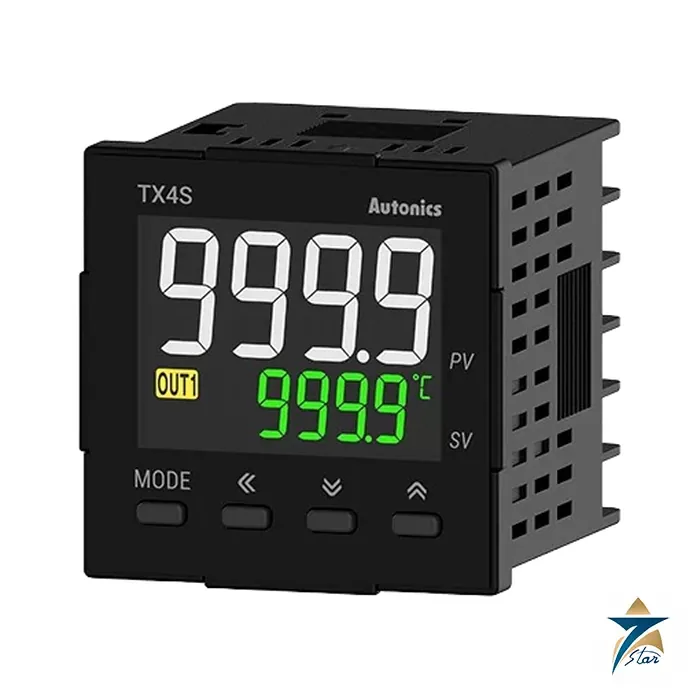
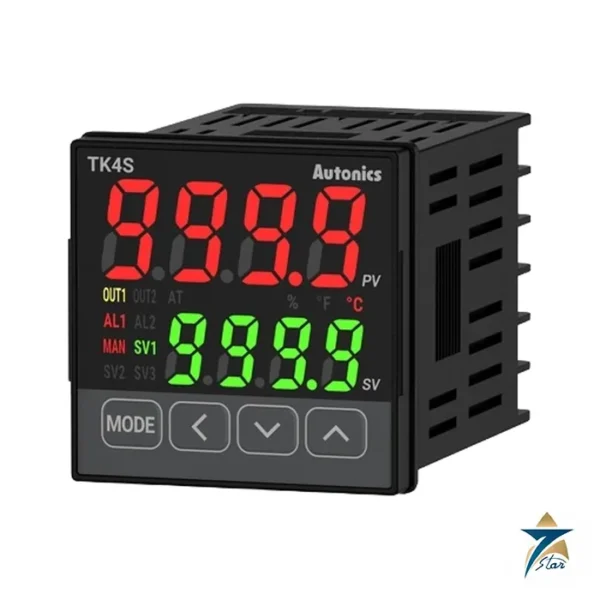
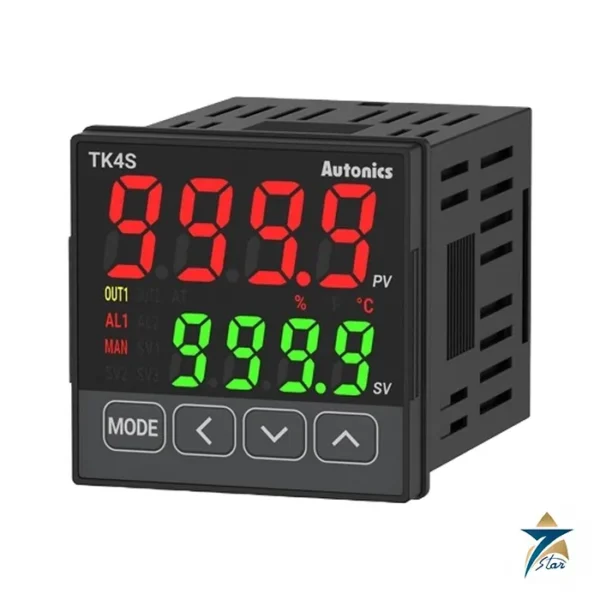
The Autonics TX4S-14R brings a bright white-on-black LCD to the familiar 48 x 48 mm DIN controller format. Behind the display is a PID controller with a relay output, one alarm relay, a 100 to 240 V AC supply and a shallow 45 mm body depth, so it fits into shallow cabinets where older models do not. It is the member of the TX series that most plants choose for small heaters, ovens and sealers. Seven Star LLC is an independent supplier serving Oman and the GCC.

Reading the code Autonics TX4S-14R

TX4 is the four-digit LCD series, and S is the 48 x 48 mm size with screw terminals. The digit 1 chooses alarm 1 as the optional output. The digit 4 stands for the 100 to 240 V AC supply, whereas 2 is for 24 V AC or 24 to 48 V DC. R is a relay control output, and because the code has no letter after it, the terminals are the screw type; an L at the end would denote the screwless version.

Key data for Autonics TX4S-14R

Item Data
Front size 48 x 48 mm, cut-out 45 mm square, body depth 45 mm
Display LCD with 11 segments, PV white, SV green, indicators yellow
Supply 100 to 240 V AC 50/60 Hz, 8 VA or less
Control output Relay 250 V AC 3 A, 30 V DC 3 A, 1a
Alarm 1 Relay 250 V AC 3 A, 1a
Sampling period 50 ms
Control modes ON/OFF, P, PI, PD, PID, heating or cooling
Proportional band 0.1 to 999.9 degrees
Integral and derivative time 0 to 9,999 seconds each
Control cycle 0.5 to 120.0 seconds
Hysteresis 1 to 100 (0.1 to 50.0) degrees
Thermocouple ranges K minus 50 to 1,200; J minus 30 to 800; L minus 40 to 800; T minus 50 to 400; R and S 0 to 1,700 degrees C
RTD ranges DPt100 minus 100 to 400; Cu50 minus 50 to 200 degrees C
Relay life 5 million mechanical, 200,000 electrical at 250 V AC 3 A
Ambient minus 10 to plus 50 degrees C, 35 to 85 percent RH
Protection IP50 front
Weight about 97 g, about 150 g packaged

How the Autonics TX4S-14R differs from other TX4S variants

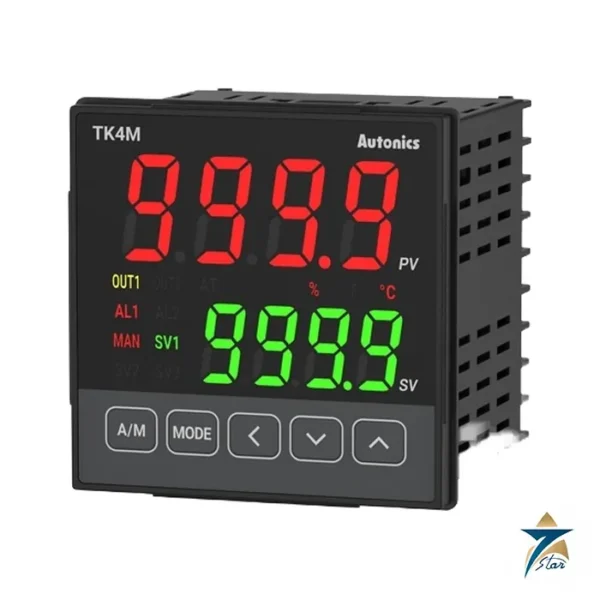
The TX4S family changes mainly in output and options. The R in the present code gives a relay; TX4S-14S would give an SSR drive of 13 V DC plus or minus 3 V up to 20 mA, and TX4S-14C a selectable current or SSR output. The TX4S-L has screwless terminals and a longer body of 54.6 mm against 45 mm. Options 2, R, T, A and B add a second alarm, PV transmission, RS485 communication or a combination. Against the larger TX4M, this unit is 48 mm square and weighs about 97 g, compared with about 138 g.

Why choose an LCD controller

An LCD of this type is easier to read from an angle and under bright light than a small seven-segment LED, and it can display text-like characters for parameters through its 11 segments. The cost is a slower display refresh at low temperature: the manual notes that below 0 degrees C the display cycle is slow. In the GCC the units are normally installed in conditioned rooms or cabinets, so this is rarely a concern, but remember that the front panel is IP50 and is not suited for washdown or heavy dust without an additional cover.

Use cases in Oman and the GCC

Typical uses are heat sealers, laminators, bench ovens, small furnaces, hot plates, packaging and label equipment and test rigs. The compact depth makes it suited to enclosures on machinery that was built with limited space behind the panel. The temperature ranges are focused on common sensors: K up to 1,200 degrees C, J to 800, and DPt100 down to minus 100, which covers the great majority of workshop heating tasks but not high-temperature furnaces that need B or higher-range types.

Selecting the right output letter for the Autonics TX4S-14R

The R in this code connects a mechanical relay, which is the simplest choice for small resistive heaters and for switching a contactor coil. It is cheap and isolates the load completely, but it wears out with switching count and is noisy in quiet laboratories. If the loop needs a fast cycle, order the S version, with an SSR drive of 13 V DC plus or minus 3 V at up to 20 mA, and add an external solid state relay. If the final element is a thyristor power unit or a proportional valve, the C version offers 4 to 20 mA or 0 to 20 mA into a load of up to 500 ohm. Ordering the wrong letter is a common cause of delay, so confirm the type of heater, the load current and the actuator before sending the RFQ.

The supply digit deserves the same care. Digit 4 accepts the usual 100 to 240 V AC mains, but a panel with only a 24 V control supply needs digit 2, which accepts 24 V AC or 24 to 48 V DC with a consumption of 8 VA on AC or 5 W on DC.

Installation and wiring

Cut a 45 mm square panel opening, insert the controller and push the mounting bracket along the arrow direction with a flathead screwdriver. Use crimp terminals of the fork or round type on the screw terminals, and observe the width limits of the terminal drawing. Use the same gauge for all three RTD leads, connect the supply and relay contacts with suitable cable and keep sensor wiring away from power cables. For heaters above 3 A, switch a contactor or SSR from the relay.

Accuracy and set-up notes

At 23 degrees C plus or minus 5, the displayed value is accurate to plus or minus 0.3 percent or 1 degree C, whichever is greater, plus one digit. For thermocouples R and S, and for L and Cu50 sensors, the figures are looser, and outside the room temperature range the accuracy is plus or minus 0.5 percent or 2 degrees C. Run auto tuning once the process is at working conditions, then trim the PID constants if the response overshoots. Parameters are held in non-volatile memory for about ten years.

Maintenance

Check the terminals for tightness, wipe the front with a dry cloth, and log relay switching so that the 200,000 operation electrical life is not exceeded unnoticed. A sensor break is reported on the display, and the control output follows the configured safe value. Keep a spare of the same code for critical heaters.

Related items you may also need: Autonics E40S6-2500-6-L-5 Rotary Encoder Incremental | Banner Q3XTBLD-Q8 Laser Contrast Sensor, 300 mm | SICK GTB6-P4211 Miniature Background Suppression Sensor | All Autonics products.

Documents and quotation

The TX series product manual that covers the Autonics TX4S-14R is attached with ordering codes, input tables, wiring and dimensions. Send an RFQ with the part number Autonics TX4S-14R, quantity and delivery location in Oman or the GCC.

Datasheets & Documents
  • PDF Datasheet Autonics TX4S-14R 48x48 LCD PID Temperature Controller Datasheet Download
Reviews (0)

Reviews

There are no reviews yet.

How would you rate this product?

It takes about 10 seconds — just tap a star. Your email is never published.

About brand

Autonics is a South Korean maker of sensors and controllers, founded in 1977 as a small engineering business making controllers for looms. It took the Autonics name in 1988 and opened a new corporate headquarters in Busan in 2014. Autonics makes proximity and photoelectric sensors, rotary encoders, temperature controllers, counters, timers and stepper motor systems, with factories in Busan and Yangsan.

Seven Star LLC lists the Autonics E40S6-2500-6-L-5 incremental rotary encoder and supplies Autonics sensors and control devices in Oman and the GCC.

Autonics company profile

Founded 1977, South Korea
Current name Autonics, since 1988
Headquarters Busan, South Korea
Factories Busan and Yangsan
Product families E40 and E50 rotary encoders, PR proximity sensors, BJ photoelectric sensors, TK temperature controllers

Milestones

  • 1977: The company is founded.
  • 1988: Renamed Autonics Corporation.
  • 2014: Opens its Busan headquarters.

Reading the Autonics E40S encoder code

E40S is the 40 mm diameter shaft-type incremental encoder, and the 6 that follows is the 6 mm shaft. 2500 is the resolution in pulses per revolution. The next 6 means six output signals: A, B and Z with their inverted signals. L is a line driver output and the final 5 is a 5 V DC supply. The same 40 mm body is made in hollow shaft form as the E40H and E40HB series.

Where Autonics encoders are used

Servo and spindle feedback, conveyor length measurement, packaging and printing machines.

Ordering Autonics encoders: what we need

Send the complete model string from the label. If it is worn off, give the body and shaft diameter, pulses per revolution, output type, supply voltage and cable or connector style.

Facts checked against Autonics corporate profiles, October 2026.

FAQ

Questions about the Autonics TX4S-14R 48×48 LCD PID Temperature

Answers from our engineering team on installation, compatibility and integration.

01What display does the Autonics TX4S-14R have?
It has an 11-segment LCD with a white process value, a green setting value and yellow indicators, in a 48 x 48 mm front.
02What outputs does the Autonics TX4S-14R provide?
It has one relay control output rated 250 V AC 3 A and one alarm 1 relay, supplied from 100 to 240 V AC at 50/60 Hz.
03How deep is the Autonics TX4S-14R?
The body depth is 45 mm for the standard TX4S, much shallower than the 54.6 mm of the screwless TX4S-L version.
04Which sensors does the Autonics TX4S-14R accept?
Thermocouples K, J, L, T, R and S, plus RTD sensors DPt100 and Cu50, each with the ranges listed in its input table.
05What is the protection rating of the Autonics TX4S-14R?
The front panel is rated IP50, with an ambient range of minus 10 to plus 50 degrees C and 35 to 85 percent relative humidity.