Moore Industries THZ2/TPRG/4-20MA/12-42DC [LH2NSP] Transmitter

Description

Moore Industries THZ2/TPRG/4-20MA/12-42DC [LH2NSP] explained

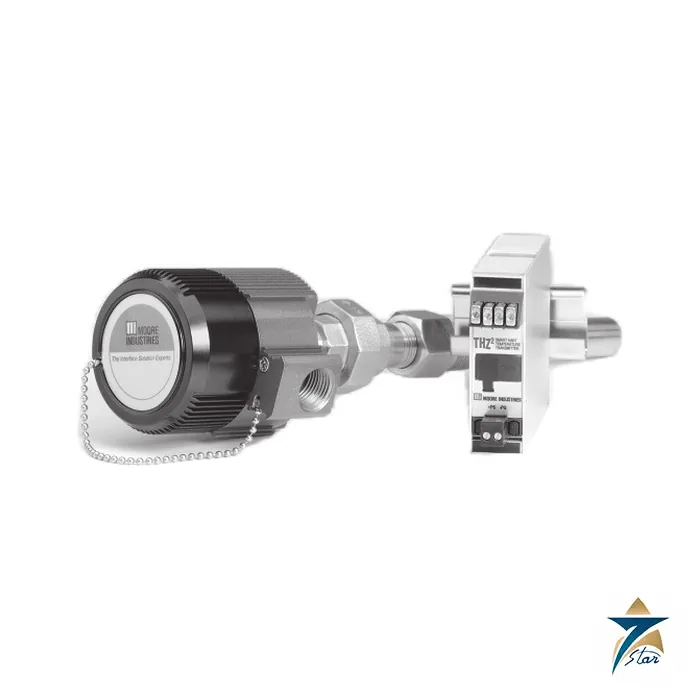
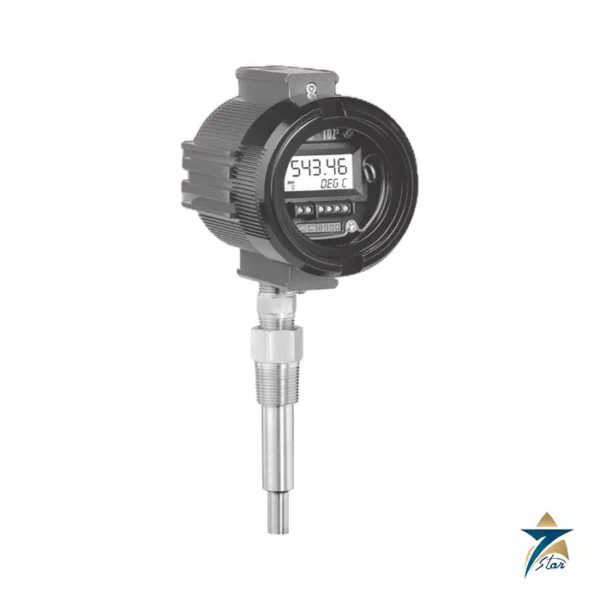
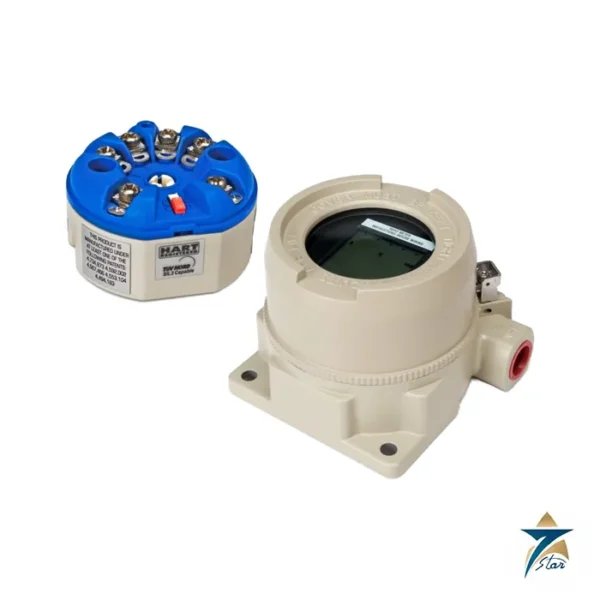
Moore Industries THZ2/TPRG/4-20MA/12-42DC [LH2NSP] combines the THZ2 hockey-puck transmitter module with an explosion-proof LH2 connection head. The result is a compact, sensor-top Smart HART transmitter for classified areas, supplied with the hardware to bolt onto a 2-inch pipe. The THZ2 name signals the second generation of the THZ platform: faster, with 0.01% analog output accuracy instead of 0.015%.

The TPRG code in the input slot matters. THZ2 sells two input families, TPRG for temperature sensors, and HLPRG for 0-50 mA and 0-10 V signals, so the letters tell you the unit is intended for RTDs, thermocouples, ohm, millivolt or potentiometer inputs.

If your records show an older THZ or an analog 4-20 mA transmitter in the same head, the swap to this code is mostly a matter of re-entering the sensor type and range, because the entry threads and the pipe hardware of the LH2NSP head follow the standard LH2 pattern in the datasheet. The unit still arrives programmed only to the extent specified in the order, so tell us the range you want if factory configuration is preferred.

THZ2/TPRG/4-20MA/12-42DC [LH2NSP] feature set

  • Step response of 256 ms typical and 500 ms maximum, quicker than the 600 to 700 ms of the first-generation THZ.
  • Start-up in less than half a second, so the loop is valid almost immediately after power returns.
  • 1500 Vrms isolation in the HPP module, the highest in the family.
  • Programmable burnout levels with upscale 20 to 23.6 mA and downscale 3.6 to 4.0 mA windows.
  • Switchable HART multidrop with fifteen addresses and the THZ2/TDZ2 device description for communicators.

Together these characteristics make the transmitter well suited to tight control loops where sensor failure must be detected and signalled rapidly.

Specification summary for THZ2/TPRG/4-20MA/12-42DC [LH2NSP]

Values are taken from the THZ2 and TDZ2 datasheet.

Parameter Value for THZ2/TPRG/4-20MA/12-42DC [LH2NSP]
Model code THZ2/TPRG/4-20MA/12-42DC [LH2NSP]
Generation THZ2 (second-generation THZ with improved output accuracy and 500 ms step response)
Input TPRG: RTD 2-, 3-, 4-wire Pt, Cu, Ni; thermocouple J, K, E, T, R, S, B, N, C; 0 to 4000 ohm; -50 to 1000 mV; potentiometer
Output 4-20 mA scalable with HART, address 0 to 15
Supply 12-42 V DC standard; 12-30 V DC for the intrinsically safe version
Housing LH2NSP: aluminum explosion-proof connection head, two 1/2-inch NPT entries, metal cover, P suffix = 2-inch pipe-mount hardware
Analog output accuracy Plus or minus 0.01% of maximum span
Isolation 1500 Vrms between input and output continuous (HPP module)
Step response 500 ms maximum, 256 ms typical
Start-up time Less than 0.5 s
Weight 644 g (22.9 oz) for the HPP module in an LH2 head
RFI/EMI immunity 10 V/m at 80-1000 MHz, 1 kHz AM, per IEC 61326, 0.5% of span or less error
Burnout Upscale 20 to 23.6 mA, downscale 3.6 to 4.0 mA, programmable; hardware limit 25 mA
Load capability 500 ohms at 24 V; (supply voltage minus 12 V) divided by 0.024 A
Hazardous-area marking (LH2) FM explosion-proof Class I Div 1 Groups A*, B, C, D; Type 4X, IP66; T6 at 60 C; ATEX Ex d IIC T6 option with E suffix
Reference junction error Plus or minus 0.45 C for thermocouples

Remember to read the table together with the model code: the 12-42DC field is the supply window, the 4-20MA field is the output, and the TPRG field fixes the sensor family. The “NS” in LH2NS means NPT-threaded entries with a metal cover, and the head listing in the datasheet shows that the sibling LH2MS has an M20 cable entry plus a 1/2-inch NPT process entry instead.

How THZ2/TPRG/4-20MA/12-42DC [LH2NSP] differs from THZ and THZ3 codes

A first-generation THZ in the LH2 head quotes 0.015% analog accuracy, 600 ms response and 654 g; this THZ2 in LH2 quotes 0.01%, 500 ms maximum and 644 g. The later THZ3 adds a second sensor input and HART 7 with a 460 ms single-input step response, so choose THZ3 where redundancy matters and THZ2 where a single sensor and the lowest cost are sufficient.

Within THZ2, the LH2NSP head offers explosion-proof protection that the DIN code cannot, but gives up the DIN module HLPRG option for current and voltage inputs.

Application examples for THZ2/TPRG/4-20MA/12-42DC [LH2NSP]

This transmitter is typical on compressor bearings, heater passes, gas-line skin temperatures and process lines in refineries and gas plants in the Sultanate. It also fits offshore decks where space is scarce and the head is bolted on the thermowell.

Because the head is a certified flameproof enclosure, it replaces older non-smart transmitters in existing heads with minimal change, adding HART diagnostics.

Choosing and combining THZ2/TPRG/4-20MA/12-42DC [LH2NSP]

Confirm the certification you need: the datasheet lists FM, CSA, ATEX and ANZEx marks for the LH2 head, with an E suffix for ATEX (supplied with pipe-mount) and an A suffix for ANZEx. Ensure the gland or conduit matches 1/2-inch NPT; M20 versions use the LH2MS code instead.

Match the sensor to the span: Pt RTDs provide 0.1 C digital accuracy, thermocouples add a reference junction term. Keep the lead resistance below 4000 ohms for the RTD plus twice the lead.

Mounting THZ2/TPRG/4-20MA/12-42DC [LH2NSP]

Fit the unit on a 2-inch pipe with the supplied hardware, thread the cable through the entry with a certified fitting, and land the sensor on terminals 1 to 4. Close the metal cover fully and observe the stated T6 ambient limits for the explosion-proof marking.

Power the loop and program the unit with a HART communicator or the PC software.

Maintenance of THZ2/TPRG/4-20MA/12-42DC [LH2NSP]

Check cover threads and entries at plant inspection intervals. The module requires no adjustments; compare the loop value with a reference sensor and apply the trim function to correct offsets. Store the configuration file so a replacement module can be programmed to match.

If a communicator cannot connect, verify that the loop has between 250 and 1100 ohms.

When ordering spares, think in modules and heads separately: the HPP puck inside is the electronics, the LH2 head is the pressure-retaining enclosure, and keeping a spare puck on the shelf is far cheaper than stocking complete assemblies. Because the configuration software and cable are shared across the whole family, one laptop kit serves every THZ2 and TDZ2 you operate.

Supply of THZ2/TPRG/4-20MA/12-42DC [LH2NSP]

Please use the complete string THZ2/TPRG/4-20MA/12-42DC [LH2NSP] when asking for stock and specify the sensor type and range.

Seven Star LLC is an independent supplier serving Oman and the wider GCC and is not affiliated with the manufacturer; all names and part numbers are used only to identify the product being requested.

Documents and quotation

The datasheet for Moore Industries THZ2/TPRG/4-20MA/12-42DC [LH2NSP] can accompany our quotation. Send an RFQ with the part number, quantity and delivery location.

Other Models in the THZ2 TDZ2 Range

Seven Star LLC supplies models from the THZ2 TDZ2 range in Oman and the GCC. Compare the related models below and request a quote for the one that matches your application.

ModelCategory
Moore Industries TDZ2/TPRG/4-20MA/12-42DC [BH2NGP] TransmitterTemperature TransmittersView details
Moore Industries THZ2/TPRG/4-20MA/12-42DC [LH2NSP] TransmitterTemperature TransmittersYou are viewing this model
Moore Industries THZ2/HLPRG/4-20MA/12-42DC [DIN] IsolatorIsolator & BarrierView details
Datasheets & Documents
  • PDF Datasheet Moore Industries THZ2/TPRG/4-20MA/12-42DC [LH2NSP] Transmitter Datasheet Download
Reviews (0)

Reviews

There are no reviews yet.

How would you rate this product?

It takes about 10 seconds — just tap a star. Your email is never published.

About brand

Moore Industries is an American manufacturer of signal interface instruments, founded in 1968 by engineer Leonard W. Moore in North Hills, California. Its first product was the SCT signal converter, built in a friend's workshop. The company has been at its North Hills headquarters since 1974 and still designs and builds its products there, known for rugged aluminium housings.

Seven Star LLC, an independent supplier in Oman, lists Moore Industries temperature transmitters, limit alarm trips, isolators and a PID backup controller, and sources units and replacements by full model number.

Moore Industries company profile

Founded 1968, North Hills, California, USA, by Leonard W. Moore
Headquarters North Hills, California, since 1974
Ownership Privately owned (Moore Industries-International, Inc.)
First product SCT signal converter
Product families Signal isolators and converters (ECT, SCT), temperature transmitters (TRY, THZ), alarm trip units (SPA), miniMOORE multichannel signal conditioners, HART interfaces, SIL-rated safety logic solvers (STA)

Milestones

  • 1968: Leonard W. Moore founds the company and builds the first SCT signal converter.
  • 1974: The company moves into its North Hills headquarters.
  • 2009: miniMOORE wins a Control Engineering Engineers' Choice Award.

Moore Industries product families on this page

The manufacturer's catalog is arranged by function, and many of the items listed here map onto it directly:

  • Temperature transmitters: the TRX, and the STZ functional safety dual input smart HART transmitter
  • Alarm trips: the SPA2 programmable limit alarm trip, including an SPA2 with HLPRG input and four relay outputs
  • Signal isolators, repeaters and converters: the SIX
  • PID controllers and backup stations: the 535 in 1/4 DIN format

Other catalog groups include temperature assemblies and sensors, I/P and P/I converters, remote I/O, HART gateways and interfaces, indicators, and fieldbus device couplers.

Where Moore Industries instruments are used

These are control room and marshalling cabinet devices, plus field-mounted transmitters. Typical jobs are isolating a 4-20 mA loop between two systems, converting a thermocouple or RTD signal for a DCS input, adding an independent high or low trip next to the control system, and keeping a control loop running on a backup station when the main controller is out of service. Process plants in oil and gas, chemicals and power across the GCC use them for exactly these tasks.

Moore Industries products we list

Family Examples
Controllers & Data Acquisition Moore 535-21120BD000 | Industrial PID Ba…, SPA2 Programmable Limit Alarm Trip, Moore-SPA2HL Associated IS Programmable…
Isolator & Barrier HIM Smart HART Loop Interface and Monitor, SIX Signal Isolator, SLA SIL 2/3 Safety Logic Solver and Alarm
Temperature Instrumentation STZ Functional Safety Dual Input Smart H…, TRX Temperature Transmitter
Industrial Communications HES HART to Ethernet Gateway
Valve Positioners IPT2 Current-to-Pressure I/P Transmitter

Ordering Moore Industries instruments: what we need

Moore Industries model numbers are built from fields separated by slashes: unit, input, output, power and options, followed by the housing code in brackets. Every field matters. Send the complete string from the label, the serial number, and for programmable units the input type and range you want set. State any hazardous area or functional safety requirement, because approved versions are ordered with their own option codes.

Facts checked against trade press obituaries of Leonard W. Moore (Control Engineering, Control Global), October 2026.

FAQ

Questions about the Moore Industries THZ2/TPRG/4-20MA/12-42DC [LH2NSP]

Answers from our engineering team on installation, compatibility and integration.

01What does THZ2 mean compared with THZ?
THZ2 is the second-generation Smart HART temperature transmitter with 0.01% analog accuracy and a 500 ms maximum step response.
02What is the LH2NSP housing?
An explosion-proof aluminum connection head with two 1/2-inch NPT entries and a metal cover; the P suffix adds the 2-inch pipe-mount hardware kit.
03How much isolation does the module have?
The HPP version is isolated at 1500 Vrms between input and output, while the DIN version is rated at 500 Vrms.
04Which input types does TPRG cover?
RTDs, thermocouples J, K, E, T, R, S, B, N and C, resistance up to 4000 ohms, millivolts from -50 to 1000 mV and potentiometers.
05How quickly does it start?
The datasheet gives a start-up time of less than 0.5 seconds.