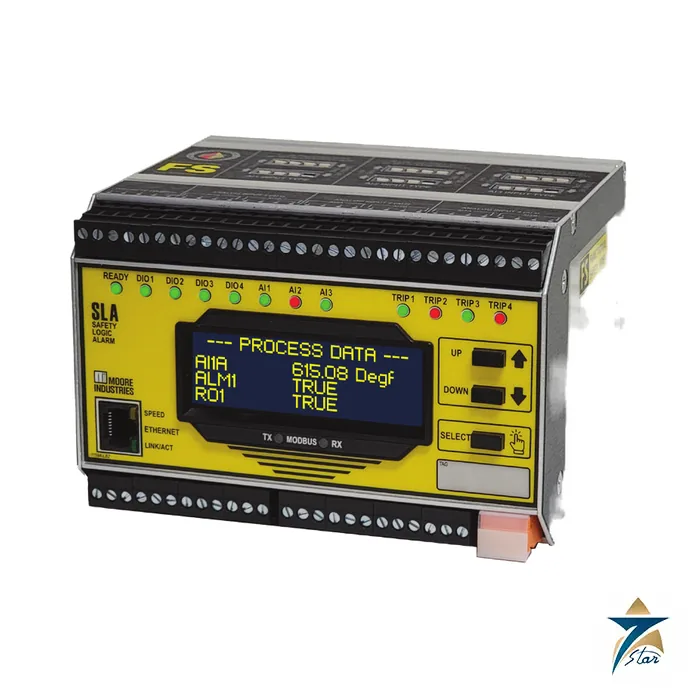
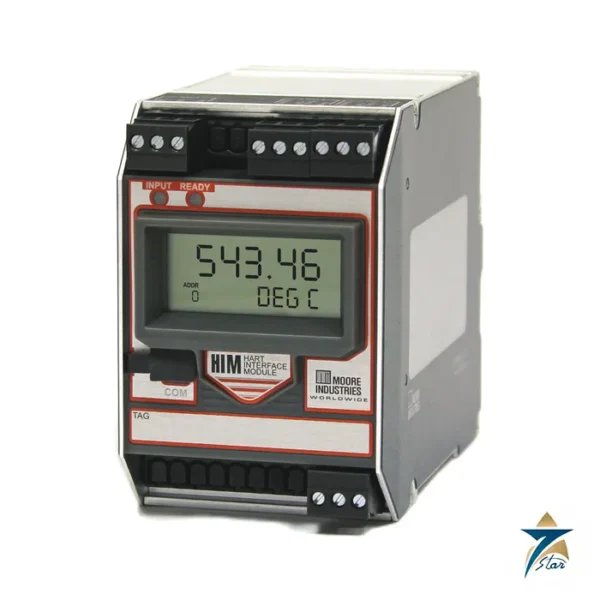
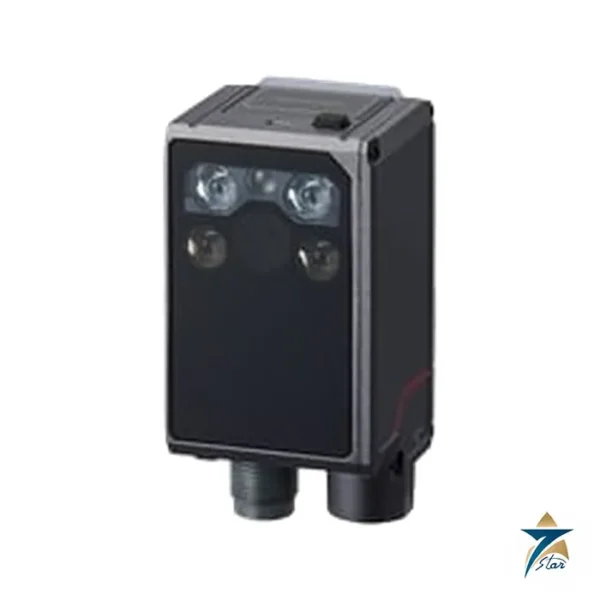
Moore Industries SLA SIL 2/3 Safety Logic Solver and Alarm

Description

A SIL 2/3 capable safety logic solver and alarm for shutdown and alarm-trip duties

The Moore Industries SLA is a 4-wire powered, multiloop and multifunction safety logic solver and alarm in the Moore Industries FS Functional Safety Series. Certified by exida to IEC 61508:2010, it has systematic integrity up to SIL 3 and random integrity up to SIL 2, so it is approved for single use in a safety instrumented system up to SIL 2 and in redundant architectures such as 1oo2 and 2oo3 up to SIL 3. It accepts three dual-input analog channels (six analog inputs) and four discrete I/O channels, drives four relays and offers up to 16 programmable alarms with voting, math and logic functions, so a separate PLC is not needed for alarm trip duty.

Technical specifications

Parameter Specification
Analog inputs Three isolated dual-input channels (AI1A/B, AI2A/B, AI3A/B); each channel set to current/voltage (HLPRG) or temperature/ohms/mV (TPRG)
Input types mA 0-25 mA; voltage 0-11 V; RTD Pt, Ni, Cu 2/3/4-wire; thermocouples J, K, E, T, R, S, N, C, B; ohms 0-4000; millivolts -50 to 1000 mV
Accuracy examples Pt RTD plus or minus 0.1 degrees C; thermocouple K plus or minus 0.3 degrees C; mA plus or minus 2 microamps; voltage plus or minus 1 mV; RJC plus or minus 0.45 degrees C
Discrete I/O Four non-isolated channels, each programmable as input or output; output 30 VDC, 120 mA sink
Relays Four SPDT relays (fourth selectable as fault relay), 3 A at 250 VAC or 30 VDC non-inductive
Analog outputs (option -3AO) Three outputs 0-21.6 mA, plus or minus 3 microamps, 600 ohms source mode, NAMUR 43 failure limits, HART pass-through from input A
Alarms and logic Up to 16 alarms (trip, band, rate of change, stuck input), 16 internal variables, 8 timers, 8 running min/max, 4 custom curves
Trip response time (typical) TPRG one sensor per channel 750 ms; HLPRG one sensor 450 ms
Communications Ethernet 10/100 (MIIP/DTM, HTTP read-only web server, MODBUS/TCP); optional RS-485 MODBUS RTU (-MB485)
Display 4 x 20 OLED with push-buttons; event logger of about 2,000 time-stamped records
Power 10.5 to 30 VDC; 11 W typical, 13 W maximum; 24 VDC transmitter supply 24 mA per input A
Isolation 500 Vrms between case, input, output and power
Ambient and storage temperature -40 to +85 degrees C; 5 to 95% RH non-condensing
Housing and weight Metal DIN-rail housing (35 mm), FLB flange bracket option; 1.3 kg (3 lb)

Ordering, configuration and security

The model number is built as Unit / Input / Output / Power / Options [Housing]. The datasheet example is SLA / 6PRG / 4PRG / 10-30DC / -3AO [DIN]. The SLA is programmed with any FDT-compliant host using its DTM; free PACTware software is offered, and the DTM includes monitoring and simulation to test alarm and safety functions before commissioning. Configuration Security Jumpers can physically stop external reprogramming and keep the web server, MODBUS/TCP and MODBUS RTU read-only, in line with IEC 62443 practice. Each alarm can be set to High Availability, which ignores wiring faults, or High Integrity, which also trips on a fault. An FMEDA report (part number 700-702-43) is available with orders on request.

What to confirm before ordering

Confirm the SIL target, the voting architecture, input types per channel (all inputs of a channel must be the same type), output options, supply and mounting. For general temperature signal conditioning, another Moore unit on this site is the Moore Industries STZ, and related items are under Isolator and Barrier. The attached datasheet (226-710-01G, April 2026) gives accuracy tables, response times and ordering information.

Datasheets & Documents
  • PDF Datasheet Moore Industries SLA datasheet 226-710-01G (April 2026) Download
Reviews (0)

Reviews

There are no reviews yet.

How would you rate this product?

It takes about 10 seconds — just tap a star. Your email is never published.

About brand

Signal conditioning is what Moore Industries has built in North Hills, California since 1968: temperature transmitters, signal isolators, alarm trips and the interface instruments that sit between field sensors and a DCS or PLC. Seven Star LLC, an independent supplier in Oman, lists Moore Industries temperature transmitters, limit alarm trips, isolators and a PID backup controller, and sources units and replacements by full model number.

Moore Industries product families on this page

The manufacturer's catalog is arranged by function, and many of the items listed here map onto it directly:

  • Temperature transmitters: the TRX, and the STZ functional safety dual input smart HART transmitter
  • Alarm trips: the SPA2 programmable limit alarm trip, including an SPA2 with HLPRG input and four relay outputs
  • Signal isolators, repeaters and converters: the SIX
  • PID controllers and backup stations: the 535 in 1/4 DIN format

Other catalog groups include temperature assemblies and sensors, I/P and P/I converters, remote I/O, HART gateways and interfaces, indicators, and fieldbus device couplers.

Where Moore Industries instruments are used

These are control room and marshalling cabinet devices, plus field-mounted transmitters. Typical jobs are isolating a 4-20 mA loop between two systems, converting a thermocouple or RTD signal for a DCS input, adding an independent high or low trip next to the control system, and keeping a control loop running on a backup station when the main controller is out of service. Process plants in oil and gas, chemicals and power across the GCC use them for exactly these tasks.

Ordering Moore Industries instruments: what we need

Moore Industries model numbers are built from fields separated by slashes: unit, input, output, power and options, followed by the housing code in brackets. Every field matters. Send the complete string from the label, the serial number, and for programmable units the input type and range you want set. State any hazardous area or functional safety requirement, because approved versions are ordered with their own option codes.

Frequently Asked Questions

What safety integrity level is the SLA certified for?
exida certified to IEC 61508: systematic integrity to SIL 3, single use up to SIL 2, redundant up to SIL 3.
How many inputs and relays does it have?
Six analog inputs, four discrete I/O channels and four SPDT relays.
How is the SLA configured?
Through an FDT/DTM host such as free PACTware, with no custom software.
Which communication protocols are supported?
MODBUS/TCP over Ethernet, an HTTP read-only web server, and optional MODBUS RTU.
What power supply does it use?
10.5 to 30 VDC, drawing 11 W typical.