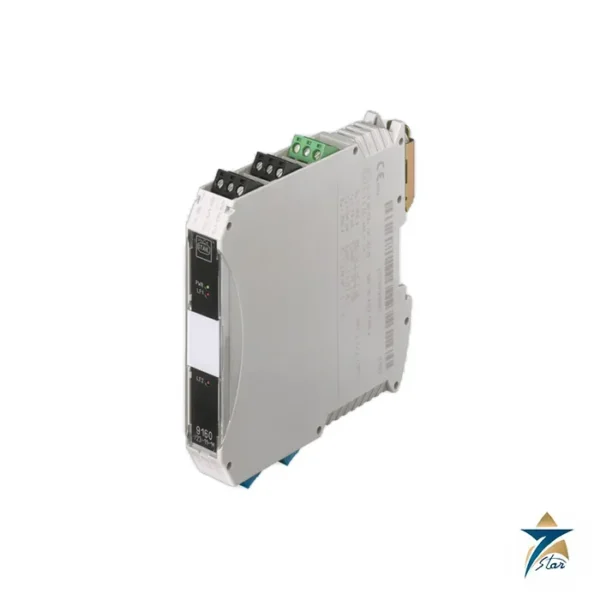
Moore Industries HIM Smart HART Loop Interface and Monitor

Description

A HART loop interface that breaks out multivariable data into 4-20 mA, relay and MODBUS signals

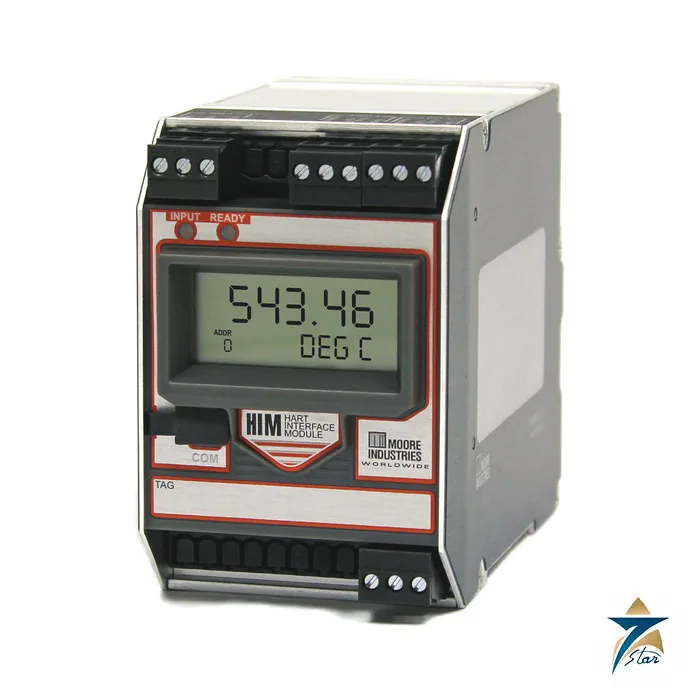
The Moore Industries HIM (Smart HART Loop Interface and Monitor) reads the digital HART data carried on a smart transmitter or valve positioner loop and converts it to additional analog, relay and MODBUS RTU outputs. It adds up to three analog process variables from a multivariable device with no extra process penetrations or wiring, and it lets trusted in-place HART instruments keep working while their non-primary variables become visible to a DCS or PLC. It can be set as HART primary or secondary master, or in passive Listen mode, and can read instruments in Normal (poll and response) or Burst mode.

Technical specifications

Parameter Specification
Input HART digital protocol from a smart HART transmitter or valve positioner; address 0-63 selectable
Analog outputs 2AO or 3AO programmable channels, 0-20 mA or 4-20 mA, into 1100 ohms maximum; MB1AO adds one channel
Output accuracy Plus or minus 0.015% of maximum output span (20 mA); response under 120 ms (10-90%)
Alarm outputs One (-1PRG, DPDT relay) or two (-2PRG, SPDT relay) outputs rated 5 A at 250 VAC; 0-120 s trip delay
MODBUS output (MB, MB1AO) Two redundant MODBUS RTU RS-485 links; address 1-247; 300 to 19.2k baud; even, odd or no parity
HART response 500 ms maximum in Normal mode (polls twice per second); 333 ms in Burst mode (samples three times per second)
Display Two-line LCD with 5-digit main row; range -99999 to 99999; 100 ms update; INPUT, READY and TRIP LEDs
Power 24 VDC plus or minus 10%; 2-3.5 W nominal, 4.5 W maximum with transmitter excitation
Transmitter supply 24 VDC plus or minus 10% at 24 mA
Isolation 500 Vrms channel to channel; 1000 Vrms between case, input, outputs and power; 1500 VAC dielectric test
Ambient range -40 to +85 degrees C operating and storage (display -25 to +85, relays -25 to +70); 0-95% RH non-condensing
Housing and weight Metal DIN-rail housing (35 mm Top Hat) or surface mount; 567 g (16 oz)
Certifications CSA general locations and Class I Division 2 (except -1PRG), CE EMC; -2PRG for Class I Div 2 groups A-D

Valve monitoring, diagnostics and configuration

With valve positioners the HIM can track stem position, actuator pressure and positioner temperature, and its relay outputs can support partial-stroke testing of emergency shutdown valves. Its alarms can respond to process variables or to HART device status such as configuration changed, primary variable out of limits, cold start or device malfunction. Parameters are set in minutes with Moore Industries PC configuration software, including up to 128 custom linearization points, scaling, deadband and fail-safe behaviour.

Ordering and documents

The order code is Unit / Input / Output / Power / Options [Housing], for example HIM / HART / 3AO / 24DC / -2PRG [DIN]. Options include -FMEDA data and -RF enhanced immunity. The signal loop must present between 250 and 1100 ohms for communication. Please confirm the HART device type, the variables required, the number of alarms and whether MODBUS is needed. Related Moore Industries products on this site include the Moore Industries SIX; see Isolators and Barriers. The attached datasheet (June 2025) has the full tables.

Datasheets & Documents
  • PDF Datasheet Moore Industries HIM datasheet (June 2025) Download
Reviews (0)

Reviews

There are no reviews yet.

How would you rate this product?

It takes about 10 seconds — just tap a star. Your email is never published.

About brand

Signal conditioning is what Moore Industries has built in North Hills, California since 1968: temperature transmitters, signal isolators, alarm trips and the interface instruments that sit between field sensors and a DCS or PLC. Seven Star LLC, an independent supplier in Oman, lists Moore Industries temperature transmitters, limit alarm trips, isolators and a PID backup controller, and sources units and replacements by full model number.

Moore Industries product families on this page

The manufacturer's catalog is arranged by function, and many of the items listed here map onto it directly:

  • Temperature transmitters: the TRX, and the STZ functional safety dual input smart HART transmitter
  • Alarm trips: the SPA2 programmable limit alarm trip, including an SPA2 with HLPRG input and four relay outputs
  • Signal isolators, repeaters and converters: the SIX
  • PID controllers and backup stations: the 535 in 1/4 DIN format

Other catalog groups include temperature assemblies and sensors, I/P and P/I converters, remote I/O, HART gateways and interfaces, indicators, and fieldbus device couplers.

Where Moore Industries instruments are used

These are control room and marshalling cabinet devices, plus field-mounted transmitters. Typical jobs are isolating a 4-20 mA loop between two systems, converting a thermocouple or RTD signal for a DCS input, adding an independent high or low trip next to the control system, and keeping a control loop running on a backup station when the main controller is out of service. Process plants in oil and gas, chemicals and power across the GCC use them for exactly these tasks.

Ordering Moore Industries instruments: what we need

Moore Industries model numbers are built from fields separated by slashes: unit, input, output, power and options, followed by the housing code in brackets. Every field matters. Send the complete string from the label, the serial number, and for programmable units the input type and range you want set. State any hazardous area or functional safety requirement, because approved versions are ordered with their own option codes.

Frequently Asked Questions

What does the HIM do?
It converts HART digital data from a smart device into extra 4-20 mA, relay and MODBUS RTU outputs.
How many analog outputs can it provide?
Two or three programmable channels, depending on the order code, and one more with the MB1AO option.
Can it be used on a loop that already has HART masters?
Yes, Listen mode connects passively alongside a primary and a secondary master.
What power does it need?
24 VDC plus or minus 10%, with 2 to 3.5 W nominal consumption.
Can it monitor valve positioners?
Yes, it can track stem position and actuator pressure and support partial-stroke ESD valve testing.