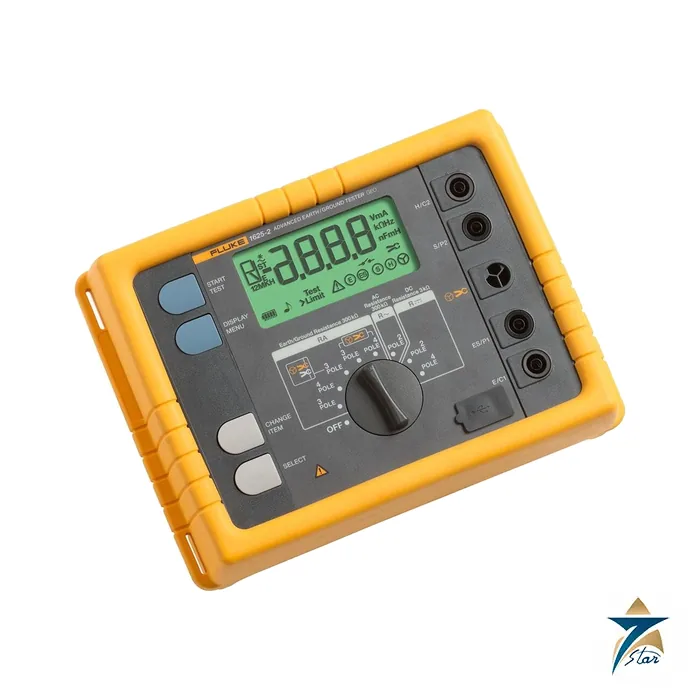
Fluke 1625-2 GEO earth ground tester with AFC and R* measurement
The Fluke 1625-2 is a handheld earth ground tester that performs all four classic earth measurements: 3- and 4-pole fall of potential, 4-pole soil resistivity, selective testing with one clip-on clamp and stakeless testing with two clamps. It sits above the 1623-2, which covers the same measurement methods but without the Automatic Frequency Control and R* functions. Seven Star LLC supplies the 1625-2 in Oman and the GCC as an independent supplier in Muscat, and this page sets out what the instrument does, what the data sheet specifies and what to include when you request a quotation.
What distinguishes the 1625-2 from the 1623-2
Both testers share the one-button rotary switch concept, the IP56 case, USB data storage of up to 1,500 records and the professional carrying case. The data sheet lists two extra features for the 1625-2. Automatic Frequency Control (AFC) identifies existing interference on the ground system and chooses a measurement frequency that minimises its effect, giving a more accurate earth value on noisy sites. R* measurement calculates earth impedance at 55 Hz, which better reflects the resistance that a fault-to-earth current would see. The 1625-2 also offers adjustable limits for quicker pass or fail testing. The 1625-2 reads on a 4-digit (2999 count) display, against a 1999-count display on the 1623-2.
Technical specifications of the 1625-2
| Parameter |
Specification |
| Manufacturer / part number |
Fluke / 1625-2 GEO |
| Measuring functions |
Earth resistance 3- and 4-pole, with or without clip-on transformer; interference voltage and frequency; 2-pole resistance (ac) and 2- and 4-pole (dc) |
| Earth resistance (RE) method |
Current and voltage measurement with probes per IEC 61557-5 |
| Open-circuit voltage |
20 / 48 V ac |
| Short-circuit current |
250 mA ac |
| Measuring frequency |
94, 105, 111, 128 Hz (manual or automatic AFC); 55 Hz in R* function |
| Noise rejection |
120 dB (16-2/3, 50, 60, 400 Hz) |
| Interference voltage range |
1 … 50 V dc/ac, 45 … 400 Hz, accuracy ±(5 % rdg + 5 digits) |
| Interference frequency range |
6 … 999 Hz, accuracy ±(1 % rdg + 2 digits) |
| Display |
4-digit (2999 count) LCD |
| Memory |
Up to 1,500 records via USB |
| Operating / storage temperature |
-10 … +50 °C / -30 … +60 °C |
| Ingress protection |
IP56 case, IP40 battery door (EN 60529) |
| Safety |
Double or reinforced insulation, max. 50 V to earth per IEC 61010-1, pollution degree 2 |
| Power |
6 x 1.5 V AA alkaline; typically 3,000 measurements (RE+RH ≤ 1 kΩ), 6,000 at RE+RH > 10 kΩ |
| Dimensions and weight |
250 x 133 x 187 mm; up to 1.1 kg without accessories; 7.6 kg in the carrying case with accessories |
The four measurement methods explained
Fall of potential uses two auxiliary stakes: current is driven between the electrode under test and a remote stake, and voltage is read from a probe in between, in 3-pole or 4-pole connection. Soil resistivity uses four stakes in a line (Wenner method) to characterise the ground before a grounding system is designed. Selective testing repeats fall of potential but places a clamp around the rod, so only the current in that rod is measured and the rod does not need to be disconnected from the bonded system. Stakeless testing clamps two transformers around the same rod, induces a voltage with one and reads current with the other; the manufacturer notes it only works where a bonded earth system provides multiple paths, and where there is a single path to ground the fall of potential method must be used. For the 1623-2 and 1625-2 the stakeless range is 0.020 to 199.9 ohms with an accuracy of ±(7 % rdg + 3 digits).
Accuracy and range of the 1625-2 earth resistance function
For 3-pole and 4-pole resistance the data sheet states a measuring range of 0.020 Ω to 19.99 kΩ with a resolution from 0.001 Ω to 10 Ω and an accuracy of ±(2 % of reading + 3 digits); the selective measurements with a clamp are specified at ±(7 % of reading + 3 digits). Probe and auxiliary electrode resistance are each allowed up to 100 kΩ, and the instrument monitors both and shows an error indicator, which makes it easy to catch a dry or poorly driven stake. The tester also measures the interference voltage (1 to 50 V) and its frequency, so the cause of a noisy reading can be investigated before the result is accepted.
Selection and ordering checklist for the 1625-2
- 1623-2 or 1625-2: choose the 1625-2 if the site has stray currents or you need R* and AFC.
- Kit or tester only: the manufacturer lists a complete kit with leads, four stakes, three cable reels, two clamps, batteries and manual in a carrying case.
- Which methods you will use: stakeless and selective testing need the clamps; soil resistivity needs the four stakes and long leads.
- Calibration certificate and traceability requirements.
- Safety category: the data sheet lists the tester as CAT none with a maximum of 50 V to earth, so it is for de-energised earth electrodes and not for live circuits.
Using the tester on site
Before testing, disconnect or isolate the electrode if you use fall of potential, place the stakes at the distances your standard calls for, and check that the display shows no stake error. Where interference is present, let the AFC choose a frequency, and repeat the measurement at a second frequency to confirm. Record results in the internal memory and download them through USB; the readings give the commissioning record for each earth pit. Batteries are standard AA alkaline cells, which are easy to source locally, and the IP56 case and rubber cover protect the instrument in dust and spray.
Typical applications in Oman and the GCC
Gulf plants rely on verified earthing for lightning protection, electrical fault clearing, instrument grounding and static discharge on storage tanks and loading racks. The 1625-2 is used for testing earth pits at substations, solar plants, gas processing facilities, refineries, telecom sites and pipelines, and for checking the integrity of earth rods after installation and at routine intervals. Dry, sandy and rocky ground makes stake placement difficult in many areas, and this is where the stakeless and selective methods of the instrument save time, provided that a bonded system exists.
Information to send with an RFQ for the 1625-2
- Model: 1625-2 tester or kit, or 1623-2 for comparison
- Test methods needed and number of earth pits per day
- Need for additional clamps, leads or cable reels
- Calibration certificate requirement
- Quantity and delivery site
Documents and quotation
The Fluke 1623-2 and 1625-2 data sheet is attached on this page. It holds the full list of measurement ranges and accuracy figures.
Send the model and the application and Seven Star LLC will confirm availability and prepare a quotation.

























Reviews
There are no reviews yet.