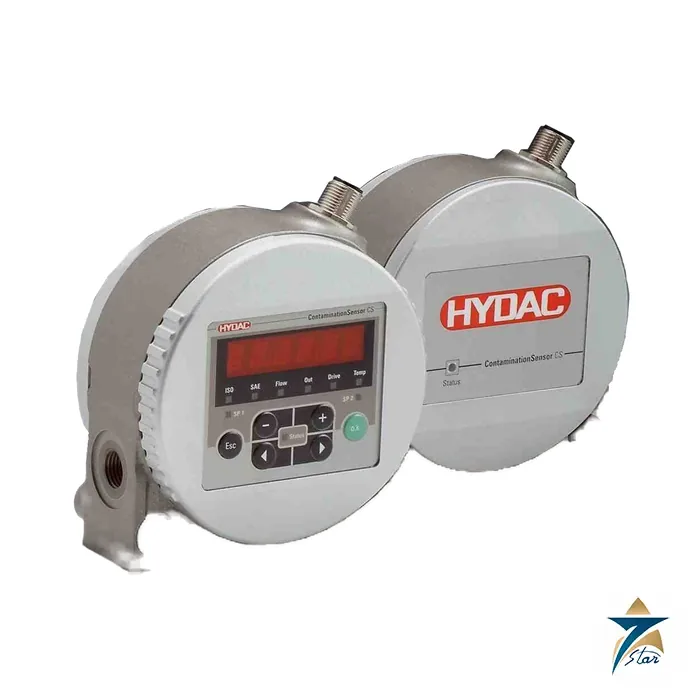
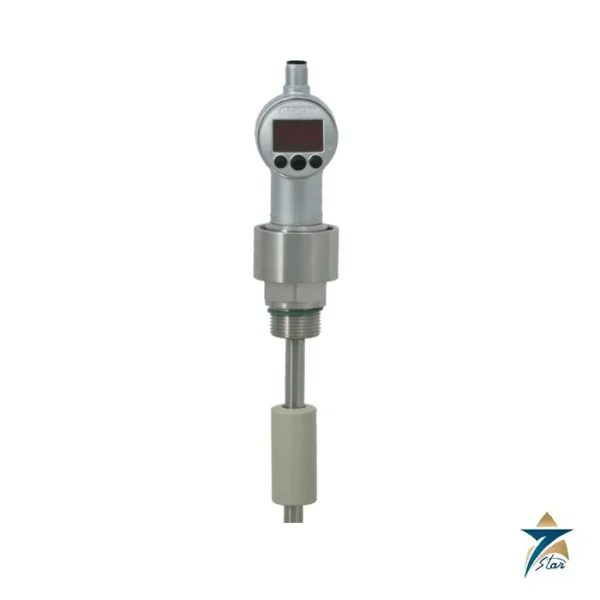
Hydac CS 1000 ContaminationSensor for online fluid cleanliness monitoring
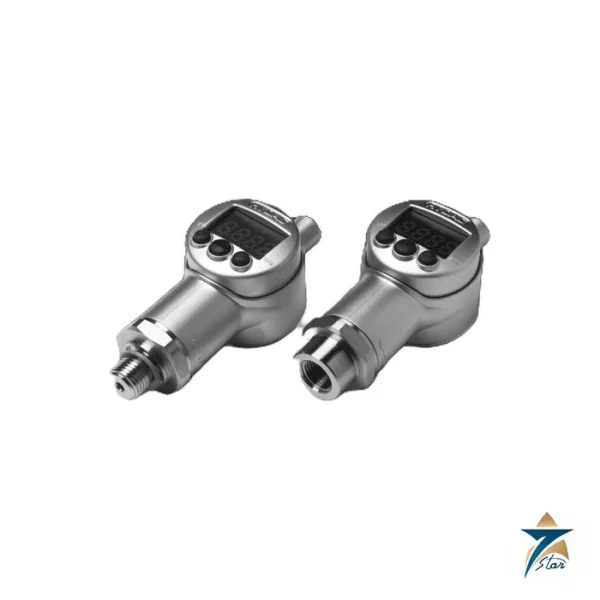
The Hydac CS 1000 series is a stationary, compact particle sensor that measures solid contamination in hydraulic and lubrication oil continuously and reports it as a cleanliness class. It counts particles in four size channels and converts the count into ISO 4406, SAE AS 4059 or NAS 1638 classes, which the sensor shows on an optional display or sends to a control system as a 4 to 20 mA or 2 to 10 V signal. It is designed for condition monitoring: instead of taking oil samples for a laboratory, the maintenance team sees the trend in oil cleanliness all the time and can plan filter changes or flushing from the data. Seven Star LLC supplies Hydac products in Oman and the GCC as an independent supplier in Muscat.
CS 1000 technical specifications
| Parameter |
Specification |
| Manufacturer / part number |
Hydac / CS 1000 series (example codes CS1210-A-0-0-0-0/-000, CS1220-A-0-0-0-1/-000) |
| Measured values |
ISO 4406:1999, SAE AS 4059 or ISO 4406:1987 / NAS 1638 depending on code |
| Measuring range |
ISO 9/8/7 to ISO 25/24/23; calibrated ISO 13/11/10 to ISO 23/21/18 |
| Accuracy |
± 1/2 ISO class in the calibrated range |
| Operating pressure |
Up to 300 bar per product page (350 bar per datasheet revision 2017) |
| Measuring volume flow |
30 to 300 ml/min per product page (30 to 500 ml/min per datasheet 2017) |
| Viscosity range |
1 to 1000 mm²/s |
| Fluid temperature |
0 to +85°C (+32 to +185°F) |
| Ambient temperature |
-30°C to +80°C |
| Supply voltage and power |
9 to 36 VDC, 3 W maximum |
| Outputs |
4 to 20 mA or 2 to 10 V analogue; passive switching output; RS485; HSI (HYDAC Sensor Interface) |
| Connector |
M12x1, 8-pole male |
| Protection |
IP 67 when correctly connected |
| Hydraulic connection |
Inline or hose G1/4 (ISO 228), or DN 4 flange |
| Weight and seals |
1.3 kg; FPM seals for mineral oil, EPDM for phosphate ester |
Decoding the CS 1000 model code
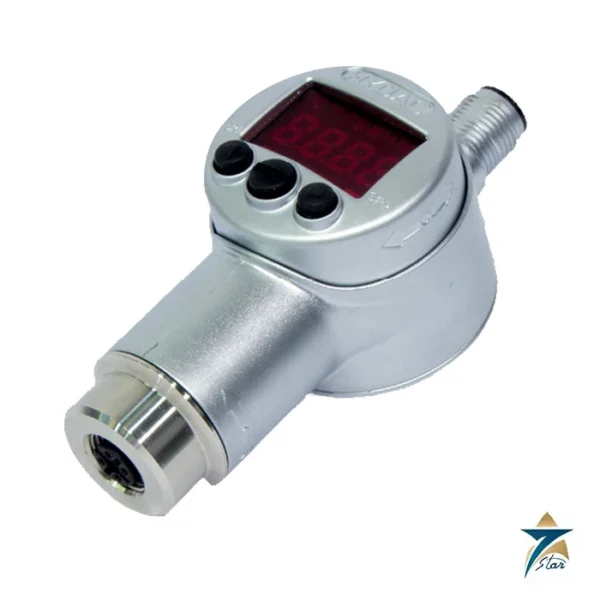
The datasheet explains the code, which has the form CS 1 2 2 0 – A – 0 – 0 – 0 – 0 / – 000. After “CS” and the series digit 1, the next digit gives the contamination code: 2 for ISO 4406:1999 with SAE AS 4059 on four channels (>4, >6, >14 and >21 µm(c)), or 3 for ISO 4406:1987 and NAS 1638. The following digit shows the display: 1 without, 2 with a display that can be rotated through 270°. The next digit selects the medium, 0 for mineral oil or 1 for phosphate ester, and the letter selects the analogue interface: A for 4 to 20 mA or B for 2 to 10 V. The last blocks set the switching output, digital interface (RS485), electrical connection and hydraulic connection, where 0 is inline or hose and 1 is a flange connection.
Example variants on the product page include CS1210-A-0-0-0-0 (pipe or wall mounted, 4 to 20 mA, no display), the flange-mounted CS1210-A-0-0-0-1 and the display versions CS1220. Order the exact variant to avoid a mismatch in output or mounting.
How the CS 1000 measures particle contamination
A small partial flow of the system fluid passes through the sensor measuring cell, where particles are counted and sorted into size channels. The sensor converts the counts into the selected class code, and continuous self-diagnosis reports the state of the measurement through the status LED or display. A flow status, output value, drive percentage and temperature are also available as service parameters. Because the measurement uses a small flow, the sensor is usually fed from a pressure line or a test point, with the outlet returned to the tank or low-pressure side. Pressure and viscosity limits for the measuring flow are shown on the graph in the datasheet, and these must be respected or the reading will be unreliable.
Where CS 1000 fits in a monitoring system
The CS 1000 is the compact, economical option in the Hydac contamination sensor range, aimed at OEM machines and condition monitoring of industrial hydraulic and lubrication systems. The CS 2000 is the step up for test rigs and critical systems where trend measurement with relay outputs and communication is wanted. The sensor connects to HYDAC condition monitoring tools through RS485 and HSI, and the supplied CD contains FluMoS light software to set up the four channels. In plants, it is typically wired to a PLC through the 4 to 20 mA output, with a threshold alarm connected to a pump or filter bypass indicator.
Selection and ordering checklist for CS 1000
- Fluid: mineral oil (FPM seals) or phosphate ester (EPDM seals).
- Cleanliness standard needed by the site: ISO 4406:1999 with SAE AS 4059, or ISO 4406:1987 with NAS 1638.
- Analogue signal expected by the PLC: 4 to 20 mA or 2 to 10 V.
- Display or no display.
- Pipe, hose or wall mounting, or flange mounting on a manifold.
- System pressure at the sampling point and fluid viscosity at operating temperature.
- Cable: the sensor comes without cable, and female connectors with cable are accessories.
Installation, commissioning and maintenance of CS 1000
Install the sensor with vertical flow direction where possible, since the datasheet recommends this, and connect it to a point with stable flow. Let the sensor run until the oil is flowing without air bubbles, because bubbles are counted as particles. Parametrize and read out through the PC software if needed, and record baseline readings after flushing a new system. The sensor is calibrated at the factory, and a calibration certificate is delivered with it. Treat the sensor as a measuring instrument: do not install it downstream of a pressure drop that causes air release, and protect the connector from water, since the IP 67 rating applies only with the correct connector fitted.
CS 1000 applications in Oman and the GCC
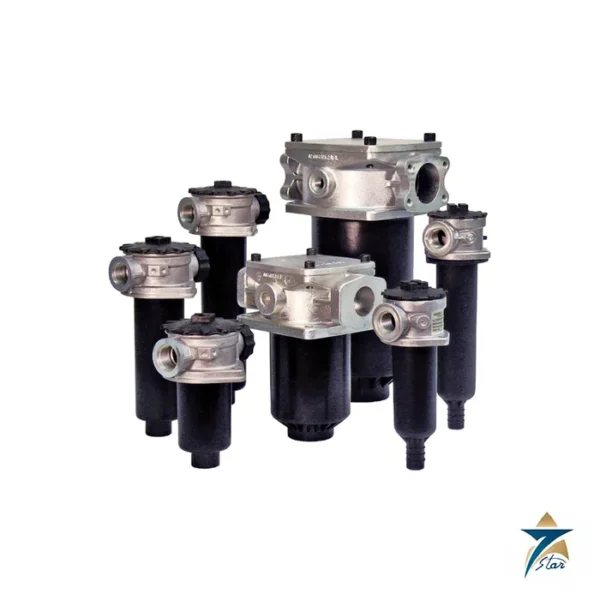
Hydraulic power units on oil and gas valves, turbine lube oil systems in power stations, compressor and pump lubrication, and hydraulic systems on cranes and offshore equipment all depend on clean oil. In hot dusty conditions, oil contamination rises quickly through breathers and seals, and cleanliness monitoring helps decide when to filter, replace oil or inspect seals. Use the sensor with Hydac offline and return filters in the same family to close the loop.
Information to send with a CS 1000 RFQ
- Full model code or required options.
- Fluid type, operating temperature, viscosity and pressure at the measuring point.
- Required output signal and display.
- Number of sensors and accessories such as cables.
Documents and quotation
The Hydac CS 1000 series datasheet is attached on this page with the technical data, model code and dimensions.
Send the model code or application data and Seven Star LLC will confirm the right CS 1000 variant and quote supply to Oman and the GCC.



















Reviews
There are no reviews yet.