Absolute pressure measurement from vacuum-side to 2.5 bar
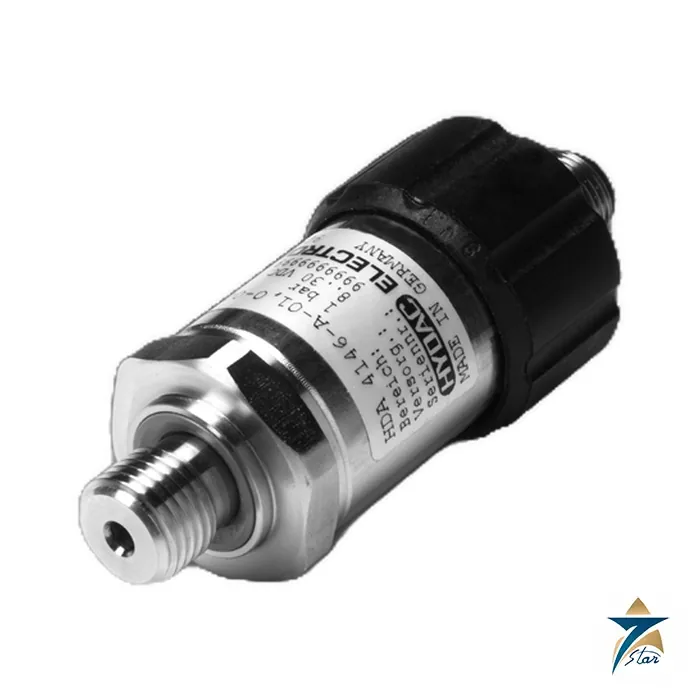
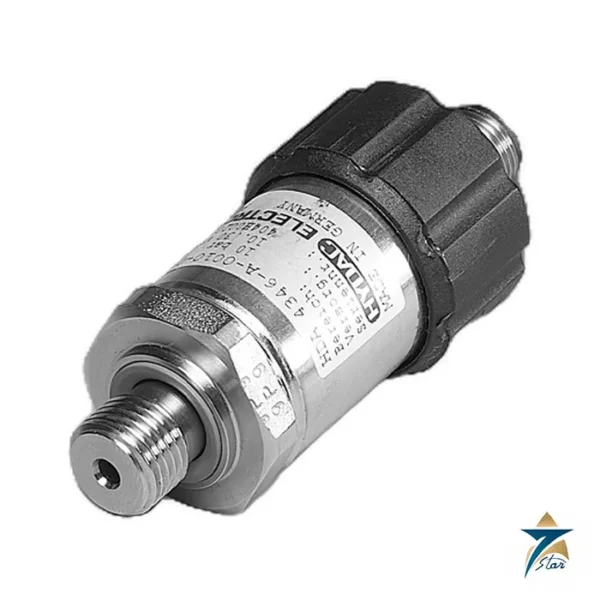
The Hydac HDA 4145-A-02.5-000-F1 (HYDAC part number 909079) measures absolute pressure, meaning pressure referenced to a vacuum rather than to the surrounding atmosphere. That is different from the usual gauge-pressure transmitters, and it is why a barometric change of a few hundred millibar does not move the reading. The range here is 0 to 2.5 bar absolute with a two-wire 4 to 20 mA output.
The series uses a ceramic cell with a thick-film strain gauge. HYDAC lists its main fields as low-pressure work in hydraulics and pneumatics, particularly refrigeration and air-conditioning, and the food and pharmaceutical industries.
Technical specifications
| Parameter |
Specification |
| HYDAC part number |
909079 |
| Model code |
HDA 4145-A-02.5-000-F1 |
| Type |
Absolute pressure transmitter |
| Measuring range |
0 to 2.5 bar absolute |
| Overload pressure |
8 bar |
| Burst pressure |
12 bar |
| Mechanical connection |
G1/4 A ISO 1179-2, male; 20 N·m |
| Output signal |
4 to 20 mA, 2-conductor |
| Supply voltage |
8 to 30 V DC |
| Accuracy (DIN 16086, terminal based) |
0.5 % FS typical, 1 % FS maximum |
| Accuracy (BFSL) |
0.25 % FS typical, 0.5 % FS maximum |
| Non-linearity / hysteresis |
0.5 % / 0.4 % FS max. |
| Repeatability / drift |
0.1 % FS / 0.3 % FS typical per year |
| Rise time |
1 ms max. |
| Temperature compensation |
0.02 % FS/°C typical, 0.03 % FS/°C maximum |
| Operating and compensated temperature |
-25 to +85 °C |
| Fluid temperature |
-25 to +100 °C |
| Storage temperature |
-40 to +100 °C |
| Electrical connection |
Male EN175301-803, 3-pole + PE |
| Wetted parts |
Stainless steel connection, ceramic sensor cell, FKM seal |
| Housing |
Stainless steel |
| Protection class |
IP 67 |
| Weight |
0.33 lb (approx. 150 g) |
| Approvals as printed |
CE (EN 61000-6-1/2/3/4); cUL, certificate no. E318391 |
Absolute versus gauge pressure
A gauge transmitter reads zero at atmospheric pressure; an absolute one reads about 1 bar there. For vacuum monitoring, boiling-point control, refrigerant suction lines or vacuum pump protection the absolute type is the right instrument. With the 8 bar overload rating there is room for accidental pressurisation, but a 12 bar burst limit means this is not a transmitter for high-pressure lines.
Code decoding and seals
In HDA 4 1 4 5 – A – 02.5 – 000 – F1 the 1 marks the absolute series, 4 the G1/4 A thread, 5 the plug, A the current output, 02.5 the range in bar abs. and F1 an FKM seal on a stainless steel connection. The EPDM version (E1) is the refrigerant choice, so state the fluid when you order. The datasheet linked here is the HYDAC USA edition (15 and 50 psia, NPT); it is cited for the series construction, while the range, thread and weight above come from the catalogue entry for this part number.
Install the transmitter where condensate or oil cannot sit against the ceramic cell, and avoid pressure shocks during evacuation, since the ceramic element takes overload better than steel but still has a 8 bar ceiling. Confirm the fluid and seal match before you order.
Because this is an absolute transmitter, the reading is referenced to vacuum, so it follows atmospheric changes as well as system pressure. That makes it a sensible pick for vacuum, evacuation or low-pressure monitoring tasks, but a gauge version is better when you only care about pressure above ambient.
Installation and mounting
Screw the transmitter into its G1/4 port at the stated tightening torque of 20 N·m, applying the spanner to the hexagon of the connection and never to the housing. Use a sealing arrangement that suits the ISO 1179-2 connection and is compatible with the fluid. On vacuum lines and refrigerant suction pipes, take the pressure from the top of the pipe and place the transmitter above the tapping, so that oil and condensate drain back rather than collecting at the ceramic cell. Avoid mounting it directly on a vibrating pump body; a short pipe or a separate bracket reduces stress on the thread. Fit the EN175301-803 plug with its gasket in place and tighten the fixing screw so the IP 67 protection is kept.
Commissioning and checks
Before start-up, confirm that the supply lies within 8 to 30 V DC and that the receiver input and cable resistance leave enough voltage at the transmitter across the full 4 to 20 mA range. With the system open to atmosphere, an absolute transmitter shows roughly 1 bar rather than zero; this is correct, and it should not be offset in the PLC to read zero. Compare the reading with a calibrated barometer or absolute reference, then evacuate the system and confirm that the signal falls towards 4 mA as pressure drops. Scale the controller input to 0 to 2.5 bar absolute and label the display clearly as absolute pressure, so operators do not confuse it with gauge readings elsewhere on the plant.
Refrigeration, HVAC and food plants in Oman
Cooling demand in Oman is high for much of the year, and refrigeration and air-conditioning systems run long hours. Transmitters on outdoor condensing units and rooftop plant can be exposed to strong direct sun, so shade the housing and keep it within the -25 to +85 °C operating range listed above. Coastal air carries salt, and although the housing and connection are stainless steel, the plug and cable entry still need to be kept sealed. In food and pharmaceutical service, confirm with the process owner that the FKM seal is acceptable for the product and cleaning agents before installation.
Maintenance routine
Check the reading against an atmospheric or absolute reference at planned intervals, bearing in mind the typical drift figure in the table, and record the result. Inspect the plug, gasket and cable for damage, and avoid sudden pressure shocks during leak tests, since the overload and burst limits above leave little margin on higher-pressure test rigs.
Points to state in your enquiry
Describe the medium, the normal and lowest expected pressure, any cleaning or test pressures the transmitter will see, and the receiving instrument. If the application is refrigeration, name the refrigerant and oil, because the seal choice discussed above depends on them, and say whether the transmitter will be installed indoors or outdoors.
Documents and quotation
Please send the model code, the fluid and the quantity. The series datasheet is attached. See also our pressure instrumentation range.












Reviews
There are no reviews yet.