Ceramic-cell transmitter for low-pressure hydraulic and pneumatic lines
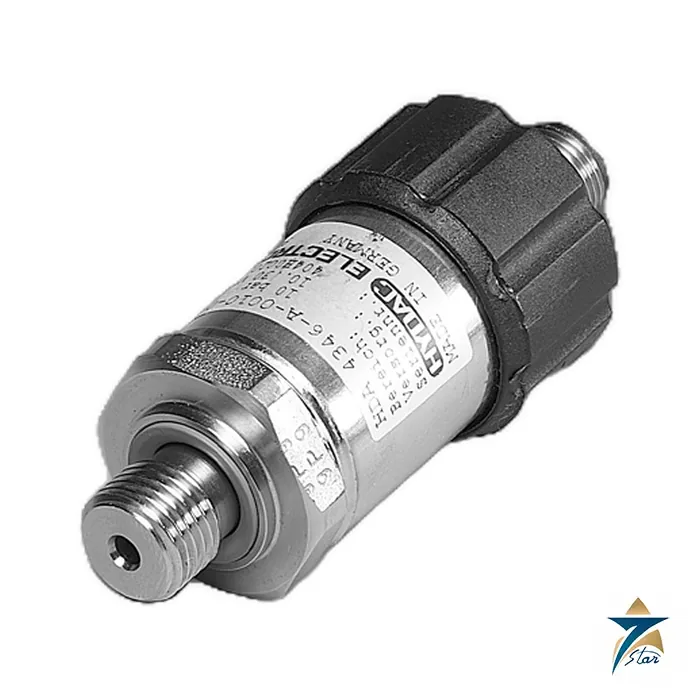
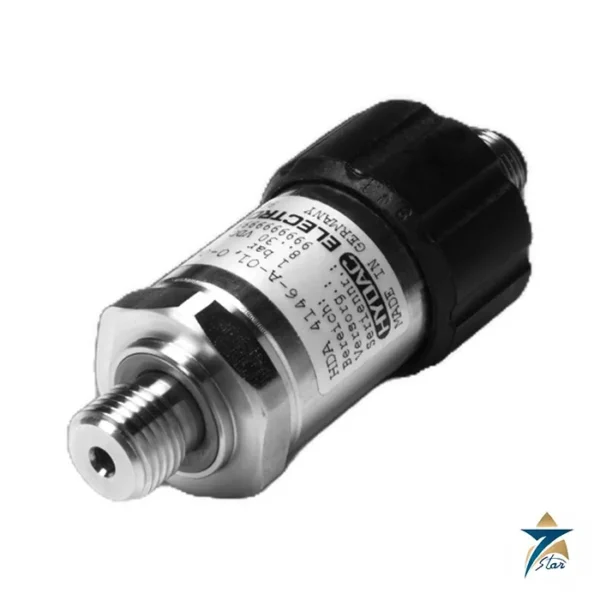
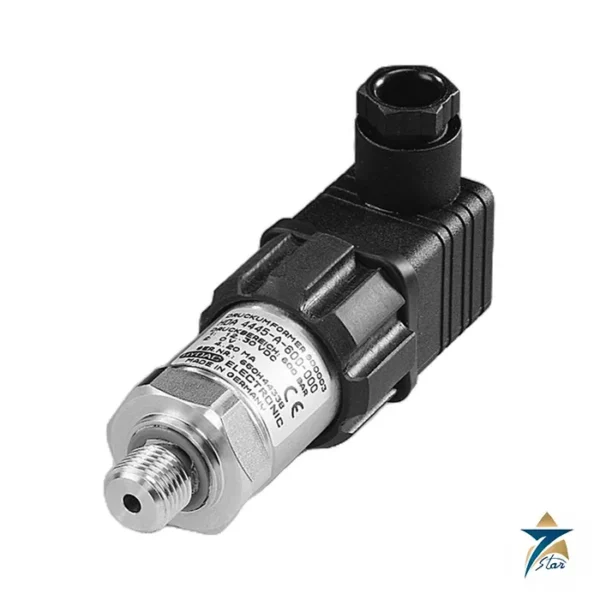
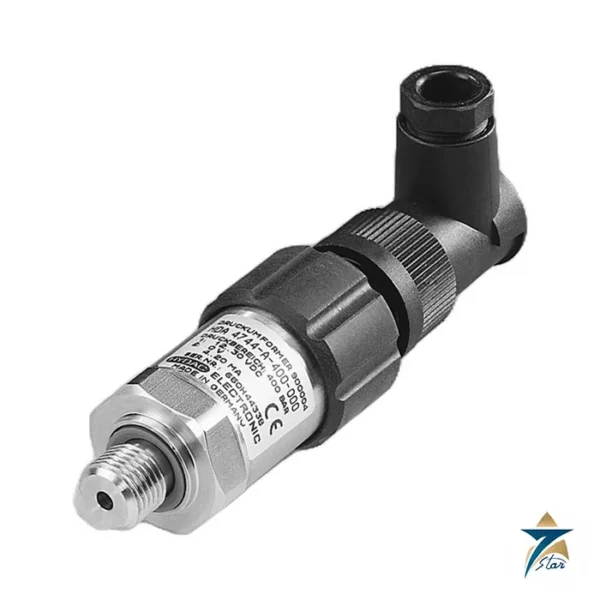
The Hydac HDA 4345-A-0016-000-F1 (HYDAC part number 908587) is the 16 bar member of the HDA 4300 series. Instead of a thin-film steel cell, it uses a ceramic measuring cell with a thick-film strain gauge, which HYDAC developed for relative pressure in the low-pressure range. It sends a two-wire 4 to 20 mA signal and comes with a G1/4 A male connection.
The F1 at the end of the code identifies an FKM seal with a stainless steel connection, the combination meant for hydraulic oils. An E1 variant with EPDM exists for refrigerants. Typical uses are filter differential checks, lubrication circuits, boost pressure and compressed-air lines.
Technical specifications
| Parameter |
Specification |
| HYDAC part number |
908587 |
| Model code |
HDA 4345-A-0016-000-F1 |
| Measuring range |
0 to 16 bar |
| Overload pressure |
50 bar |
| Burst pressure |
75 bar |
| Mechanical connection |
G1/4 A ISO 1179-2, male; 20 N·m |
| Sensor cell material |
Ceramic |
| Output signal |
4 to 20 mA, 2-conductor |
| Supply voltage |
8 to 30 V DC |
| Permitted load resistance |
RL max = (UB – 8 V) / 20 mA |
| Accuracy (DIN 16086, max. setting) |
0.5 % FS typical, 1 % FS maximum |
| Accuracy at minimum setting (BFSL) |
0.25 % FS typical, 0.5 % FS maximum |
| Non-linearity / hysteresis |
0.5 % / 0.4 % FS max. |
| Repeatability / drift |
0.1 % FS / 0.3 % FS typical per year |
| Rise time |
1 ms max. |
| Temperature compensation |
0.02 % FS/°C typical, 0.03 % FS/°C maximum |
| Operating and compensated temperature |
-25 to +85 °C |
| Fluid temperature |
-25 to +100 °C (FPM or EPDM seal; -40 °C on request) |
| Electrical connection |
Male EN175301-803 (DIN 43650), 3-pole + PE, connector supplied |
| Wetted parts |
Stainless steel connection, ceramic cell, FKM seal |
| Protection class |
IP 65 with EN175301-803 plug |
| Vibration / shock |
20 g / 100 g |
| Approvals as printed |
CE (EN 61000-6-1/2/3/4) |
Where the ceramic cell helps
At low ranges a steel membrane has to be very thin, which makes it sensitive to overload. The ceramic cell in the HDA 4300 holds its zero well at 16 bar while taking an overload of 50 bar. That makes it a sensible choice for circuits with occasional pressure spikes above the working range, such as pump start-up or cold oil. It is not meant for high-pressure points: for 100 bar and above choose the HDA 4400 or 4700.
Reading the code
HDA 4 3 4 5 – A – 0016 – 000 – F1: 4 selects the G1/4 A thread, 5 the EN175301-803 plug, A the 4 to 20 mA signal, 0016 the range in bar, 000 the standard modification and F1 the FKM seal on stainless steel. The HYDAC USA datasheet attached to the catalogue entry prints the psi and NPT edition (HDA 4385), so use it for series data and compare the bar code above with your drawing before ordering.
For compressed-air or refrigerant duty, confirm the seal code with the supplier, since the F1 FKM version is selected for hydraulic oils. Fit a damping device if the line carries sharp pressure peaks above the 50 bar overload rating, and keep the cable gland tight to hold the IP 65 rating of the plug.
Matching the 16 bar range to the measuring point
A transmitter gives its best resolution when the normal working pressure sits well inside its span rather than at the bottom of it. On a lubrication circuit or a filter outlet that normally runs at a few bar, a 0 to 16 bar range leaves room for start-up peaks while keeping the reading meaningful. If the line normally runs close to 16 bar, the reading will spend much of its time near full scale and every spike will push it into overload, so a higher range from the series should be reviewed instead.
Check the loop as well as the pressure. The permitted load formula in the table shows that the total resistance of the input card, any barrier or indicator in the loop and the cable must stay below the limit set by the supply voltage. With a lower supply voltage, less load is allowed, so add up the loop before choosing where to land the signal.
Installing and commissioning the transmitter
- Mount the transmitter on a port or test point where air can escape on hydraulic lines; a pocket of trapped air can make the reading slow or unsteady.
- Use the sealing method the G1/4 A ISO 1179-2 thread is designed for and tighten to 20 N·m; overtightening does not improve the seal and can stress the connection.
- Wire the two-conductor loop through the supplied EN175301-803 connector, seat the connector gasket correctly and tighten the fixing screw so the plug sits flat.
- With the system depressurised, check that the controller reads close to 4 mA, then compare the reading at working pressure with a test gauge before handing over.
Maintenance and fault finding
A reading stuck at or below 4 mA usually means a broken loop, a reversed connection or a supply below 8 V DC at the transmitter terminals, so measure the voltage at the plug, not only at the power supply. A noisy or jumping signal often comes from pressure pulsation in the line, a loose plug or a shared earth with motor wiring. If the zero has shifted after an event such as a water hammer or an unplanned pressure surge, compare it with a reference gauge; repeated peaks above the overload rating are a reason to add damping before replacing the unit. Inspect the connector gasket whenever the plug is removed, because a damaged gasket lets moisture reach the pins.
Application notes for Oman and the GCC
Hydraulic power units on Omani sites often stand outdoors or in hot plant rooms. The operating range of -25 to +85 °C covers most installations, but transmitters mounted directly on hot manifolds in direct sun should be checked against the fluid and ambient limits, and a short sun shield helps. Fine desert dust and coastal salt can work into a poorly seated DIN plug, so point the cable entry downwards where possible and keep spare connector gaskets with the maintenance stores. For the compressed-air duties named on this page, condensate in the line is a bigger concern in humid coastal plants than temperature, so install the transmitter where water can drain away from the port.
Documents and quotation
The series datasheet is attached. Please send the complete model code and quantity. Related: our pressure instrumentation range.











Reviews
There are no reviews yet.