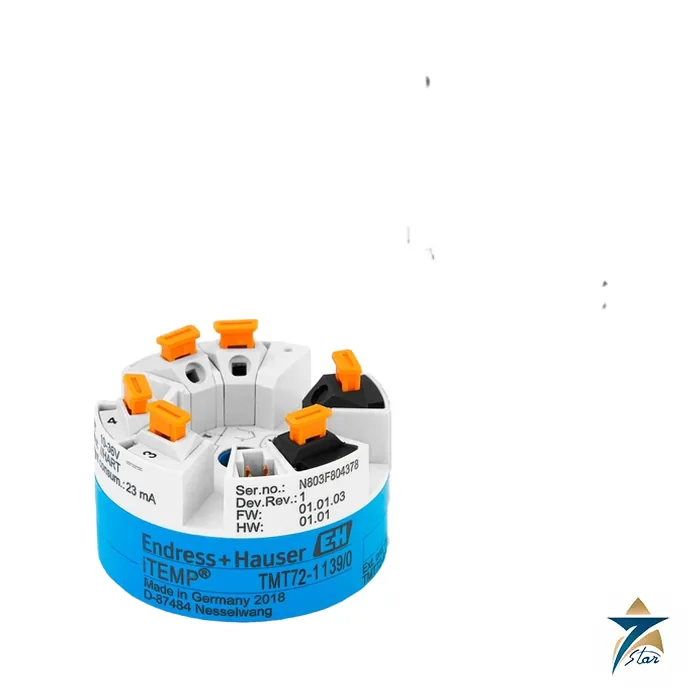
TMT72 iTEMP HART temperature transmitter for head, rail and field housing
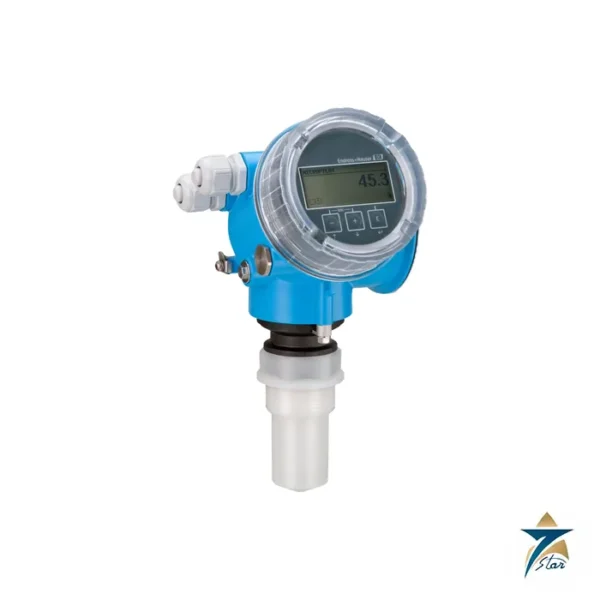
The Endress+Hauser TMT72 is an iTEMP temperature transmitter that combines a conventional 4–20 mA loop with the HART 7 digital protocol. It has one universal input for RTDs, thermocouples, resistance and millivolt signals, so a single model covers most sensors found in a plant. It can be installed in a form B terminal head, on a DIN rail inside a cabinet, or in a field housing, and an optional Bluetooth interface allows wireless setup with the SmartBlue app. Seven Star LLC supplies the TMT72 in Oman and the GCC as an independent supplier in Muscat.
The reason to specify the TMT72 rather than the analog TMT71 is the digital layer: the same two wires carry the temperature as current and, through HART, the sensor value, device temperature and diagnostic status. That makes remote configuration, loop checks and asset monitoring possible from a control room or a handheld.
Endress+Hauser TMT72 technical specifications
| Parameter |
Specification |
| Manufacturer / part number |
Endress+Hauser TMT72 (iTEMP TMT72 HART temperature transmitter) |
| Input |
One universal input: RTD, thermocouple, resistance (10 to 400 or 10 to 2,000 Ω) or voltage (−20 to 100 mV) |
| Pt100 range |
−200 to 850 °C (IEC 60751), minimum span 10 K; thermocouples min. span 50 K |
| Output |
4–20 mA with HART 7 (FSK ±0.5 mA, 1,200 baud); galvanic isolation 2 kV AC |
| HART data |
Manufacturer ID 17 (0x11), device type 0x11D0; PV is the sensor value, SV device temperature, TV and QV sensor values; multi-drop addresses 0 to 63 |
| HART load |
Minimum 250 Ω; max. load (Ub − 10 V) / 23 mA for head, (Ub − 11 V) / 23 mA for DIN rail |
| Supply voltage |
Head 10 to 36 V DC; DIN rail 11 to 36 V DC; current consumption ≤23 mA |
| Typical accuracy |
Pt100 0 to 200 °C: 0.05 °C digital (HART), 0.08 °C at the current output |
| Failure signal |
NAMUR NE43: 3.8 to 20.5 mA range; alarm ≤3.6 mA or ≥21 mA (21.5 to 23 mA selectable) |
| Response / switch-on |
≤1 s; ≤7 s until first valid value and start of HART communication |
| Ambient temperature |
−40 to +85 °C; hazardous areas per Ex documentation |
| Degree of protection |
IP20 for head and DIN rail; field housing determines installed protection |
| Weight |
Head approx. 40 to 50 g; field housings from about 330 g (TA30A) upward |
| Certification |
Registered with the FieldComm Group to HART specification revision 7; Bluetooth radio approval (RED, FCC) |
How the HART layer changes the TMT72 compared with an analog transmitter
Digital HART communication rides on the loop current as a small frequency-shift signal. A master such as a handheld, a HART modem or a multiplexer reads the primary variable, the device temperature and the sensor status without interrupting the analog value. The TMT72 supports squawk (to locate a device physically) and condensed status, and standard NAMUR NE107 diagnostics, so a technician can see whether a sensor is open, a lead is corroded, or the electronics are overheated.
In multi-drop mode the loop current is fixed at 4 mA and up to 64 addresses (0 to 63) are selectable by software, which is useful when many temperature points share one cable pair, although the analog signal is then no longer usable. The datasheet also states Wireless HART start-up data: minimum starting and operating voltage of 10 V DC, 3.58 mA start-up current and 4 mA multidrop current.
TMT72 input flexibility and sensor-transmitter matching
The input covers Pt50 to Pt1000, Ni100/Ni120, Cu50/Cu100 and thermocouple types A, B, C, D, E, J, K, L, N, R, S, T and U, plus resistance and millivolt measurement. Accuracy can be improved by loading Callendar-Van Dusen coefficients of a calibrated Pt100 or a polynomial for nickel or copper RTDs, so the transmitter replaces the standard curve with the real sensor curve. A one-point adjustment and a current-output correction are also offered. Thermocouples use an internal Pt100 as cold junction or an external value between −40 and +85 °C, and the sensor wire resistance limit of 10 kΩ triggers a corrosion warning per NAMUR NE89.
Where the TMT72 fits and related transmitters
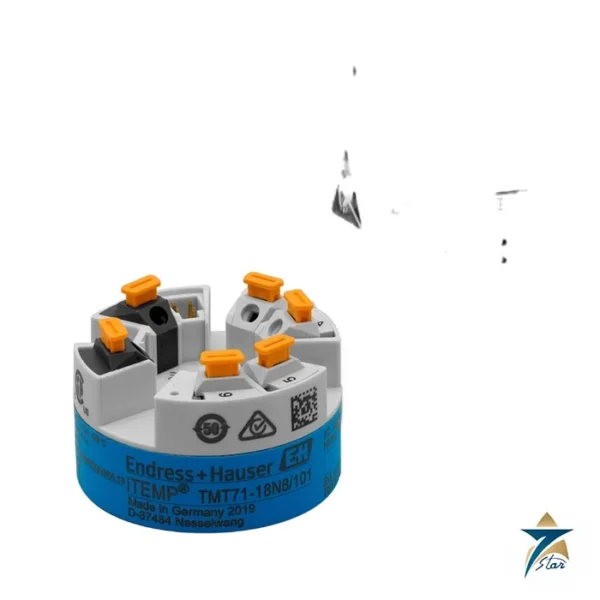
The TMT72 is the right choice for the typical HART-enabled DCS or PLC loop: it replaces a head-mounted analog unit while adding diagnostics. For simple cabinet wiring without HART, the TMT71 delivers the same input flexibility on an analog-only loop. For a fieldbus segment with two sensors per device, the TMT84 provides PROFIBUS PA. Companion items in the signal chain include RN series active barriers for intrinsically safe circuits, the plug-on TID10 display, the TA30 field housings and configuration tools such as FieldCare, DeviceCare and the Field Xpert tablet.
TMT72 selection and ordering checklist
- Mounting: terminal head form B, DIN rail on TH35 or field housing, including the Ex d option.
- Sensor type, wire count and configured range, and whether calibration coefficients will be supplied.
- Terminal version (screw or push-in) and the need for ferrules.
- Bluetooth interface or not; note that Bluetooth and the plug-on display cannot run at the same time.
- Hazardous-area approval, and the supply voltage allowed by the related safety instructions.
- Loop resistance: check that the barrier, indicator and cable fit within the load limit while still giving 250 Ω for HART.
- Alarm direction, tag and HART address plan.
Installing, commissioning and maintaining the TMT72
Wire the sensor to the numbered input terminals and the loop to terminals 1 and 2; a shielded cable is recommended for HART, and the plant grounding concept should be followed. For a thermocouple, a two-wire RTD can be connected to terminals 4 and 6 to measure the reference junction. Confirm that the loop has at least 250 Ω before expecting HART communication to work.
Commission via HART or the CDI service interface, or with SmartBlue over Bluetooth within roughly 10 m for housings with a display window or 5 m for closed heads. The device offers hardware write protection through a DIP switch on the display and a user-role password concept. Use diagnostics simulation to check what the DCS shows for each alarm. Because the device cannot be repaired, keep a configured spare, noting that the MTTF is 168 years without Bluetooth and 123 years with it.
TMT72 in Oman and GCC applications
HART temperature transmitters are widespread on oil and gas, power and desalination sites in Oman and the GCC because most DCS and asset-management systems already read HART. The TMT72 serves on pipe skin and thermowell points, heater passes, turbine and compressor bearing monitoring, and heat exchanger loops, with the vibration rating and −40 to +85 °C range handling outdoor heat and equipment shake. In humid coastal sites, choose a field housing with the correct ingress protection and cable glands.
Information to send with a TMT72 RFQ
- Sensor type, wiring and measuring range.
- Head, DIN rail or field housing and any Ex requirement.
- Terminal type, Bluetooth or display requirement.
- Loop supply, barrier or isolator and the HART host system.
- Quantity and tags.
Documents and quotation
The Endress+Hauser Technical Information for the iTEMP TMT72 is attached on this page as a datasheet, including input ranges, accuracy data and housing information.
Send the TMT72 part number with the sensor details and installation style, and Seven Star LLC will confirm availability and delivery to Oman and the GCC.
Other Models in the Eh Itemp Transmitter Range
Seven Star LLC supplies models from the Eh Itemp Transmitter range in Oman and the GCC. Compare the related models below and request a quote for the one that matches your application.



























Reviews
There are no reviews yet.