- Automation & ControlView all 2,895 products
- Automation Accessories
- AC Drives
- PLC & I/O Cards
- Industrial Communications
- Vibration Monitoring
- Controllers & Data Acquisition
- Isolator & Barrier
- Safety Switches & Guard Locking
- Motor Soft Starters
- CCTV & Security
- Encoders
- Pneumatic Cylinders
- HMI Displays
- Servo Drives
- Industrial Computers
- Machine Vision
- Automation Software
- Robotics
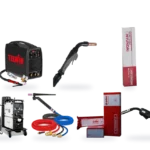
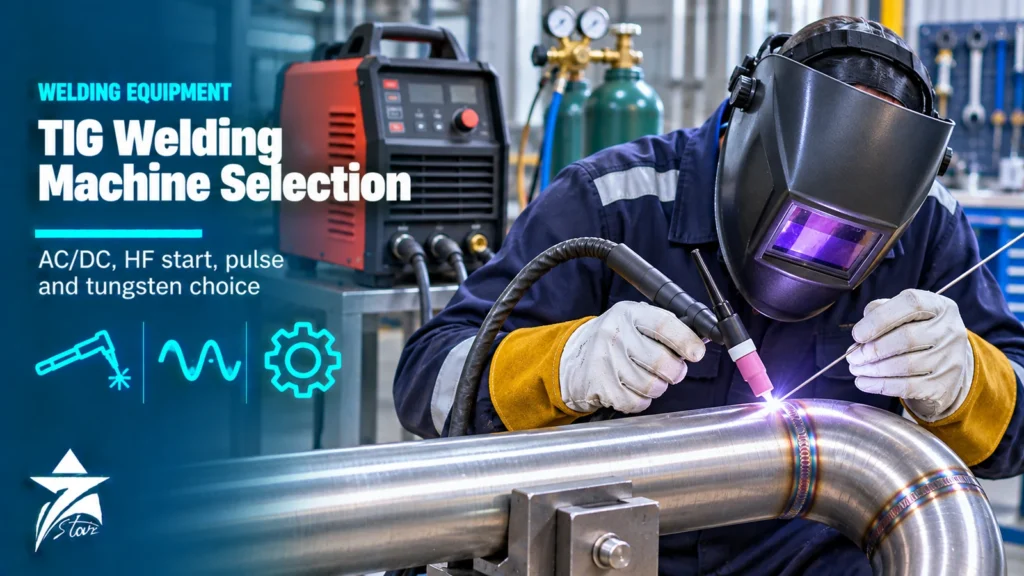
Gas tungsten arc welding (GTAW), usually called TIG, produces the cleanest and most controllable welds of the common arc processes. It is the standard choice for stainless steel pipe, root passes on carbon steel pipelines, aluminium fabrication, thin sheet and high-integrity work on nickel alloys and titanium. The quality of the result depends heavily on the power source. A TIG welding machine that matches the materials, thicknesses and working conditions makes the welder faster and the welds more consistent, while a poorly matched unit limits the work that can be done. This guide explains the main selection points: output type, arc starting, pulse and AC controls, duty cycle, cooling, tungsten choice and accessories.
How TIG Welding Works
In TIG welding, an arc is struck between a non-consumable tungsten electrode and the workpiece. An inert shielding gas, usually pure argon, protects the tungsten and weld pool from the air. Filler metal, if needed, is added by hand or with a cold or hot wire feeder. Because the heat source and the filler are controlled separately, the welder can make precise, low-spatter welds in all positions. The trade-off is lower deposition rate than MIG or flux-cored processes, which is why TIG is often used for roots and critical joints while other processes fill the rest. Our welding process selection guide compares TIG with SMAW, GMAW, FCAW and SAW.
DC or AC/DC TIG Welding Machine: The First Decision
| Output | Materials | Notes |
|---|---|---|
| DC only (DCEN) | Carbon steel, stainless steel, nickel alloys, copper, titanium | Simpler and lower cost; covers most pipe and process plant work |
| AC/DC | All of the above plus aluminium and magnesium | AC breaks up the oxide layer on aluminium; needed for aluminium fabrication |
For aluminium, the AC cycle alternates between electrode positive, which cleans the oxide film, and electrode negative, which puts heat into the work. Modern inverter AC/DC machines allow the welder to adjust:
- AC balance: the share of the cycle in electrode-negative. More EN gives deeper penetration and longer tungsten life; more EP gives more cleaning action.
- AC frequency: higher frequencies, for example 100 to 200 Hz, focus the arc and narrow the bead; lower frequencies widen it.
- Waveform: square, soft square, sine or triangular waves change arc sound, stability and heat input.
- Mixed AC/DC modes: some machines mix AC and DC segments to increase travel speed on thick aluminium.
If aluminium is not part of the work, a DC TIG welding machine is the simpler and more economical choice. Many workshops keep one AC/DC unit for aluminium and several DC units for steel and stainless.
Arc Starting: HF, Lift Arc and Scratch Start
- High-frequency (HF) start: a high-voltage spark ionises the gap so the arc starts without the tungsten touching the work. It gives clean starts and is standard on AC/DC machines, but HF can interfere with nearby electronics, CNC controls and instrumentation.
- Lift arc: the tungsten touches the work at low current, then the arc forms as it is lifted. It avoids HF interference and tungsten contamination is minimal; common on DC inverters and for site work near sensitive equipment.
- Scratch start: the simplest method, used on basic machines and stick inverters with TIG function. It risks tungsten inclusions and is not suitable for critical work.
On plant shutdowns and in control rooms, lift arc is often specified to protect electronics. Check the site requirements before choosing HF.
Pulse TIG and Other Control Features
Pulse TIG switches between a peak current and a background current at a set frequency. It controls heat input, reduces distortion on thin sheet and helps with out-of-position and root welding.
- Low-frequency pulse (0.5 to 10 Hz): helps the welder time filler additions and produces a ripple bead appearance.
- High-frequency pulse (hundreds of Hz to kHz): constricts the arc, stiffens it and improves control on very thin material.
- Pre-flow and post-flow: gas before and after the arc protects the tungsten and the end of the weld from oxidation.
- Up-slope, down-slope and crater fill: smooth current ramps avoid cracks and craters at the end of the weld.
- 2T/4T trigger modes and remote control: foot pedals and torch-mounted controls allow current changes during welding.
- Job memory and synergic programs: saved parameters help repeat qualified procedures (WPS) across welders and shifts.
TIG Welding Machine Current, Duty Cycle and Input Power
Duty cycle is the percentage of a 10-minute period that the machine can weld at a given current without overheating, usually stated at 40 °C ambient under IEC 60974-1. Required current depends on material and thickness: thin stainless sheet may need only 20 to 80 A, while thick aluminium may need 300 A or more.
| Typical class | Output range | Common uses |
|---|---|---|
| Portable inverter | Up to about 200 to 230 A | Site work, maintenance, thin stainless and steel |
| Medium workshop | About 250 to 350 A | Pipe spools, general fabrication, aluminium up to medium thickness |
| Heavy industrial | 400 to 500 A | Thick aluminium, heavy fabrication, automation and orbital systems |
In hot climates, high ambient temperatures reduce the effective duty cycle, so choose a unit with margin above the expected current. Confirm input voltage and phase: compact machines often run from single-phase 230 V, while larger units need three-phase 400 V supplies. Check generator compatibility if the TIG welding machine will be used on site.
Air-Cooled vs Water-Cooled Torches
| Torch type | Typical rating | Advantages | Limitations |
|---|---|---|---|
| Air-cooled (gas-cooled) | Up to about 150 to 200 A | Light, simple, no cooler needed; good for site and maintenance work | Torch heats up at high current and long arc times |
| Water-cooled | 200 to 500 A | Smaller torch head at high current, cooler grip, higher duty cycle | Needs a cooling unit, coolant maintenance and more hoses |
For workshop production at higher currents, a water-cooled torch with a matching cooling unit improves welder comfort and duty cycle. For pipe welding on site, an air-cooled torch with a flexible cable is easier to carry and position.
Choosing the Right Tungsten Electrode
Tungsten electrodes are classified under ISO 6848 and AWS A5.12 and colour-coded at the tip.
| Type | Colour (ISO 6848) | Typical use |
|---|---|---|
| WC20 (2% ceriated) | Grey | DC and AC; good low-current starts; common general choice |
| WL20 (2% lanthanated) | Blue | DC and AC; stable arc and long life; popular replacement for thoriated |
| WL15 (1.5% lanthanated) | Gold | DC and AC; general purpose |
| WT20 (2% thoriated) | Red | Traditional DC choice; contains radioactive thorium, so grinding needs dust control |
| WZ8 (zirconiated) | White | AC on traditional transformer machines; balls well for aluminium |
| WP (pure tungsten) | Green | AC on older transformer machines; low current capacity |
| WR (rare earth mixes) | Turquoise and others | Multi-purpose DC and AC; long life |
For DC work, grind the tungsten to a point with lengthwise grinding marks. For AC on inverters, a slightly blunted point is common. Choose the tungsten diameter to match the current range, and use a dedicated grinder to avoid contamination.
Accessories That Complete a TIG Setup
- Torch consumables: collets, collet bodies or gas lenses, ceramic or glass cups, back caps.
- Gas supply: argon regulator or flowmeter; argon/helium mixes for thick aluminium and copper.
- Back purging: purge plugs, dams and oxygen monitors for stainless and duplex pipe roots.
- Remote controls: foot pedals for bench work, hand or torch controls for pipe and site work.
- Trolley and cooling unit for workshop machines.
- Filler rods: ER70S-2 or ER70S-6 for carbon steel, ER308L or ER316L for stainless, ER4043 or ER5356 for aluminium.
For repeat high-quality pipe welds in stainless and sanitary systems, see our orbital pipe welding guide. For SMAW electrodes used alongside TIG roots, see our welding electrode classification guide.
Using a TIG Welding Machine on Oman Sites
Oil and gas, desalination and petrochemical projects in Oman use TIG for stainless and duplex pipe, root passes on carbon steel lines and aluminium fabrication. Summer heat reduces machine duty cycles and makes water-cooled torches more comfortable for long shifts. Fine dust gets drawn into cooling fans, so machines with protected electronics, filters or tunnel cooling designs and an IP23S rating last longer on site. Wind can blow away argon shielding outdoors, so screens and gas lenses help keep welds clean. Where work is done near live control systems, lift arc start avoids HF interference.
Selected TIG Power Sources in Our Catalogue
The table lists examples of DC and AC/DC TIG equipment we can quote.
| Product | Type | Typical use |
|---|---|---|
| Miller Dynasty 400 | AC/DC inverter, TIG and stick | Aluminium and stainless fabrication |
| Miller Syncrowave 300 | AC/DC TIG and stick power source | Workshop aluminium and steel work |
| Miller Maxstar 400 | DC TIG and stick power source | Heavy stainless and steel welding |
| Kemppi Master T 355 ACDC | AC/DC TIG power source | Industrial fabrication |
| EWM Tetrix XQ 300 puls AC/DC | AC/DC pulse TIG | Precision aluminium and stainless |
| Lorch V 30 AC/DC | AC/DC TIG | Workshop and production welding |
| GYS TITANIUM 400 AC/DC | AC/DC TIG, water-cooled option | Heavy aluminium fabrication |
| GYS TITAN 400 DC | DC TIG and MMA | Pipe and structural work |
| Migatronic CenTIG 300 DC | DC TIG | Stainless and steel fabrication |
| Telwin Superior TIG 251 DC Pulse | DC pulse TIG | Thin stainless and steel |
| OTC Daihen WB-A350P Welbee | AC/DC pulse TIG | Production aluminium and stainless |
| Böhler Welding TERRA NX 400 TLH | DC TIG | Heavy-duty site and workshop |
| Lorch HandyTIG 180 DC | Portable DC TIG | Maintenance and site repairs |
| REHM TIGER digital 230 AC/DC | Portable AC/DC TIG | Mobile aluminium and stainless work |
Browse more in our TIG welders category. To get a quotation, send the materials and thickness range, required current and duty cycle, input supply, torch cooling preference and accessories through our quote request form or to [email protected].
Sourcing TIG Welding Equipment in Oman Through Seven Star LLC
Seven Star LLC is an independent supplier in Oman of TIG, MIG, stick and plasma welding equipment, torches, cooling units and accessories for fabrication shops, contractors and plant maintenance teams. We quote products from manufacturers such as Miller, Kemppi, EWM, Lorch, GYS, Migatronic, Telwin and OTC Daihen, and can help match a TIG welding machine to your materials, current range and site conditions. Ratings, duty cycle, input supply and lead time are confirmed against the manufacturer data at quotation.
Frequently asked questions
Do I need an AC/DC TIG welder?
Only if you weld aluminium or magnesium. AC breaks up the oxide layer on these metals. For carbon steel, stainless steel, nickel alloys, copper and titanium, a DC TIG machine is sufficient and usually more economical.
What is the difference between HF start and lift arc?
HF start uses a high-voltage spark to start the arc without touching the tungsten to the work. Lift arc starts with a light touch and lift at low current. Lift arc avoids HF interference with nearby electronics, which is why it is often required on plant sites.
What does pulse TIG do?
Pulse TIG alternates between peak and background currents. It reduces heat input and distortion, gives better control on thin sheet and in positional welding, and can help the welder time filler additions.
When do I need a water-cooled TIG torch?
Water-cooled torches are recommended above about 150 to 200 A or for long arc times. They keep the torch cooler and smaller at high current but need a cooling unit and coolant maintenance.
Which tungsten electrode should I use?
For most DC and inverter AC work, 2% lanthanated (blue) or 2% ceriated (grey) tungsten is a good general choice. Thoriated (red) tungsten is still used for DC but contains radioactive thorium. Zirconiated or pure tungsten suits AC on older transformer machines.
Who supplies TIG welding machines in Oman?
Seven Star LLC is an independent supplier in Oman that quotes DC and AC/DC TIG power sources, torches, cooling units and accessories from leading manufacturers. Send your requirements through the quote request form or to [email protected].
Was this guide helpful?One click helps us write better guides for engineers.
Thank you! Glad it helped. Need this equipment for your project? Request a quotation
Thank you. We will use this to improve the guide.