- Automation & ControlView all 2,221 products
- Automation Accessories
- AC Drives
- PLC & I/O Cards
- Industrial Communications
- Vibration Monitoring
- Controllers & Data Acquisition
- Isolator & Barrier
- CCTV & Security
- Safety Switches & Guard Locking
- Encoders
- Motor Soft Starters
- HMI Displays
- Pneumatic Cylinders
- Industrial Computers
- Servo Drives
- Machine Vision
- Automation Software
- Robotics
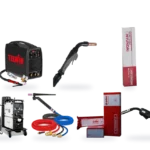


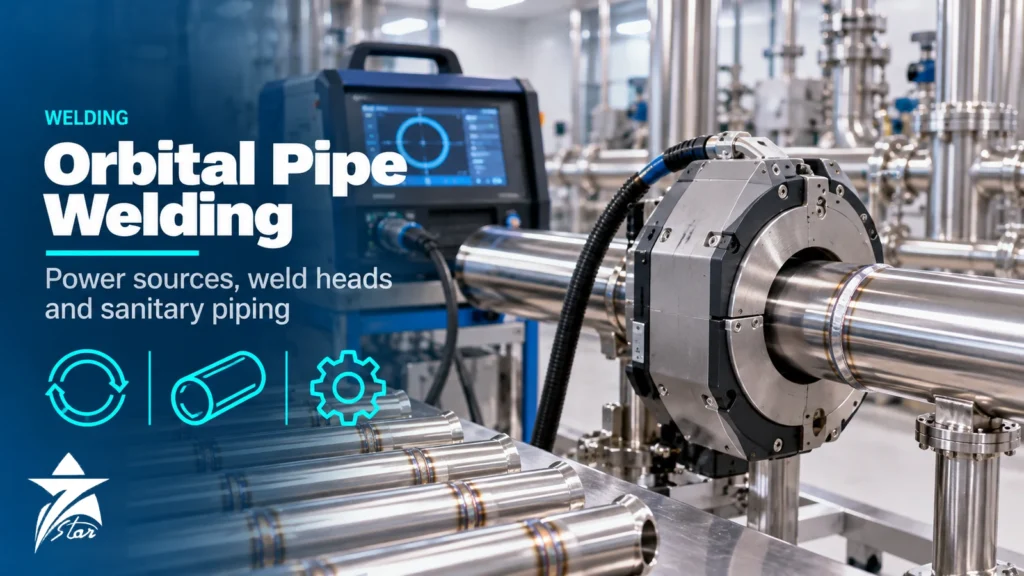
Orbital pipe welding is a mechanised process: a weld head clamps onto a tube or pipe and carries the torch or electrode around a fixed joint, while a programmable power source controls current, travel speed, wire feed and gas flow. Because those parameters are recorded and repeated on every joint, orbital welding gives consistent bead shape and penetration that are very hard to achieve by hand, particularly on thin-wall stainless tubing and in positions that are awkward to reach. This guide explains when orbital welding is worth the investment, how the power sources and weld heads differ, what preparation the process demands, and how it is applied in sanitary, semiconductor, power and pipeline work.
How Orbital Welding Works
Most orbital systems use the gas tungsten arc (GTAW) process. The joint stays still and the tungsten electrode rotates around it inside the weld head. Since gravity acts differently on the weld pool as it moves from flat to vertical to overhead, the program is divided into levels or sectors, and current, pulse settings and travel speed are adjusted for each sector to keep penetration even all the way around. Pulsed current is almost always used: high-current pulses melt through the wall, and low-current background periods let the pool freeze slightly, which helps it stay in place out of position.
Thin-wall tube is usually welded autogenously, which means the square-butted ends fuse together with no filler metal. Thicker pipe needs a groove, filler wire and several passes. In that case the weld head adds a wire feeder, arc voltage control (AVC) to hold the arc length constant, and often torch oscillation to fill a wider groove. Orbital GMAW and FCAW systems also exist for heavier pipe and are widely used on cross-country pipelines, but the term “orbital welding” most often refers to GTAW on tube and pipe.
When Orbital Welding Makes Sense
- Hygienic and high-purity systems where internal weld bead consistency, full penetration and smooth surfaces are required for cleanability, such as pharmaceutical, biotech, food, dairy and semiconductor process lines.
- Large numbers of identical joints, where the setup time is paid back by fast, repeatable welds with low reject rates.
- Code work with full documentation, where recorded parameters for every weld support quality records and traceability.
- Restricted access, for example tube welds in tight racks or behind other lines, where a compact head can reach a joint the welder cannot see properly.
- Shortage of highly skilled manual welders, since operators are trained to set up and monitor the system rather than control the arc by hand.
- Thick-wall power and process piping, where narrow-groove mechanised GTAW cuts the weld volume and keeps quality consistent over long arc times.
Orbital welding is less suitable for a small number of one-off joints, very poor fit-up conditions, or field sites where the joint geometry varies widely and setup time cannot be recovered.
Power Sources and Controls
An orbital power source is a precision inverter-based GTAW supply with a controller that stores weld programs. Features to compare include:
- Number of programmable levels or sectors and the range of pulse parameters.
- Automatic program generation from material, outside diameter and wall thickness, which gives a starting point that is then refined on test coupons.
- Control of gas pre-flow and post-flow, and connection of purge monitoring.
- Data logging of current, voltage, travel speed and wire feed for each weld, with export or printing for quality records.
- Compatibility with several types of weld head, including enclosed and open heads, and with wire feed and AVC.
- Supply voltage, generator compatibility and cooling, which matter on site and in hot climates.
Conventional TIG welding machines remain useful alongside an orbital system for tack welds, repairs and joints the orbital head cannot reach, so many shops run both.
Weld Head Types Compared
| Head type | Typical use | Filler wire | Key points |
|---|---|---|---|
| Enclosed (closed) tube head | Thin-wall tube in sanitary, pharma, semiconductor and instrumentation lines | Usually none (autogenous) | Inert gas fills the head chamber, so the weld and heat-affected zone stay shielded; each head covers a range of tube diameters with interchangeable inserts |
| Open-frame head | Heavier-wall pipe in process, power and offshore piping | Yes, with wire feeder | Often has AVC and oscillation; mounted on a ring or track clamped to the pipe; gas shielding comes through a torch cup or trailing shield |
| Narrow-groove head | Thick-wall power piping and heavy components | Yes, often hot wire | Thin torch and long electrode reach into a narrow bevel; reduces filler volume and arc time on heavy walls |
| Tube-to-tubesheet head | Heat exchangers and boilers | With or without wire | Electrode rotates inside the tube bore at the face of the tubesheet |
| Mechanised pipeline GMAW system | Cross-country pipelines | Solid or flux-cored wire | Bug runs on a band around the pipe; often used with internal clamps and multiple heads per spread |
Sanitary and High-Purity Tube Welding
Hygienic piping relies on orbital welding because the inside of the joint must be smooth, fully penetrated and free from crevices, oxidation and concavity where product or bacteria could collect. ASME BPE (Bioprocessing Equipment) sets acceptance criteria for such welds, covering features such as penetration, misalignment, discolouration of the inside surface, bead width variation and concavity. Inspection is usually visual and borescopic on the inside surface, and a sample of welds is often made as test coupons at the start of each shift or when conditions change.
Several factors decide whether a sanitary weld will pass:
- Heat-to-heat variation in 316L sulfur content. Sulfur influences how the weld pool flows. Tubing with very different sulfur contents can weld with an off-centre bead, so many bioprocess specifications control the sulfur range and require matched heats on each joint.
- Internal purge quality. The bore must be purged with argon and the oxygen level checked with a meter before welding. Too much oxygen produces heat tint and reduces corrosion resistance.
- End preparation. Ends must be square, burr-free and clean. Facing tools give a consistent square end that autogenous welding needs.
- Tungsten condition. The electrode tip geometry and arc gap must be repeatable; a worn or contaminated tungsten changes the arc and the bead.
After welding, any remaining heat tint on accessible surfaces is often removed and the system passivated so the stainless steel recovers its passive film. Weld cleaning and passivation equipment and chemicals support that step.
Power and Process Piping
In power plants, boiler tubing and high-energy piping governed by ASME B31.1 involve thick walls in chromium-molybdenum steels such as Grade 91, often with preheat and post-weld heat treatment. Mechanised GTAW with open heads, oscillation and AVC lays down consistent, low-defect passes in these joints. Narrow-groove bevels and hot-wire GTAW, where the filler wire is resistance heated before it enters the pool, raise deposition and shorten arc time on heavy sections. The same approach suits high-alloy and nickel alloy piping in refineries and petrochemical plants under B31.3, where weld quality and repeatability are important and each defective weld is expensive to repair.
Joint Preparation and Fit-Up
Orbital welding only repeats what the joint allows. A fixed program cannot compensate for poor preparation the way a manual welder can, so the cutting and fit-up steps are part of the process. Ends should be cut square with a clean, burr-free face; for groove welds the bevel angle and root face must be consistent from joint to joint. Dedicated pipe cutting and bevelling machines and tube facing tools give this repeatability far better than abrasive cutting and hand grinding. Misalignment (hi-lo) and gaps must be kept within the tolerances established in the procedure qualification, and tacks made so the head can pass over them without disturbing the arc.
Consumables and Gases
- Filler wire for open heads matching the base metal, for example ER308L or ER316L for austenitic stainless steel, ER70S-2 or ER70S-6 for carbon steel, and ERNiCrMo grades for nickel alloys. Precision-layer-wound TIG welding wire on small spools is preferred for consistent feeding.
- High-purity argon for shielding and purging; argon–hydrogen or argon–helium mixtures are sometimes used for shielding on stainless steel to improve wetting and travel speed where the specification allows.
- Tungsten electrodes of the type and diameter in the WPS, with a consistent ground tip.
- Purge dams, plugs and an oxygen meter for internal purging.
- Inserts and collets for the weld head to match each tube diameter.
Typical Orbital Weld Defects and Their Causes
- Lack of penetration or concave root: current too low or travel too fast in one sector, poor fit-up, or excessive internal purge pressure pushing the root inward.
- Bead wander: sulfur mismatch between heats, magnetised tube or an off-centre tungsten.
- Heat tint inside the bore: purge oxygen too high, purge time too short or a leaking dam.
- Arc starting failures or erratic arc: worn or contaminated tungsten, wrong arc gap or a damaged insert.
- Porosity: moisture or contamination on the joint, gas leaks in hoses or fittings, or drafts at an open head.
Recording every weld’s parameters makes it much easier to trace these problems to one cause, rather than guessing after an inspection reject.
Orbital Welding Project Checklist
- Material grades, diameters and wall thicknesses to be welded, and the governing code or standard.
- Autogenous or filler-wire joints; required weld head types and diameter ranges.
- Power source features: number of levels, data logging, supply voltage and cooling.
- End preparation and fit-up tools for every size.
- Purge equipment, oxygen measurement and gas supply.
- Procedure qualification, operator qualification and test coupon plan.
- Post-weld inspection method (visual, borescope, radiography) and documentation format.
- Cleaning and passivation steps for stainless steel systems.
Orbital Welding Equipment We Supply
These examples cover power sources and weld heads.
| Product | Type | Where it fits |
|---|---|---|
| Polysoude P6 Smart Welding Station for Orbital TIG | Orbital TIG welding station | Production orbital welding. |
| Polysoude P4 Portable Orbital TIG Welding Power Source | Portable orbital TIG power source | Site welding. |
| Orbitalum Mobile Welder Orbital Welding Power Source | Orbital welding power source | Tube welding. |
| Orbitalum DVR M Welding Rotary Device for Orbital TIG | Welding rotary device | Orbital TIG on tubes and fittings. |
| Gullco Pipe KAT PK-500 Orbital Pipe Welding Carriage | Orbital pipe welding carriage | Mechanised welding of larger pipe. |
Send the tube or pipe sizes, materials and weld procedure through our quote request form.
Sourcing Orbital Pipe Welding Equipment Through Seven Star LLC
Seven Star LLC supplies orbital pipe welding systems, weld heads, power sources, consumables and pipe preparation tools on request for contractors and plants in Oman and the GCC. We can help with selection and cross-checking part numbers for heads, inserts, collets and spares from different manufacturers. Availability and lead time are confirmed at quotation.
Planning an orbital welding package? Send us the tube or pipe sizes, materials, wall thickness and the head or power source model you already use, or your RFQ, and we will quote matching equipment and spares.
Frequently asked questions
What is orbital pipe welding?
It is a mechanised welding process in which a weld head clamps onto a fixed tube or pipe and moves the torch or electrode around the joint. A programmable power source controls current, travel speed, wire feed and gas so every weld is made with the same recorded parameters.
What is the difference between enclosed and open orbital weld heads?
Enclosed heads surround the joint and fill with inert gas, and they are mainly used for autogenous welds on thin-wall tube. Open heads mount on a ring or track, add filler wire, arc voltage control and oscillation, and are used for heavier-wall pipe with multiple passes.
Does orbital welding need filler wire?
Thin-wall tube is normally welded autogenously, with no filler metal. Thicker pipe with a beveled groove needs filler wire, which is added by a wire feeder built into the open weld head.
Why is sulfur content important in sanitary tube welding?
Sulfur affects how the molten pool flows. When two tubes with very different sulfur content are joined, the bead can shift to one side and penetration can be uneven, so bioprocess specifications often control the sulfur range and require matched material.
Which standard covers orbital welds in bioprocessing systems?
ASME BPE sets the requirements for hygienic bioprocessing equipment, including acceptance criteria for tube welds such as penetration, alignment, discolouration and bead profile. Project specifications may add their own requirements.
Is orbital welding used on pipelines?
Yes. Mechanised orbital GMAW systems with bugs running on bands around the pipe are widely used on cross-country pipeline projects, often with internal clamps and several heads working on the same joint.
Was this guide helpful?One click helps us write better guides for engineers.
Thank you! Glad it helped. Need this equipment for your project? Request a quotation
Thank you. We will use this to improve the guide.