- Automation & ControlView all 2,895 products
- Automation Accessories
- AC Drives
- PLC & I/O Cards
- Industrial Communications
- Vibration Monitoring
- Controllers & Data Acquisition
- Isolator & Barrier
- Safety Switches & Guard Locking
- Motor Soft Starters
- CCTV & Security
- Encoders
- Pneumatic Cylinders
- HMI Displays
- Servo Drives
- Industrial Computers
- Machine Vision
- Automation Software
- Robotics
















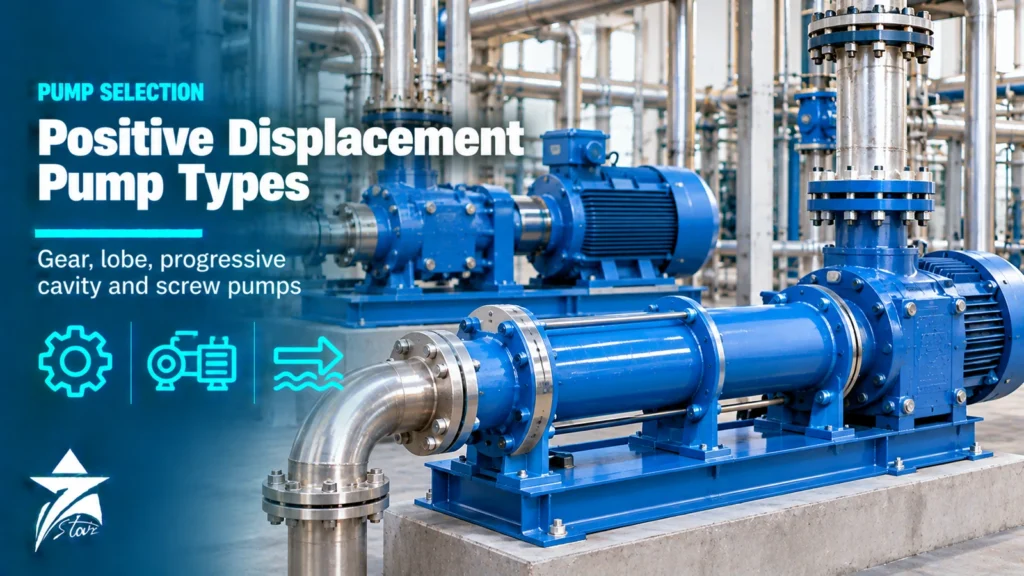
Centrifugal pumps move most of the water in industry, but many fluids and duties need a different approach. Viscous oils, sludges, slurries, shear-sensitive food products, chemicals that must be dosed accurately and high-pressure water all call for a positive displacement pump. These pumps trap a fixed volume of fluid and push it from the suction to the discharge, so flow stays nearly constant as pressure changes. This guide compares the main types, explains when each is the right choice and covers the sizing and protection points that keep them running reliably.
How a Positive Displacement Pump Differs From a Centrifugal Pump
| Aspect | Centrifugal pump | Positive displacement pump |
|---|---|---|
| Principle | Adds velocity, converted to pressure | Traps and moves a fixed volume per revolution or stroke |
| Flow vs pressure | Flow falls as pressure rises along the curve | Flow nearly constant; pressure set by the system |
| Viscosity | Efficiency drops sharply above about 100 to 200 cSt | Handles high viscosity; efficiency often improves |
| Flow control | Throttling valve or speed | Speed (VFD), stroke length or bypass; never throttle discharge |
| Closed discharge | Runs at shut-off head (overheats if prolonged) | Pressure rises until something fails; relief valve required |
| Typical duties | Water, low-viscosity liquids, high flows | Oils, sludge, slurries, dosing, high pressure, metering |
For centrifugal pump selection, see our guide to reading pump curves and BEP.
Rotary vs Reciprocating Designs
Positive displacement pumps fall into two families. Rotary pumps (gear, lobe, screw, progressive cavity, vane, peristaltic, circumferential piston) use rotating elements and give a smooth, low-pulsation flow. Reciprocating pumps (piston, plunger, diaphragm) use a back-and-forth motion with check valves, give pulsating flow and can reach very high pressures. Each design has its own strengths.
Gear Pumps
External gear pumps use two meshing gears; internal gear pumps use a rotor gear inside an idler. Fluid is carried in the spaces between the teeth and the casing.
- Best for: clean oils, fuels, lubricants, hydraulic fluids, resins and polymers.
- Strengths: compact, simple, good suction lift, accurate flow, wide viscosity range.
- Limits: close clearances wear quickly with abrasives; not suited to solids or shear-sensitive products.
- Typical pressures: up to around 25 bar for transfer pumps, much higher for hydraulic gear pumps.
Lobe and Circumferential Piston Pumps
Rotary lobe pumps use two non-contacting lobed rotors driven by timing gears. Circumferential piston pumps use arc-shaped rotors in a similar arrangement with longer sealing paths.
- Best for: food, dairy, beverage, pharmaceuticals, cosmetics, sludges and products with soft solids.
- Strengths: gentle low-shear handling, hygienic designs for CIP/SIP, reversible flow, can run briefly dry in some designs.
- Limits: slip increases with low-viscosity fluids and higher pressure; timing gears need lubrication.
Progressive Cavity Pumps
A progressive cavity (progressing cavity) pump uses a helical rotor turning inside a double-helix elastomer stator. Sealed cavities move steadily from suction to discharge.
- Best for: wastewater sludge, slurries, crude oil with sand, polymer dosing, paste, multiphase oil production.
- Strengths: smooth, pulse-free flow, handles solids and high viscosity, low shear, pressure set by number of stages.
- Limits: the stator is damaged by dry running within seconds; elastomer must match the fluid and temperature; long footprint.
Dry-run protection, such as a stator temperature sensor or flow switch, is strongly recommended on every progressive cavity positive displacement pump.
Screw Pumps
Screw pumps use two or three intermeshing screws. Three-screw pumps are common for lubricating oil, fuel and hydraulic duties; twin-screw pumps with timing gears handle crude oil, bitumen, multiphase mixtures and products with some gas.
- Best for: fuel oil transfer and burner supply, lube oil systems on turbines and compressors, tank farm transfer, multiphase oil.
- Strengths: high flow rates, low pulsation, low noise, high efficiency with viscous fluids, good suction capability.
- Limits: three-screw pumps need lubricating fluids; twin-screw pumps are larger and more expensive.
Diaphragm, Peristaltic and Piston Pumps
| Type | How it works | Typical use |
|---|---|---|
| Air-operated double diaphragm (AODD) | Compressed air flexes two diaphragms; no electrical drive | Chemicals, paints, sludge, drum and tank transfer, hazardous areas |
| Metering diaphragm pump | Motor-driven diaphragm with adjustable stroke | Accurate chemical dosing (see API 675) |
| Peristaltic (hose or tube) | Rollers squeeze a flexible hose; only the hose touches the fluid | Abrasive slurries, lime, chemicals, laboratory dosing |
| Piston and plunger pumps | Reciprocating plunger with check valves | High-pressure water, RO feed, washdown, injection |
| Axial piston (seawater RO) | Swashplate-driven pistons in water-lubricated designs | Seawater reverse osmosis high-pressure feed |
Diaphragm pumps self-prime, can run dry and handle solids, which makes them very flexible for transfer. Pulsation dampers smooth their discharge where needed.
Quick Comparison Table
| Type | Viscosity | Solids | Shear | Pulsation | Dry running |
|---|---|---|---|---|---|
| Gear | Low to very high | Poor | Moderate | Low | Poor |
| Lobe | Medium to high | Good (soft) | Low | Low | Limited |
| Progressive cavity | Low to very high | Very good | Low | Very low | Very poor |
| Screw | Low to very high | Limited (twin-screw better) | Low | Very low | Poor |
| AODD | Low to high | Very good | Low | High (damper helps) | Good |
| Peristaltic | Low to high | Excellent | Very low | Moderate | Good |
| Piston/plunger | Low | Poor | Moderate | High | Poor |
Sizing and Selecting a Positive Displacement Pump
- Flow and pressure: define normal, minimum and maximum flow and the full discharge pressure, including friction losses with viscous fluids.
- Viscosity at operating temperature: viscous fluids need slower speeds and larger pumps to avoid cavitation on the suction side.
- NPSH: check NPSH available against NPSH required; viscous fluids and long suction lines often limit speed.
- Solids and abrasives: size, hardness and concentration push the choice toward PC, peristaltic or diaphragm pumps and lower speeds.
- Materials: cast iron, ductile iron, stainless steel or plastics for the wetted parts; elastomers compatible with the fluid.
- Sealing: packing, single or double mechanical seals, or sealless magnetic drive. Our mechanical seals guide explains API 682 arrangements.
- Drive and control: a gearmotor or VFD sets speed; flow is roughly proportional to speed. See our motor efficiency classes guide for IE3 and IE4 motors.
- Standards: API 676 covers rotary pumps and API 674 covers reciprocating pumps for petroleum and gas service.
Protecting a Positive Displacement Pump
Because a positive displacement pump keeps pushing fluid until something gives, overpressure protection is essential. Use an integral or external relief valve sized for full flow, piped back to the suction tank rather than to the pump inlet where possible. Never fit a closable valve between the pump and the relief valve. Add pressure gauges or transmitters on suction and discharge, dry-run protection for PC and gear pumps, strainers sized for low pressure drop on the suction side, and pulsation dampers on reciprocating and diaphragm pumps. For custody transfer and blending on the same skid, our positive displacement flow meter guide covers oval gear and piston meters.
Common Failure Modes and Maintenance Checks
| Symptom | Likely cause | Check or fix |
|---|---|---|
| Flow lower than rated | Internal slip from worn gears, lobes, screws or stator; speed too low; air leaks on suction | Measure speed and suction pressure, inspect clearances, replace worn stator or rotor |
| Noise and vibration | Cavitation from high viscosity or blocked strainer; coupling misalignment; worn bearings | Clean strainer, reduce speed, check NPSH, realign coupling |
| Stator damage or burning smell | Dry running or excessive temperature on progressive cavity pumps | Install dry-run protection, check elastomer temperature rating |
| Seal leakage | Wrong seal material, dry running, pressure spikes, shaft run-out | Review seal selection, add flush or quench, check relief valve setting |
| Motor overload | Viscosity higher than design, discharge restriction, relief valve set too high | Check fluid temperature, open discharge path, verify relief setting |
| Diaphragm rupture | Chemical attack, excessive air pressure, abrasive wear | Change diaphragm material, reduce air pressure, add leak detection |
A simple maintenance plan covers weekly checks of noise, leaks and pressures, monthly strainer cleaning on dirty services, periodic measurement of flow at known speed to detect internal wear early, and stocking critical spares such as stators, rotors, gear sets, seals, diaphragms and check valves. Recording speed, pressure and motor current at commissioning gives a baseline that makes later troubleshooting much faster.
Applications in Oman
In Oman, rotary and reciprocating pumps serve crude oil transfer and multiphase production in the interior fields, fuel and lube oil systems in power plants, sludge handling and polymer dosing in wastewater treatment, chemical dosing in desalination and high-pressure seawater RO feed. High ambient temperatures affect fluid viscosity and elastomer life, so stator and seal materials should be checked for the real operating temperature, and pumps installed outdoors benefit from shading and motor ratings suited to 50 °C ambient.
Selected Rotary and Reciprocating Pumps in Our Catalogue
The table lists examples of pump types we can quote.
| Product | Type | Typical use |
|---|---|---|
| KRACHT KF80RF2-D15 | External gear pump | Oil and fuel transfer |
| KRACHT DT DuroTec | Gear pump for abrasive fluids | Fluids with fillers and abrasives |
| Alfa Laval M Gear | Hygienic gear pump | Food and viscous products |
| NETZSCH TORNADO T2 | Rotary lobe pump | Sludge and industrial transfer |
| Alfa Laval SRU | Hygienic rotary lobe pump | Food, dairy and beverage |
| Alfa Laval DuraCirc | Circumferential piston pump | Hygienic viscous products |
| NETZSCH NEMO SY | Progressing cavity, bearing housing | Wastewater sludge and slurries |
| NETZSCH NEMO Multiphase | Multiphase progressing cavity | Oil and gas production |
| Allweiler OptiFix AEB | Progressing cavity pump | Industrial and water treatment |
| Allweiler SN Series | Three-screw pump | Lubricating and fuel oil systems |
| NETZSCH NOTOS 4NS | Geared twin-screw pump | Crude oil and viscous media |
| VERDERAIR VA50 | Metallic AODD pump | Chemical and sludge transfer |
| Verderflex Rapide | Peristaltic tube pump | Dosing and abrasive fluids |
| Danfoss APP 10.2 | Axial piston seawater pump | Seawater RO high pressure |
Browse more in our rotary and reciprocating pumps category. To get a quotation, send the fluid, viscosity, temperature, solids content, flow, suction and discharge pressure, materials and seal preference through our quote request form or to [email protected].
Sourcing Pumps in Oman Through Seven Star LLC
Seven Star LLC is an independent supplier in Oman of gear, lobe, progressing cavity, screw, diaphragm, peristaltic and piston pumps, along with seals, stators and spare parts. We quote products from manufacturers such as NETZSCH, Allweiler, KRACHT, Alfa Laval, Verder, Debem, Tapflo and Danfoss, and can help match pump type, materials and drive to your fluid and duty. Performance, materials and lead time are confirmed against the manufacturer data at quotation.
Frequently asked questions
What is a positive displacement pump?
It is a pump that traps a fixed volume of fluid and moves it from suction to discharge with each revolution or stroke. Flow stays nearly constant when pressure changes, unlike a centrifugal pump.
When should I use a positive displacement pump instead of a centrifugal pump?
Use one for viscous fluids, sludges and slurries, shear-sensitive products, accurate dosing, high pressure at low flow, or when constant flow is needed regardless of system pressure.
What is the difference between a gear pump and a progressive cavity pump?
Gear pumps use meshing metal gears and suit clean oils and fuels. Progressive cavity pumps use a helical rotor in an elastomer stator and handle solids, slurries and sludge with smooth, low-shear flow, but must never run dry.
Why does a positive displacement pump need a relief valve?
If the discharge is blocked, the pump keeps pushing fluid and pressure rises until a pipe, seal or casing fails. A relief valve sized for full flow protects the pump and system.
How do I control the flow of a positive displacement pump?
Change the speed with a variable frequency drive or gearbox, adjust the stroke on reciprocating pumps, or use a bypass back to the tank. Never throttle the discharge valve.
Who supplies positive displacement pumps in Oman?
Seven Star LLC is an independent supplier in Oman that quotes gear, lobe, progressive cavity, screw, diaphragm and piston pumps from leading manufacturers. Send your requirements through the quote request form or to [email protected].
Was this guide helpful?One click helps us write better guides for engineers.
Thank you! Glad it helped. Need this equipment for your project? Request a quotation
Thank you. We will use this to improve the guide.