- Automation & ControlView all 2,895 products
- Automation Accessories
- AC Drives
- PLC & I/O Cards
- Industrial Communications
- Vibration Monitoring
- Controllers & Data Acquisition
- Isolator & Barrier
- Safety Switches & Guard Locking
- Motor Soft Starters
- CCTV & Security
- Encoders
- Pneumatic Cylinders
- HMI Displays
- Servo Drives
- Industrial Computers
- Machine Vision
- Automation Software
- Robotics
















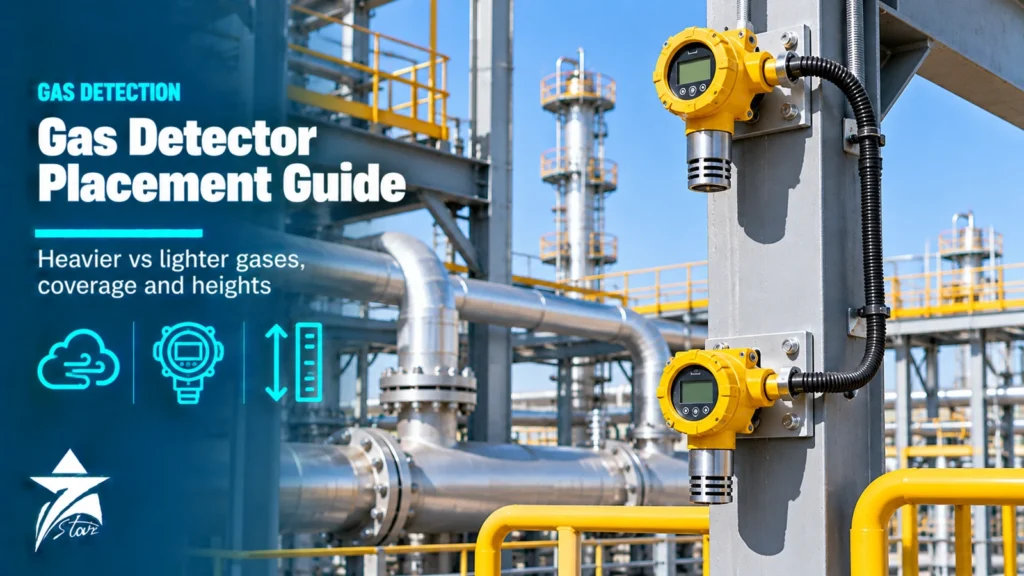
A fixed gas detector only protects people and plant if the gas reaches it. A well specified sensor mounted in the wrong place, behind an obstruction or at the wrong height, can stay silent while a flammable or toxic cloud builds a few metres away. Good gas detector placement starts with the gas, the leak sources and the way air moves around them, not with a fixed grid copied from another project. This guide explains how density and release conditions affect gas behaviour, recommended mounting heights, how to cover areas with point and open path detectors, how mapping studies are done, and the practical installation details that matter on hot, dusty sites.
Start With the Hazard: What, Where and How Much
Before choosing positions, the design team should list for each area:
- The gases present: flammable hydrocarbons, hydrogen, H2S, ammonia, chlorine, CO, CO2 or solvent vapours, each with its density, toxicity limits and lower explosive limit (LEL).
- Leak sources: flanges, valve stems, pump and compressor seals, instrument connections, sample points, vents, loading arms and drains. Most leaks start at these points, not in the middle of straight pipe.
- Release conditions: pressure, temperature and phase. A high-pressure jet behaves very differently from a slow leak or an evaporating liquid pool.
- Ventilation and wind: indoor air change rates, HVAC flow patterns, prevailing wind direction and the effect of buildings and equipment on outdoor air movement.
- Objective: is the detector meant to protect people (toxic exposure), prevent ignition (flammable cloud before it reaches an ignition source), or trigger shutdown (ESD, isolation, ventilation)? Each objective leads to different positions.
IEC 60079-29-2 gives guidance on the selection, installation and maintenance of flammable gas detectors, and EN 45544-4 covers toxic gas detectors. Our gas detector selection guide for oil and gas facilities compares catalytic, infrared, electrochemical and flame detection technologies.
Gas Density and Mounting Height
The relative density of a gas compared with air (air = 1.0) is the first indicator of where it will accumulate, but it is not the only one.
| Gas | Relative density (air = 1) | Typical behaviour | Usual mounting |
|---|---|---|---|
| Hydrogen | 0.07 | Rises rapidly, collects under roofs | At high level, close to the ceiling or roof apex |
| Methane (natural gas) | 0.55 | Rises and disperses | High level indoors; near sources outdoors |
| Ammonia | 0.59 | Rises when warm, but cold releases from liquid can stay low | High level, with low-level detectors near liquid sources |
| Carbon monoxide | 0.97 | Mixes with air | Breathing zone, around 1.5 m |
| Hydrogen sulphide | 1.19 | Slightly heavier, follows air movement, collects in pits and low areas | Near sources and at breathing height, plus low points such as pits |
| Carbon dioxide | 1.52 | Sinks and collects in low areas | Low level, around 0.3 to 0.5 m |
| Propane | 1.55 | Sinks, flows along the ground and into drains | Low level, around 0.3 m above the floor |
| Butane | 2.0 | Sinks, collects in pits and trenches | Low level, also in pits and trenches |
| Chlorine | 2.5 | Heavy, flows along the ground | Low level, near the floor |
Density is only a starting point. A cold release of a light gas, such as LNG vapour or ammonia flashing from liquid, can stay at ground level until it warms. A hot release of a heavy gas can rise at first. High-pressure jets carry gas in the jet direction regardless of density. For these reasons gas detector placement often combines high and low detectors around the same source.
Gas Detector Placement: Coverage and Spacing
There is no single spacing distance that applies everywhere, but some practical rules are widely used in fire and gas design:
- Near the source: place point detectors close to likely leak points such as pump seals and compressor packing, typically within a few metres and downwind under prevailing wind.
- Congested process areas: many operator standards design for detection of a gas cloud of around 5 m diameter in congested modules, which leads to point detector spacing of the same order. This size is linked to the minimum cloud that could cause significant overpressure if ignited.
- Open areas and perimeters: open path infrared detectors cover lines of 5 to over 100 m across a pipe rack, a tank farm boundary or the edge of a plant, where point detectors would need very many units.
- Enclosed rooms: one or more detectors per room depending on volume, ventilation and sources; analyser shelters, compressor buildings and battery rooms usually have their own detectors interlocked with ventilation.
- Voting: shutdown actions typically use 2ooN voting (two detectors in alarm) to avoid spurious trips, so detectors must be close enough that a realistic cloud reaches two of them.
Point vs Open Path Detectors
| Aspect | Point detector | Open path detector |
|---|---|---|
| Measures | Concentration at one point (%LEL or ppm) | Integrated concentration along a beam (LEL·m) |
| Best for | Specific leak sources, rooms, ducts, toxic gases | Perimeters, pipe racks, large open areas, fence lines |
| Technologies | Catalytic bead, point IR, electrochemical, semiconductor, PID | Infrared beam, laser-based for H2S and some toxics |
| Limitations | Gas must reach the sensor; many units for large areas | Beam blockage by fog, heavy rain or obstructions; needs stable mounting |
| Maintenance | Calibration with gas at each head | Alignment checks, functional test with gas cells or test films |
Most facilities use both: point detectors at sources and in enclosures, and open path detectors to detect clouds moving toward ignition sources, buildings or the plant boundary.
Gas Detector Placement by Fire and Gas Mapping
For new oil and gas, petrochemical and LNG projects, positions are increasingly set by a fire and gas mapping study following ISA TR84.00.07. Instead of a fixed grid, the study models the area in 3D and measures how much of it is covered by detectors.
- Geographic coverage: the fraction of the area in which a defined gas cloud would be seen by the required number of detectors.
- Scenario coverage: the fraction of realistic release scenarios, from dispersion modelling (often computational fluid dynamics), that would be detected.
- Targets: coverage targets, for example 80% or 90%, are set according to the risk grade of the area and the performance required by the safety instrumented function.
- Iteration: detectors are added or moved until the target is met, which also prevents over-design in low-risk areas.
Mapping studies are as good as their inputs, so it is worth checking that leak sources, congestion, wind and detector performance in the model match the real plant.
Special Locations Not to Forget
- HVAC air intakes: detectors at the intake of control rooms, substations and accommodation shut dampers and stop fans if gas is drawn toward occupied buildings.
- Pits, trenches, sumps and drains: heavy gases and H2S collect in low points that are also where people enter for maintenance.
- Turbine and compressor enclosures: detectors in the ventilation outlet often see leaks earlier than detectors inside the enclosure.
- Battery rooms: hydrogen from charging lead-acid batteries collects at ceiling level.
- Ducts: duct-mounted detectors with sample probes check air in ventilation systems.
- Confined spaces: fixed detection does not replace portable detectors for entry; see our portable gas detector guide.
Installation Details That Affect Performance
- Sensor orientation: most point sensors are mounted facing down so that rain, dust and condensation do not collect on the sintered flame arrestor.
- Weather and sun protection: use weather protection and sun shields; in direct summer sun, detector housings can exceed their rated temperature.
- Access for calibration: mount detectors where they can be reached for bump tests and calibration, or fit remote calibration adapters and gas lines for inaccessible points.
- Avoid dead zones: keep detectors away from corners without air movement and out of direct jets from steam or water, which can damage sensors.
- Poisons and inhibitors: silicones, lead compounds and H2S can poison catalytic sensors; IR sensors avoid this issue for hydrocarbons.
- Alarm signalling: locate beacons and sounders so that people near the hazard see and hear the alarm, not only the control room.
Gas Detector Placement on Oman Sites
Many oil and gas fields in Oman produce sour gas with high H2S content, so toxic detection near wellheads, separators, sulphur recovery units and drains is a central part of the design. Hot summers, strong sun and fine sand affect detectors outdoors: sun shields, dust filters suitable for the sensor type and regular inspection of the sinter are important. Shamal and seasonal winds change prevailing directions, so gas detector placement should consider more than one wind case. Desalination and water treatment plants also need chlorine and ammonia detection in dosing rooms and storage areas. Our gas detector supplier overview for Oman summarises the fixed and portable ranges available.
Selected Fixed Gas and Flame Detection Products in Our Catalogue
The table lists examples of detectors and controllers we can quote for new systems and replacements.
| Product | Type | Typical use |
|---|---|---|
| Det-Tronics PIRECL PointWatch Eclipse | Point IR flammable detector | Hydrocarbon detection at process sources |
| MSA PrimaX IR | Point IR transmitter, HART, SIL 2 | Flammable gas in process areas |
| Honeywell Sensepoint XCD IR | Point IR flammable detector | Compact flammable detection |
| Honeywell Searchline Excel | Open path IR detector | Perimeters, pipe racks and open areas |
| Honeywell OmniPoint | Multi-sensor fixed detector | Toxic and flammable gases indoors |
| Dräger Polytron 8100 EC | Electrochemical toxic transmitter | H2S, CO, Cl2 and other toxics |
| Crowcon Xgard IQ | Fixed detector and transmitter | Toxic, flammable and oxygen detection |
| Oldham OLCT 60 | Explosion-proof detector | Industrial toxic and flammable monitoring |
| H2scan HY-GUARD | Hydrogen area monitor | Battery rooms and hydrogen systems |
| Det-Tronics X3301 | Multispectrum IR flame detector | Hydrocarbon fire detection |
| Honeywell Touchpoint Plus | Gas detection controller | Small and medium systems |
| MSA GasGard XL | 8-channel controller | Building and plant monitoring |
| E2S GNExS1F | Explosion-proof horn sounder | Local alarm in hazardous areas |
Browse more in our fire and gas detectors category. To get a quotation, send the gases, ranges, hazardous area classification, output and protocol, quantity and controller requirements through our quote request form or to [email protected].
Sourcing Gas Detection Equipment in Oman Through Seven Star LLC
Seven Star LLC is an independent supplier in Oman of fixed and portable gas detectors, open path detectors, flame detectors, controllers and alarm devices for oil and gas, petrochemical, utility and industrial sites. We quote products from manufacturers such as Honeywell, MSA, Det-Tronics, Dräger, Crowcon and Oldham, and can match detector types and accessories to the positions shown in a gas detector placement layout or mapping report. Ranges, approvals, SIL data and lead time are confirmed against the manufacturer data at quotation.
Frequently asked questions
At what height should an H2S detector be mounted?
H2S is slightly heavier than air but usually follows air movement, so many operators mount detectors near the leak sources and at breathing height, with additional detectors in pits, trenches and other low points where it can collect. Follow the project specification and mapping study.
Where should a methane detector be installed?
Methane is lighter than air, so indoors it is detected at high level near the ceiling or roof, especially above leak sources. Outdoors, detectors are placed close to the sources and downwind, because wind and jets dominate over density.
How far apart should fixed gas detectors be?
There is no universal spacing. Congested process areas are often designed to detect a cloud of about 5 m diameter, giving point detector spacing of the same order, while open path detectors cover long lines. A mapping study to ISA TR84.00.07 gives a quantified layout.
What is fire and gas mapping?
It is a study that models a plant in 3D and calculates the geographic or scenario coverage achieved by flame and gas detectors. Detectors are added or moved until the coverage targets for each area are met.
When are open path detectors better than point detectors?
Open path detectors are better for long lines such as perimeters, pipe racks and tank farm boundaries, where a cloud may cross the beam anywhere along its length. Point detectors are better for specific sources, rooms, ducts and toxic gases.
Who supplies gas detectors in Oman?
Seven Star LLC is an independent supplier in Oman that quotes fixed, open path and portable gas detectors, flame detectors and controllers from leading manufacturers. Send your requirements through the quote request form or to [email protected].
Was this guide helpful?One click helps us write better guides for engineers.
Thank you! Glad it helped. Need this equipment for your project? Request a quotation
Thank you. We will use this to improve the guide.