- Vibration Monitoring
- Industrial Communications
- AC Drives
- PLC & I/O Cards
- Automation Accessories
- Controllers & Data Acquisition
- Encoders
- Industrial Computers
- CCTV & Security
- Safety Switches & Guard Locking
- Motor Soft Starters
- Isolator & Barrier
- HMI Displays
- Pneumatic Cylinders
- Servo Drives
- Automation Software
- Robotics
- Machine Vision
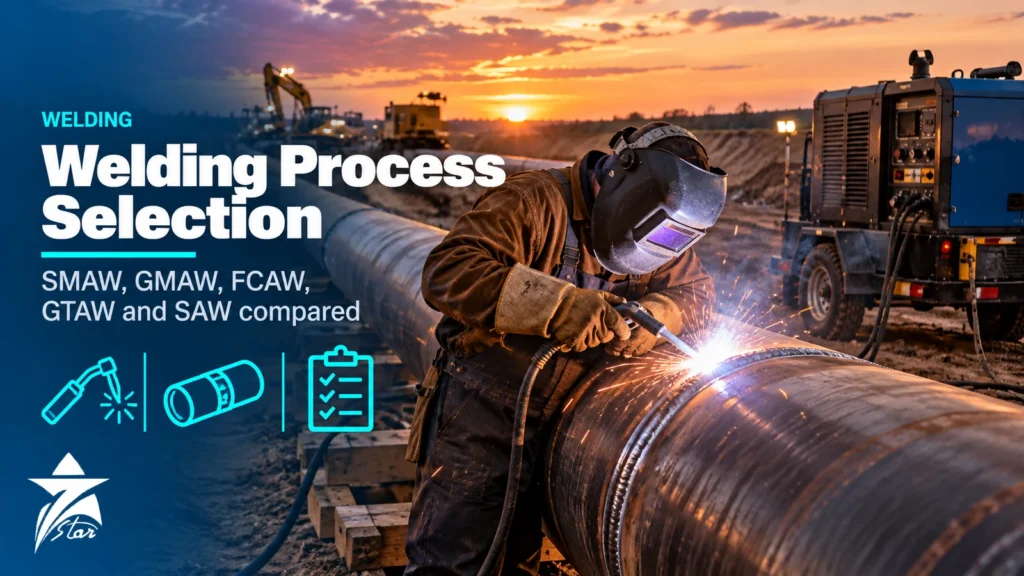
Welding process selection decides the cost, schedule and defect rate of a fabrication or pipeline job long before the first arc is struck. SMAW, GMAW, FCAW, GTAW and SAW can all produce code-quality welds in carbon steel, but they differ widely in deposition rate, tolerance to wind and position, welder skill, equipment cost and the kinds of defects they tend to produce. Choosing the wrong one means slow progress, high repair rates or a WPS that cannot be qualified for the project specification. This guide compares the five main arc processes, sets out the selection criteria that matter in shops and on site, and shows typical process combinations for structural fabrication, process piping, pipelines and tank work.
The Five Arc Welding Processes in Brief
SMAW (Stick, MMA)
A flux-covered electrode melts in the arc; the coating produces shielding gas and slag. Equipment is simple and portable, there is no external gas, and the process works in all positions and in wind. It is slow because electrodes must be changed and slag removed between passes, and quality depends heavily on the welder. Electrode types range from cellulosic (E6010) for pipe roots to low-hydrogen (E7018) for structural and pressure work.
GMAW (MIG/MAG)
A continuously fed solid wire with external shielding gas (argon, CO2 or mixtures). Deposition is high and there is no slag, making it fast in the shop and easy to mechanise. Metal transfer mode matters: short-circuit transfer is used for thin material and out-of-position root passes but is prone to lack of fusion on thicker sections; spray and pulsed-spray transfer give better fusion. Gas shielding is easily disturbed by drafts.
FCAW (Flux-Cored)
A tubular wire filled with flux. Gas-shielded FCAW (FCAW-G) combines high deposition with an easy-to-use, all-position slag system and is a workhorse in structural and shipyard fabrication. Self-shielded FCAW (FCAW-S) needs no gas, so it tolerates wind better and is used on site and in some pipeline fill passes. Both leave slag that must be removed between passes.
GTAW (TIG)
A non-consumable tungsten electrode with inert gas shielding and separately added filler rod. It gives the best control and cleanest welds, which is why it is used for root passes on pipe, thin wall, stainless steel, nickel alloys and other corrosion-resistant alloys. It is also the slowest manual process with the lowest deposition rate and demands the most skilled welders.
SAW (Submerged Arc)
A continuously fed wire under a blanket of granular flux; the arc is invisible. It delivers the highest deposition rates of the group, deep penetration and excellent surface finish, but it is mechanised and essentially limited to flat and horizontal positions, with the work rotated or the head traversed. It is ideal for long seams, heavy plate, vessels, tanks, pipe mills and rotated spool welding.
Side-by-Side Comparison
| Factor | SMAW | GMAW | FCAW | GTAW | SAW |
|---|---|---|---|---|---|
| Relative deposition rate | Low to moderate | High | High | Lowest | Very high |
| Typical deposition efficiency* | ~65% | ~92–98% | ~87% | ~99% (with filler) | ~99% |
| Positions | All | All (mode-dependent) | All (wire-dependent) | All | Flat, horizontal |
| Wind tolerance | Good | Poor | FCAW-S good, FCAW-G poor | Poor | Good (flux-shielded) |
| Welder skill needed | High | Moderate | Moderate | Highest | Operator skill, setup critical |
| Equipment portability | Excellent | Moderate | Moderate to good | Good | Low |
| Slag | Yes | No | Yes | No | Yes |
| Typical defects | Slag inclusions, porosity at starts | Lack of fusion (short-circuit), porosity in drafts | Slag lines, porosity, wormholes | Tungsten inclusions, lack of fusion on heavy wall | Centreline cracking, slag in multi-pass grooves |
*Approximate deposition efficiency values as published in welding trade literature; actual figures vary with consumable, parameters and stub loss.
Selection Criteria That Actually Drive the Decision
- Code and specification. AWS D1.1 for structures, ASME Section IX with B31.3 or B31.1 for piping, ASME Section VIII for vessels, API 1104 for pipelines and API 650 for tanks all permit several processes, but project specifications often restrict them, for example banning short-circuit GMAW on pressure parts or requiring GTAW roots on stainless lines.
- Material. Carbon steel can be welded with any of the five. Stainless steel, duplex and nickel alloys usually call for GTAW roots and GTAW, SMAW or GMAW fill; aluminium is mostly GMAW and GTAW.
- Thickness and joint volume. Thin sections favour GTAW or short-circuit GMAW; heavy walls favour FCAW, SAW or a combination with a GTAW or SMAW root.
- Position. Fixed pipe in the 5G or 6G position rules out SAW; rotated spools in the shop allow SAW or high-deposition GMAW in the flat position.
- Location and environment. Field work in wind favours SMAW and FCAW-S or requires shelters for gas-shielded processes; remote sites need engine-driven power.
- Quality and inspection. If welds will be radiographed or ultrasonically tested, choose a process and transfer mode with low lack-of-fusion risk and train welders on it.
- Productivity and labour. Arc-on time, deposition rate and the availability of qualified welders for each process.
- Hydrogen and toughness. Crack-sensitive steels and low-temperature service favour low-hydrogen processes and consumables with H4 or H8 designators.
Typical Process Combinations by Application
Structural Steel Fabrication
Shops typically use FCAW-G or GMAW for most fillet and groove welds, SAW for long built-up girder seams and SMAW E7018 for site connections and repairs. Self-shielded FCAW is common for site erection where wind is a problem.
Process Piping and Spools
A common combination is a GTAW root and hot pass for clean, fully penetrated roots, followed by SMAW E7018 or FCAW fill and cap. Rotated carbon steel spools can use SAW or mechanised GMAW for fill and cap to raise productivity. Stainless and alloy piping is often all-GTAW or GTAW root with SMAW fill.
Cross-Country Pipelines
Manual pipelines have long used cellulosic SMAW vertical-down for root and hot pass, with cellulosic or low-hydrogen fill and cap. Larger projects use mechanised GMAW systems with internal clamps and multi-head bugs for higher productivity, and FCAW-S is used for fill and cap on some spreads. Procedures are qualified to API 1104 or the project’s equivalent.
Storage Tanks and Vessels
Automatic SAW is widely used for horizontal girth seams on tanks and for longitudinal and circumferential seams on vessels, with FCAW or GMAW for vertical seams and SMAW for nozzles and repairs.
Consumable Families to Match Each Process
- SMAW: AWS A5.1 carbon steel and A5.5 low-alloy covered electrodes.
- GMAW: AWS A5.18 carbon steel solid wires such as ER70S-6 and A5.28 low-alloy wires.
- FCAW: AWS A5.20 carbon steel and A5.29 low-alloy flux-cored welding wire, including gas-shielded and self-shielded types.
- GTAW: A5.18 and A5.28 rods for steels, A5.9 for stainless steel and A5.14 for nickel alloys.
- SAW: AWS A5.17 carbon steel and A5.23 low-alloy submerged arc welding wire, always classified as a wire–flux combination.
Equipment Considerations
Modern inverter power sources often cover several processes, but serious production still benefits from dedicated machines. MIG/MAG welding machines with pulsed programs widen the usable range of GMAW on pipe and stainless; TIG welding machines with high-frequency start, pulsing and AC capability cover root passes and non-ferrous work; SAW needs a high-duty-cycle power source, tractor or column-and-boom and flux handling. The wider welding equipment range also includes positioners, wire feeders and torches that affect productivity as much as the power source.
GCC Site Conditions
Gulf projects add three practical constraints. First, wind and blowing sand disturb gas shielding and cause porosity in GMAW, FCAW-G and GTAW, so field welding with those processes needs shelters or habitats, or a switch to SMAW or FCAW-S. Second, ambient heat reduces the usable output of power sources: the duty cycle of arc welding equipment under IEC 60974-1 is rated at 40 °C ambient, so machines working in direct sun at higher temperatures need shading, ventilation or derating. Third, remote desert sites rely on engine-driven welders, whose fuel, dust filtration and cooling need attention in summer. Humidity in coastal areas also raises moisture pickup in low-hydrogen electrodes and SAW fluxes, which must be stored and dried correctly. For sour service, all processes must meet NACE MR0175/ISO 15156 hardness limits, which influences heat input and consumable selection.
Joint Design and Fit-Up Differ by Process
The process you choose also changes the bevel, and that affects cutting, fit-up and the amount of filler metal you need. Manual SMAW and GTAW on pipe usually use a conventional V-bevel with a small root face and a root gap sized so the welder can see and control penetration. Mechanised GMAW pipeline systems often use a compound or narrow bevel with a tight, consistent fit, because the bug follows a programmed path and cannot correct for poor alignment the way a skilled hand welder can. SAW on heavy plate can use larger root faces and fewer passes because of its deep penetration, but it needs backing or a sealing pass to avoid burn-through. In practice, if you change the process you should review the bevel geometry, the tolerance on root gap and hi-lo misalignment, and the cutting and bevelling method that will hold those tolerances on every joint.
Common Mistakes in Welding Process Selection
- Using short-circuit GMAW on thick pressure welds, then finding lack of sidewall fusion at UT.
- Specifying gas-shielded processes for open-air field work without providing wind protection.
- Choosing SAW for a job where most welds are fixed-position and cannot be rotated.
- Underestimating welder qualification time for GTAW on large stainless or alloy projects.
- Selecting a process before checking that the WPS can be qualified for impact toughness and hardness requirements.
- Ignoring flux and electrode storage needs for low-hydrogen SMAW and SAW.
Welding Process Selection Checklist
- Governing code, project specification and any process restrictions.
- Base material, thickness range and joint types.
- Welding positions and whether work can be rotated.
- Shop or field; wind, sand, temperature and power availability.
- Required toughness, hardness, hydrogen level and NDT method.
- Target productivity and available qualified welders per process.
- Consumable classifications and storage facilities.
- Power sources, feeders, torches and accessories for each process.
Sourcing Welding Equipment and Consumables Through Seven Star LLC
Seven Star LLC supplies welding power sources, wire feeders, engine-driven welders, torches and consumables for SMAW, GMAW, FCAW, GTAW and SAW on request for fabrication shops, contractors and plants in Oman and the GCC. We can help match consumable classifications to your WPS and cross-check part numbers for spares and accessories. Availability and lead time are confirmed at quotation.
Planning a new fabrication or pipeline package? Send us your WPS list, material and thickness range, and the equipment you already run, and we will quote suitable machines and matching consumables.
Frequently asked questions
Which welding process has the highest deposition rate?
Submerged arc welding (SAW) has the highest deposition rate of the common arc processes, followed by FCAW and GMAW. GTAW has the lowest. SAW is, however, mechanised and essentially limited to flat and horizontal positions.
Is FCAW better than GMAW for site welding?
Self-shielded FCAW needs no external gas, so it tolerates wind much better than GMAW and is widely used for field erection and some pipeline fill passes. Gas-shielded FCAW and GMAW both need wind protection outdoors.
Why is GTAW used for pipe root passes?
GTAW gives precise control of the weld pool and produces a clean, fully penetrated root with minimal spatter or slag. That matters for stainless steel and alloy lines and for any piping where internal cleanliness and root quality are critical.
Can short-circuit GMAW be used on pressure piping?
It can be qualified under ASME Section IX, but short-circuit transfer is prone to lack of fusion on thicker sections, and many project specifications restrict or prohibit it for pressure-retaining welds. Check the project specification and qualify the procedure with appropriate testing.
What processes are used for cross-country pipeline welding?
Manual cellulosic SMAW in the vertical-down direction is the traditional choice, while larger projects use mechanised GMAW systems and sometimes self-shielded FCAW for fill and cap. Procedures are qualified to API 1104 or the project's equivalent.
How does hot weather affect welding equipment?
Arc welding power source duty cycles under IEC 60974-1 are rated at 40 °C ambient. In direct sun at higher temperatures, machines may overheat or need derating, so shading, ventilation and attention to engine-driven welder cooling are important on Gulf sites.
Was this guide helpful?One click helps us write better guides for engineers.
Thank you! Glad it helped. Need this equipment for your project? Request a quotation
Thank you. We will use this to improve the guide.