- Automation & ControlView all 2,894 products
- Automation Accessories
- AC Drives
- PLC & I/O Cards
- Industrial Communications
- Vibration Monitoring
- Controllers & Data Acquisition
- Isolator & Barrier
- Safety Switches & Guard Locking
- Motor Soft Starters
- CCTV & Security
- Encoders
- Pneumatic Cylinders
- HMI Displays
- Servo Drives
- Industrial Computers
- Machine Vision
- Automation Software
- Robotics
















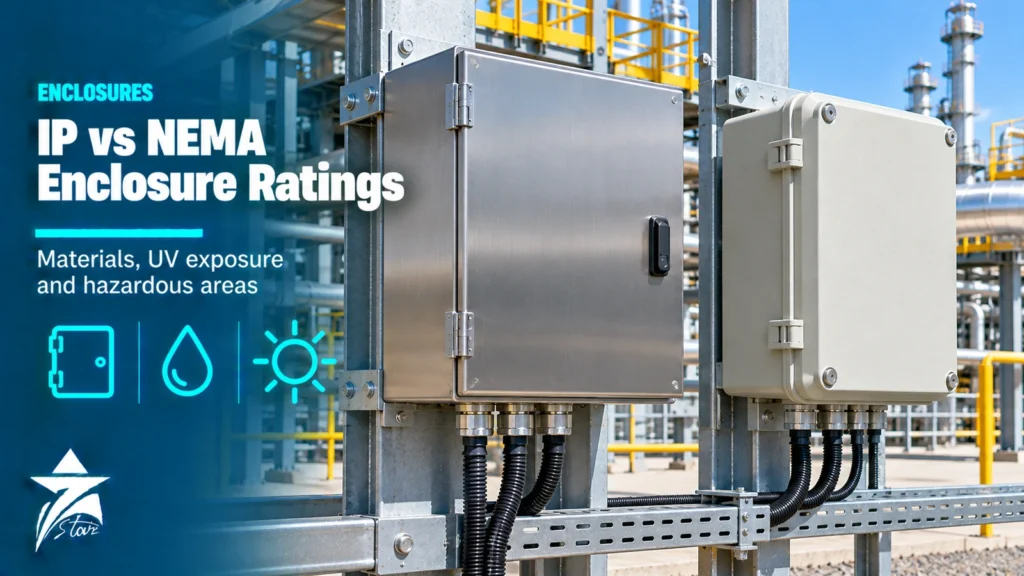
Every electrical enclosure on a plant, from a small junction box to a large control panel, carries a rating that says how well it keeps out solids and water. Two systems dominate: the IP code from IEC 60529, used in Europe, the Middle East and most of the world, and the NEMA type from NEMA 250, used mainly in North America. Specifications on international projects often mention both, and buyers regularly ask for a direct IP vs NEMA rating conversion. This guide explains what each system tests, how they compare, why a simple conversion is not exact, and how to choose materials and enclosures for outdoor, corrosive and hazardous areas.
The IP Code Under IEC 60529
An IP code has two digits. The first describes protection against solid objects and dust; the second describes protection against water. An optional letter may follow.
| First digit | Protection against solids | Second digit | Protection against water |
|---|---|---|---|
| 0 | No protection | 0 | No protection |
| 1 | Objects over 50 mm (back of hand) | 1 | Vertically dripping water |
| 2 | Objects over 12.5 mm (fingers) | 2 | Dripping water with enclosure tilted 15° |
| 3 | Objects over 2.5 mm (tools) | 3 | Spraying water up to 60° from vertical |
| 4 | Objects over 1 mm (wires) | 4 | Splashing water from any direction |
| 5 | Dust protected (limited ingress, no harmful deposit) | 5 | Water jets (6.3 mm nozzle) |
| 6 | Dust tight | 6 | Powerful water jets (12.5 mm nozzle) |
| 7 | Temporary immersion up to 1 m for 30 minutes | ||
| 8 | Continuous immersion beyond 1 m, conditions agreed with the manufacturer | ||
| 9K | High-pressure, high-temperature spray (from ISO 20653) |
So IP65 means dust tight and protected against water jets; IP66 adds powerful water jets; IP67 adds temporary immersion. Higher second digits are not always cumulative: an IP68 enclosure is not automatically tested for jets, which is why some products are marked IP66/IP68 to show both tests were passed.
NEMA Enclosure Types Under NEMA 250
NEMA types describe the environment an enclosure is designed for. Besides dust and water, many types also cover corrosion, ice formation, oil and coolant, and in some cases hazardous locations.
| NEMA type | Location | Main protection |
|---|---|---|
| 1 | Indoor | Contact with live parts, falling dirt |
| 3 | Outdoor | Rain, sleet, windblown dust, external ice formation |
| 3R | Outdoor | Rain, sleet and ice; not windblown dust |
| 3S | Outdoor | As type 3, plus external mechanisms operable when ice laden |
| 4 | Indoor or outdoor | Hose-directed water, splashing, windblown dust, rain |
| 4X | Indoor or outdoor | As type 4, plus corrosion resistance |
| 6 / 6P | Indoor or outdoor | Temporary / prolonged submersion |
| 12 | Indoor | Dust, dirt, dripping non-corrosive liquids |
| 13 | Indoor | Dust, spraying oil and non-corrosive coolants |
| 7, 8, 9, 10 | Hazardous locations | Explosion-proof and dust-ignition-proof designs for classified areas |
IP vs NEMA Rating: Approximate Equivalents
Because the two systems test different things, NEMA 250 itself states that IP codes cannot be converted to NEMA types. A NEMA type includes tests for corrosion, icing, gasket ageing and construction that the IP code does not cover. The reverse works only as a guide: a NEMA type usually meets or exceeds the IP code shown below, but an IP-rated enclosure does not automatically meet the NEMA type.
| NEMA type | Meets or exceeds (approx.) |
|---|---|
| 1 | IP10 |
| 2 | IP11 |
| 3 | IP54 |
| 3R | IP14 |
| 3S | IP54 |
| 4 and 4X | IP56 (often supplied IP66) |
| 5 | IP52 |
| 6 and 6P | IP67 |
| 12 and 12K | IP52 |
| 13 | IP54 |
When a specification lists an IP vs NEMA rating pair, such as “IP66 / NEMA 4X”, the enclosure should be tested and certified to both standards, not just assumed equivalent. Ask for the test reports or certificates when the rating is critical.
Additional Ratings: IK, UV and Temperature
- IK code (IEC 62262): impact resistance from IK00 to IK10. IK08 (5 J) and IK10 (20 J) are common for outdoor and industrial enclosures exposed to mechanical damage.
- UV resistance: plastic enclosures in direct sun need UV-stabilised polycarbonate, GRP or polyester; non-stabilised plastics become brittle and discolour within a few seasons.
- Operating temperature: gaskets and plastics have temperature limits. Solar heating can raise surface temperatures far above ambient, which affects electronics inside.
- Fire behaviour: UL 94 V-0 or glow-wire tests (IEC 60695-2-11) for plastic enclosures housing electrical equipment.
- Salt mist: coastal and offshore sites may require corrosion testing such as ISO 9227 for painted steel.
Choosing Enclosure Materials
| Material | Strengths | Typical use |
|---|---|---|
| Painted mild steel | Strong, economical, easy to modify | Indoor panels, MCCs, protected outdoor locations |
| Stainless steel 304 | Corrosion resistance, hygienic | Food, water treatment, general outdoor |
| Stainless steel 316L | Higher chloride resistance | Coastal, offshore, chemical and desalination plants |
| Aluminium | Light, corrosion resistant, good heat dissipation | Ex d enclosures, outdoor junction boxes |
| Polycarbonate | Light, insulating, UV-stabilised grades, transparent covers | Small junction boxes, instrument housings |
| GRP / polyester | Excellent chemical and UV resistance, insulating | Outdoor and corrosive sites, Ex e terminal boxes |
How to Specify an IP vs NEMA Rating on a Datasheet
A clear enclosure specification avoids surprises at factory acceptance and site inspection. When writing or checking a datasheet, state the IP vs NEMA rating requirement together with the conditions it must survive, rather than a single code on its own.
| Datasheet item | What to state | Why it matters |
|---|---|---|
| Ingress rating | IP code (e.g. IP66) and, if required, NEMA type (e.g. 4X) | Defines dust and water protection; dual marking needs dual certification |
| Location | Indoor, outdoor, sheltered, washdown, submersible | Determines whether UV, rain and icing tests are relevant |
| Material and finish | Steel grade, coating system, stainless grade or plastic type | Controls corrosion life and UV resistance |
| Impact rating | IK code (e.g. IK08) | Protects against mechanical damage in traffic areas |
| Ambient range | Minimum and maximum air temperature plus solar exposure | Sizes cooling, heaters and gasket material |
| Hazardous area | Zone, gas group, temperature class, Ex concept | Required for ATEX or IECEx certified enclosures |
| Cable entries | Number, size, thread type and gland rating | Glands must keep both the IP and Ex rating |
Ask the supplier to confirm each line at quotation. If a vendor offers an enclosure marked only with an IP code where the specification calls for a NEMA type, request evidence of NEMA 250 testing or a written deviation before approval.
Enclosures for Hazardous Areas
An ingress rating does not make an enclosure suitable for explosive atmospheres. In hazardous areas, enclosures must carry an Ex certificate (ATEX or IECEx) for the required protection concept:
- Ex d (flameproof): contains an internal explosion and prevents flame transmission through flame paths; usually cast aluminium or stainless steel.
- Ex e (increased safety): prevents sparks and hot surfaces; common for terminal and junction boxes in GRP or stainless steel.
- Ex tb / Ex t (dust): protection by enclosure for combustible dust zones, which relies on a high IP rating.
- Ex p (pressurised): purge and pressurisation of larger panels and analyser houses.
Ex enclosures still carry an IP rating, typically IP66, and cable glands must be certified to match both the Ex concept and the IP rating. Our hazardous area classification guide explains zones, gas groups and temperature classes, and our guide to reading nameplates and Ex markings explains how to read certification labels.
Installation Practices That Keep the Rating
- Use cable glands, blanking plugs and breathers with at least the same IP rating as the enclosure.
- Mount enclosures with cable entries at the bottom where possible to prevent water running into glands.
- Do not drill extra holes without sealing them with rated fittings; every modification can reduce the rating.
- Fit drain or breather plugs in outdoor enclosures to release condensation caused by day-night temperature swings.
- Inspect and replace door gaskets when they harden or crack, and keep door locks fully engaged.
- Use sun shields or canopies to reduce solar heat gain on enclosures in direct sun.
Small components also carry ratings: solenoid coils, connectors and sensors need IP ratings suited to their location. See our solenoid valve selection guide for coil and connector ratings.
IP vs NEMA Rating Choices for Oman Sites
Most Oman projects follow IEC standards and specify IP ratings, while equipment from North American suppliers arrives with NEMA types, so understanding the IP vs NEMA rating relationship avoids confusion at approval stage. Outdoor enclosures on oil and gas and utility sites are usually specified at IP65 or IP66 to keep out fine sand and washdown water. Coastal desalination and port sites often call for 316L stainless steel or GRP to resist salt. Strong sun and summer surface temperatures make UV-stabilised materials, sun shields and enclosure cooling important for long-term reliability.
Selected Enclosures in Our Catalogue
The table lists examples of general-purpose and hazardous area enclosures we can quote.
| Product | Type | Typical use |
|---|---|---|
| Rittal AE 1350.500 (500 x 500 x 300 mm) | Compact steel enclosure | Control and distribution panels |
| Rittal AE 1055.500 (800 x 600 x 300 mm) | Compact steel enclosure | Larger control panels |
| Rittal AE 1033.500 (300 x 300 x 210 mm) | Compact steel enclosure | Small control boxes |
| Rittal AE 1006.500 (380 x 380 x 210 mm) | Stainless steel enclosure | Corrosive and hygienic areas |
| Rittal AE 1010.500 (600 x 600 x 210 mm) | Stainless steel enclosure | Outdoor and washdown areas |
| Rittal KS 1432.500 (250 x 350 x 150 mm) | Plastic enclosure | Insulated junction and control boxes |
| Rittal KS 1466.500 (600 x 600 x 200 mm) | Plastic enclosure | Larger insulated enclosures |
| Schneider Electric Kaedra 54-module (13986) | IP65 modular plastic enclosure | Outdoor and industrial distribution |
| Schneider Electric Kaedra 18-module (13982) | IP65 modular plastic enclosure | Small sub-distribution |
| BARTEC GUB Ex d IIC | Flameproof enclosure | Hazardous area control gear |
| Cooper Crouse-Hinds GUE Series | Explosionproof junction box | Hazardous area terminations |
| Cooper Crouse-Hinds GUB01 SA | Explosionproof junction box | Small Ex d terminations |
Browse more in our switchgear, enclosures and distribution category. To get a quotation, send the dimensions, material, required IP or NEMA type, hazardous area zone and gas group, mounting plate and cable entry requirements through our quote request form or to [email protected].
Sourcing Enclosures in Oman Through Seven Star LLC
Seven Star LLC is an independent supplier in Oman of steel, stainless steel and plastic enclosures, Ex d and Ex e junction boxes, distribution boards, cable glands and enclosure accessories for industrial, utility and oil and gas projects. We quote products from manufacturers such as Rittal, Schneider Electric, BARTEC and Cooper Crouse-Hinds. Ratings, certificates, dimensions and lead time are confirmed against the manufacturer data at quotation.
Frequently asked questions
What is the difference between IP and NEMA ratings?
IP codes from IEC 60529 rate protection against solids and water only. NEMA types from NEMA 250 describe the intended environment and also cover corrosion, icing, oil and construction details. NEMA types are used mainly in North America; IP codes in most other regions.
Is NEMA 4X the same as IP66?
Not exactly. NEMA 4X meets or exceeds IP56 according to NEMA 250, and many NEMA 4X enclosures are also tested to IP66. NEMA 4X also requires corrosion resistance, which the IP code does not test. Check that the enclosure is certified to both.
Can I convert an IP rating to a NEMA type?
No. Because NEMA types include tests that IP codes do not, an IP rating cannot be converted to a NEMA type. A NEMA type can only be used as an approximate guide to the minimum IP code it meets.
What IP rating do I need outdoors?
Outdoor industrial enclosures are usually specified at IP65 or IP66 to keep out dust and water jets. Add IP67 or IP68 only where temporary or continuous immersion is possible, and choose UV-resistant materials for direct sun.
Does a high IP rating make an enclosure explosion-proof?
No. Hazardous areas need an Ex certificate for a protection concept such as Ex d, Ex e or Ex t under ATEX or IECEx. Ex enclosures also carry an IP rating, but the IP code alone does not make an enclosure safe in explosive atmospheres.
Who supplies industrial enclosures in Oman?
Seven Star LLC is an independent supplier in Oman that quotes steel, stainless steel, plastic and Ex enclosures and accessories from leading manufacturers. Send your requirements through the quote request form or to [email protected].
Was this guide helpful?One click helps us write better guides for engineers.
Thank you! Glad it helped. Need this equipment for your project? Request a quotation
Thank you. We will use this to improve the guide.