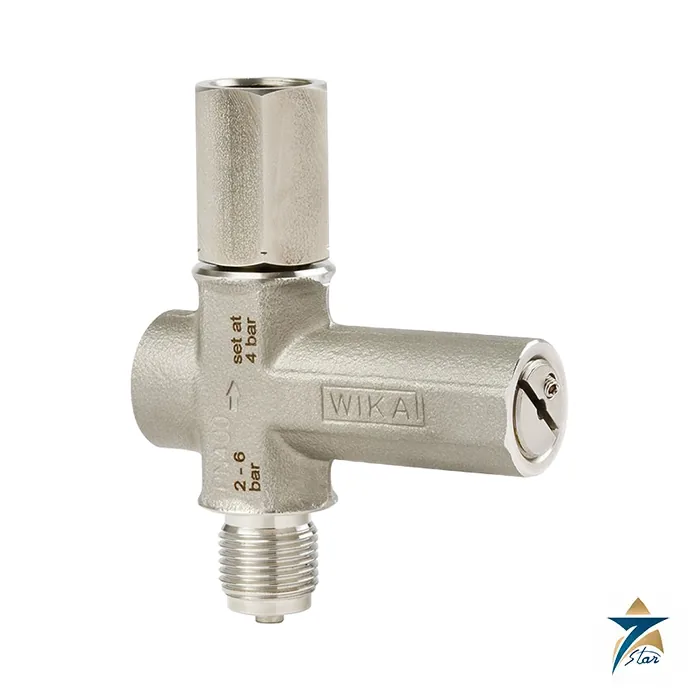
WIKA 910.13 adjustable overpressure protector for pressure gauges, to 600 bar
The WIKA 910.13 is an adjustable overpressure protector, in effect a spring-loaded piston valve that closes off the instrument when the pressure rises beyond a preset closing pressure. It protects a pressure gauge or other measuring instrument against overpressure beyond its scale range. It is made in brass or stainless steel, with seven selectable setting ranges, nominal pressures up to 600 bar and an overpressure safety of up to 1,000 bar for the stainless version. Seven Star LLC supplies the 910.13 in Oman and the GCC as an independent supplier in Muscat, and this page describes the operating principle and the ordering choices.
How the 910.13 closes and reopens
A helical spring holds the piston in the outlet position, so the medium flows freely to the instrument. When the pressure acting on the piston overcomes the spring back pressure, the piston moves and closes the valve; the instrument is then isolated from the higher pressure. Once the line pressure falls to about 25 % below the closing pressure, the valve reopens and the piston returns under spring force. The instrument therefore sees only pressures up to the closing value, and the measurement resumes automatically after the pressure peak has passed.
The closing pressure is set by the adjustment screw. Turning clockwise increases the spring force and raises the closing pressure; turning anti-clockwise lowers it. The factory setting is half the span of the chosen setting range. When WIKA mounts the protector onto one of its own pressure gauges, it sets the closing pressure to 1.1 times the full scale value of the gauge. The data sheet adds that the temperature at the measuring location must be taken into account when setting, and that the protector is not suitable as a controller or for control and regulation purposes.
Technical specifications of the 910.13
| Parameter |
Specification |
| Manufacturer / part number |
WIKA / 910.13 |
| Type |
Piston valve, spring-loaded, adjustable closing pressure |
| Nominal pressure |
PN 400 or PN 600, depending on version |
| Overpressure safety |
Brass 600 bar; stainless steel 1.4571 up to 1,000 bar |
| Setting ranges |
0.4 … 2.5, 2 … 6, 5 … 25, 20 … 60, 50 … 250, 240 … 400 and 400 … 600 bar |
| Factory settings |
1.45, 4, 15, 40, 150, 320 and 500 bar respectively |
| Valve body |
Brass (LH-RH union steel, rust-protected) or stainless steel (LH-RH union 1.4571) |
| O-ring |
FPM |
| Temperature |
Maximum +80 °C; up to +130 °C on request from the 2 … 6 bar range |
| Process connection |
Form A: LH-RH union / male G 1/2 B; Form B: female / male 1/2 NPT |
| Vacuum |
Vacuum protected |
| Other versions |
Other threads, DVGW (form A), 3.1 certificate, oil- and grease-free, Monel, NACE |
Form A and Form B of the 910.13
Form A has an LH-RH union with male G 1/2 B, standard in Europe and tied to DIN 16283 unions, and is offered in brass and in stainless steel 1.4571. Form B has a female / male 1/2 NPT arrangement and is offered in stainless steel only. Both forms have 27 mm spanner flats according to the dimension drawings. A stainless steel 1.4571 version, oil and grease free (OEF), is offered for oxygen service up to 60 °C in the lower setting ranges; the 20 … 60 bar OEF version is limited to a setting range of 20 … 49 bar.
Where the 910.13 fits and related accessories
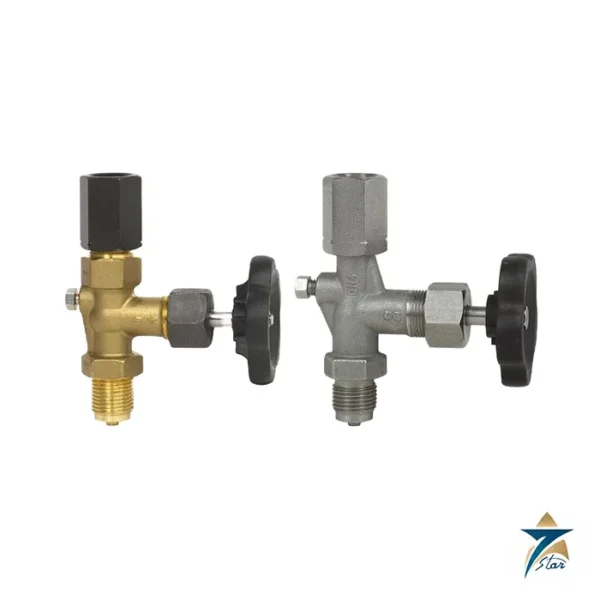
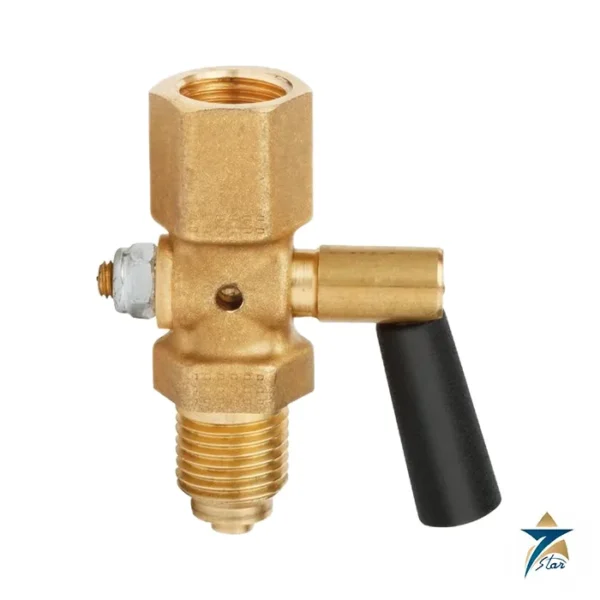
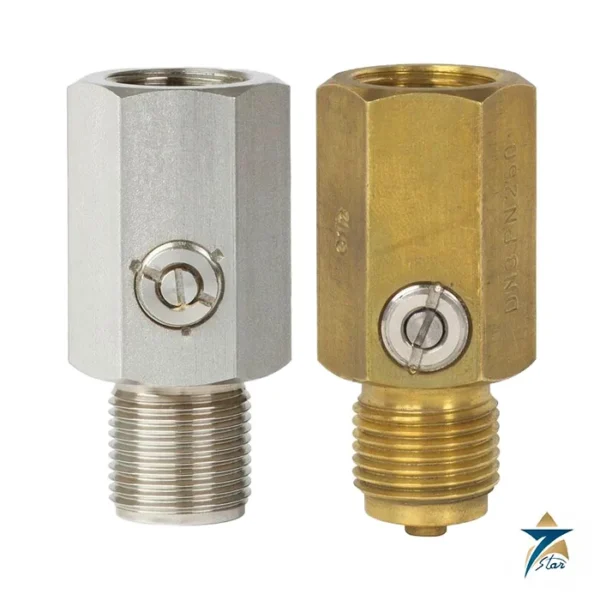
The 910.13 is different from a snubber. The 910.12 snubber damps continuous pulsation and always passes pressure, while the 910.13 closes off when a pressure above the setting appears. An instrument that sees both pulsation and rare surges can use both, with the protector on the process side. Position the 910.11 shut-off valve or the 910.10 stopcock ahead of it so the instrument can be changed. On hot lines place a syphon 910.15 or cooling element 910.32 ahead of the protector because of the 80 °C limit. Sealings 910.17 are used on parallel threads. For electrical output instruments such as the PGT23.100 or the S-20 the 910.13 gives the sensing element extra safety between its working range and its burst pressure.
Selection and ordering checklist for the 910.13
- Scale end value or measuring range of the instrument to be protected.
- Setting range that contains the desired closing pressure (the pressure should lie in the working middle of the range, not at its ends).
- Body material: brass or stainless steel 1.4571.
- Form A (LH-RH union G 1/2 B) or Form B (1/2 NPT).
- Medium temperature, which must not exceed +80 °C unless the higher-temperature version is arranged.
- Special requirements: oxygen (OEF), NACE, Monel, DVGW.
- Whether it is to be factory set or mounted on the gauge by the supplier.
Installation, setting and maintenance of the 910.13
Fit the protector between the line and the instrument, with the process on the male connection. Set the closing pressure with a reference gauge and a pressure source, not by eye: raise the pressure slowly and observe where the instrument pointer stops rising, then adjust. Allow for the fact that the valve reopens at roughly 25 % below its closing value. If the instrument is mounted in a hot position, repeat the setting at working temperature. Regularly check that the protector still closes by raising the pressure, and replace the O-ring if the closing point drifts or the piston sticks. After any closure event, inspect the gauge for signs of shock.
Typical applications in Oman and the GCC
The data sheet lists machine building, general plant construction, chemical, petrochemical, power plants, mining and on- and offshore. In Oman and the Gulf it is used on test lines, on gauge and transmitter tappings downstream of pumps, where start-up or valve shut-off can create a pressure peak, and on hydraulic power unit gauge points. A protector is useful in contractor workshops where gauges at low scale ranges are installed on lines that are hydrotested to a higher pressure than the gauge scale.
Setting ranges and factory settings of the 910.13
| Setting range (bar) |
Factory setting (bar) |
Nominal pressure |
| 0.4 … 2.5 |
1.45 |
PN 400 |
| 2 … 6 |
4 |
PN 400 |
| 5 … 25 |
15 |
PN 400 |
| 20 … 60 |
40 |
PN 400 |
| 50 … 250 |
150 |
PN 400 |
| 240 … 400 |
320 |
PN 400 |
| 400 … 600 |
500 |
PN 600 (1.4571 only) |
Information to send with an RFQ
- Model 910.13 with form and body material
- Setting range and required closing pressure
- Medium and temperature
- Special cleanliness, NACE or certificates
- Quantity and delivery site
Documents and quotation
The WIKA data sheet for the 910.13 is attached on this page and lists every order variant by setting range and material.
Send the setting range, material and form and Seven Star LLC will confirm availability and a quotation.
Other Models in the Wika 910 Valves Range
Seven Star LLC supplies models from the Wika 910 Valves range in Oman and the GCC. Compare the related models below and request a quote for the one that matches your application.




















Reviews
There are no reviews yet.