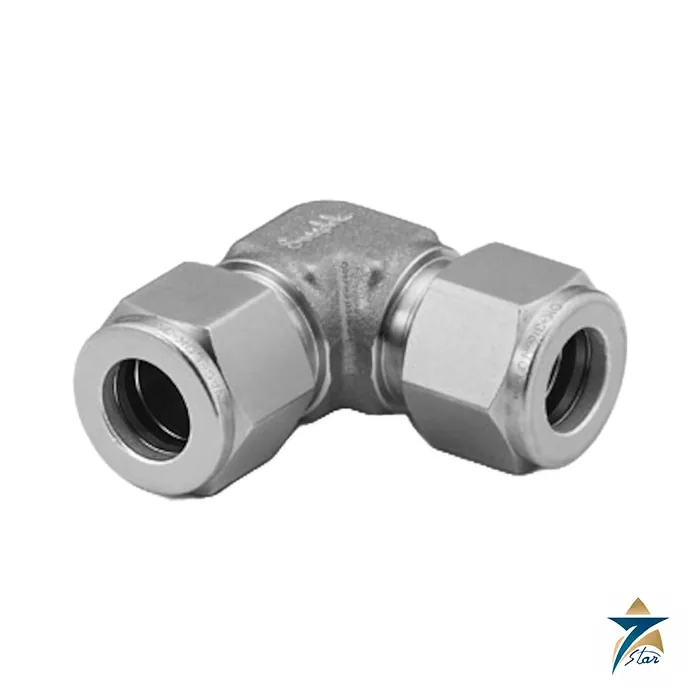
The Swagelok SS-810-9 is a 90 degree union elbow with a 1/2 in. Swagelok tube end on both legs. Where the male elbow SS-810-2-8 turns a tube at a threaded port, this part turns a tube run around a corner with no thread at all, which is how most tight instrument tubing is routed along walls, frames and under panels.
Technical specifications
| Parameter |
Specification |
| Part number |
SS-810-9 |
| Description |
Union elbow, 90 degrees, two 1/2 in. tube-fitting ends |
| Body material |
316 stainless steel (forged shape) |
| Tube OD |
1/2 in. |
| Dimension A (leg length) |
1.42 in. |
| Dimension D (nut size) |
0.90 in. |
| Dimension E (nominal opening) |
0.41 in. |
| Hex flat F |
13/16 in. |
| Metric equivalent |
12 mm: 12M0-9 size block (dimensions in mm in the catalog) |
| Pressure basis |
Working pressure of tubing used (Tubing Data MS-01-107) |
| Cleaning |
Standard cleaning and packaging SC-10 |
A forged corner with no thread
The union elbow is one of the more demanding shapes for the manufacturer, because the bore must turn without a thin section. Swagelok lists elbows among the shapes made from forgings, with ASTM A182 listed for 316 stainless. For the 1/2 in. size the catalog gives leg dimension A as 1.42 in., nut dimension D as 0.90 in. and a nominal opening E of 0.41 in. Both ports are identical, so the elbow has no inlet or outlet and either leg can take the supply.
Because no pipe thread is involved, there is no thread sealant to manage and no rotational orientation problem: the elbow can be turned to any angle around the tube axis before the nuts are tightened.
Selecting the correct elbow
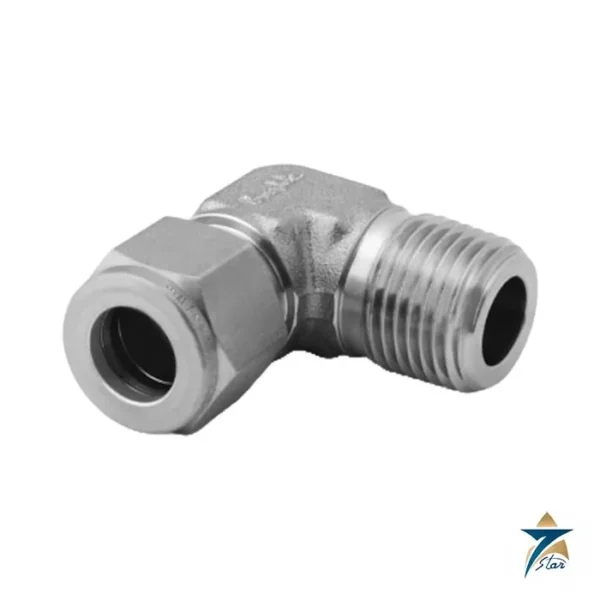
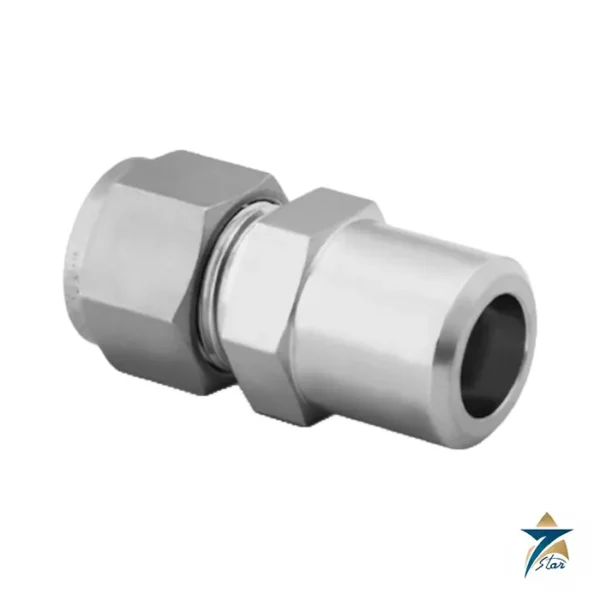
SS-810-9 reads SS (316 stainless), 810 (1/2 in. tube), 9 (union elbow). The catalog also lists 45 degree male elbows (code 5), male elbows with pipe threads (2), female elbows (8), reducing elbows (2R), positionable elbows with ISO or SAE straight threads and weld elbows. If you need a thread on one leg, one of those other codes is the correct choice, not this part.
Elbows are shape fittings and are available in 316 stainless, brass and other alloys under different prefixes; check that the elbow material matches the tubing, with the tubing softer than or equal to the fitting.
Installing and supporting
Assemble on clean, unmarked tubing seated hard against the shoulder. A finger-tight nut plus one and one-quarter turns completes the first pull-up for this tube size, and the gap inspection gauge proves it. Always vent the line first and hold the body with a second wrench.
Elbows concentrate the load of the tube weight at the corner, so clamp tubing within a few tube diameters of each leg. Where a run is long, an elbow also provides a natural point of flexibility for thermal growth if the leg is left unrestrained between clamps; design thermal loops for hot service in line with your own piping practice.
Checks before fitting the union elbow
Before the SS-810-9 goes into a tubing run, confirm that the tube is 1/2 in. outside diameter and not 12 mm, because the two sizes are close enough to be confused on site but the fittings are not interchangeable. Check the wall thickness of the tube against the Swagelok tubing data so that the system pressure is supported by the tube itself, since the working pressure of this elbow is based on the tubing used. Cut the tube square with a proper tube cutter, deburr the inside and outside edges, and inspect the end for scratches running along the surface where the ferrules will seal. Leave the nuts and ferrules on the elbow as supplied, in their original order, so that no part is lost or reversed.
Pressure testing at commissioning
After assembly and gap-gauge inspection, pressure test the completed tubing system as required by the plant’s own procedures, using a suitable test medium and pressure for the service. Check each nut on both legs of the elbow with a leak detection solution or a method chosen by the site, and do not attempt to tighten a fitting while the line is under pressure. Record the test result together with the tag or line number, so that later inspections have a reference.
Instrument tubing in Oman and Gulf environments
Instrument and analyser tubing in Oman and the GCC is often installed outdoors on pipe racks, wellhead skids and coastal plants, where it faces strong sun, sand and salt-laden humid air. The 316 stainless body is a common choice for such locations, but stainless steel can still show tea staining or pitting where salt deposits and moisture remain on the surface for long periods. Routing tubing so that water drains off rather than collecting at the elbow, and washing down exposed runs as part of site housekeeping, both help. Large daily temperature swings make the tubing expand and contract, so check that clamps hold the tube firmly near each leg without crushing it, and that no long straight section is fixed rigidly at both ends with the elbow taking all the movement.
Maintenance and remaking connections
During inspections, look for discoloured deposits around the nuts, signs of rubbing where the tubing touches steelwork, and loose or missing clamps near the corner. If a connection has to be broken for maintenance, mark the nut and tube before disassembly, then remake it following Swagelok’s reassembly instructions for that tube size, rather than repeating the first pull-up. Replace an elbow whose tube end or body has been damaged, and never mix ferrules or nuts from other manufacturers with this fitting.
Documents and quotation
Download the official Swagelok catalog MS-01-140 from this page for the full ordering tables. Requests for SS-810-9 are quoted against the exact order code, so include quantity and any cleaning or packaging option.
We recommend confirming the exact size, thread standard and material with the attached document before placing an order. Related items: product category.






Reviews
There are no reviews yet.