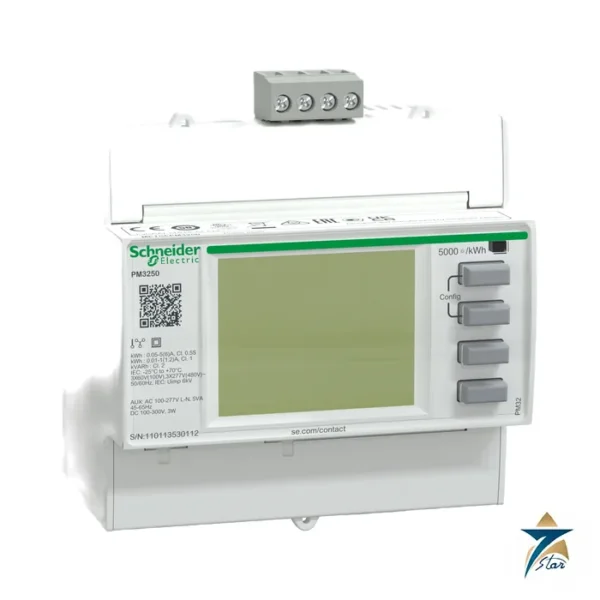
Schneider Electric METSEPM2130 EasyLogic PM2130 Power Meter

Description

METSEPM2130: EasyLogic PM2130 power and energy meter

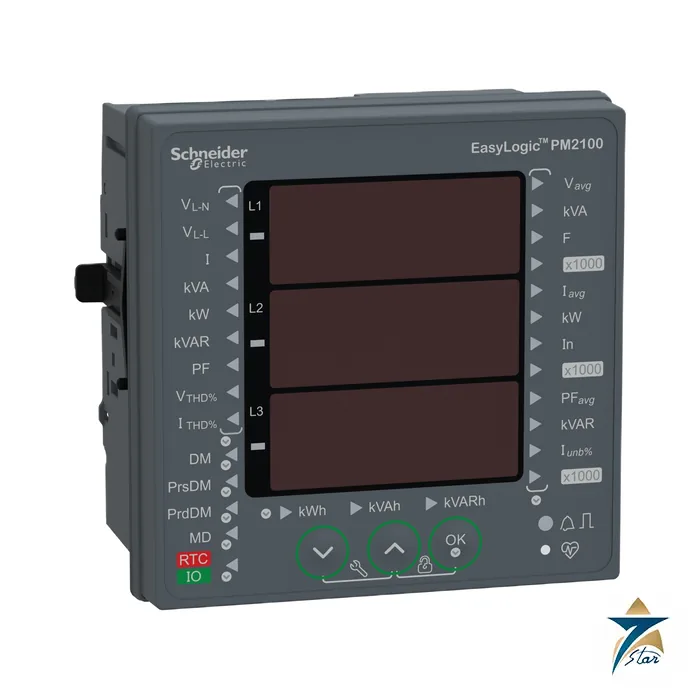
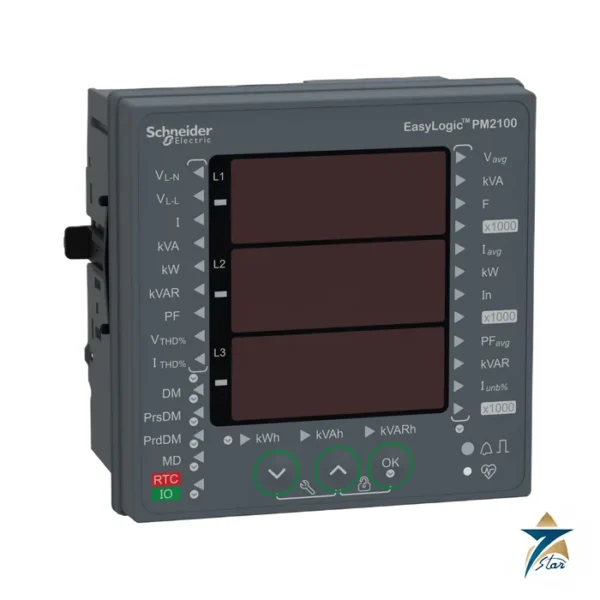
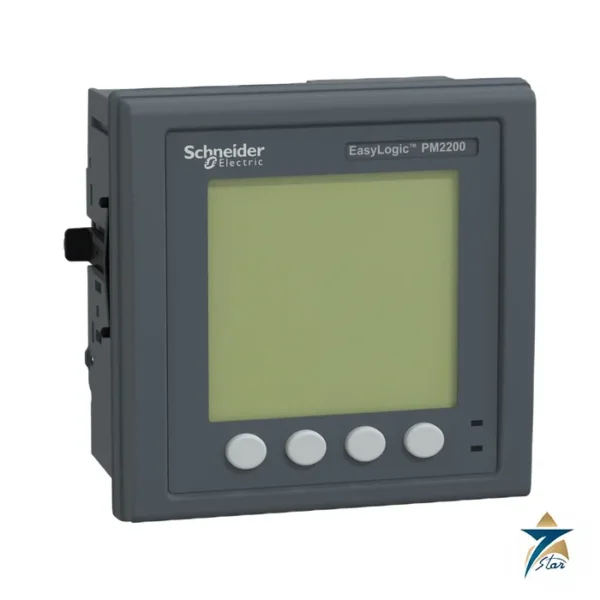
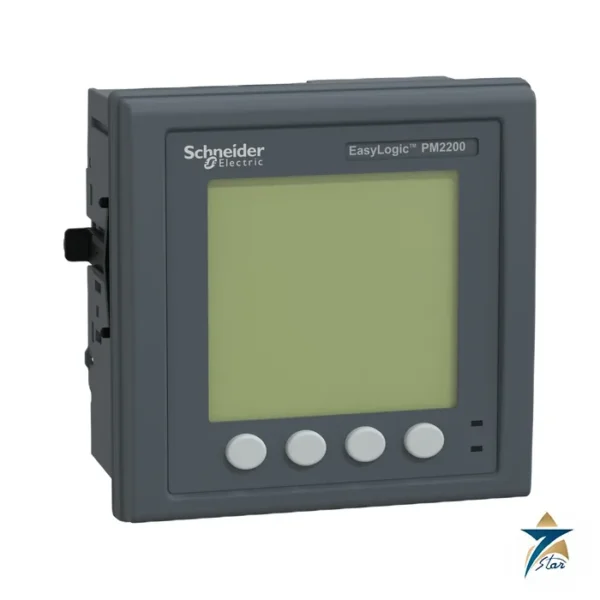
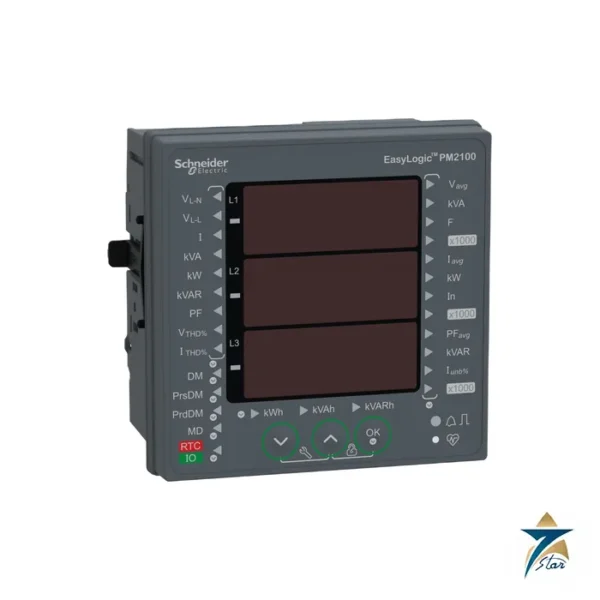
The METSEPM2130 is a Schneider Electric EasyLogic PM2130 power meter in the PM2100 series. The datasheet lists it for sub-billing and power monitoring, with harmonic distortion analysis up to the 31st harmonic, a red 7-segment LED display and RS485 Modbus, and gives class 0.5S for active energy, which is the accuracy class commonly asked for in sub-metering.

Compared with the entry meters, the PM2130 adds a real-time clock, min/max logs for eight parameters, power logs with time stamping, a configurable demand interval of 1 to 60 minutes and a 64 samples per cycle sampling rate. It has no digital inputs or outputs listed, so it is a measuring and communicating device, not a control one.

METSEPM2130 technical specifications

Parameter Specification
Manufacturer / part number Schneider Electric / METSEPM2130
Range / product name EasyLogic / EasyLogic PM2100 (PM2130)
Product type Power meter
Application Sub billing; power monitoring
Power quality analysis Total harmonic distortion up to the 31st harmonic
Supply voltage [Us] 80–277 V AC 45–65 Hz ±10 %; 100–277 V DC ±10 %
Ride-through time 50 ms typical at 120 V AC, 230 V AC and 125 V DC
Maximum power consumption 3.3 W AC; 3.3 W at 277 V DC
Rated current [In] 1 A; 5 A
Measurement voltage 35–480 V AC between phases; 20–277 V AC phase-neutral; up to 999000 V AC with external VT
Measurement current 5–6000 mA
Frequency range 45–65 Hz
Accuracy class Class 0.5S active energy (IEC 62053-22); class 1 reactive energy (IEC 62053-24); class 5 harmonic distortion
Sampling rate 64 samples/cycle
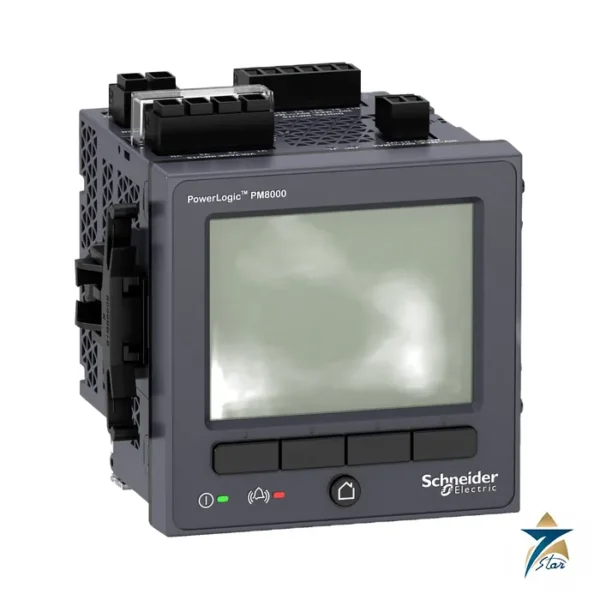
Display 7-segment red LED, 3 fields of 4 characters, 12 digits 14.2 mm high
Control 3 buttons
Demand interval Configurable 1 to 60 min
Inputs / outputs 0 / 0
Communication Modbus RTU, RS485 screw terminals, 4800 to 38400 bps, 2-wire, 2500 V insulation
Data recording Power logs; time stamping; energy logs; min/max for 8 parameters
Cybersecurity Enable/disable communication ports
Mounting Clip-on, flush, vertical
Dimensions H × W × D @96 × 96 × 76.09 mm total, 61.64 mm embedded
Net weight 300 g
IP protection IP54 front; IP30 body
Operating / storage temperature -10 to 60 °C / -25 to 70 °C
Relative humidity 5–95 % at 50 °C
Measurement category III 480 V; II 480–600 V
Service life 7 year(s)
Certifications CE conforming to IEC 61010-1, CULus conforming to UL 61010-1, CULus conforming to CSA C22.2 No 61010-1, RCM, EAC, C-Tick

Using the METSEPM2130 in Oman and the GCC

Class 0.5S meters are the usual choice for tenant sub-metering in towers, malls and industrial estates in Oman and the GCC, and for monitoring large feeders at desalination, water pumping and petrochemical plants where the energy cost allocation must be defensible. Time-stamped logs help to match consumption to shifts or tariff periods.

The operating range is -10 to 60 °C, so mount it behind a door that is not in direct sun.

Harmonics, logging and clock of the METSEPM2130

Harmonic analysis reaches the 31st harmonic, with the 64 samples per cycle sampling rate supporting the calculation. Total harmonic distortion is displayed per phase for current and voltage, so a drive or rectifier that distorts the supply is easy to see. The datasheet lists total distortion figures.

The meter keeps power logs, time-stamped events, energy logs and min/max records for eight parameters, and a real-time clock allows demand intervals and time stamps to be consistent across a site. The demand interval can be set from 1 to 60 minutes; the datasheet lists demand current and demand power with past and present values.

Accuracy and measured quantities of the METSEPM2130

The datasheet separates the accuracy class of the energy registers from the accuracy of instantaneous values. For active energy the class is 0.5S, one step finer than the class 1 of the entry meters, which matters when readings are used to allocate cost between tenants or departments.

Quantity Accuracy
Active energy Class 0.5S (IEC 62053-22)
Reactive energy Class 1 (IEC 62053-24)
Harmonic distortion Class 5
Active power ±0.5 %
Apparent power ±0.5 %
Current ±0.5 %
Voltage ±0.5 %
Reactive energy tolerance ±1 %
Frequency ±0.05 %
Power factor ±0.01

Measured quantities include min/max, average and total values of apparent, active and reactive power, current, voltage, frequency and power factor, total current and voltage harmonic distortion per phase, apparent, active and reactive energy, demand values with past and present values, peak demand, calculated neutral current and current unbalance.

Selection checklist and RFQ details for the METSEPM2130

  • Accuracy class needed: 0.5S for billing-grade registers or class 1 for monitoring
  • Network type, nominal voltage and any external VT ratio
  • Current transformer ratio and secondary: 1 A or 5 A
  • Auxiliary supply within the 80–277 V AC or 100–277 V DC range
  • RS485 and Modbus master in the monitoring system
  • Panel cut-out for a 96 × 96 mm device with 61.64 mm embedded depth

Please include these in an enquiry:

  • Part number METSEPM2130 and quantity
  • Application and system voltage
  • Delivery location and required date

Installation and environment of the METSEPM2130

The front is 96 × 96 mm, the total depth is 76.09 mm and the embedded depth is 61.64 mm, weighing 300 g. It clips into a flush panel cut-out in a vertical position. The enclosure is polycarbonate with V-0 flame retardance, IP54 at the front and IP30 for the body.

The operating range is -10 to 60 °C, relative humidity 5–95 % at 50 °C, pollution degree 2 and altitude up to 2000 m. The meter has measurement category III at 480 V and overvoltage category III and is double insulated. Service life is stated as 7 years.

Wiring, supply and communication of the METSEPM2130

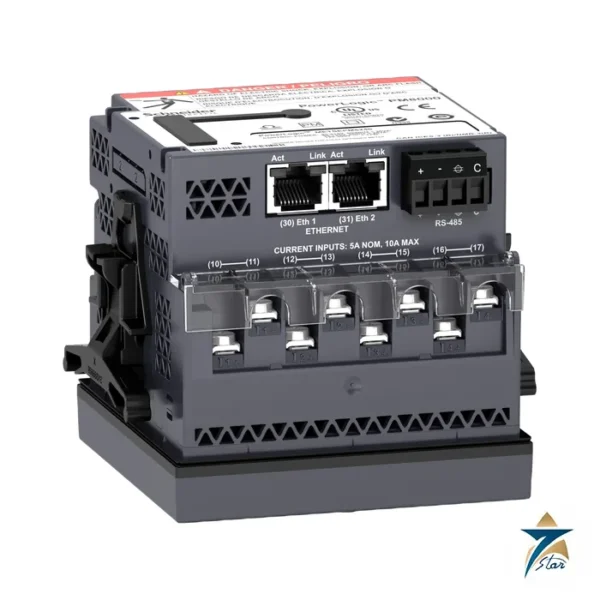
The supply range is 80 to 277 V AC at 45 to 65 Hz or 100 to 277 V DC, both with a tolerance of 10 percent, and the meter rides through a supply interruption for about 50 ms at 120 V AC, 230 V AC or 125 V DC. Current inputs are six screw terminals at the bottom for current transformers with a 1 A or 5 A secondary; four voltage inputs are at the top.

The RS485 port speaks Modbus RTU at 4800, 9600, 19200 or 38400 bps, with even, odd or no parity, 2-wire, insulated to 2500 V. A red LED outputs energy pulses of 1 to 9999000 pulses per kWh, kVAh or kVARh, and a green LED shows module operation and communication. The communication ports can be enabled or disabled for cybersecurity.

METSEPM2130 against the PM1120H meter

The PM2130 and the PM1120H are in the same 96 mm panel format, so the choice is made on accuracy class, harmonic depth and logging.

Feature METSEPM2130 METSEPM1120HCL10RS
Active energy class 0.5S 1
Harmonics THD up to 31st THD (I and U)
Sampling 64 samples/cycle 32 samples/cycle
Clock and logs RTC, power logs, min/max Energy logs
Demand interval 1 to 60 min 1 s
Ingress (front) IP54 IP51
Depth in panel 61.64 mm 49 mm

Documents and quotation

The Schneider Electric manufacturer datasheet for the METSEPM2130 is attached on this page as a PDF. It is the reference for every rating quoted above, and it is worth checking the revision against your project documents before an order is placed. The accuracy table, logging data and environmental limits are all in it.

Seven Star LLC is an independent supplier in Muscat that serves buyers in Oman and the GCC. Send the part number METSEPM2130, the quantity and the delivery site, and we will reply with a quotation and the availability we can confirm.

Datasheets & Documents
  • PDF Datasheet Schneider Electric METSEPM2130 Datasheet Download
Reviews (0)

Reviews

There are no reviews yet.

How would you rate this product?

It takes about 10 seconds — just tap a star. Your email is never published.

About brand

Schneider Electric is the French group for energy management and industrial automation: low and medium voltage switchgear and circuit breakers, motor control, drives, PLCs, power monitoring, UPS systems and building management. Its history goes back to 1836, when the brothers Adolphe and Eugène Schneider took over the iron and steel works at Le Creusot in Burgundy. Over the 20th century the company left steel and heavy engineering and became an electrical group through acquisitions such as Merlin Gerin, Télémécanique, Square D and Modicon. Its head office is in Rueil-Malmaison near Paris, and its shares are listed on Euronext Paris.

Schneider Electric company profile

Origins 1836, Le Creusot, France: Adolphe and Eugène Schneider take over the Le Creusot foundry
Headquarters Rueil-Malmaison (Paris region), France
Ownership Public company listed on Euronext Paris
Key acquisitions Télémécanique (1988), Square D (1991), Merlin Gerin (1992), Modicon (1997), APC (2007), Invensys (2014); majority owner of AVEVA software
Brand names still in use Acti9, ComPacT and MasterPacT breakers, TeSys motor control, Altivar drives, Altistart soft starters, Modicon PLCs, Harmony control components, PowerLogic and Easergy protection and metering, APC UPS, EcoStruxure software platform
Product families Low voltage distribution, medium voltage switchgear and protection relays, motor control and drives, PLCs and HMIs, power meters, UPS and cooling, enclosures, building automation and energy software

Milestones

  • 1836: The Schneider brothers acquire the Le Creusot works; the business grows in steel, locomotives and heavy engineering.
  • 1975: First investment in Merlin Gerin, a French maker of electrical distribution equipment.
  • 1988–1992: Télémécanique, Square D (USA) and Merlin Gerin join the group, making it an electrical specialist.
  • 1997: Modicon, the company behind the first programmable logic controller, joins the group.
  • 1999: The group takes the name Schneider Electric.
  • 2007 and 2014: APC (UPS and data centre power) and Invensys (process automation) are acquired.

Choosing Schneider Electric breakers and motor control

Circuit breakers are chosen by current and breaking capacity. Acti9 miniature circuit breakers (iC60, C120) protect final circuits up to 125 A. ComPacT NSX molded case breakers cover about 16 to 630 A, and the letter after the frame size sets the breaking capacity: B, F, N, H, S, L from lowest to highest. MasterPacT air circuit breakers are used as main incomers on large switchboards. For motors, a TeSys contactor with an LRD overload relay or a GV2 motor circuit breaker suits direct starting, an Altistart soft starter reduces starting current, and an Altivar drive controls speed. The breaking capacity must always be at least the prospective short-circuit current at the point of installation.

Where Schneider Electric products are used

In Oman and the GCC, Schneider Electric equipment is found in main and sub-main switchboards of commercial and residential buildings, motor control centres in water, oil and gas and industrial plants, substations protected by Sepam and Easergy relays, data centres powered by Galaxy and APC UPS systems, and buildings controlled by EcoStruxure Building Operation.

APC by Schneider Electric: UPS and critical power

Since 2007, APC has been part of Schneider Electric and is now its product brand for uninterruptible power supplies, replacement batteries, battery packs, network management cards and rack power distribution. Our APC catalogue covers Smart-UPS line-interactive and on-line models, Easy UPS On-Line, the modular Symmetra LX, RM and PX ranges, Silcon three-phase systems and their spare part kits, and the RBC cartridges that keep them running. Schneider Electric breakers, drives and PLCs can be quoted together with APC UPS systems in one request.

Schneider Electric products we list

Family Examples
Circuit breakers Acti9 iC60N, C120N, NSX100F, NSX250N, NSX630, EasyPact EZC, MasterPacT MTZ1, MasterPacT NW
Motor control TeSys Deca LC1D, TeSys F, LRD overload relay, GV2ME08, Altistart 22, Altistart 480
Drives Altivar 12, Altivar 320, ATV340, Altivar Process 630, ATV930, Lexium 32 servo
PLCs, HMIs and relays Modicon M221, M241, M580 BMEP582040, Zelio Logic, Magelis HMISTU655
Protection, metering and power Sepam series 20, Easergy P3U30, MiCOM P139, PM5560, iEM3255, Galaxy VS UPS

Ordering Schneider Electric products: what we need

Send the commercial reference from the label (for example LC1D18M7 or ATV320U22N4C). For breakers, confirm the rated current, number of poles, breaking capacity and trip unit. For contactors, give the coil voltage. For drives, give the motor power and supply voltage. APC products are listed on their own brand page.

Facts checked against Schneider Electric's published company history, October 2026.

FAQ

Questions about the Schneider Electric METSEPM2130 EasyLogic PM2130

Answers from our engineering team on installation, compatibility and integration.

01What accuracy class does the METSEPM2130 have?
Class 0.5S for active energy (IEC 62053-22) and class 1 for reactive energy (IEC 62053-24), per the datasheet.
02Up to which harmonic does the METSEPM2130 analyse?
The datasheet states total harmonic distortion analysis up to the 31st harmonic, with total harmonic distortion shown per phase for current and voltage.
03What communication does the METSEPM2130 offer?
RS485 with Modbus RTU at 4800 to 38400 bps, 2-wire, 2500 V insulation. Communication ports can be enabled or disabled.
04What supply voltage does the METSEPM2130 need?
80 to 277 V AC at 45 to 65 Hz or 100 to 277 V DC, both with 10 percent tolerance, and a maximum consumption of 3.3 W.
05What are the size and temperature range of the METSEPM2130?
It is 96 x 96 mm, 76.09 mm deep in total and 61.64 mm embedded in the panel, weighing 300 g. Operating range is -10 to 60 °C.