NI NI-9219 C Series 4-Channel Universal Analog Input Module

Description

Overview

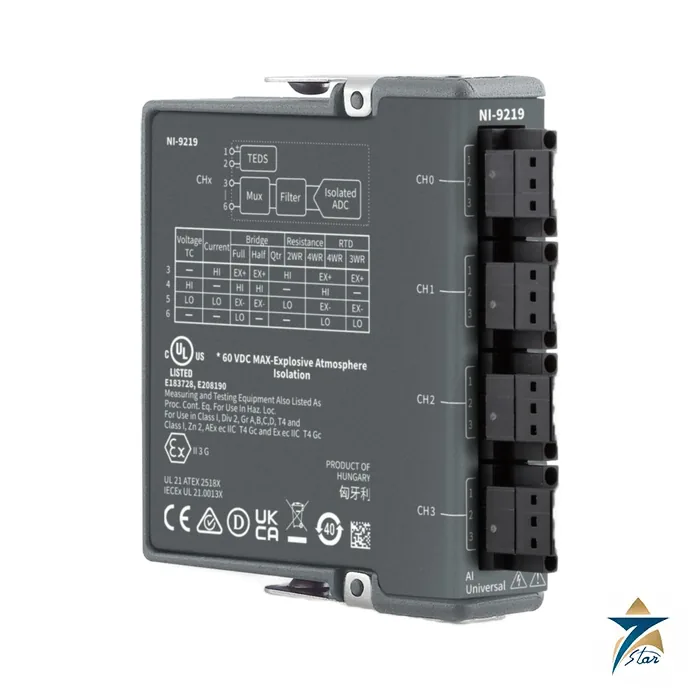
The NI NI-9219 is the universal measurement module of National Instruments C Series range. Instead of fixing a module to one sensor type, it lets you choose a measurement type for each of four channels: voltage, current, thermocouple, RTD, two-wire and four-wire resistance, quarter-, half- and full-bridge strain, and a digital-in or open-contact mode. A 24-bit delta-sigma converter samples the four channels simultaneously at up to 100 S/s per channel, or 50 S/s per channel when thermocouples are configured. The module has spring-terminal connectivity and works in NI CompactDAQ and CompactRIO chassis.

One module, many sensors: what the NI NI-9219 can read

The practical value of this module is flexibility in mixed-sensor work. A single slot can read a load cell on channel 0, a Pt100 RTD on channel 1, a 4 to 20 mA transmitter on channel 2 and a type K thermocouple on channel 3, each with the right excitation and ranges. The channels are individually selectable. The module also supports IEEE 1451.4 TEDS Class 2 interface for smart sensors, and it provides voltage and current excitation as needed by resistive and bridge sensors.

Measurement type Nominal ranges
Voltage 60 V, 15 V, 4 V, 1 V, 125 mV
Current 25 mA
Thermocouple 125 mV
2-wire and 4-wire resistance 10 kilohm, 1 kilohm
3-wire and 4-wire RTD Pt 1000, Pt 100
Quarter-bridge 350 ohm, 120 ohm
Half-bridge 500 mV/V
Full-bridge 62.5 mV/V, 7.8 mV/V
Digital in 0 V to 60 V

Timing modes and what they cost in time

Conversion time is selectable. With no thermocouple channel configured, the high-speed mode scans all channels in 10 ms, best 60 Hz rejection takes 110 ms, best 50 Hz rejection 130 ms and high resolution 500 ms. If at least one channel is a thermocouple, the same modes take 20, 120, 140 and 510 ms. Slower modes bring lower noise: for the plus or minus 60 V range, noise is 7.6 ppm of range rms in high-speed mode and 0.5 ppm in high-resolution mode. Common-mode rejection is above 100 dB at 60 Hz, and normal-mode rejection is 90 dB at 60 Hz in the best 60 Hz mode and 80 dB at 50 Hz in the best 50 Hz mode.

NI NI-9219 accuracy and electrical data

Parameter Datasheet value
Channels and ADC 4 simultaneous channels, 24-bit delta-sigma with analog prefiltering
Voltage gain error 0.3 percent typical, 0.4 percent maximum on 60 V, 15 V and 4 V; 0.1 percent typical, 0.18 percent maximum on 1 V and 125 mV
Current gain error 0.1 percent typical, 0.6 percent maximum
Full-bridge gain error 0.03 percent typical, 0.08 percent maximum
Cold-junction sensor 1 degree C typical accuracy
Input impedance 1 megohm voltage ranges 60 V, 15 V, 4 V; under 40 ohm current; above 1 gigohm other types
Overvoltage protection 30 V on terminals 1 and 2; 60 V across terminals 3 to 6
Integral nonlinearity 15 ppm
Isolation 250 VAC channel-to-channel and channel-to-earth, Measurement Category II
Power from chassis 750 mW maximum active; 25 microwatt sleep
Weight 156 g
Operating temperature -40 degrees C to 70 degrees C
MTBF 384,716 hours at 25 degrees C

How NI-9219 differs from dedicated input modules

Dedicated modules give simpler wiring but only one function. The NI 9211 reads thermocouples only, at 14 S/s in total with an 80 mV range. The NI 9215 reads plus or minus 10 V on four channels at 100 kS/s per channel. The NI-9219 trades speed for versatility: it tops out at 100 S/s per channel and only 50 S/s per channel with thermocouples, but it can switch each channel between nine kinds of measurement and provides 250 VAC channel-to-channel isolation, which the other two modules do not offer. Choose it for slow, mixed, isolated measurements such as temperature, strain and process signals in test cells; do not choose it for vibration or fast electrical waveforms.

Excitation and loading considerations

For resistive and bridge sensors the module applies excitation that depends on the load. The datasheet lists characteristic levels: a half-bridge of 700 ohm sees 2.5 V and 240 ohm sees 2.0 V; a full bridge of 350 ohm sees 2.7 V and 120 ohm sees 2.2 V. For resistance, RTD and quarter-bridge measurements the excitation is a small voltage matched to the load, from 50 mV on 120 ohm up to 2,200 mV on 10 kilohm. The datasheet states that the excitation level is characteristic and not software-selectable, so choose bridge sensors and load resistances that suit those values.

Wiring and installation

The module uses a spring-terminal connector that accepts 28 AWG to 18 AWG copper wire with 7 mm of insulation stripped, one wire per terminal. A spring-terminal tool and a getting-started guide come in the kit, and the NI 9972 backshell is listed as an accessory. Secure the connector with the screw flanges at 0.2 N m. To meet vibration and shock specifications the system must be panel mounted. In Division 2 or Zone 2 areas, do not connect the module to signals in Measurement Categories II, III or IV; the limit becomes 60 VDC, Measurement Category I, for Zone 2 applications in Europe.

Applications in Oman and the GCC

This module is a good fit for test cells in oil, gas and power equipment makers, structural and strain testing in universities, and thermal and electrical monitoring on pilot plants. It can read powered process transmitters up to 25 mA and voltage signals up to 60 V in the same chassis as thermocouples. Hazardous-location ratings of Class I Division 2 and Zone 2 apply, with Ex nA IIC T4 Gc for ATEX and IECEx, provided the entire system carries matching approvals.

Maintenance and handling

Clean the module only with a dry cloth. Configure each channel through NI-DAQmx or the LabVIEW project, and verify sensor wiring against the terminal assignment printed on the module. Periodic calibration against reference sources keeps the stated accuracy valid in critical test work.

Ordering NI NI-9219

Tell us the number of modules, the chassis, and the sensors you plan to connect, so that we can include suitable backshells or spares. Seven Star LLC is an independent supplier serving Oman and the GCC.

Related items you may also need: SICK FX3-ANA020002 Flexi Soft Analog Input Module | ABB PM573-ETH AC500 Processor Module 512 kB, Ethernet | Allen-Bradley 1756-OB32 ControlLogix 32-Point DC Output | All NI products.

Documents and quotation

The NI NI-9219 datasheet is attached to this page. To request a quotation, send an RFQ stating the part number NI NI-9219, the quantity and your delivery location in Oman or the GCC.

Datasheets & Documents
Reviews (0)

Reviews

There are no reviews yet.

How would you rate this product?

It takes about 10 seconds — just tap a star. Your email is never published.

About brand

NI, formerly National Instruments, is an American maker of modular data acquisition, embedded control and automated test hardware, best known for the LabVIEW graphical programming environment and the CompactRIO and CompactDAQ platforms. The company was founded in 1976 by James Truchard, Jeff Kodosky and Bill Nowlin, who started in Truchard's garage in Austin, Texas with the idea of connecting a test instrument to a computer. In 2020 the company shortened its name to NI, and in 2023 it became part of Emerson, where it operates within the Test and Measurement business group.
NI company profile

Founded1976, Austin, Texas, USA, by James Truchard, Jeff Kodosky and Bill Nowlin
HeadquartersAustin, Texas, USA
OwnershipPart of Emerson since 2023, operating as its Test and Measurement business
Core technologyC Series I/O modules, CompactRIO controllers with reconfigurable FPGA, CompactDAQ and USB data acquisition, LabVIEW software
Typical applicationsCondition monitoring, embedded control, machine and production test, laboratory and teaching measurements
StandardsIndustrial modules designed to IEC 61010-1 and UL 61010-1, with Class I Division 2 and Zone 2 Ex nA IIC T4 Gc hazardous-location ratings on many models

Milestones

1976: NI is founded in Austin, Texas by three engineers.
1986: LabVIEW, the graphical programming environment, is first released for the Macintosh.
2020: National Instruments announces its new short name, NI.
2023: Emerson acquires NI and brings it into its Test and Measurement business.
Today: Data acquisition modules, embedded controllers, instruments and test software are sold worldwide for engineering and industrial use.

How a CompactRIO system works
A CompactRIO system is built from three layers that are easy to picture. At the base are C Series modules, each a small plug-in unit that contains its own signal conditioning for one kind of measurement, such as voltage, thermocouple, current or digital lines. Above them sits a reconfigurable FPGA, which handles anything that must be timed in hardware, such as custom triggering, filtering or fast control loops. On top is a real-time processor running NI Linux Real-Time, which executes the application, logs data and talks to the network. The same C Series module can be moved between a CompactRIO controller and a CompactDAQ chassis, so a sensor interface designed once can be reused in a test bench and in a deployed controller. When selecting a system, start with the sensors and counts, choose the modules, and only then pick a controller with enough slots and processing headroom.
Where NI products are used in Oman and the GCC
NI hardware is common in condition monitoring on pumps and compressors, in test benches for motors and drives, in water and power utility monitoring, and in university and training laboratories across the region. Compact controllers with Zone 2 ratings also appear in skid-mounted and remote cabinets, and low-cost USB devices are used for field diagnostics. Because the modules are rated for operation from minus 40 to plus 70 degrees C on several models, they cope with the high cabinet temperatures typical of Gulf summers, provided the chassis and controller ratings are checked as well.
NI models we list

FamilyExamples

CompactRIO controllerscRIO-9056, cRIO-9063
C Series voltage input modulesNI-9205, NI-9215
Temperature and universal input modulesNI-9211, NI-9219
USB data acquisitionUSB-6009

Ordering NI products: what we need
Send the exact model, such as NI-9205 or cRIO-9063, together with the connector version where there is a choice, the quantity and your delivery location. For a complete CompactRIO system, list the controller, every C Series module, backshells or strain relief, the power supply and any mounting accessories, because controllers ship without I/O modules. For replacements, include the serial number or the part number printed on the label.
Facts checked against the NI company profile, published NI datasheets and the public company history, November 2026.
Browse NI products by category: PLC & I/O Cards, Controllers & Data Acquisition.

FAQ

Questions about the NI NI-9219 C Series 4-Channel Universal Analog

Answers from our engineering team on installation, compatibility and integration.

01Which sensors can the NI-9219 measure?
Voltage, current, thermocouple, RTD, 2-wire and 4-wire resistance, quarter-, half- and full-bridge strain, digital in and open contact. Each of the four channels is individually selectable.
02What is the sample rate of the NI-9219?
It samples four channels simultaneously at up to 100 S/s per channel, or 50 S/s per channel when thermocouples are used. The 24-bit converter offers high-speed through high-resolution timing modes.
03Does the NI-9219 provide channel-to-channel isolation?
Yes. The datasheet rates it at 250 VAC continuous, Measurement Category II, channel-to-channel and channel-to-earth. For Zone 2 hazardous use in Europe the limit is 60 VDC.
04What voltage and current ranges does the NI-9219 cover?
Voltage ranges are 60 V, 15 V, 4 V, 1 V and 125 mV, and the current range is 25 mA. Thermocouples use the 125 mV range.
05Does the NI-9219 support TEDS smart sensors?
Yes, it supports IEEE 1451.4 TEDS Class 2 interface. It also supplies voltage and current excitation for resistive and bridge sensors.