- Automation & ControlView all 3,212 products
- Automation Accessories
- AC Drives
- PLC & I/O Cards
- Industrial Communications
- Vibration Monitoring
- Controllers & Data Acquisition
- Isolator & Barrier
- Safety Switches & Guard Locking
- Encoders
- Motor Soft Starters
- CCTV & Security
- Pneumatic Cylinders
- HMI Displays
- Servo Drives
- Industrial Computers
- Machine Vision
- Automation Software
- Robotics
Brand: National Instruments
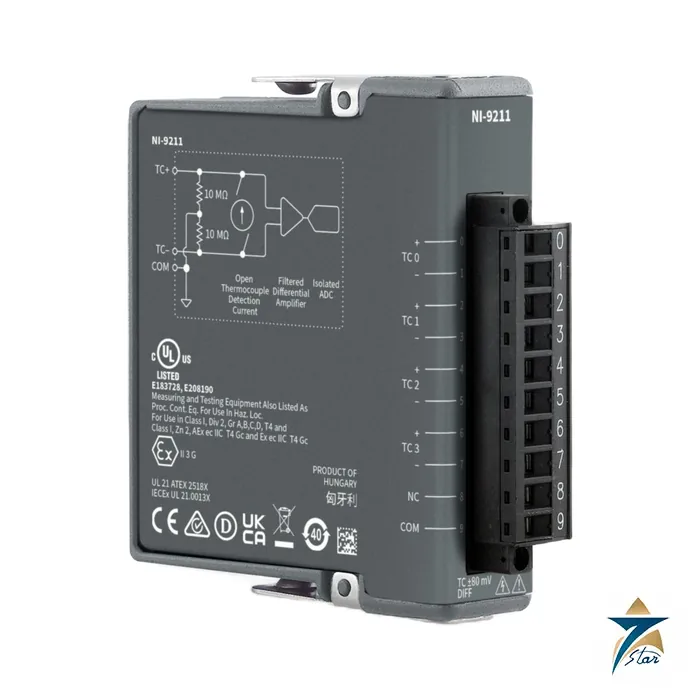
NI NI-9211 C Series 4-Channel Thermocouple Input Module
Description
Overview
Thermocouples produce millivolt signals, so a thermocouple module has to be quiet, slow and careful rather than fast. The NI NI-9211 follows that philosophy. This C Series module from National Instruments offers four thermocouple channels with a plus or minus 80 mV measurement range, a 24-bit delta-sigma converter and a conversion rate of 14 S/s in total. It is used in NI CompactDAQ and CompactRIO chassis, can be hot-swapped, and includes antialiasing filters, open-thermocouple detection and cold-junction compensation. Its operating range is minus 40 to plus 70 degrees C.
Reading temperatures with the NI NI-9211
Besides the four external channels, the module scans two internal channels: an autozero channel that tracks offset, and a cold-junction compensation channel that measures the temperature at the screw terminals. Each channel takes 70 ms, so a complete scan including the internal channels takes 420 ms. The software linearises the thermocouple voltage using NIST tables for the following thermocouple types: J, K, T, E, N, B, R and S. You select the type per channel in the software, so one module can read a type K furnace probe and a type T surface sensor at the same time.
Open-thermocouple detection is built in, which is useful in plants where a broken lead would otherwise appear as a plausible temperature. The module can also read plain voltage within its plus or minus 80 mV window, so it doubles as a low-level millivolt input for shunts or load cell amplifiers with suitable outputs.
Accuracy details for NI-9211 measurements
The datasheet gives gain error of 0.05 percent maximum at 25 degrees C, and 0.06 percent typical or 0.1 percent maximum across the whole operating range. Offset error with the autozero channel enabled is 15 microvolts typical and 20 microvolts maximum. Input noise is 1 microvolt rms. For high-impedance sources, add 0.05 ppm per ohm of gain error and 0.05 microvolt typical per ohm of offset error whenever source impedance exceeds 50 ohms, which is a reminder to keep thermocouple extension wire short and clean.
Measurement sensitivity, the smallest change the module can resolve, is better than 0.07 degrees C for types J, K, T, E and N with the autozero channel on, better than 0.25 degrees C for type B and better than 0.60 degrees C for types R and S. With autozero off the figures improve to 0.05, 0.20 and 0.45 degrees C. The cold-junction sensor accuracy is 0.6 degrees C typical and 1.3 degrees C maximum between 0 and 70 degrees C, and 1.7 degrees C maximum from minus 40 to plus 70 degrees C. The datasheet adds that these figures exclude the accuracy of the thermocouple itself.
NI NI-9211 electrical and mechanical data
| Item | Datasheet value |
|---|---|
| Channels | 4 thermocouple channels, 1 autozero channel, 1 cold-junction channel |
| ADC | 24-bit delta-sigma, scanned sampling |
| Voltage range | 80 mV |
| Conversion time | 70 ms per channel; 420 ms all channels |
| Input bandwidth | 15 Hz at -3 dB |
| Noise rejection | 85 dB minimum at 50 and 60 Hz |
| Common-mode range | 1.5 V channel-to-COM; 250 V COM-to-earth ground |
| CMRR | 95 dB channel-to-COM; above 170 dB COM-to-earth |
| Input impedance and current | 20 megohm differential; 50 nA |
| Overvoltage protection | 30 V between any input and COM |
| Power from chassis | 170 mW maximum active; 4 mW sleep |
| Terminals | Screw terminal, 12 AWG to 24 AWG, 10 mm strip, 0.5 to 0.6 N m |
| Isolation | 250 Vrms channel-to-earth, Measurement Category II |
| Weight | 150 g |
| MTBF | 633,012 hours at 25 degrees C |
How NI-9211 differs from other temperature-capable modules
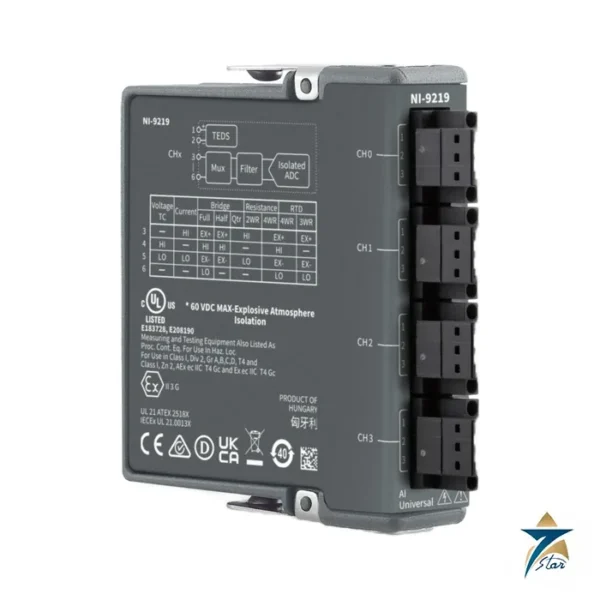
Another C Series option for thermocouples is the NI 9219, a universal four-channel module that measures thermocouples at 50 S/s per channel along with RTD, resistance, bridge, voltage and current signals, and that offers channel-to-channel isolation of 250 VAC. The NI-9211 is narrower in scope: thermocouples and millivolts only, at 14 S/s in total, with no channel-to-channel isolation but with the very low noise typical of a slow delta-sigma converter. If you need only thermocouples and want a simple, economical module, this is the better fit; if you must mix sensor types in one slot, choose the universal module.
Choosing a sampling strategy
Because a full scan takes 420 ms and the input bandwidth is only 15 Hz, the module is meant for thermal processes that change over seconds and minutes, not for fast transients. The built-in filtering rejects 50 Hz and 60 Hz mains pickup by at least 85 dB, so long thermocouple runs in electrically noisy plants still read steadily. If you log temperature next to fast signals from other modules in the same chassis, plan the acquisition so the slow channel is timed separately, and use software averaging or a moving window for display rather than trying to speed the module up.
Wiring and isothermal practice
Good cold-junction compensation depends on the terminal block staying at one temperature. Keep the module out of draughts and away from heat sources, and consider the NI 9932 backshell, which the datasheet specifies to protect the connections and to meet the shock and vibration ratings together with panel mounting. Use thermocouple extension wire of the correct type, twist pairs and keep them away from power cables. Because the channels share a common, keep the thermocouple junctions insulated from process vessels where possible; the channel-to-COM common-mode range is only 1.5 V, even though the COM can sit 250 V from earth.
Applications in Oman and the GCC
Typical uses are furnace and kiln monitoring, heat-exchanger and boiler surface temperatures, bearing and winding temperatures during motor and generator tests, and process-skid temperature logging where thermocouples are already installed. In hot climates the wide ambient range of minus 40 to plus 70 degrees C helps when the chassis sits inside a cabinet exposed to the sun, although the cold-junction accuracy should then be reviewed. Hazardous-location ratings are listed for Class I Division 2 and Zone 2, subject to the whole system being rated.
Calibration and care
The datasheet specifies a calibration interval of one year and notes that the calibration certificate can be obtained from the manufacturer. Clean the module only with a dry cloth, and never connect it to circuits in Measurement Category III or IV.
Ordering NI NI-9211
Seven Star LLC is an independent supplier serving Oman and the GCC. Tell us how many NI-9211 modules you need and which chassis they will go into, and we will check availability for the model and its backshell.
Related items you may also need: Turck TBEN-L5-16DOP Block I/O Module 16 PNP Outputs 2 A M12 | Yokogawa CP451-10 S2 Processor Module | Allen-Bradley 5069-IB8S Compact 5000 Safety Sinking Input Module | All NI products.
Documents and quotation
The NI NI-9211 datasheet is attached to this page. To receive a quotation, send an RFQ with the part number NI NI-9211, the quantity and your delivery location in Oman or the GCC.
Datasheets & Documents
- Datasheet NI NI-9211 Datasheet Download
Reviews (0)
How would you rate this product? Cancel reply
About brand
NI, formerly National Instruments, is an American maker of modular data acquisition, embedded control and automated test hardware, best known for the LabVIEW graphical programming environment and the CompactRIO and CompactDAQ platforms. The company was founded in 1976 by James Truchard, Jeff Kodosky and Bill Nowlin, who started in Truchard's garage in Austin, Texas with the idea of connecting a test instrument to a computer. In 2020 the company shortened its name to NI, and in 2023 it became part of Emerson, where it operates within the Test and Measurement business group.
NI company profile
Founded1976, Austin, Texas, USA, by James Truchard, Jeff Kodosky and Bill Nowlin
HeadquartersAustin, Texas, USA
OwnershipPart of Emerson since 2023, operating as its Test and Measurement business
Core technologyC Series I/O modules, CompactRIO controllers with reconfigurable FPGA, CompactDAQ and USB data acquisition, LabVIEW software
Typical applicationsCondition monitoring, embedded control, machine and production test, laboratory and teaching measurements
StandardsIndustrial modules designed to IEC 61010-1 and UL 61010-1, with Class I Division 2 and Zone 2 Ex nA IIC T4 Gc hazardous-location ratings on many models
Milestones
1976: NI is founded in Austin, Texas by three engineers.
1986: LabVIEW, the graphical programming environment, is first released for the Macintosh.
2020: National Instruments announces its new short name, NI.
2023: Emerson acquires NI and brings it into its Test and Measurement business.
Today: Data acquisition modules, embedded controllers, instruments and test software are sold worldwide for engineering and industrial use.
How a CompactRIO system works
A CompactRIO system is built from three layers that are easy to picture. At the base are C Series modules, each a small plug-in unit that contains its own signal conditioning for one kind of measurement, such as voltage, thermocouple, current or digital lines. Above them sits a reconfigurable FPGA, which handles anything that must be timed in hardware, such as custom triggering, filtering or fast control loops. On top is a real-time processor running NI Linux Real-Time, which executes the application, logs data and talks to the network. The same C Series module can be moved between a CompactRIO controller and a CompactDAQ chassis, so a sensor interface designed once can be reused in a test bench and in a deployed controller. When selecting a system, start with the sensors and counts, choose the modules, and only then pick a controller with enough slots and processing headroom.
Where NI products are used in Oman and the GCC
NI hardware is common in condition monitoring on pumps and compressors, in test benches for motors and drives, in water and power utility monitoring, and in university and training laboratories across the region. Compact controllers with Zone 2 ratings also appear in skid-mounted and remote cabinets, and low-cost USB devices are used for field diagnostics. Because the modules are rated for operation from minus 40 to plus 70 degrees C on several models, they cope with the high cabinet temperatures typical of Gulf summers, provided the chassis and controller ratings are checked as well.
NI models we list
FamilyExamples
CompactRIO controllerscRIO-9056, cRIO-9063
C Series voltage input modulesNI-9205, NI-9215
Temperature and universal input modulesNI-9211, NI-9219
USB data acquisitionUSB-6009
Ordering NI products: what we need
Send the exact model, such as NI-9205 or cRIO-9063, together with the connector version where there is a choice, the quantity and your delivery location. For a complete CompactRIO system, list the controller, every C Series module, backshells or strain relief, the power supply and any mounting accessories, because controllers ship without I/O modules. For replacements, include the serial number or the part number printed on the label.
Facts checked against the NI company profile, published NI datasheets and the public company history, November 2026.
Browse NI products by category: PLC & I/O Cards, Controllers & Data Acquisition.
FAQ
Questions about the NI NI-9211 C Series 4-Channel Thermocouple Input
Answers from our engineering team on installation, compatibility and integration.
01Which thermocouple types does the NI-9211 support?
It supports J, K, T, E, N, B, R and S thermocouples using NIST linearisation, with a plus or minus 80 mV voltage range. Open-thermocouple detection and cold-junction compensation are built in.
02How fast does the NI-9211 scan its channels?
Each channel takes 70 ms to convert, so a full scan of the four thermocouple channels plus the internal autozero and cold-junction channels takes 420 ms, equal to 14 S/s in total.
03Does the NI-9211 isolate channels from each other?
No. There is no channel-to-channel isolation, but channel-to-earth isolation is 250 Vrms Measurement Category II and the channel-to-COM common-mode range is 1.5 V.
04What is the cold-junction accuracy of the NI-9211?
The sensor is accurate to 0.6 degrees C typical and 1.3 degrees C maximum from 0 to 70 degrees C, and 1.7 degrees C maximum from minus 40 to plus 70 degrees C.
05How does the NI-9211 compare with the NI-9219 for temperature?
The NI-9211 is thermocouple-only at 14 S/s total with 24-bit resolution. The NI-9219 is a universal module with 50 S/s per channel thermocouple support and channel-to-channel isolation.


Reviews
There are no reviews yet.