Keyence FS-N11P: PNP digital fiber amplifier and how its code reads
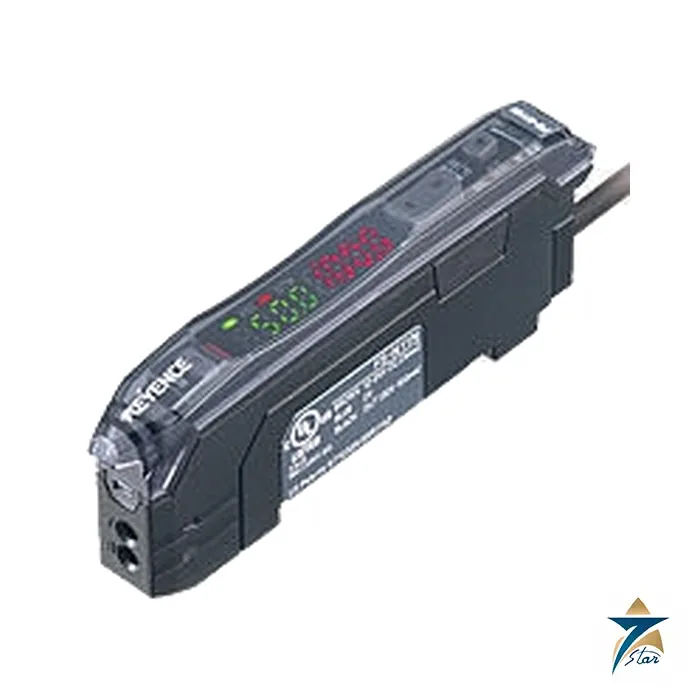
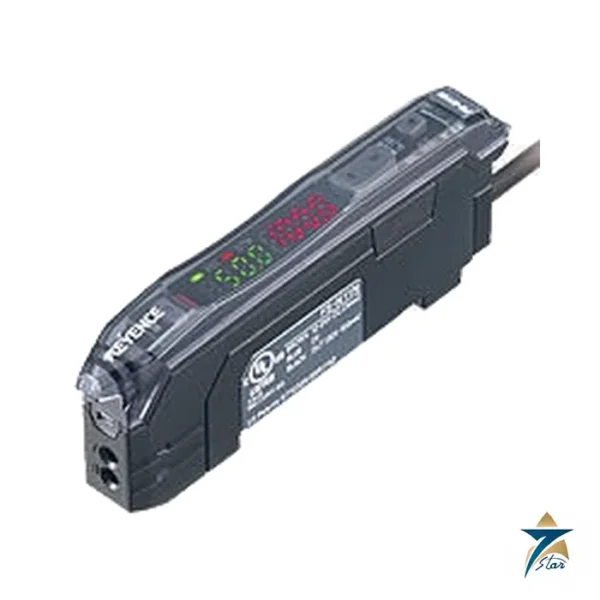
The Keyence FS-N11P is the PNP version of the standard one-output main unit in the FS-N digital fiber amplifier series. The amplifier sits on a DIN rail inside the cabinet or machine frame and feeds light into a plastic or glass fiber unit; the fiber carries the beam to a very small sensing tip, so the FS-N11P can watch tight spaces where a normal photoelectric sensor body would not fit. Seven Star LLC supplies the FS-N11P in Oman and the GCC as an independent supplier in Muscat.
Reading the code: FS-N is the series, 11 marks the standard main unit with a single control output and no extra functions such as monitor or external input, and the final letter P means the output is a PNP open collector, which sources current to the load. If your PLC input card expects a sinking signal from a NPN device, the matching code is FS-N11N instead.
The maker lists the amplifier with six selectable response times from 50 µs up to 16 ms, a four-element red LED light source, and the ability to chain up to 16 further units, which makes the FS-N11P a flexible base unit for a bank of small-part detection points on one machine.
FS-N11P technical specifications
| Parameter |
Specification |
| Manufacturer / part number |
Keyence / FS-N11P |
| Product description |
Fiber Amplifier, Cable Type, Main Unit, PNP |
| Type |
Standard 1 output, cable |
| Output |
PNP |
| Main unit / expansion unit |
Main unit |
| Control output |
1 PNP open collector, 24 V; 100 mA or less per output; residual voltage 1 V or less |
| Monitor output (1-5 V) |
None |
| External input |
None |
| Light source |
Red, 4-element LED |
| APC |
ON/OFF switchable (factory setting OFF) |
| Response time |
50 µs (HIGH SPEED) / 250 µs (FINE) / 500 µs (TURBO) / 1 ms (SUPER) / 4 ms (ULTRA) / 16 ms (MEGA) |
| Interference prevention units |
0 for HIGH SPEED; 4 for FINE; 8 for TURBO, SUPER, ULTRA and MEGA (doubled when set to double) |
| Unit expansion |
Up to 16 units in total (a two-output type counts as two units) |
| Power voltage |
12 to 24 VDC ±10 %, ripple (P-P) 10 % or less |
| Current consumption |
Normal 950 mW or less (39 mA at 24 V, 52 mA at 12 V); Eco ON 850 mW or less; Eco FULL 520 mW or less |
| Ambient light |
Incandescent lamp 20,000 lux or less; sunlight 30,000 lux or less |
| Ambient temperature |
-20 to +55 °C, no freezing (derated when many units are chained) |
| Relative humidity |
35 to 85 % RH, no condensation |
| Vibration resistance |
10 to 55 Hz, double amplitude 1.5 mm, 2 hours in each of X, Y and Z |
| Shock resistance |
500 m/s2, 3 times in each of X, Y and Z |
| Case material |
Polycarbonate |
| Weight |
Approx. 75 g |
How the FS-N11P works with a fiber unit
A fiber amplifier is the electronics half of a two-part sensor. Inside the FS-N11P the red LED emits light into one fiber core; light returns through a second core (reflective fibers) or arrives from a separate emitter fiber across a gap (through-beam fibers). The receiving element converts the amount of returned light into a digital value shown on the amplifier display, and the unit switches its PNP output when that value crosses the threshold you set.
Because all the decision-making is in the amplifier, the sensing tip stays tiny and passive, which suits locations with vibration, moving parts or limited space. The FS-N11P lets you trade speed for stability: the 50 µs HIGH SPEED setting suits fast small-part counting, while the slower MEGA setting at 16 ms averages more light and is better for weak signals such as transparent film or long fiber runs.
The APC function, switchable on or off, is the amplifier’s LED output control; the maker ships it OFF. The Eco modes reduce the display and consumption figures listed in the table, which matters when several amplifiers share one small 24 V supply.
Where the FS-N11P fits: related FS-N series parts
Within the FS-N family, the FS-N11P is the PNP main unit. Its NPN twin is FS-N11N. FS-N11MN adds a 1-5 V monitor output to the standard layout, FS-N13N is another cable-type NPN main unit, and FS-N14N is a two-output expansion unit with an external input. FS-N12CP is the M8 connector, PNP expansion unit for installations that prefer a plug.
In a typical bank, one FS-N11P is placed on the DIN rail first, and expansion units are snapped on to its side to share power and to exchange mutual-interference prevention data. Remember the table note: the more units you chain, the lower the permitted ambient temperature, falling to +45 °C at 11 to 16 additional units, so check cabinet temperature before building a long chain.
Selecting FS-N11P: ordering checklist
- Output polarity: PNP for sourcing inputs; choose FS-N11N if the PLC card wants NPN.
- Fiber unit type and length: reflective or through-beam, plastic or glass, and the correct sensing-tip shape for the target.
- Whether you need a monitor output (FS-N11MN) or a second output and external input (FS-N14N) instead of the standard single output.
- Response time needed: 50 µs for fast counting, longer times for low-contrast targets.
- Number of amplifiers per bank and the resulting ambient temperature derating.
- Supply voltage 12 to 24 VDC with 10 % ripple or less; verify the control cabinet supply.
Installing, commissioning and maintaining FS-N11P
Mount the FS-N11P on a 35 mm DIN rail, snap expansion units on to its side before wiring, and keep the fibers clear of sharp bends. Insert each fiber fully into the amplifier port before closing the lock lever; a partly inserted fiber is the most common cause of weak and unstable readings.
For commissioning, place the target in the sensing position and run the amplifier’s power-tuning set-up, then confirm the stability reading on the display. Switch the response time to match your cycle speed and recheck, especially if several amplifiers are close together and need the interference-prevention setting.
Maintenance is light: clean fiber tips with a lint-free cloth, replace damaged fibers rather than re-bending them, and re-run set-up after any fiber change. Keep a spare amplifier and fibers on site for lines where downtime is costly.
Typical applications of FS-N11P in Oman and the GCC
In Oman and the GCC the FS-N11P suits packaging lines, small-part assembly, labelling and laboratory automation, where the sensing point is tiny but the control cabinet is conditioned. Muscat and Sohar installations often see high ambient temperatures and fine dust, so confirm the temperature row against your cabinet and keep the amplifier inside an enclosed panel.
Because the amplifier is rated 12 to 24 VDC and PNP, it drops straight onto many European-style and regional PLC input cards, which is useful for machine builders delivering skids to oil and gas, water and food projects around the Gulf.
FS-N series models compared with FS-N11P
The table puts FS-N11P next to its closest FS-N siblings so you can pick the right unit by output and position in the chain.
| Model |
Maker description / difference |
| FS-N11P |
Main unit, cable type, PNP, 1 output, no monitor or external input |
| FS-N11N |
Main unit, cable type, NPN, 1 output |
| FS-N11MN |
Main unit, NPN, with 1-5 V monitor output |
| FS-N14N |
Expansion unit, NPN, high-functionality 2 outputs, 1 external input |
| FS-N12CP |
M8 connector, PNP expansion unit |
Information to send with your FS-N11P RFQ
- Exact part number: FS-N11P, with the quantity and any matching items listed below.
- Fiber units that will be used with it (type, length, sensing tip).
- Output polarity of the PLC card (PNP or NPN).
- Number of amplifiers in each bank and the cabinet temperature.
- Required response time and the target material and size.
- Project reference, delivery location in Oman or the GCC and the lead time you need.
Documents and quotation
Send us the part number FS-N11P and we will confirm the available documents, including the maker datasheet and instruction manual where we can provide them. Prices are quoted per request and are not shown on this page.
Seven Star LLC is an independent supplier in Muscat serving Oman and the GCC. We are not affiliated with the manufacturer, and every quotation states delivery and lead time against your RFQ.
Other Models in the Keyence Fs N Range
Seven Star LLC supplies models from the Keyence Fs N range in Oman and the GCC. Compare the related models below and request a quote for the one that matches your application.
| Model | Category | |
|---|
| Keyence FS-N11N Digital Fiber Amplifier, Main Unit, NPN | Photoelectric Sensors | View details |
| Keyence FS-N12CP Digital Fiber Amplifier, M8 Expansion, PNP | Photoelectric Sensors | View details |
| Keyence FS-N13N Digital Fiber Amplifier, 2-Output, NPN | Photoelectric Sensors | View details |
| Keyence FS-N11P Digital Fiber Amplifier, Main Unit, PNP | Automation Accessories | You are viewing this model |
| Keyence FS-N11MN Digital Fiber Amplifier, Monitor Output, NPN | Automation Accessories | View details |
| Keyence FS-N14N Digital Fiber Amplifier Expansion Unit, NPN | Automation Accessories | View details |

























Reviews
There are no reviews yet.