83V average-responding industrial multimeter explained
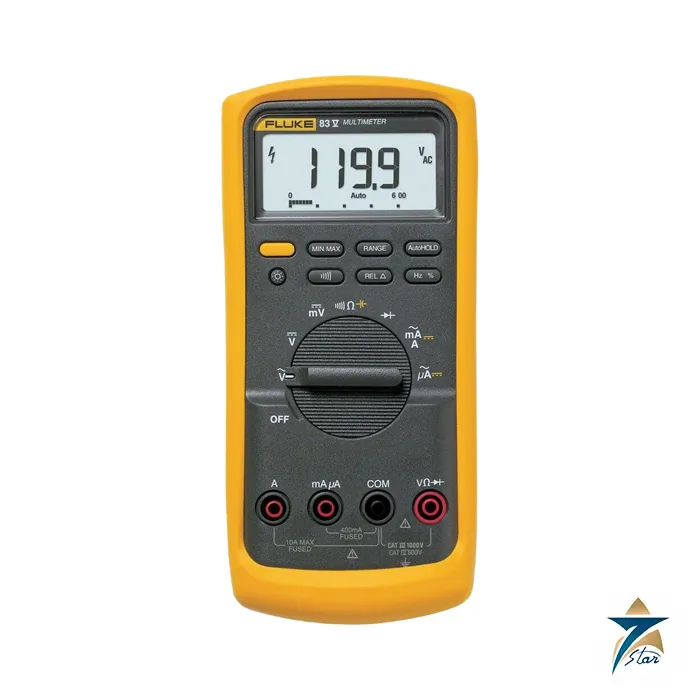
The Fluke 83V Industrial Multimeter (83V) is an industrial handheld multimeter from the Fluke 80 series. It is average-responding for AC, reads to 1000 V and 10 A, and adds frequency to 200 kHz, duty cycle, conductance and capacitance for control-room and plant-floor troubleshooting. Seven Star LLC supplies 83V in Oman and the GCC as an independent supplier in Muscat, not affiliated with the manufacturer.
The V in the model name marks the 80 V series generation. The table decodes the identifiers that matter when comparing it with the 87V.
| Element |
Value |
Meaning |
| 83V |
Model |
Industrial multimeter, 80 V series |
| Average responding |
AC method |
Accurate on sine waves; true-RMS models differ on distorted signals |
| CAT III 1000 V / CAT IV 600 V |
Safety category |
Rated for industrial distribution work |
| 6000 counts |
Display |
Digital display plus 32-segment analog bar |
83V technical specifications
| Parameter |
Specification |
| Manufacturer / part number |
Fluke / 83V |
| DC voltage |
Up to 1000 V, ±(0.1% + 1), resolution 100 µV |
| AC voltage |
Up to 1000 V, ±(0.5% + 2) |
| DC current |
10 A (20 A for 30 s), ±(0.4% + 2) |
| AC current |
10 A (20 A for 30 s), ±(1.2% + 2) |
| Resistance |
Up to 50 MΩ, ±(0.4% + 1) |
| Capacitance |
Up to 9,999 µF, ±(1% + 2) |
| Frequency |
Up to 200 kHz, ±(0.005% + 1) |
| Duty cycle |
Up to 99.9% |
| Conductance |
Up to 60.00 nS |
| Operating temperature |
-20 °C to +55 °C |
| Size / weight |
201 x 98 x 52 mm with holster / 355 g meter only |
| Battery life |
About 400 hours typical, alkaline, without backlight |
| Warranty |
Lifetime |
Specifications come from the manufacturer product page for the Fluke 83V. Operating altitude is stated as 2000 m.
How the Fluke 83V Industrial Multimeter works
The 83V rectifies the AC input and scales the average value to display RMS, which is accurate for a clean sine wave. For distorted waveforms a true-RMS meter such as the 87V is the better instrument, so the 83V suits supplies and signals that are known to be sinusoidal.
Min/Max records signal changes, and the frequency counter reaches 200 kHz with 0.005% accuracy. Duty cycle and conductance extend its use to pulse-width signals and high-resistance leakage checks.
Key features
- Min/Max recording to capture signal changes
- Frequency to 200 kHz and duty cycle
- Conductance to 60 nS
- Test leads and alligator clips included
- Operates from -20 °C to +55 °C
Where 83V fits and related Fluke models
The 83V is the lower-cost sibling of the 87V in the 80 series. The 87V adds true-RMS, temperature and extra industrial functions. If your plant has many variable-speed drives, true-RMS matters; if you mostly read control supplies, relays and signals, the 83V is sufficient.
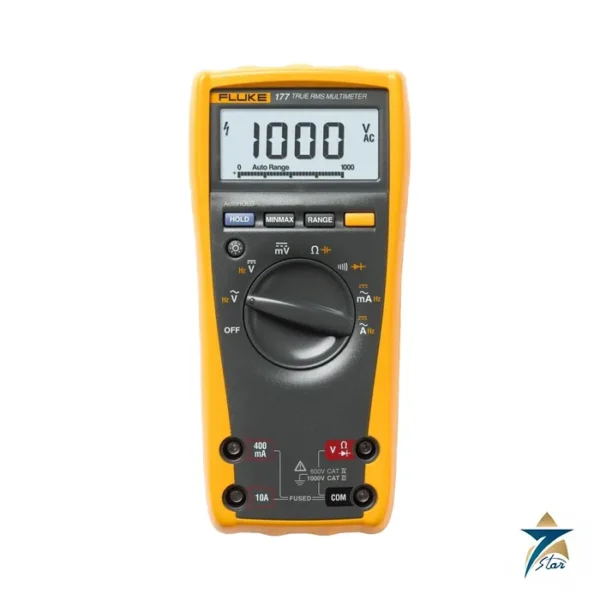
Compared with the 17x series, the 83V has better DC accuracy and a higher frequency range, and it works in a wider temperature range.
Selection checklist for 83V
Confirm the following points before ordering, so that the instrument matches the work and the safety rules of your site.
- Waveform content: average-responding AC is not suitable for heavily distorted signals.
- Need for temperature: not included in the specification table.
- Current: 10 A direct, 20 A for 30 seconds.
- Check the included TL75 leads and AC175 clips fit your tasks.
Safe use, care and maintenance of 83V
- Before each shift, inspect the case, the holster and the test leads. Cracked insulation, exposed metal or a loose input jack means the leads should be replaced before the 83V touches any live circuit.
- Confirm the meter on a known live source before and after a measurement that decides whether a circuit is dead. Never rely on a single reading when the result will be used to release a lock-out.
- Keep the input fuses to the specified type only. A blown fuse in the current inputs is the most common service event on a multimeter used on motor circuits, and a wrong fuse defeats the safety design of the Fluke 83V Industrial Multimeter.
- Replace the battery when the low-battery symbol appears, because readings near the lower end of the range become unreliable on a weak cell. Remove the battery before long storage.
- Store the instrument clean and dry. In coastal Oman, wipe off salt film and condensation after outdoor use and avoid leaving it in a vehicle cabin in summer.
Typical applications of 83V in Oman and the GCC
Handheld multimeters are carried in every plant. In Oman, oil and gas facilities, power stations, desalination plants and petrochemical sites rely on them for control-panel faults, motor circuits, instrument loops and routine electrical checks.
Industrial electricians and instrument technicians use the 83V in control rooms and on the plant floor for relay coil voltages, sensor supplies, pulse signals and continuity checks. The wide temperature range suits outdoor Omani plants in summer heat, and MIL-style vibration tolerance suits shutdown work.
83V compared with nearby models
| Model |
AC method |
DC accuracy |
Frequency |
| 83V |
Average responding |
±(0.1% + 1) |
200 kHz |
| 179 |
True-RMS |
±(0.09% + 2) |
100 kHz |
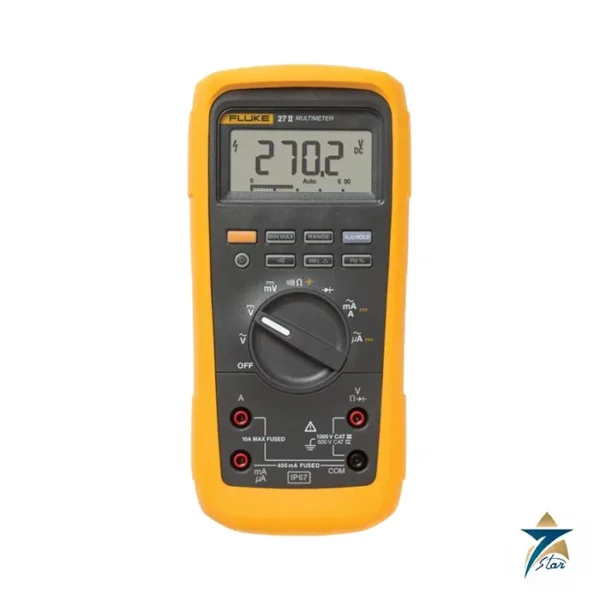
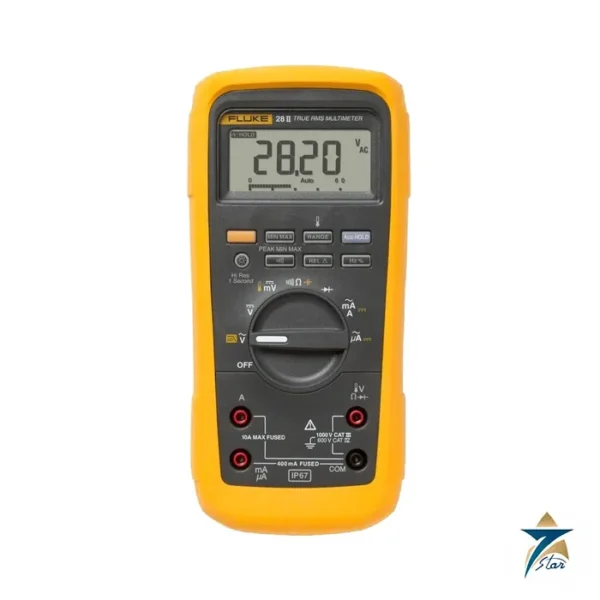
| 28 II |
True-RMS |
0.05% + 1 |
199.99 kHz |
The 87V is the true-RMS member of the same 80 series; see its own page for full details.
Information to send with an RFQ for 83V
To prepare an accurate quotation, please send:
- Exact model 83V and the quantity required.
- Whether the meter is for a lab, a workshop or field service, so the correct accessory set can be quoted.
- Required test lead type and any extra clips or probes.
- Temperature probe, case or magnetic hanger requirements.
- Whether calibration traceability paperwork is needed on delivery.
- Delivery point in Oman or elsewhere in the GCC and the required date.
Storage, handling and spares for the Fluke 83V
Store the Fluke 83V in its case or holster with the test leads disconnected. Remove the batteries if the meter will not be used for several weeks, because leaking cells can damage the battery contacts. In Oman and the GCC, do not leave the instrument in a parked vehicle during summer, where cabin temperature can go well above the storage limit in the user manual.
- Inspect test leads, probes and clamps before each use and replace any lead with damaged insulation or exposed metal.
- Use only leads and accessories rated for the same or a higher measurement category than the work you do.
- Keep spare fuses of the exact type given in the manual; a wrong fuse removes the protection the meter is built with.
- Plan a regular calibration interval, often twelve months, and keep the certificate with the instrument records.
If your team uses several units of the Fluke 83V, it is useful to order spare test leads and batteries in the same RFQ, so that a meter is not taken out of service for a simple accessory.
Documents and quotation
Send the part number 83V and we will confirm which manufacturer documents are available for this model.
For a quotation, send the part number 83V, the quantity and your delivery location in Oman or the GCC through the RFQ button on this page. Availability and lead time are confirmed per request.






















Reviews
There are no reviews yet.