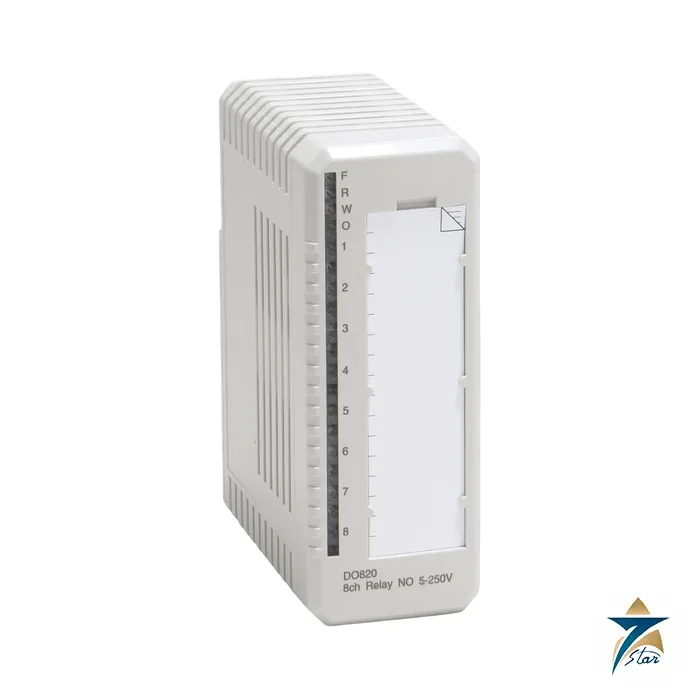
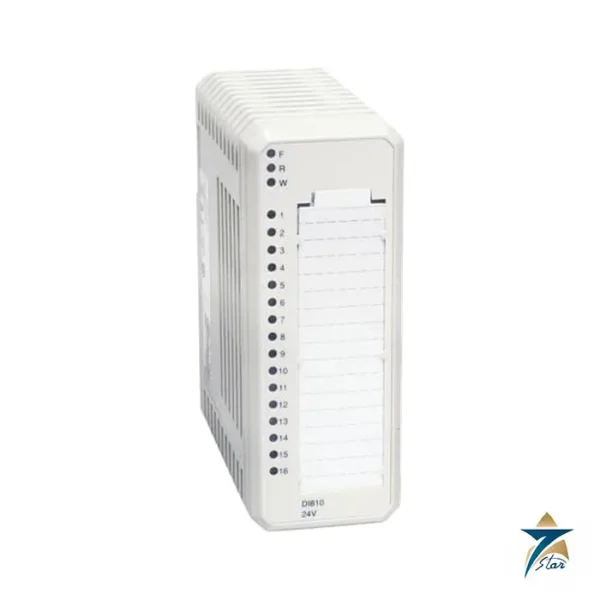
The DO820 is an S800 I/O relay output module from ABB, article number 3BSE008514R1. It has eight individually isolated relay channels with normally open contacts, switching up to 3 A at voltages from 5 to 250 V AC or DC, so one module can switch 230 V AC solenoids, contactor coils and signal lamps directly, within the 3 A limit. It plugs into an S800 module termination unit and is listed under PLC and I/O cards, alongside the DI810/DO810 module set.
Technical specifications
| Parameter |
Specification |
| Type / article number |
DO820 / 3BSE008514R1 |
| Module type |
Digital output, relay (N.O.) |
| Channels |
8, individually galvanically isolated, separate returns |
| Signal specification |
230 V AC/DC (5-250 V AC/DC), 3 A |
| Power factor / DC power on the product page |
Power factor above 0.4; 42 W DC |
| Mechanics |
S800 housing: 45 mm wide, 102 mm deep (111 mm with connector), 119 mm high |
| HART / SOE / redundancy |
No / No / No |
| High integrity / intrinsic safety |
No / No |
| Compatible MTUs per ABB page |
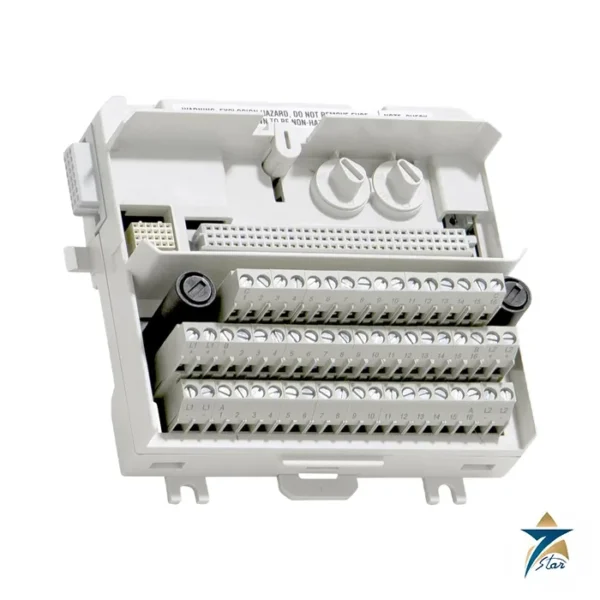
TU811, TU813, TU831, TU836, TU837 and TU851 |
| RoHS / WEEE |
EU RoHS, UAE RoHS, CN RoHS / Directive 2012/19/EU |
| Product page rating text |
24-230 V AC/DC, 3 A (the outline states 5-250 V) |
Using a relay output module
Relay channels give galvanic separation between the controller and the load and allow mixed AC and DC voltages on different channels of the same module, because each channel has its own return. They suit field devices where a solid-state output would leak, such as small contactors, signal horns and valve solenoids on a 230 V AC circuit. The relays are normally open, and a normally closed variant exists as the DO821. Contact life and inductive-load suppression need attention on high-duty channels.
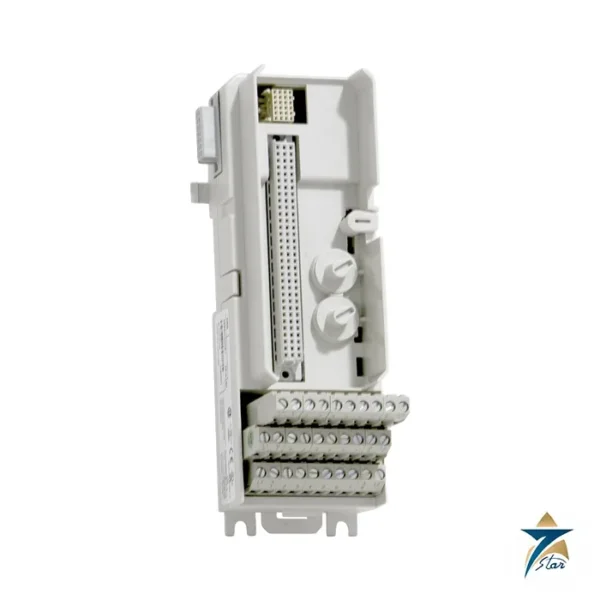
Choosing the termination unit and confirming before ordering
Because this module switches line voltages, it needs a termination unit with a 250 V rating: ABB lists the TU811, TU813, TU831, TU836, TU837 and TU851. Note that the outline gives the voltage range as 5 to 250 V while the product page text says 24 to 230 V; for system design use the data sheet value and confirm with ABB documentation. Please confirm the controller, the MTU, the load voltage and current and whether the system software version supports the module before ordering.
Other S800 digital output modules for comparison
The same ABB outline lists the DO815 (8 channels, 24 V DC, 2 A, high-side driver), the DO818 (32 channels, 24 V DC, 0.5 A, current sourcing), the DO821 (8 channels, relay N.C., 5 to 250 V AC/DC, 3 A), the DO828 (16 channels, relay N.O., 2 A at 5 to 125 V DC or 5 to 250 V AC) and the DO840 (24 V DC, 0.5 A, current sourcing, redundant). The DO820 is the choice when the load needs a dry normally open contact at line voltage; for 24 V DC loads one of the transistor outputs is usually the better fit. All of these use the S800 housing of 45 mm width.
Preparing the load list
Before a DO820 is added to an S800 station, list the eight loads it will drive. For each channel, note the device, its supply voltage, whether it is AC or DC, its steady current and its inrush or switching behaviour. Contactor coils and solenoid valves are inductive, so they produce a voltage spike when the contact opens and draw a higher current at switch-on; lamps can also show a high cold current. Comparing each load with the 3 A contact limit and the voltage range stated above, with a margin for these effects, protects the relay contacts and avoids nuisance failures later. Where a load is close to the limit or switches very often, an interposing relay or contactor driven by the DO820 channel is a sensible solution.
Wiring and suppression
Because each channel has its own return, 230 V AC and 24 V DC circuits can share the module, but they should be kept apart in the cable routing and clearly identified on the termination unit and in the drawings. Use the fuse or circuit protection the design requires for each circuit, and fit suppression across inductive loads: an RC network or varistor for AC coils and a diode or similar device for DC coils, following the device manufacturers’ guidance. Suppression reduces contact wear and the electrical noise that can disturb nearby signal cables. Label each wire with the channel number and the tag of the field device so that loop checks and later fault-finding are straightforward.
Loop checks during commissioning
With the controller in a safe test mode and the field devices isolated or under control of the commissioning team, force each output in turn and confirm that the correct device responds, that the status indication in the control system matches, and that the device drops out when the output is released. Record the result for every channel on the loop check sheet before handing the system over to operations.
Operating conditions in Omani installations
S800 I/O is often mounted in marshalling and remote I/O cabinets at oil and gas, water and power sites in Oman, some of them far from air-conditioned buildings. High cabinet temperatures shorten the life of electronics and relay contacts, so keep cabinet cooling and filters maintained and avoid packing heat-producing equipment around the module. Dust and humidity should be kept out by closing cable entries properly and checking door seals.
Maintenance and spares
Relay contacts wear with use, so channels driving loads that switch frequently deserve periodic checking. If a channel fails to switch or a load behaves erratically, check the field wiring, the suppression device and the load itself before replacing the module. Keep the article number 3BSE008514R1 and the termination unit type on the spares list, and keep the I/O configuration backed up so that a replacement module can be put into service with the same settings.
Documents and quotation
The linked ABB outline (2026-09-25) lists all S800 I/O modules with article numbers, signal specifications, channel counts and mechanical data. Seven Star LLC is an independent supplier in Muscat; send the article number and quantity for a quotation. No price or stock is shown on this page.















Reviews
There are no reviews yet.