- Automation & ControlView all 3,111 products
- Automation Accessories
- AC Drives
- PLC & I/O Cards
- Industrial Communications
- Vibration Monitoring
- Isolator & Barrier
- Controllers & Data Acquisition
- Safety Switches & Guard Locking
- Encoders
- Motor Soft Starters
- CCTV & Security
- Pneumatic Cylinders
- HMI Displays
- Servo Drives
- Industrial Computers
- Machine Vision
- Automation Software
- Robotics
Brand: ION Science
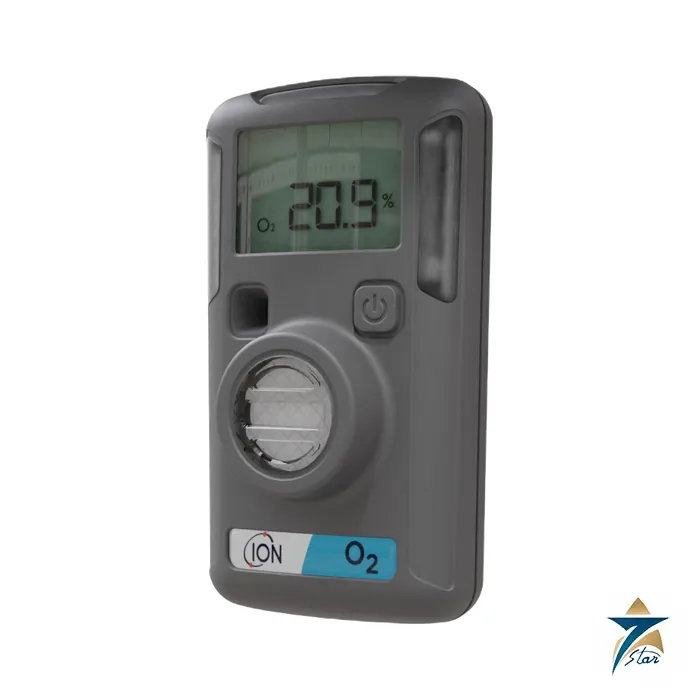
ION Science ARA300 Disposable Personal O2 Detector
Description
Overview
Not every confined space hazard is a poison. Sometimes the problem is simply that the air does not contain enough oxygen, because rust, fermentation, inerting gases or purge nitrogen have displaced it. The ION Science ARA300 is the oxygen model of the ION Science ARA personal disposable detector range. Seven Star LLC is an independent supplier serving Oman and the GCC. The facts here are taken from the ARA brochure, version 1.1, and recast for permit issuers and rescue planners who rely on a wearable oxygen alarm.
Measuring oxygen with the ION Science ARA300
The ARA300 reads oxygen from 0 to 25 percent using a single plug-in electrochemical cell. Normal fresh air contains about 20.9 percent, so the display of a healthy badge sits near that value, and any drift downward or upward is visible at once. The brochure says nothing about oxygen thresholds beyond the adjustable low and high alarms, so the site sets the alarm points to match its own procedures. An audible alarm of 95 dB at 10 cm, an LED and a vibration motor all trigger together.
Power comes from a 3.6 Vdc, 1.65 Ah lithium battery. The standard unit runs for 24 months assuming two minutes of alarm each day, and a lifetime-remaining counter can be shown on the display instead of the live reading if the user prefers.
Technical sheet for ION Science ARA300
| Characteristic | Published value |
|---|---|
| Gas and model number | Oxygen, ARA300 |
| Range | 0 to 25 percent O2 |
| Sensor | Single plug-in electrochemical cell |
| Battery life | 24 months with two minutes of alarm per day |
| Temperature | -30 to +60 degrees C; 5 to 95 percent RH |
| Ingress protection | IP67 |
| Alarms | 95 dB at 10 cm, LED, vibrator |
| Logged events | Last 30 |
| Mass and size | 92 g, 87 x 50 x 29 mm |
| Shelf life | 6 months |
| Hazardous area rating | Ex ia IIC T4 Ga with ambient -30 to +60 degrees C for the ARA300; Class I Division 1 Groups A to D T4 |
Where ARA300 departs from the toxic gas ARA models
Three differences matter when you place an order. The ION Science ARA300 has a narrower cold limit of -30 degrees C, where ARA100, ARA200 and ARA400 are certified to -40 degrees C. Its shelf life is six months rather than twelve, so stock must be rotated faster. And it has no hibernation version, since the H variants exist only for the H2S and CO models. In exchange, it is the only member that reports a percentage and can alarm on both depletion and enrichment.
Applications in Oman and the GCC
Oxygen-deficient atmospheres appear in ballast tanks, storage vessels, culverts and pipework that has been purged with nitrogen for maintenance, all common in Gulf refineries, shipyards and desalination plants. The brochure names confined space entry, plant shutdown processes, first response and site-wide safety. A badge on each entrant adds a personal layer beside the tripod or stand-alone instrument used for the permit, and it travels with the worker if the atmosphere changes after entry.
Managing a fleet of ARA300 badges
Because the shelf life is short, the six month figure should drive purchasing: order in quantities that will be consumed within that window, date the packaging on receipt, and issue oldest stock first. The ARA PC software with the optional IR Link downloads event logs and sets alarm levels, self test intervals and user ID. The ARA DOCK4 station bump tests up to four detectors in one operation and stores serial number, date and time for each result. These are sold separately from the detector.
Why oxygen needs its own badge
Toxic gas cells respond to a contaminant appearing in clean air, but an oxygen cell watches the main constituent of air itself. A drop of only a few percent can impair judgement, and a larger drop leads to rapid collapse, so the margin between a safe and an unsafe atmosphere is small. For that reason the accepted working band is narrow, and the instrument has to be accurate near 20.9 percent rather than only at the ends of its range. Carrying a personal oxygen detector therefore matters even when a four gas portable monitor is lowered into the space first, because conditions can change after entry when work disturbs sludge, opens a purge line or restarts ventilation. Atmosphere testing before entry remains mandatory, and the badge supplements it, never replaces it.
Oxygen enrichment is also a hazard, since it makes materials burn fiercely. The adjustable high alarm lets a site protect crews near oxygen cylinders or generators as well as in deficient spaces. Document the alarm settings you choose and issue them to every user so that the badges alarm consistently across the crew.
Safe use of the ION Science ARA300
Run the single-button self test at the start of each shift, perform a bump test under your procedure and wear the badge close to the face. If the oxygen alarm sounds, leave the area immediately, because low oxygen can cause unconsciousness without warning. Never enter to rescue without suitable breathing apparatus and a rescue plan.
Storage and issue routine
Keep ARA300 badges in a cool, dry store, issue them in strict date order, and check the display on handover to see that the reading is close to normal air. A badge that shows an obviously wrong value in clean air should be returned rather than used.
Ordering notes for ARA300
State the quantity and whether you need the IR Link or the DOCK4. Confirm the model number ARA300 on the unit label when ordering replacements.
Related items you may also need: ION Science Tiger XT Handheld VOC Detector | ION Science Titan 2 Fixed Benzene Monitor | MSA Ultima XIR Infrared Combustible Gas Monitor (legacy) | All ION Science products.
How to specify the exact ION Science ARA300 configuration
The ION Science ARA300 is offered as a model with several kit and accessory options, so the exact supply is defined by the points below rather than by the model name alone.
- Target gas or gases and the measuring range needed for the ION Science ARA300 application.
- Lamp or sensor option where the instrument offers more than one, for example the standard VOC lamp or a selective configuration.
- Hazardous area approval required for the site, such as ATEX or IECEx zone rating.
- Accessories needed with the unit, such as charger, calibration adaptor, sampling probe, carry case or docking station.
- Any data logging, software or calibration certificate requirement for your records.
Share these points, or the part number printed on an existing unit or previous order, and the quotation will list the confirmed kit contents.
Documents and quotation
The manufacturer’s ARA brochure is attached to this page as a datasheet. Send your RFQ with the part number ARA300, the quantity and your delivery location in Oman or the GCC for a quotation.
Other Models in the ARA Range
Seven Star LLC supplies models from the ARA range in Oman and the GCC. Compare the related models below and request a quote for the one that matches your application.
| Model | Category | |
|---|---|---|
| ION Science ARA100 Disposable Personal H2S Detector | Fire & Gas Detectors | View details |
| ION Science ARA200 Disposable Personal CO Detector | Fire & Gas Detectors | View details |
| ION Science ARA300 Disposable Personal O2 Detector | Fire & Gas Detectors | You are viewing this model |
Datasheets & Documents
- Datasheet ION Science ARA300 Disposable Personal O2 Detector Datasheet Download
Reviews (0)
How would you rate this product? Cancel reply
About brand
ION Science is a British maker of gas detection instruments, based in Fowlmere, Cambridgeshire. It has been active since 1989 and is best known for photoionisation detectors (PIDs) that measure volatile organic compounds at low concentrations. Its portable and fixed instruments are used for worker exposure monitoring, leak detection and environmental surveys.
Seven Star LLC is an independent supplier in Muscat. We list ION Science detectors for oil and gas, petrochemical and environmental users in Oman and the GCC.
ION Science company profile
| Active since | 1989, United Kingdom |
|---|---|
| Head office | Fowlmere, Cambridgeshire |
| Core technology | Photoionisation detection (PID) with patented Fence Electrode design |
| Product families | Tiger XT and Cub portable PIDs, Titan benzene monitor, Falco fixed detectors |
Milestones
- 1989: ION Science begins operating.
- 1998: Patents its PID sensor.
- 2002: Patents the Fence Electrode for humidity-resistant PIDs.
- 2017: Opens its head office in Fowlmere.
ION Science product series
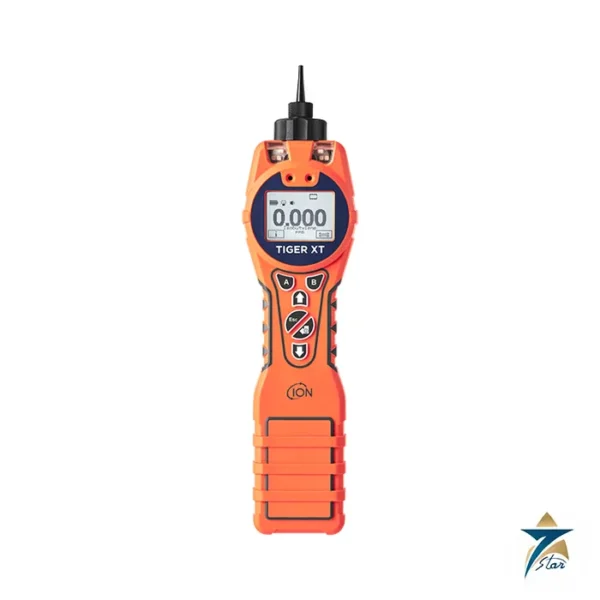
The Tiger XT is a handheld VOC detector for hazardous areas, and the Titan 2 is a fixed benzene monitor.
A PID uses ultraviolet light to ionise volatile organic compounds and measures the resulting current, which allows detection down to ppb levels. Response factors convert the reading for each specific compound. General VOC detectors measure the total, while benzene-specific monitors separate benzene from other hydrocarbons, which matters because benzene has very low exposure limits.
Where ION Science detectors are used
Leak detection, confined space entry checks, worker exposure monitoring, refinery and terminal benzene monitoring, and environmental and soil surveys.
Ordering ION Science detectors: what we need
Send the model, the compounds and ranges, lamp type, hazardous-area requirement and accessories such as probes, filters and calibration kits.
Facts checked against ION Science's published company history, October 2026.
Browse ION Science products by category: Gas Analyzer Systems, Fire & Gas Detectors.
FAQ
Questions about the ION Science ARA300 Disposable Personal O2 Detector
Answers from our engineering team on installation, compatibility and integration.
01What range does the ION Science ARA300 measure?
The ARA300 measures oxygen from 0 to 25 percent with a single plug-in electrochemical cell and adjustable low and high alarms.
02What is the shelf life of the ARA300?
The brochure gives 6 months for the oxygen model, shorter than the 12 months quoted for the H2S, CO and SO2 models.
03How long does the ARA300 run on its battery?
The standard unit gives 24 months of operation with two minutes of alarm per day; there is no hibernation version of the oxygen model.
04What temperature range does the ARA300 allow?
It operates from -30 to +60 degrees C at 5 to 95 percent RH, with IP67 protection.
05Does the ARA300 alarm on both low and high oxygen?
Yes. The low and high alarm levels are adjustable, and the unit gives audible, LED and vibrating alarms.


Reviews
There are no reviews yet.