Brand:

Pepperl+Fuchs HiD2030SK Transmitter Supply, Current Sink

Description

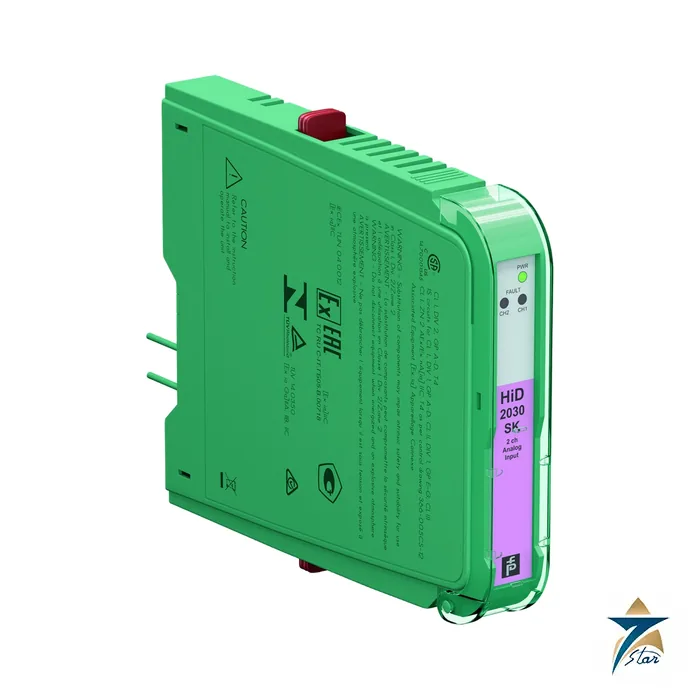
HiD2030SK: sink-mode version of the HiD transmitter supply

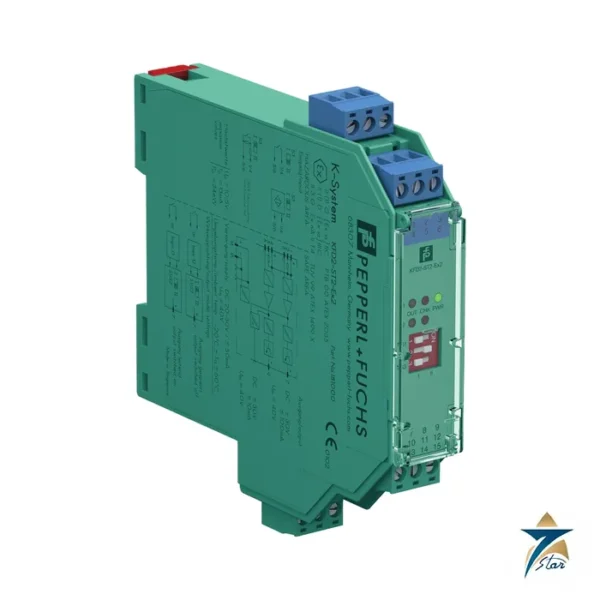
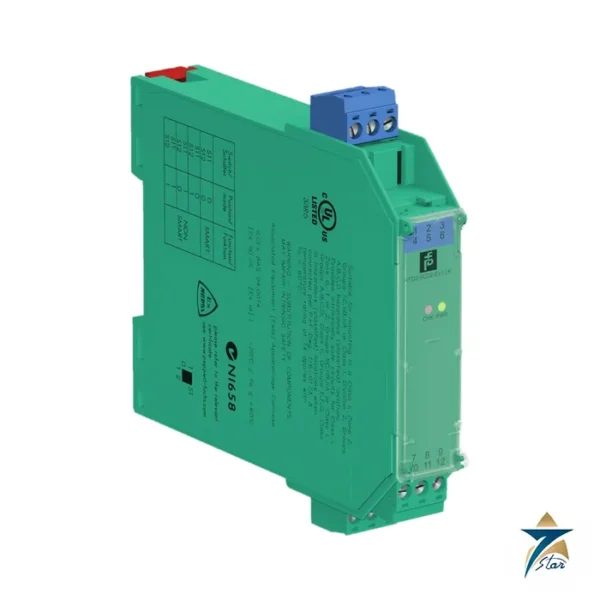
Some control systems supply the loop voltage themselves and expect the field barrier to behave like a variable resistor, not a source. For these systems the Pepperl+Fuchs HiD2030SK is built. It is a two-channel, 18 mm wide isolated barrier that feeds SMART 2-wire transmitters or current sources in a hazardous area and presents a 4 to 20 mA current sink to the safe-area side, powered from the PLC or DCS card at 7 to 30 V.

Like the other HiD modules it plugs into a Termination Board, receives its internal supply from the 24 V DC bus and shares one open-collector fault output between the two channels.

Points that matter

  • Output in sink mode from an external supply, signal 4 to 20 mA with a current limit of 24 mA
  • Working voltage on the output side: 7 to 30 V
  • Rated current from the bus: 40 mA at 24 V with 20 mA output, per channel
  • Response 70 ms for a 10 to 90 percent step
  • Fault detection below 0.2 mA or above 24 mA input current

HiD2030SK data

Parameter Value
Channels 2, isolated, splitter capable
Bus supply 20.4 to 30 V DC via Termination Board
Supply current 40 mA at 24 V and 20 mA output per channel
Dissipation 1.05 W at 20 mA and 24 V external from PCS or PLC, per channel
Input 4 to 20 mA, limit about 26 mA, 15.5 V minimum at 20 mA
Output sink mode, 4 to 20 mA, 24 mA limit, 7 to 30 V working voltage
Normal range 1 to 23.5 mA input current
Linearity better than 0.05 percent of full scale
Safe-side values Uo 26 V, Io 93 mA, Po 605 mW
Certificates CESI 02 ATEX 086; PF 11 CERT 2109 X
Marking (Zone 2 device) Ex nA IIC T4 Gc
Dimensions 18 x 114 x 130 mm, about 140 g
Temperature -20 to 60 degrees C

When sink mode is the right choice

Many DCS analogue input cards, especially in older installations, are of the powered-loop type: they provide 24 V and measure the current. Connecting a source-type output to such a card would create a conflict between two supplies. A sink-type barrier avoids that and leaves the loop power with the card, so card diagnostics for open circuit or short circuit still work in the way the control system designer intended.

Differences between HiD2030SK and HiD2030

On paper the two share input data, certificates and dimensions. The difference is the safe-side output: HiD2030 supplies a floating 4 to 20 mA or 1 to 5 V signal into 0 to 650 ohm, whereas HiD2030SK sinks current from an external supply of 7 to 30 V and has no 1 to 5 V option. Bus current also drops from 60 mA to 40 mA per channel. Mixing the two on one board is therefore a wiring mistake that would disable the loop.

Termination board practice

Select the board variant that matches the control system cables, check that the SL1 connector pin allocation corresponds to the module, and fit coding where the system description requires it. A Fault Indication Board may monitor the fault bus.

Testing the sink behaviour

With a calibrated 24 V source in series with a milliammeter on the output terminals, apply 4, 12 and 20 mA at the input and read the same values on the output. Remove the external supply and verify the loop reads zero, which is normal for a sink.

Service life

No consumables exist inside; inspect connectors yearly and log any fault bus activations.

Where it is deployed

Refinery tank gauging, offshore wellhead monitoring and water utility pressure monitoring use HiD2030SK whenever the controller is a loop-powered input system. Seven Star LLC can quote this in Oman and across the GCC.

Interplay with the control system card

Verify the card data sheet before wiring: the input must be a current-sourcing receiver that supplies the loop voltage in the range 7 to 30 V and tolerate the 24 mA limit. Where the card itself offers HART multiplexing, the digital path through the barrier lets it interrogate each transmitter. Place the barrier as close to the card as the cable length allows, and check shield termination at the Termination Board only, to avoid ground loops that would show up as noise on the 4 to 20 mA signal. A shorted output simply raises the card current to its own limit, while an open output removes the loop current completely and triggers the card open-circuit diagnostics.

Questions buyers ask about HiD2030SK

What does the SK in HiD2030SK mean for the output? The datasheet describes a sink-mode output on the safe-area terminals, powered from an external supply of 7 to 30 V.

What current limit does HiD2030SK have on its output? The output signal is 4 to 20 mA with a current limit of 24 mA.

How much bus current does HiD2030SK draw? The rated current is 40 mA at 24 V with a 20 mA output, per channel, from the 20.4 to 30 V DC bus via the Termination Board.

Can HiD2030SK repeat HART signals? Yes, digital signals can be superimposed and are transferred in both directions, except on the sink terminals 4, 7 and 5, 6.

Which certificate applies to HiD2030SK? The EU-type examination certificate is CESI 02 ATEX 086, with PF 11 CERT 2109 X for Ex nA IIC T4 Gc in Zone 2.

Documents and quotation

The manufacturer datasheet for HiD2030SK accompanies this listing as a PDF so your engineers can verify terminals, ratings and approvals before purchase. Say which control card powers the loop. To request a quotation, send the RFQ with the exact part number HiD2030SK, the quantity, the delivery location in Oman or the GCC and any project reference. Seven Star LLC is an independent supplier serving Oman and the GCC and is not affiliated with the manufacturer.

Ordering Checklist for the Pepperl+Fuchs HiD2030SK

Before you ask for a quotation for the Pepperl+Fuchs HiD2030SK, check the full order code on the nameplate of the unit you are replacing, the supply voltage, and the process or signal ranges your system expects. If this is an upgrade rather than a like-for-like swap, tell us the existing make and model so that mounting, wiring and connection details can be checked against the isolator & barrier already installed. For multi-unit orders, list the quantity per site and the delivery location in Oman or the wider GCC, so packing, paperwork and lead time can be confirmed in a single quotation.

Datasheets & Documents
  • PDF Datasheet Pepperl+Fuchs HiD2030SK Transmitter Supply, Current Sink Datasheet Download
Reviews (0)

Reviews

There are no reviews yet.

How would you rate this product?

It takes about 10 seconds — just tap a star. Your email is never published.

About brand

Pepperl+Fuchs is a German manufacturer of industrial sensors and explosion protection equipment, founded in 1945 in Mannheim by Walter Pepperl and Ludwig Fuchs as a radio repair shop. Defective transformers led them into manufacturing, and the company developed its first proximity switch in the late 1950s. Pepperl+Fuchs is headquartered in Mannheim and is a pioneer of intrinsically safe electrical equipment for hazardous areas.

Seven Star LLC lists Pepperl+Fuchs sensors, isolated barriers, power supplies and hazardous-area mobile devices, and supplies them to instrument and automation teams in Oman by exact model designation.

Pepperl+Fuchs company profile

Founded 1945, Mannheim-Sandhofen, Germany, by Walter Pepperl and Ludwig Fuchs
Headquarters Mannheim, Germany
Ownership Privately owned (Pepperl+Fuchs SE)
Origins Radio repair workshop that began making replacement transformers
Product families Inductive, capacitive, ultrasonic and photoelectric sensors, rotary encoders, R2000 LiDAR scanners, KFD and HiC isolated barriers, Zener barriers, remote I/O, purge and pressurization systems, Ex-rated enclosures

Milestones

  • 1945: Walter Pepperl and Ludwig Fuchs open their radio repair shop in Mannheim.
  • 1958: The first proximity switch is developed (some company sources say 1959).

Pepperl+Fuchs product families on this page

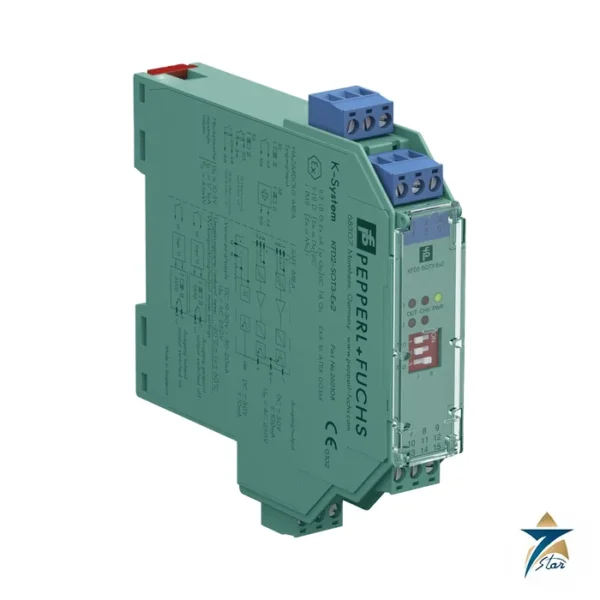
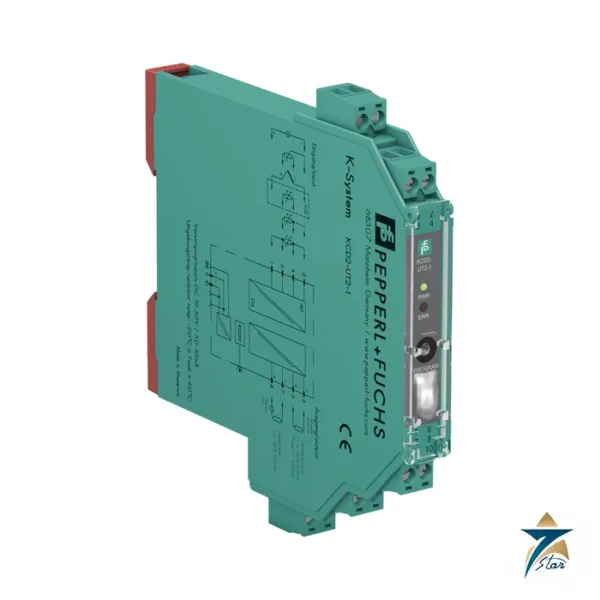
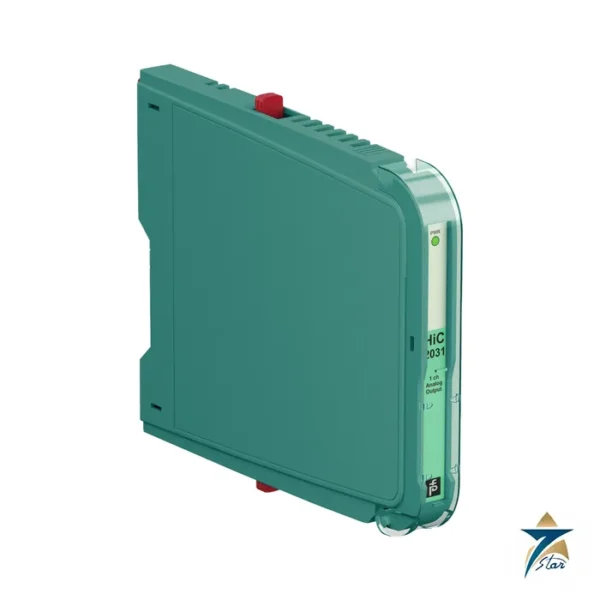
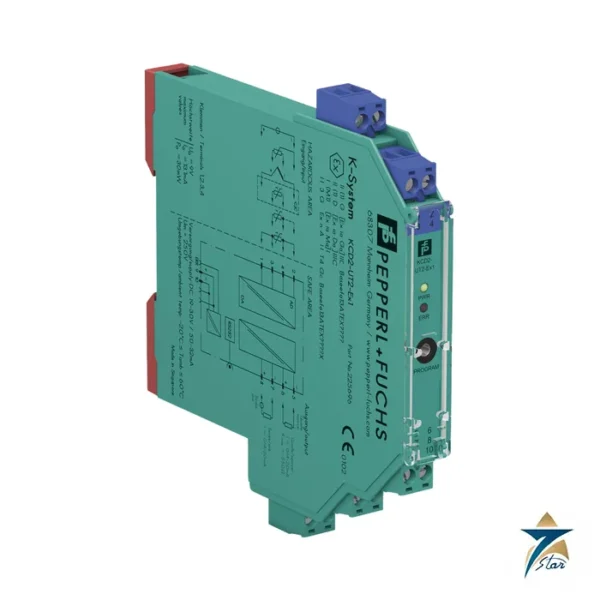
On the interface side there are two systems. The K-System mounts on DIN rail and is represented here by the KFD2-UT2-Ex2 universal temperature converter. The H-System plugs into termination boards and is represented by the HiD2030 SMART transmitter power supply with HART. The PS1000-A6-24.20 is a 24 VDC, 20 A power supply for cabinets. Sensors listed include the NJ2-12GK-SN NAMUR inductive sensor, the R101 retro-reflective photoelectric sensor and the R2000 2-D LiDAR scanner. For field staff there are the Tab-Ex 05 DZ1 tablet for Zone 1/21 areas and the Smart-Ex 03 DZ2 smartphone for Zone 2/22 and Division 2 areas.

Where Pepperl+Fuchs equipment is used

Isolated barriers sit between field instruments in Zone 0 or Zone 1 and the DCS or safety system in refineries, gas plants and chemical works. NAMUR sensors report valve position and machine states in classified areas. Photoelectric sensors and LiDAR scanners work in conveying, packaging, warehousing and vehicle guidance. Ex-rated tablets and phones are carried on operator rounds and maintenance jobs.

Pepperl+Fuchs products we list

Family Examples
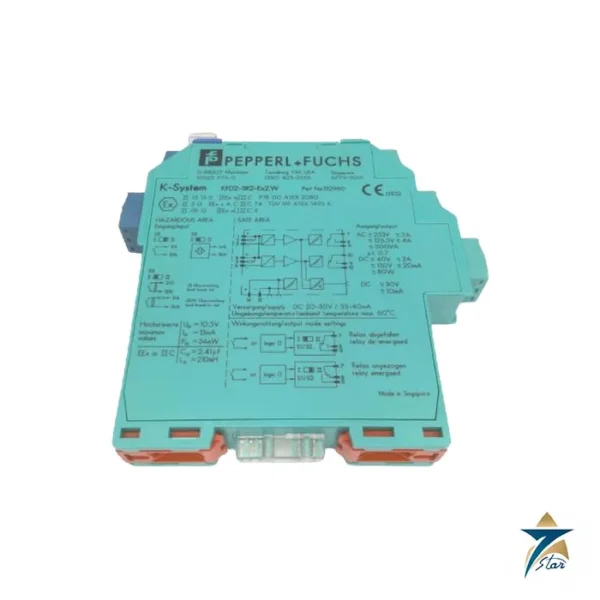
Isolator & Barrier HiD2030 SMART Transmitter Power Supply w…, KFD2-SR2-Ex2.W K-System Isolated Switch…, KFD2-UT2-Ex2 Universal Temperature Conve…
Industrial Computers Tab-Ex 05 DZ1 WWAN Hazardous Area Tablet, Smart-Ex® 03 DZ2 smartphone for Zone 2/2…
Inductive Proximity Sensors NJ2-12GK-SN NAMUR Inductive Sensor
Power Modules PS1000-A6-24.20 Power Supply 24 VDC 20 A
Photoelectric Sensors R101 Retro-Reflective Photoelectric Sensor
Laser Distance, LiDAR & Radar Sensors R2000 2-D LiDAR Laser Scanner

Ordering Pepperl+Fuchs parts: what we need

Send the complete model designation as printed on the device, including every suffix; a single letter can change the supply voltage or the output type. Add the part number if the label shows one. For barriers, tell us the field device and signal type, the number of channels and whether the safety loop needs a SIL-assessed module. For mobile devices, state the zone or division and the regional radio version.

Facts checked against Pepperl+Fuchs's own chronicle pages, October 2026.

FAQ

Questions about the Pepperl+Fuchs HiD2030SK Transmitter Supply, Current

Answers from our engineering team on installation, compatibility and integration.

01What does the SK in HiD2030SK mean for the output?
The datasheet describes a sink-mode output on the safe-area terminals, powered from an external supply of 7 to 30 V.
02What current limit does HiD2030SK have on its output?
The output signal is 4 to 20 mA with a current limit of 24 mA.
03How much bus current does HiD2030SK draw?
The rated current is 40 mA at 24 V with a 20 mA output, per channel, from the 20.4 to 30 V DC bus via the Termination Board.
04Can HiD2030SK repeat HART signals?
Yes, digital signals can be superimposed and are transferred in both directions, except on the sink terminals 4, 7 and 5, 6.
05Which certificate applies to HiD2030SK?
The EU-type examination certificate is CESI 02 ATEX 086, with PF 11 CERT 2109 X for Ex nA IIC T4 Gc in Zone 2.