Overview
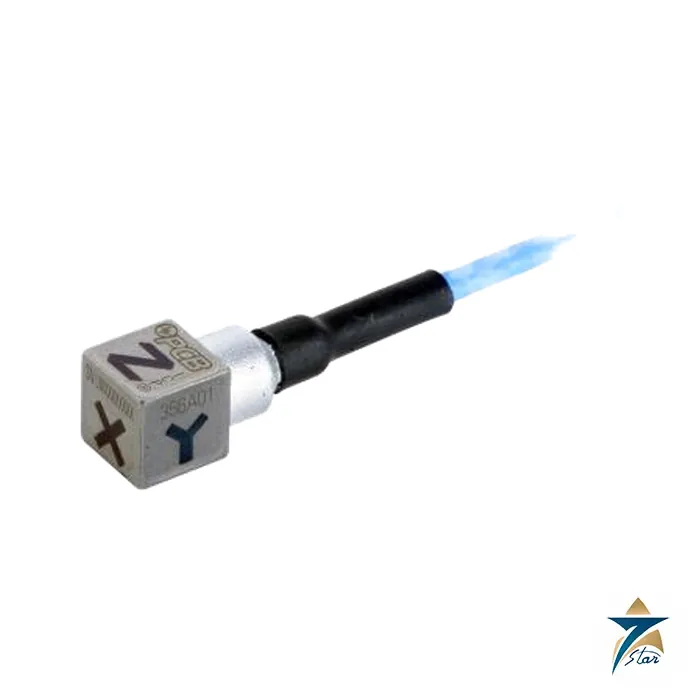
The PCB Piezotronics Model 356A01 is a triaxial, lightweight miniature ceramic shear ICP® accelerometer in a 0.25 in. titanium cube weighing 1.0 g. It measures vibration simultaneously in three orthogonal axes from a single adhesive mounting point, keeping mass loading of the test structure to a minimum.
The sensor has integral electronics powered by constant current excitation, giving a low-impedance voltage output. It is supplied with a 1.5 m 4-conductor shielded cable terminating in three BNC plugs (Model 034G05). A TEDS (IEEE 1451.4) option and a high-temperature option are available.
Key Features
- Triaxial ICP® accelerometer, ceramic shear sensing element
- Sensitivity 5 mV/g (±20%), measurement range ±1000 g pk
- 0.25 in. cube, 1.0 g, hermetically sealed titanium housing
- Frequency range 2 to 8000 Hz (y, z) and 2 to 5000 Hz (x) at ±5%
- Operating temperature −54 to +121 °C
- Adhesive mounting; optional TEDS (TLD) and high-temperature (HT) versions
Technical Specifications
| Parameter |
Value |
| Model |
356A01 |
| Sensitivity (±20%) |
5 mV/g (0.51 mV/(m/s²)) |
| Measurement range |
±1000 g pk |
| Frequency range (±5%) |
y, z axis: 2 to 8000 Hz; x axis: 2 to 5000 Hz |
| Resonant frequency |
≥50 kHz |
| Transverse sensitivity |
≤5% |
| Shock limit |
±10 000 g pk |
| Operating temperature |
−54 to +121 °C |
| Excitation voltage |
18 to 30 V DC |
| Constant current excitation |
2 to 20 mA |
| Output bias voltage |
7 to 12 V DC |
| Output impedance |
≤200 Ω |
| Housing / sealing |
Titanium / hermetic |
| Size |
6.35 × 6.35 × 6.35 mm |
| Weight |
1.0 g (without cable) |
| Connection |
Integral cable, side exit, 1.5 m, 4-conductor shielded |
| Mounting |
Adhesive |
| Broadband resolution (1 to 10,000 Hz) |
0.003 g rms typical |
| Non-linearity |
1 % or less |
| Discharge time constant |
0.24 to 1.0 s |
| Settling time (within 10 % of bias) |
Under 3 s |
| Sensing element / geometry |
Ceramic, shear |
| Integral cable type |
Four-conductor shielded, 5 ft (1.5 m), side exit |
| HT option operating range |
-54 to +163 °C |
Applications
- Modal analysis and structural testing of small or lightweight components
- Machinery diagnostics needing three-axis data from one location
- Laboratory vibration studies and product qualification testing
PCB Piezotronics 356A01 Ordering Code and Options
The spec sheet lists two option prefixes for the 356A01. Prefix HT is the high-temperature version and raises the upper operating limit from +121 °C to +163 °C. Prefix W is the water-resistant cable version, in which the cable entry becomes a sealed integral cable. More than one option can be combined.
The standard delivery is more than the sensor. PCB lists four supplied accessories: Model 034G05, a 1.5 m four-conductor shielded cable with a 4-pin plug on one end and three BNC plugs on the other; Model 080A109 petro wax; Model 080A90 quick bonding gel; and a NIST-traceable triaxial amplitude response calibration. The wax and gel are the mounting media, since the sensor has no threaded hole and is fixed with adhesive only.
PCB Piezotronics 356A01 Selection Notes
Two points in the spec sheet affect channel planning. The × axis has a narrower flat band than the other two axes: ±5 % holds to 5 kHz on × and to 8 kHz on y and z, so the most demanding high-frequency direction should be aligned with y or z. Low-frequency behaviour is set by the 0.24 to 1.0 s discharge time constant, and the output settles to within 10 % of bias in under 3 seconds after power is applied.
Why Seven Star LLC
Seven Star LLC supplies PCB Piezotronics vibration sensors and accessories to test laboratories, R&D facilities and maintenance teams across Oman and the GCC. The model number, options (TEDS, HT) and cable configuration are verified against PCB data before the order is confirmed.
Request a Quote for PCB Piezotronics 356A01 Tri-Axial Accelerometer
Submit a formal inquiry with the model 356A01, the quantity, any required option (TEDS or HT), and your signal conditioner or data acquisition system. Inquiry Form
Related Products
How the PCB Piezotronics 356A01 works
A ceramic element in shear mode produces a charge when the structure vibrates. Built-in electronics turn that charge into a low-impedance voltage. The sensor measures in three axes at the same time from a single mounting point.
Where the 356A01 is used
- Modal analysis
- Structural testing of small components
- Machinery diagnostics
- Laboratory vibration tests
- Lightweight structures
Selection checklist for the 356A01
- Axes needed
- Sensitivity
- Measurement range
- Frequency range
- Temperature range
- Mass of the test part
- Cable and connectors
- TEDS need
Installation, commissioning and maintenance notes for the 356A01
Clean the surface and fix the cube with adhesive in the right axis direction. Connect the cable to a constant current supply and check the bias voltage. Keep the cable strain relieved and inspect it at regular intervals.
Requesting a quotation for the PCB Piezotronics 356A01
Please send the frequency range, the temperature range and the TEDS or high-temperature option. Seven Star LLC serves industrial customers in Oman and the GCC and replies with a quotation based on the information provided.
356A01 sensor type
It is a triaxial, lightweight miniature ceramic shear accelerometer.
356A01 housing
It sits in a 0.25 in. titanium cube.
356A01 weight
The weight is 1.0 g without cable.
356A01 mass loading
The low mass keeps loading of the test structure to a minimum.
356A01 single mounting point
It measures three orthogonal axes from a single adhesive mounting point.
356A01 electronics
It has integral electronics powered by constant current excitation.
356A01 output
The output is a low-impedance voltage.
356A01 cable
It comes with a 1.5 m 4-conductor shielded cable.
356A01 connectors
The cable ends in three BNC plugs, Model 034G05.
356A01 sensitivity
The sensitivity is 5 mV/g.
356A01 measurement range
The measurement range is 1000 g peak.
356A01 shock limit
The shock limit is 10,000 g peak.
356A01 frequency range
The y and z axes cover 2 to 8000 Hz and the x axis covers 2 to 5000 Hz.
356A01 resonant frequency
The resonant frequency is at least 50 kHz.
356A01 operating temperature
The range is minus 54 to plus 121 degrees C.
356A01 high-temperature option
The HT option works up to plus 163 degrees C.
356A01 TEDS option
A TEDS version is available.
356A01 excitation voltage
The excitation voltage is 18 to 30 V DC.
356A01 excitation current
The constant current excitation is 2 to 20 mA.
356A01 bias voltage
The output bias voltage is 7 to 12 V DC.
356A01 output impedance
The output impedance is 200 ohm or less.
356A01 sealing
The housing is hermetically sealed.
356A01 size
The size is 6.35 x 6.35 x 6.35 mm.
356A01 broadband resolution
Broadband resolution is 0.003 g rms typical.
356A01 settling time
Settling time is under 3 seconds.
Sensor records for the 356A01
Record the axis mapping, the mounting location and the date of each check.
Choosing the right 356A01 version
Choose the standard, TEDS or high-temperature version to match the test conditions.

























Reviews
There are no reviews yet.