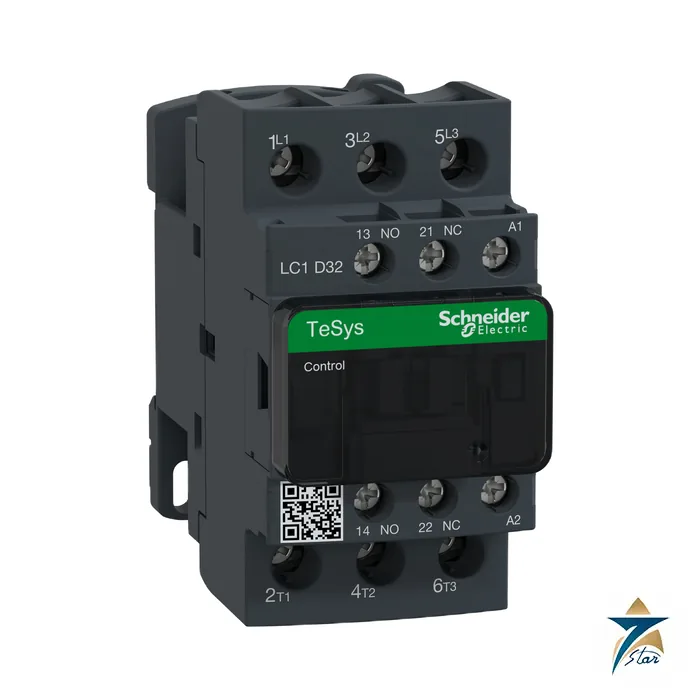
LC1D32F7: 32 A TeSys Deca contactor with 110 V AC coil
The LC1D32F7 is a Schneider Electric TeSys Deca contactor that the datasheet describes as TeSys D contactor – 3P(3 NO) – AC-3 – <= 440 V 32 A – 110 V AC coil. The 32 A reference shares the 85 x 45 x 92 mm housing with the 25 A and 38 A versions, so panel layouts do not change when the AC-3 rating steps up; the datasheet gives 32 A in AC-3 and 50 A in AC-1. Seven Star LLC supplies the LC1D32F7 in Oman and the GCC as an independent supplier based in Muscat.
Reading the reference: LC1D is the TeSys Deca three-pole contactor family, the figure 32 is the frame and current class, and the final letters F7 point to the coil. The datasheet confirms the coil as 110 V AC 50/60 Hz, so no further ordering table is needed to see what is fitted.
Weight is 0.375 kg and mechanical durability is 15 million cycles, the same as its smaller neighbour, while the AC-3 electrical durability is stated at 1.65 million cycles at 32 A.
Technical specifications of the LC1D32F7
| Parameter |
Specification |
| Manufacturer / part number |
Schneider Electric / LC1D32F7 |
| Description |
TeSys D contactor – 3P(3 NO) – AC-3 – <= 440 V 32 A – 110 V AC coil |
| Range |
TeSys Deca Advanced |
| Device short name |
LC1D |
| Poles / contact composition |
3P / 3 NO |
| Contactor application |
Resistive load; Motor control |
| Utilisation categories |
AC-3; AC-3e; AC-1; AC-4 |
| Rated operational voltage |
Power circuit: <= 690 V AC 25 to 400 Hz; Power circuit: <= 300 V DC |
| Rated operational current AC-3 (≤440 V) |
32 A (below 60 °C) |
| Rated operational current AC-1 |
50 A at up to 440 V AC (below 60 °C) |
| Control circuit voltage |
110 V AC 50/60 Hz |
| Rated breaking capacity |
550 A at 440 V for power circuit |
| Associated gG fuse, coordination type 1 / type 2 |
63 A / 63 A |
| Rated insulation voltage Ui / impulse Uimp |
690 V / 6 kV |
| Mechanical durability |
15 Mcycles |
| Electrical durability |
1.65 million cycles at 32 A in AC-3 and 1.4 million cycles at 50 A in AC-1 (Ue up to 440 V) |
| Coil technology |
Without built-in suppressor module |
| Inrush / hold-in power (50 Hz) |
70 VA / 7 VA |
| Operating time |
12 to 22 ms closing; 4 to 19 ms opening |
| Auxiliary contacts |
1 NO + 1 NC |
| Mounting |
Plate; Rail |
| Ingress protection |
IP20 front face conforming to IEC 60529 |
| Ambient temperature around the device |
-40 to 60 °C |
| Dimensions H x W x D |
85 mm x 45 mm x 92 mm |
| Net weight |
0.375 kg |
| Certifications listed |
UL; CCC; CSA; Marine; UKCA; EAC; CB Scheme |
Motor ratings of the LC1D32F7 at each supply voltage
| Supply voltage (AC, 50/60 Hz) |
Motor power in AC-3 (kW) |
| 220/230 V |
7.5 kW |
| 380/400 V |
15 kW |
| 415/440 V |
15 kW |
| 500 V |
18.5 kW |
| 660/690 V |
18.5 kW |
AC-3 is the category for squirrel-cage motors started and stopped while running; the datasheet converts the 32 A rating into the motor powers above for each supply voltage. At 380/400 V the LC1D32F7 is listed for 15 kW. For heavier duty such as inching or plugging the AC-4 category applies and the datasheet lists 7.5 kW at 400 V, which is lower because those duties wear the contacts faster. The same device is rated 50 A in AC-1, the category for resistive loads such as heaters, so it can switch a higher current when the load is not a motor.
Coil and control supply of the LC1D32F7
The coil of the LC1D32F7 is rated 110 V AC at 50/60 Hz. That fits machine-control circuits fed from a 110 V transformer, a voltage seen on equipment built to some other markets; a lower coil current than 24 V and a lower hazard to maintenance staff than line voltage.
According to the datasheet the contactor operates between 0.8 and 1.1 times Uc at 50 Hz, which for this coil is about 88 V to 121 V, and between 0.85 and 1.1 times Uc at 60 Hz (93.5 V to 121 V). Drop-out occurs between 0.3 and 0.6 times Uc, about 33 V to 66 V, which is the range to remember when a weak control supply makes the contactor chatter instead of opening cleanly.
Inrush is 70 VA at 50 Hz (70 VA at 60 Hz) and hold-in is 7 VA (7.5 VA at 60 Hz). Dividing by the coil voltage gives roughly 0.64 A on closing and 0.06 A when held; these are calculated approximations for sizing the control transformer or PLC interposing relay, not datasheet figures. The datasheet gives closing in 12 to 22 ms and opening in 4 to 19 ms.
The coil is described as without built-in suppressor module, so inductive switching of the coil can disturb sensitive electronics on the same control circuit unless a suppressor is added separately; check accessory compatibility with the supplier before ordering one.
Protection, coordination and service life of the LC1D32F7
For short-circuit protection the datasheet pairs the LC1D32F7 with a 63 A gG fuse at up to 690 V for coordination type 1 and 63 A gG for type 2. Type 2 is the stricter level: the contactor must remain usable after a fault, with at most light welds that can be separated. The rated breaking capacity is 550 A at 440 V for power circuit and the short-time withstand current is listed as 260 A 40 °C – 10 s for the power circuit.
Contact life is stated as 15 Mcycles mechanically and, electrically, 1.65 million cycles at 32 A in AC-3 and 1.4 million cycles at 50 A in AC-1 (Ue up to 440 V). The maximum operating rate is 3600 cyc/h at 60 °C. For functional-safety calculations the datasheet gives a B10d of 1,369,863 cycles at nominal load and 20,000,000 cycles at mechanical load, per EN/ISO 13849-1.
The auxiliary block built into the LC1D32F7 is 1 NO + 1 NC; the datasheet notes the contacts are mechanically linked and that the NC is a mirror contact to IEC 60947-4-1, so it can be used in a safety circuit to prove that the main contacts have opened. The signalling circuit is specified for a minimum of 17 V and 5 mA.
Where the LC1D32F7 sits among the LC1D frames
The same coil letters appear on the 25 A and 38 A references, so a plant that standardises on one control voltage can keep one coil code across three current ratings. Other coil versions of the same frame that we handle are LC1D32B7, LC1D32M7, LC1D32P7, LC1D32U7; they carry the same power circuit and differ only in the coil voltage.
| Frame |
AC-3 current |
AC-3 kW at 380/400 V |
AC-1 current |
Body H x W x D |
Net weight |
Mechanical life |
| LC1D25.. |
25 A |
11 kW |
40 A |
85 x 45 x 92 mm |
0.37 kg |
15 Mcycles |
| LC1D32 (this frame) |
32 A |
15 kW |
50 A |
85 x 45 x 92 mm |
0.375 kg |
15 Mcycles |
| LC1D38.. |
38 A |
18.5 kW |
50 A |
85 x 45 x 92 mm |
0.38 kg |
15 Mcycles |
The 15 kW rating at 380/400 V places it in the range of circulation pumps, supply and exhaust fans, screw compressors of modest size and mixer drives.
Selecting and ordering the LC1D32F7
- Motor power or load current at your supply voltage, and the duty category: AC-3 for starting, AC-4 for plugging and inching, AC-1 for resistive loads. This LC1D32F7 is rated 32 A AC-3 and 50 A AC-1.
- Coil voltage: this reference is 110 V AC; any other control voltage needs a different suffix, so state the control supply before quoting.
- Panel space: 85 mm x 45 mm x 92 mm and 0.375 kg for this body, mounted on plate or rail.
- Overload protection and the fuse or breaker that will be paired with the contactor, using the coordination values above.
- Any auxiliary or mechanical interlock accessories, the quantity, and whether the unit is for new work or a replacement of an existing LC1D device.
Mounting, wiring and commissioning of the LC1D32F7
Mount the LC1D32F7 on a 35 mm rail or screw it to a plate with the clearances of the installation sheet. The datasheet lists a flexible power conductor range of 2.5 to 10 mm² on connector 1 and 2.5 to 10 mm² on the second connector (without cable end), with a power-terminal torque of 2.5 N.m; the control terminals take 1.7 N.m on this frame except where the datasheet states otherwise. Keep control cabling apart from the power cables and fit the protective cover.
Typical applications of the LC1D32F7 in Oman and the GCC
Oil and gas facilities, power stations and petrochemical plants use contactors of this size for auxiliary drives: lube-oil pumps, ventilation, dosing, sump and transfer pumps. The LC1D32F7 suits designs that need a 110 V AC control voltage and a compact body. The datasheet lists marine and other certifications for the reference (see the table), but confirm the approval required by the project against the exact reference.
On construction and industrial sites around Muscat, Sohar and Salalah the LC1D32F7 replaces or extends starters on conveyors, crushers, compressors and washdown pumps. Dust and humidity make enclosure ratings and regular cleaning important. The datasheet lists a protective treatment of TH conforming to IEC 60068-2-30, which is relevant for damp heat.
Documents and quotation
A datasheet for the LC1D32F7 is attached on this page, listing the electrical, mechanical and environmental data used above. Send us the part number, quantity and application and we will confirm availability and a quotation.
Seven Star LLC is an independent supplier in Muscat and is not affiliated with the manufacturer.
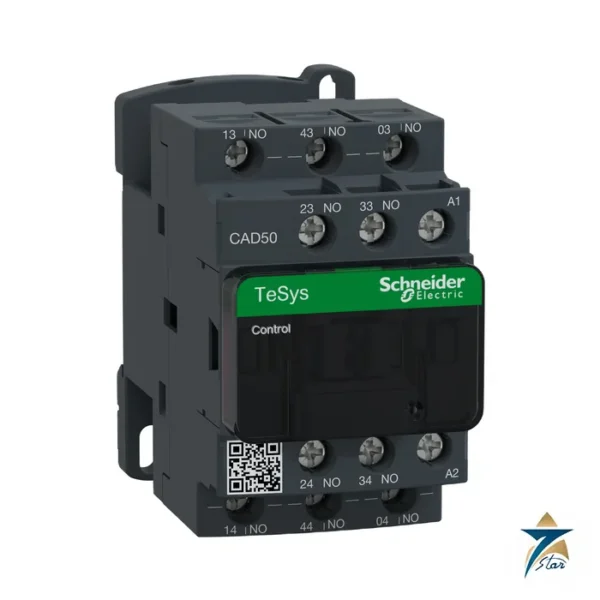
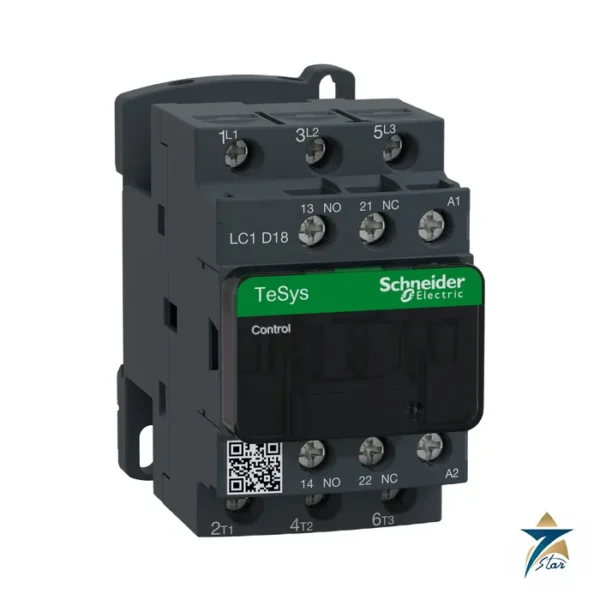
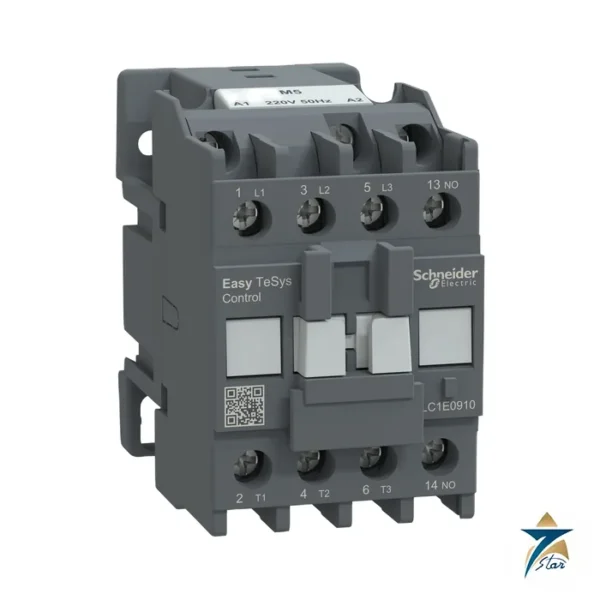
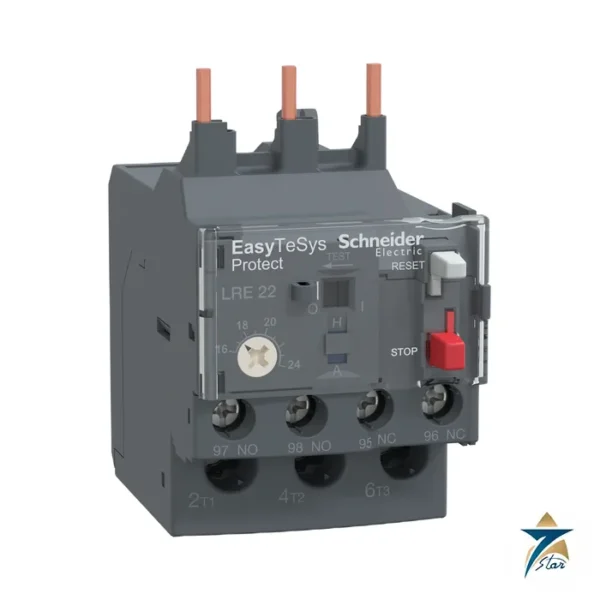
Other Models in the Se Lc1d 32 Range
Seven Star LLC supplies models from the Se Lc1d 32 range in Oman and the GCC. Compare the related models below and request a quote for the one that matches your application.





















Reviews
There are no reviews yet.