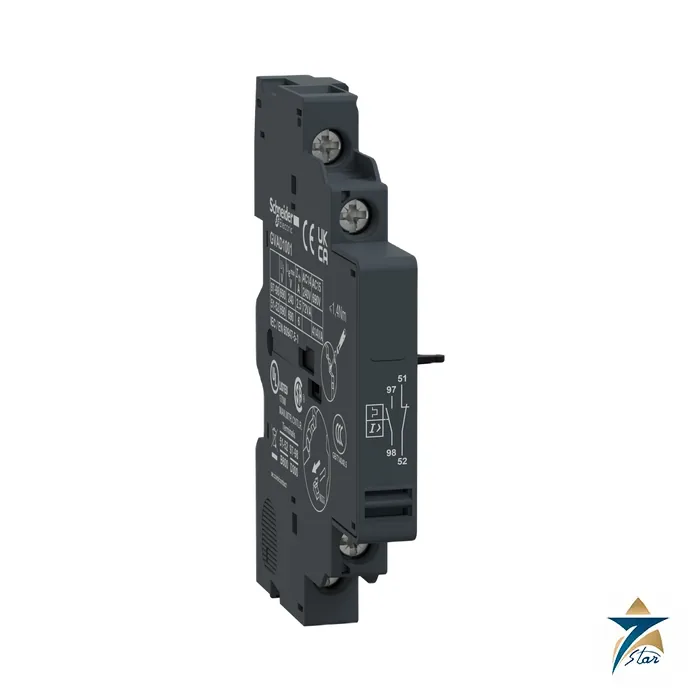
GVAD1001: 1 NO plus 1 NC block with a normally open fault contact
The GVAD1001 is a Schneider Electric TeSys Deca auxiliary contact for GV2 and GV3 motor circuit-breakers. Like the GVAD0110 it holds one normally open and one normally closed contact, but the fault signal sits on a normally open contact, which is what the datasheet states as fault signal 1 NO. Seven Star LLC supplies the GVAD1001 in Oman and the GCC as an independent supplier based in Muscat.
The practical difference from the GVAD0110 is one of logic. A normally open fault contact closes when the breaker trips, which suits an alarm lamp, a buzzer or a PLC input that is read as true during a fault. A normally closed fault contact does the opposite.
Technical specifications of the GVAD1001
| Parameter |
Specification |
| Manufacturer / part number |
Schneider Electric / GVAD1001 |
| Description |
Product datasheet TeSys GV2 & GV3 – auxiliary contact – 1 NC + 1 NO (fault) |
| Range |
TeSys; TeSys Deca |
| Device short name |
GVAD |
| Product or component type |
Auxiliary contact block |
| Product compatibility |
GV2P; GV2LE; GV3L; GV2ME; GV2RT; GV3P; GV2L |
| Mounting location |
Left side |
| Auxiliary contacts operation |
Fault signal 1 NO |
| Pole contact composition |
1 NO + 1 NC |
| [Ui] rated insulation voltage |
690 V conforming to IEC 60947-1; 300 V conforming to UL 508; 300 V conforming to CSA C22.2 No 14 |
| [Ue] rated operational voltage |
48 to 690 V AC; 24 to 240 V DC |
| [Ith] conventional free air thermal |
6A |
| Mechanical durability |
100000 cycles |
| Minimum switching current |
5 mA |
| Minimum switching voltage |
17 V |
| Protection type |
GB2CB– circuit breaker; GG fuse 10 A |
| Rated operational power in VA |
300 VA at 48 V AC-15 – electrical durability: 100000 cycles; 414 VA at 690 V AC-15 – electrical durability: 100000 cycles |
| Rated operational power in W |
120 W at 240 V DC-13 – electrical durability: 100000 cycles; 140 W at 110 V DC-13 – electrical durability: 100000 cycles |
| Height |
89 mm |
| Width |
9.3 mm |
| Depth |
66 mm |
| Net weight |
0.055 kg |
| Environmental characteristic |
Normal environment |
| Product certifications |
UKCA |
Choosing the NO fault logic of the GVAD1001
Alarm systems fall into two schools. In an energise-to-alarm design the fault contact closes and drives a lamp or a horn directly, which is easy to understand and to test. In a de-energise-to-alarm design the contact opens and the system is supervised against wire breaks. The GVAD1001 serves the first school and the GVAD0110 the second.
Check what your PLC input card or annunciator expects before ordering, because swapping a block later means reopening the panel and re-lettering the terminals.
GVAD1001 selection notes
- Confirm that the fault circuit is meant to close on a trip.
- Check that the second contact, normally closed, matches the status function required.
- Confirm the breaker family against the compatibility list.
- Review the 17 V and 5 mA minimum for low-level inputs.
- Compare with GVAD1010 if two normally open contacts are wanted.
Mounting and electrical ratings of the GVAD1001
The block clips on the left flank of GV2ME, GV2P, GV2L, GV2LE, GV2RT, GV3L and GV3P breakers, as listed in the datasheet. It measures 9.3 mm by 89 mm by 66 mm.
The thermal current is 6 A, the fault contact is rated 2.5 A, and the voltage ranges are 48 to 690 V AC and 24 to 240 V DC. The minimum switching values of 5 mA and 17 V mean that a low-level electronic input is acceptable only above that level.
The block mounts on the left side of the breaker and is 9.3 mm wide, 89 mm high and 66 mm deep, with a net weight of 0.055 kg. The datasheet lists a rated operational voltage of 48 to 690 V AC and 24 to 240 V DC, a conventional thermal current of 6 A, and 2.5 A for the fault-signalling contact. Rated operational power at AC-15 is 720 VA at 230 to 240 V and 850 VA at 380 to 415 V, each with an electrical durability of 100000 cycles; the DC-13 figures include 120 W at 240 V DC.
GVAD1001 applications in Oman and the GCC
Alarm annunciators on pump houses, camp utilities and small process skids typically collect trip signals as closing contacts. The GVAD1001 gives the NO fault contact to feed those channels and a NC contact to show that the breaker is on.
The same arrangement is common on HVAC plant rooms in malls and hospitals, where a BMS counts trips as digital inputs.
Installing the GVAD1001
Isolate and open the breaker, seat the block on the left side, tighten the terminals and label each wire. Test the fault contact by tripping the breaker with its standard test method and observing that the circuit closes.
Any spare breaker panels in a stock room should have the contact block fitted only after the control wiring is confirmed. Adding it later is simple, but the label on the block is the only reminder of its logic.
GVAD family: the GVAD1001 against its siblings
The four references below share the same left-side mounting and ratings and differ only in contact pattern and lifecycle status.
| Reference |
Contacts |
Fault signal contact |
Status in datasheet |
| GVAD0101 |
2 NC |
Fault signal 1 NC |
Discontinued (17 Jul 2023) |
| GVAD0110 |
1 NO + 1 NC |
Fault signal 1 NC |
Listed |
| GVAD1001 |
1 NO + 1 NC |
Fault signal 1 NO |
Listed |
| GVAD1010 |
2 NO |
Fault signal 1 NO |
Listed |
Information to send with an RFQ for the GVAD1001
- Full reference and quantity required
- Breaker model (GV2 or GV3 type) the block must fit
- Contact logic needed (NO or NC fault signal)
- Signal voltage and the input card that reads it
- Delivery location and timing
Documents and quotation
A datasheet for the GVAD1001 is attached on this page. It carries the electrical, mechanical and environmental data summarised above, so the figures can be checked against your drawings.
Send the part number, quantity and application and we will confirm availability and a quotation. Seven Star LLC is an independent supplier in Muscat and is not affiliated with the manufacturer.
Other Models in the Se Tesys Gvad Range
Seven Star LLC supplies models from the Se Tesys Gvad range in Oman and the GCC. Compare the related models below and request a quote for the one that matches your application.




















Reviews
There are no reviews yet.