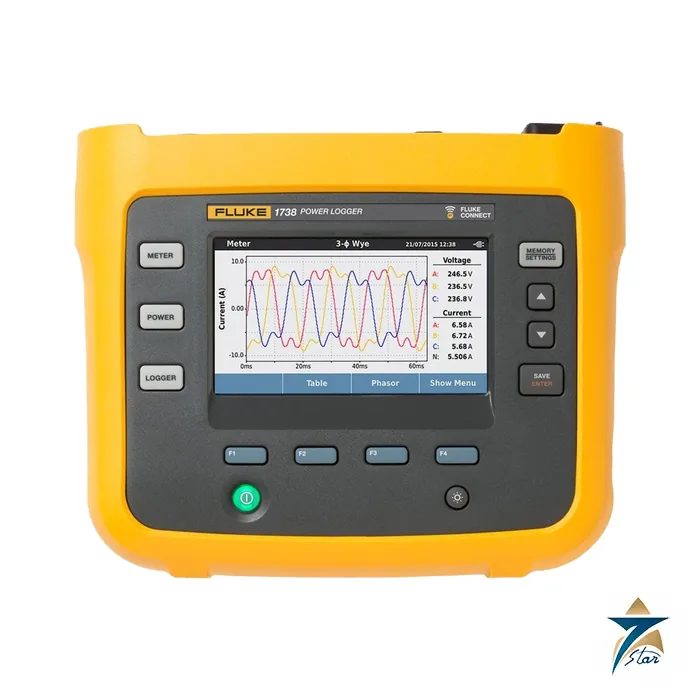
Fluke 1738 three-phase power quality logger (1736 and 1738 family)
The Fluke 1738 is a three-phase power and energy logger that records voltage, current, power, harmonics and power quality events over days or weeks, using four thin flexible current probes and a touch-screen display. It shares one data sheet with the 1736, and the manufacturer positions the pair for load studies, energy assessments and basic power quality logging. The 1738 adds Bluetooth reading of Fluke Connect 3000 series modules (a 1736 needs an upgrade option for that). Seven Star LLC supplies the 1738 in Oman and the GCC as an independent supplier in Muscat, and this page explains what the instrument measures and what to specify when you ask for a quotation.
What the 1738 logs and how it is set up
The data sheet says the 1736 and 1738 automatically capture and log more than 500 power quality parameters. The logger measures rms voltage, rms current, voltage and current events, voltage and current THD, harmonics up to the 50th, active, reactive and apparent power, power factor, active and reactive energy and more. All measured values are logged automatically, so the operator does not have to decide in advance which parameters to record. A guided graphical setup and an intelligent Verify Connection function check that the leads are connected correctly and can digitally correct common connection errors without disconnecting the leads. Four flexible current probes cover the three phases and neutral and are scaled automatically.
Technical specifications of the 1738
| Parameter |
Specification |
| Manufacturer / part number |
Fluke / 1738 (shared data sheet with 1736) |
| Voltage inputs |
4 inputs (3 phases and neutral), up to 1000 Vrms, 10 MΩ impedance, 1000 V CAT III / 600 V CAT IV |
| Voltage accuracy |
±(0.2 % of reading + 0.01 % of full scale), range 1000 V |
| Current probes |
i17XX-flex 1500 12 in (1 … 1500 A), flex 3000 24 in (3 … 3000 A), flex 6000 36 in (6 … 6000 A), i40s-EL clamp (40 mA … 40 A) |
| Current accuracy (flex 1500) |
±(1 % of reading + 0.02 % of full scale) |
| Frequency range |
42.5 … 69 Hz, ±0.1 % |
| Sampling |
16-bit, 10.24 kHz synchronised to mains frequency |
| Circuit types |
1-phase, split phase, 3-phase delta, wye, wye IT, Aron/Blondel, delta open leg, wye balanced, currents only |
| Harmonics and THD |
Up to the 50th harmonic; IEC 61000-4-7 Class 1 |
| Power quality standards |
IEC 61000-4-30 Class S, IEC 62586-1 (PQI-S); EN 50160 for measured parameters; IEEE 519, IEEE 1459 |
| Events |
Voltage dips, swells, interruptions; inrush current; waveform snapshots and RMS profile |
| Averaging interval |
1 s to 30 min, user selectable |
| Memory |
Typically 10 logging sessions of 8 weeks at 1-minute interval with 500 events |
| Auxiliary inputs |
2 inputs, 0 … ±10 V dc, user-scaled; 2 wireless Fluke Connect inputs |
| Interfaces |
USB-A, USB mini, Wi-Fi, Bluetooth |
| Power |
Powered from the measured circuit (100 … 500 V) or 100 … 240 V mains; Li-ion battery gives about 4 hours (5.5 h in power-saving mode) |
| Operating temperature |
-10 … +50 °C |
Choosing between flexible probes and the 40 A clamp
The flexible Rogowski probes come in three lengths and each is set electronically to a low or high range: the 12 in probe to 150 A or 1,500 A, the 24 in probe to 300 A or 3,000 A, and the 36 in probe to 600 A or 6,000 A. The thin probes pass through tight conductor spacing. The i40s-EL clamp covers 40 mA to 4 A and 0.4 A to 40 A for small feeders and sub-circuits. The accuracy table shows that for the 12 in probe the current accuracy is ±(1 % + 0.02 %), for the 24 in probe ±(1 % + 0.03 %), and for the 36 in probe ±(1.5 % + 0.03 %), so use the shortest probe that fits the conductor bundle.
Events, standards and what the data can be used for
Voltage dips, swells and interruptions and current inrush are captured with a waveform snapshot and an RMS profile, along with date, time stamp and severity. The compliance list names IEC 61000-4-30 Class S and IEC 62586-1, so it can serve for monitoring and for supporting a study, but the data sheet describes the instrument as a logger for energy studies and basic power quality logging. A permanent Class A analyser is a different instrument. Data goes to a USB flash drive, to a PC by USB, or by Wi-Fi, and the Energy Analyze Plus software included with the logger produces charts and reports.
Selection and ordering checklist for the 1738
- 1736 or 1738, depending on the need for Bluetooth Fluke Connect module logging.
- Current range and conductor size: which of the three flexible probes, or the 40 A clamp.
- Circuit type and voltage level against the 1000 V CAT III / 600 V CAT IV rating.
- Study length: memory is typically 10 sessions of 8 weeks at 1-minute intervals.
- Power source at the logging point: the logger can power itself from the measured circuit.
- Software and reporting needs.
- Fluke Connect features may not be available in all countries; confirm before relying on them.
Connecting, logging and safety
Fit the voltage leads and current probes with the circuit de-energised wherever the site procedure requires, confirm the circuit type on screen and run the Verify Connection function before starting the log. Set the averaging interval to match the study, for example 1 or 10 minutes for a long energy study. After a session, review the trends on the touch screen before leaving site, then download the data. The logger is rated for 1000 V CAT III and 600 V CAT IV, but the rating applies to the complete setup with the correct accessories, and site safety rules and PPE still apply.
Typical applications in Oman and the GCC
Load studies before adding equipment to a substation or MCC, energy assessments for chillers and compressors in hot climates, harmonics checks near variable-speed drives and rectifiers, and troubleshooting nuisance trips and resets are the typical jobs. In Oman and the GCC, high air-conditioning loads, large motors and long feeders make load logging and harmonics studies routine for facilities teams, EPC commissioning crews and consultants.
Information to send with an RFQ for the 1738
- Model: 1738 or 1736, kit contents and probe size
- System voltage, circuit type and expected current
- Study duration and reporting needs
- Calibration certificate requirement
- Quantity and delivery site
Documents and quotation
The Fluke 1736 and 1738 technical data sheet is attached on this page. It contains the accuracy tables, standards list and interface details.
Send the model and the application and Seven Star LLC will confirm availability and prepare a quotation.
























Reviews
There are no reviews yet.