WIKA S-11 flush diaphragm pressure transmitter for viscous and particle-laden media
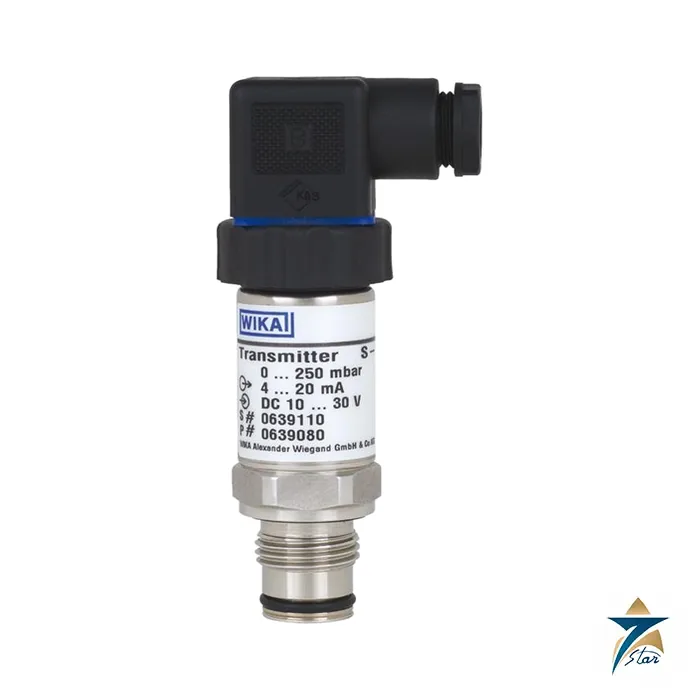
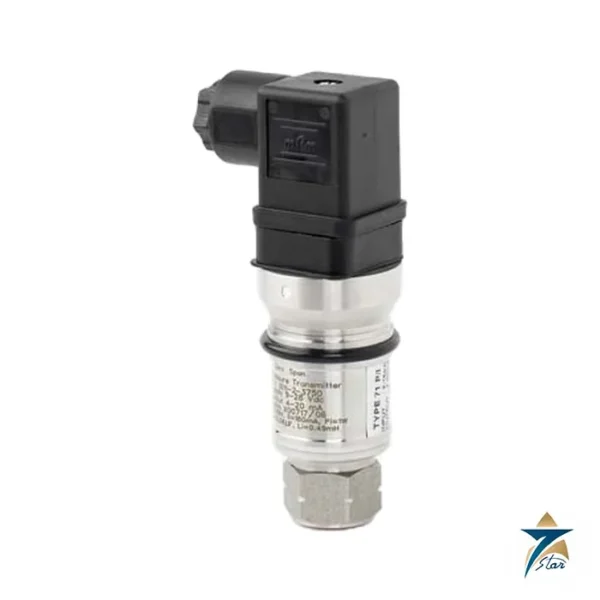
The WIKA S-11 is a pressure transmitter with a flush, welded stainless steel diaphragm, made for media that would block the pressure channel of a conventional threaded connection. WIKA lists viscous, paste-like, adhesive, crystallising, particle-laden and contaminated media, with food and beverage, filling and packing machinery, dosing technology and level measurement as typical fields. The process connection is G 1/2 B or G 1 B flush, with a hygienic G 1 B version and an optional cooling element for medium temperatures to 150 °C. Seven Star LLC supplies the S-11 in Oman and the GCC as an independent supplier in Muscat; this page explains the S-11 type options and the points that most often decide an RFQ.
Why a flush diaphragm matters on the S-11
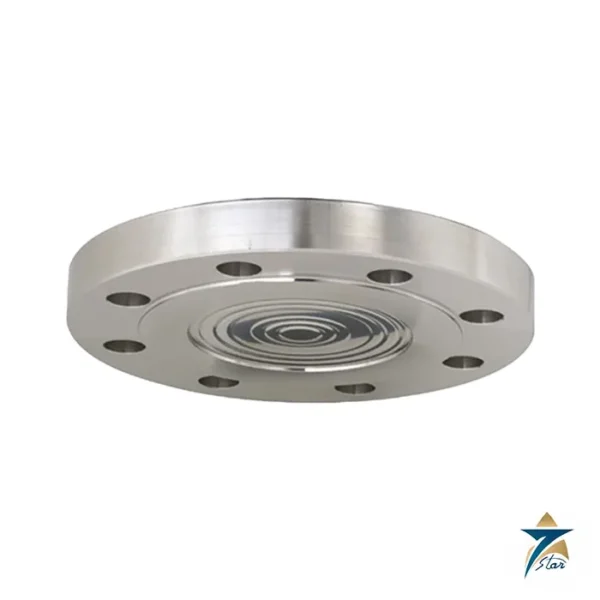
On a standard transmitter the medium enters a small pressure port and reaches the sensor. Sludge, polymers, syrups, crystallising solutions or fibre can settle in that port, dry out and give false readings. In the S-11 the diaphragm sits flush with the process wall; the connections are fully welded and isolate the medium from the measuring element by positive seal, so there is no dead space and the wetted diaphragm can be cleaned together with the process. The internal pressure transmission uses synthetic oil, or, for food and beverage use, a system fill fluid per FDA 21 CFR 178.3750. The hygienic G 1 B connection is in 316L and the instrument carries 3-A marking for that connection, verified by a third party.
Technical specifications of the S-11
| Parameter |
Specification |
| Manufacturer / part number |
WIKA / S-11 |
| Measuring ranges (gauge) |
0 … 0.1 bar to 0 … 600 bar [0 … 15 to 0 … 6,000 psi] |
| Absolute and vacuum |
0 … 0.25 to 0 … 16 bar abs.; vacuum and compound ranges from -1 bar |
| Vacuum tightness |
Yes |
| Output signals |
4 … 20 mA (2-wire); 0 … 20 mA (3-wire); DC 0 … 10 V; DC 0 … 5 V |
| Accuracy at reference conditions |
≤ ±0.5 % of span standard; ≤ ±0.25 % optional (ranges from 0.25 bar) |
| Non-linearity (BFSL) |
≤ ±0.2 % of span |
| Non-repeatability |
≤ 0.1 % of span |
| Long-term stability |
≤ ±0.2 % of span per year |
| Settling time |
≤ 2 ms |
| Power supply |
4 … 20 mA: DC 10 … 30 V; DC 0 … 10 V: DC 14 … 30 V |
| Process connection |
G 1/2 B flush; G 1 B flush; hygienic G 1 B flush (3-A) |
| Wetted parts |
316Ti (G 1/2 B and G 1 B); 316L (hygienic G 1 B) |
| Medium temperature |
-30 … +100 °C, optional +125 °C; -20 … +150 °C with cooling element |
| Ingress protection |
IP65 (DIN 175301-803 A), IP67 (M12 x 1 or cable), IP68 (cable outlet) |
Seals, connections and temperatures for the S-11
The seal material limits pressure and temperature. Without a cooling element and up to 100 °C, NBR is standard and good to 600 bar, FKM/FPM to 600 bar and EPDM to 200 bar; at 125 °C, FKM falls to 400 bar. With the cooling element (to 150 °C), FKM/FPM is limited to 300 bar and EPDM to 200 bar. The hygienic G 1 B connection is delivered with EPDM and limited to 200 bar and 150 °C. An FFKM O-ring for the G 1/2 B flush connection is optional with a 600 bar limit at all temperatures. G 1 B flush covers 0 … 0.1 to 0 … 1.6 bar and the hygienic G 1 B version 0 … 0.1 to 0 … 25 bar, while G 1/2 B flush covers 0 … 2.5 to 0 … 600 bar.
Electrical connections are angular connector DIN 175301-803 A (IP65), M12 x 1 four-pin circular connector (IP67), a cable outlet IP67 or an IP68 cable outlet in lengths of 1.5, 3, 5, 10 or 15 m. Zero and span can be adjusted by internal potentiometers by ±5 %, except on the IP68 cable outlet. The device is protected against short circuit, reverse polarity and overvoltage of DC 36 V.
Where the S-11 fits and related WIKA transmitters
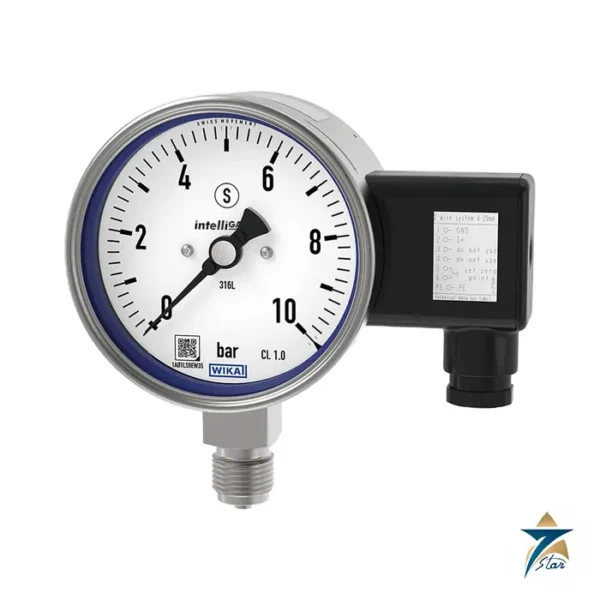
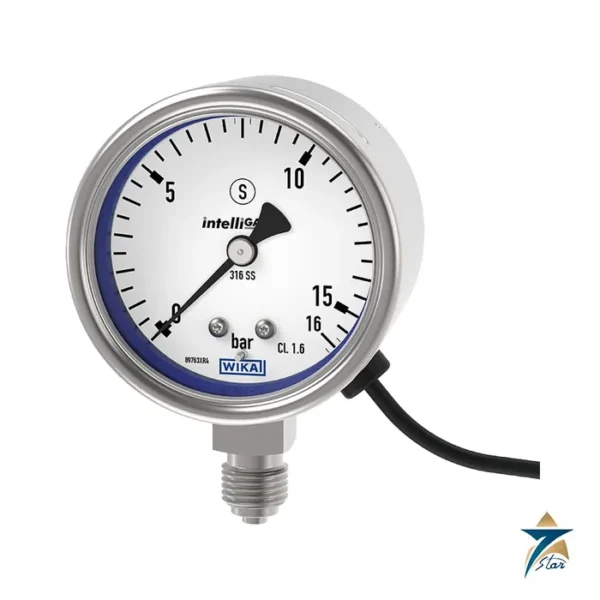
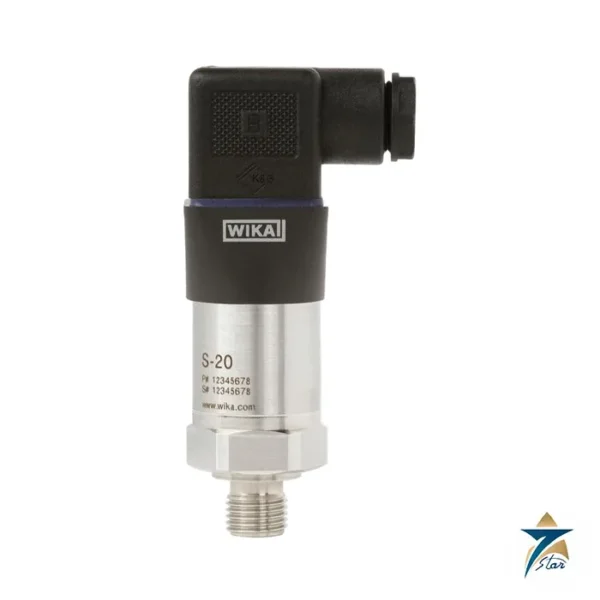
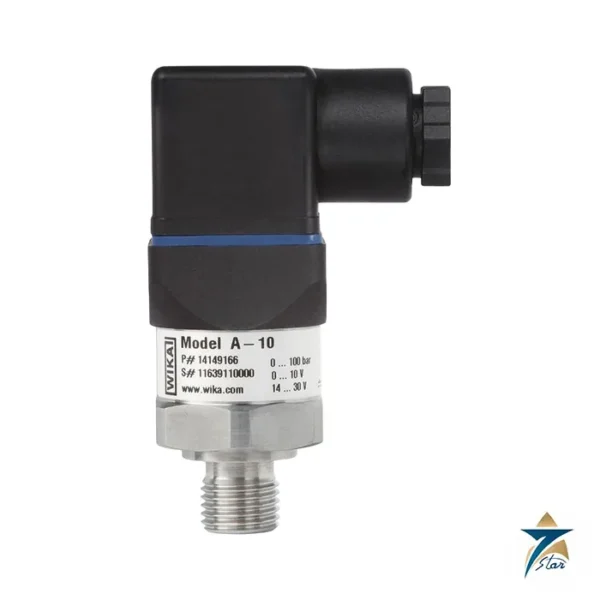
WIKA points to the S-20 for general industrial applications with a pressure port, to the IS-3 for hazardous areas and to the HP-2 for very high pressures. The A-10 is the general-purpose version. The S-11 is the one to choose when the process, not the pressure range, decides the connection: sugar, dairy and beverage lines, polymer or paint circuits, wastewater sludge, and slurries. For measurement in plain water or clean oil the S-20 or A-10 is simpler.
Selection and ordering checklist for the S-11
- Medium description: viscosity, solids content, crystallising tendency, cleaning method.
- Pressure range and unit; consider vacuum and absolute options.
- Flush connection: G 1/2 B, G 1 B or hygienic G 1 B (3-A).
- Seal: NBR, FKM/FPM, EPDM or FFKM, matched to medium and temperature.
- Cooling element if the medium exceeds 125 °C.
- Fill fluid: synthetic oil or FDA-compliant system fill fluid.
- Output signal and accuracy class (0.5 % or 0.25 %).
- Electrical connection and IP rating.
Installation, commissioning and maintenance of the S-11
Fit a flush transmitter so the diaphragm is not scratched; never insert tools into the port. Use only the sealing delivered with the instrument and tighten to the torque of the mating thread. The S-11 is calibrated in vertical mounting with the process connection facing downwards, so a different position may shift zero slightly; correct it with the zero potentiometer if the cable outlet allows. When cleaning in place, check the maximum medium temperature of the seal, particularly during steam cycles. Expect a temperature coefficient of up to ±0.2 % of span per 10 K over the 0 … 80 °C rated range (below 0.25 bar, up to 0.4 %). The data sheet quotes a mean time to failure above 100 years.
Typical applications in Oman and the GCC
Typical Gulf uses include date and juice processing, dairy and beverage plants, water treatment sludge lines, desalination brine and chemical dosing, and pulp or paint circuits in industrial zones. In hot sites the cooling element version covers process media up to 150 °C, while the ambient limit of 80 °C is relevant to outdoor panels in direct sun.
S-11 flush connections compared
| Connection |
Range covered |
Wetted material |
Notes |
| G 1/2 B flush |
0 … 2.5 to 0 … 600 bar |
316Ti |
Also with cooling element |
| G 1 B flush |
0 … 0.1 to 0 … 1.6 bar |
316Ti |
Also with cooling element |
| Hygienic G 1 B flush |
0 … 0.1 to 0 … 25 bar |
316L |
3-A marked; EPDM seal; 200 bar max. |
Information to send with an RFQ
- S-11 with range, type of pressure and unit
- Flush connection and seal material
- Medium, temperature and cleaning method
- Output signal, accuracy and electrical connection
- Cooling element and fill-fluid needs
- Quantity, delivery site and certificates
Documents and quotation
The WIKA data sheet for the S-11 is attached on this page, with range tables, sealing data and dimensions.
Send the range, connection, seal and medium and Seven Star LLC will confirm availability and a quotation.























Reviews
There are no reviews yet.